Rasmussen - MDC III - Final Exam With Complete
Solution
respiratory alkalosis Correct Answer- high pH, low CO2
pH: 7.35-7.45 acidic-basic
HCO3: 21-28 acidic-basic
CO2: 45-35 acidic-basic
metabolic acidosis Correct
...
Rasmussen - MDC III - Final Exam With Complete
Solution
respiratory alkalosis Correct Answer- high pH, low CO2
pH: 7.35-7.45 acidic-basic
HCO3: 21-28 acidic-basic
CO2: 45-35 acidic-basic
metabolic acidosis Correct Answer- low pH, low HCO3
pH: 7.35-7.45 acidic-basic
HCO3: 21-28 acidic-basic
CO2: 45-35 acidic-basic
respiratory acidosis Correct Answer- low pH, high CO2
pH: 7.35-7.45 acidic-basic
HCO3: 21-28 acidic-basic
CO2: 45-35 acidic-basic
metabolic alkalosis Correct Answer- high pH, high HCO3
pH: 7.35-7.45 acidic-basic
HCO3: 21-28 acidic-basic
CO2: 45-35 acidic-basic▪ change in condition make take priority over ABCs (ex: post op bleeding is priority over an O2 Sat% of
90%)
▪ pick the patient that is going to die first Correct Answer- Priority questions...something to consider
CPR, press the code button Correct Answer- You walk into your patient's room and they *don't have a
pulse*, what are you going to do?
bag resuscitation, press the code button Correct Answer- You walk into your patient's room and they are
*not breathing but have a pulse*, what are you going to do?
▪ unconscious, pulseless
▪ shock them with the AED! Correct Answer- If you walk into a room with a patient that is in *ventricular
fibrillation (v fib)*
▪ How will they present?
▪ What must we do to get them out of that state?
▪ make them bear down (valsalva maneuver)
▪ make them cough (vagal maneuver) Correct Answer- If you walk into a room and a patient is alert and
oriented, speaking to you, has a pulse, but their cardiac monitor shows they are in *ventricular
tachycardia*
▪ What are you going to do?
Supraventricular Tachycardia (SVT) Correct Answer- Which cardiac rhythm requires the patient to take
*adenosine*?
▪ they may end up with a *blood clot* because the blood is pooling in the atria Correct Answer- What is
our priority concern for a patient in *atrial fibrillation (a-fib)*?
*control RVR for patient:*
▪ give anticoagulants▪ beta blockers, digoxin, diltiazem
▪ if meds don't work...cardioversion (synchronized shock to re-start the rhythm)
▪ if cardioversion doesn't work...ablation Correct Answer- Nursing Interventions: *A-fib RVR*
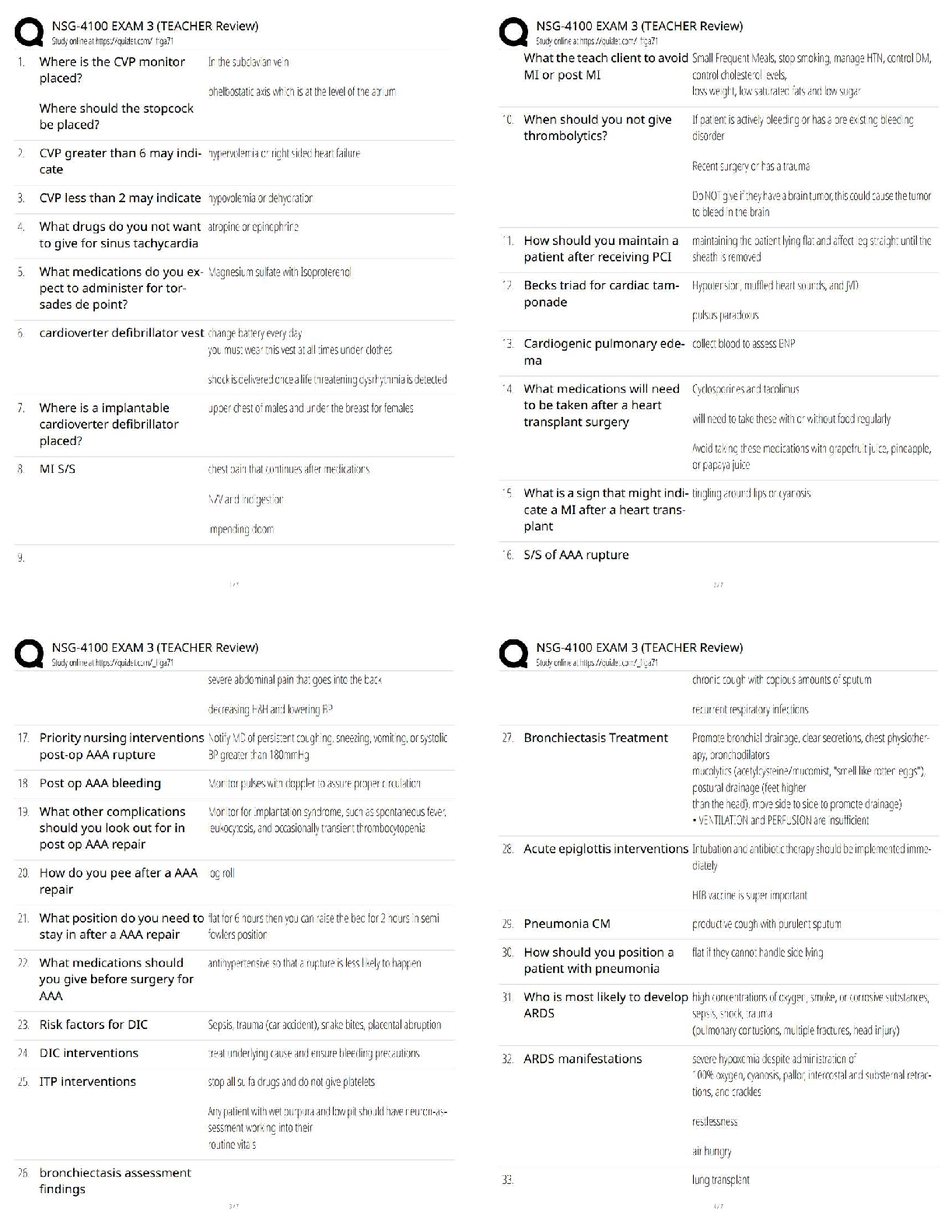
▪ chest pain
▪ SOB
▪ diaphoresis
▪ N/V
▪ hypertension
▪ tachycardia
▪ jaw pain, anxiety, indigestion (women)
▪ elevated troponin levels
▪ EKG changes - ST elevation Correct Answer- If you have a patient who comes into the ED and they are
having an MI, what are the signs/symptoms? lab values to confirm this?
*Oxygen* - 1st
*Nitro* - given sublingual, 3 doses q 5 min (home), drip (hospital), drops BP (vasodilator)
*Aspirin* - antiplatelet, stops clotting, 325 mg, chew it
*Morphine* - calms the patient down, helps pain Correct Answer- Treatment: *Myocardial Infarction*
▪ CPK
▪ troponin
▪ CK-MB
▪ BNP Correct Answer- Name the cardiac enzymes
angioplasty
stent the artery
angiogram
remove clotscardiac catheterization Correct Answer- Procedures: *Myocardial Infarction (MI)*
CABG (Coronary Artery Bypass Graft) Correct Answer- Procedure: Patient has an MI and extreme plaque
build up
pericarditis Correct Answer- inflammation of the membrane surrounding the heart
heart can't expand and contract properly (*cardiac tamponade*) Correct Answer- When you have
pericarditis what are you at risk for?
pleural friction rub Correct Answer- What sounds will you hear in a patient with pericarditis?
pericardial effusion Correct Answer- accumulation of fluid in the pericardial cavity
Pericardialcentesis Correct Answer- Surgical treatment: *Pericardial Effusion*
aneurysm Correct Answer- a localized weak spot or balloon-like enlargement of the wall of an artery
Abdominal Aortic Aneurysm (AAA) Correct Answer- Which is the most common aneurysm?
▪ epigastric pain
▪ pulsating in the abdomen - do not push on it! Correct Answer- S/S: *Abdominal Aortic Aneurysm
(AAA)*
immediately go to the OR for surgery
▪ pain between the scapulas (straight across the back) Correct Answer- S/S: *Thoracic Aortic Aneurysm*
monior BP periodically and check the size of it
no anticoagulants!!! Correct Answer- Non-emergent thoracic aortic aneurysm interventionselevated BP 3 times in a six month period - documented by MD Correct Answer- How do we diagnose
hypertension?
▪ lifestyle modifications (diet, exercise)
▪ record values at home Correct Answer- Patient Education: *Hypertension*
▪ obesity
▪ drugs
▪ alcohol
▪ age
▪ race (hispanic, african american)
▪ high cholesterol
▪ family Hx
▪ elevated LDL, decreased HDL Correct Answer- Risk Factors: *Hypertension*
primary - because of the pressure in the arteries only, usually hereditary
secondary - r/t kidney problems or other issues Correct Answer- What's the difference between primary
and secondary hypertension?
▪ ACE inhibitors
▪ Beta Blockers
▪ ARBs
▪ Calcium Channel lockers Correct Answer- Pharmacological Treatment: *Hypertension*
atherosclerosis Correct Answer- plaque builds up on the inner walls of the arteries
▪ Cholesterol
▪ Smoking
▪ Uncontrolled diabetes▪ Uncontrolled HTN
▪ Obesity
▪ Diet
▪ Lack of exercise Correct Answer- Causes of plaque build up
arteriosclerosis Correct Answer- hardening of the arteries, happens with age, normal
good cholesterol, want it >60 Correct Answer- What is HDL?
bad cholesterol, want it <150 Correct Answer- What is LDL?
"sugary cholesterol" Correct Answer- What are triglycerides?
peripheral arterial disease (PAD) - shiny hairless legs
peripheral vascular disease (PVD) Correct Answer- Atherosclerosis and Arteriosclerosis can cause what
conditions?
▪ cool hands and feet
▪ bad pedal pulses
▪ leg pain
▪ decreased capillary refill
▪ mottled skin Correct Answer- S/S: *Peripheral Vascular Disease (PVD)*
lower extremity doppler Correct Answer- How do you diagnose Peripheral Vascular Disease (PVD)?
▪ anticoagulants
▪ cath lab to have stent placement
[Show More]