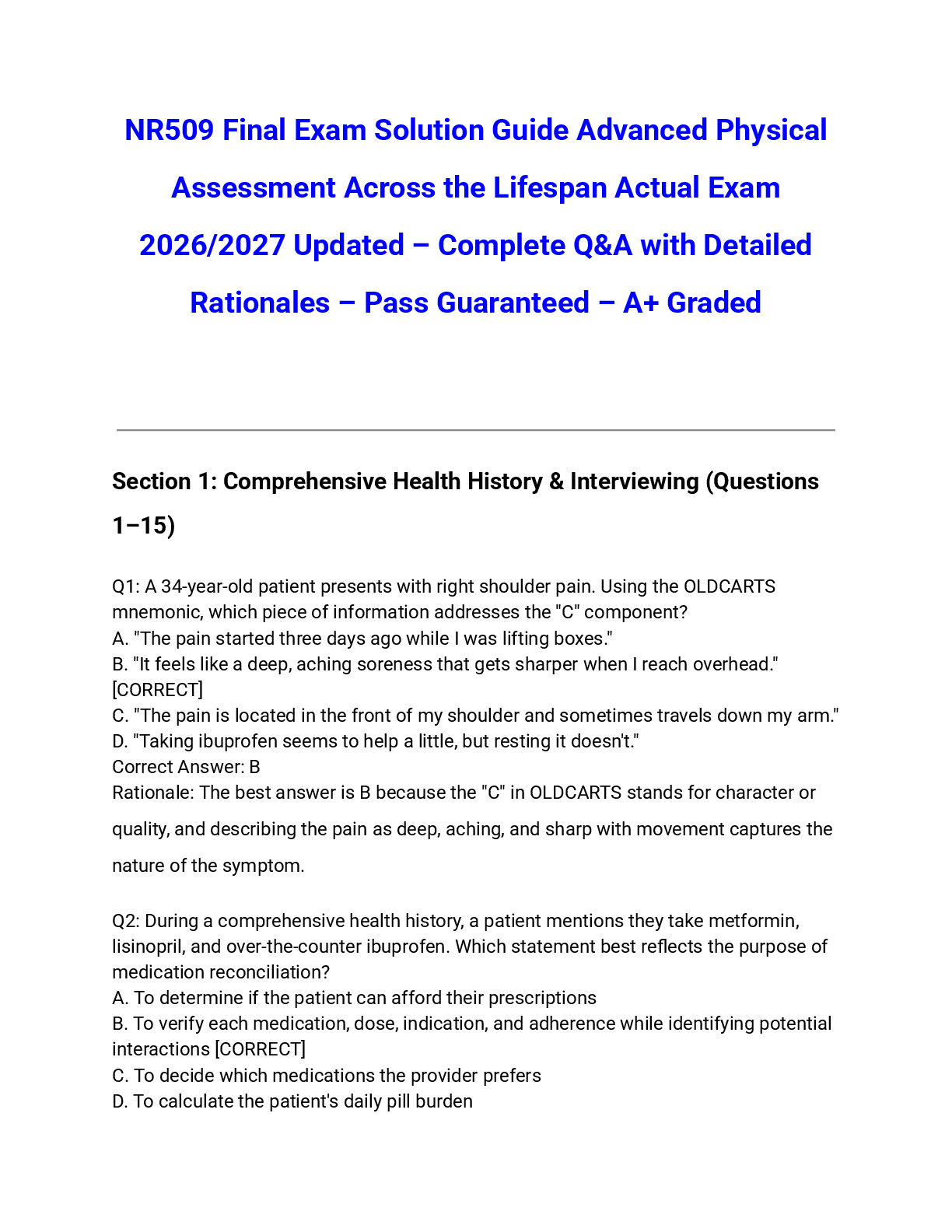
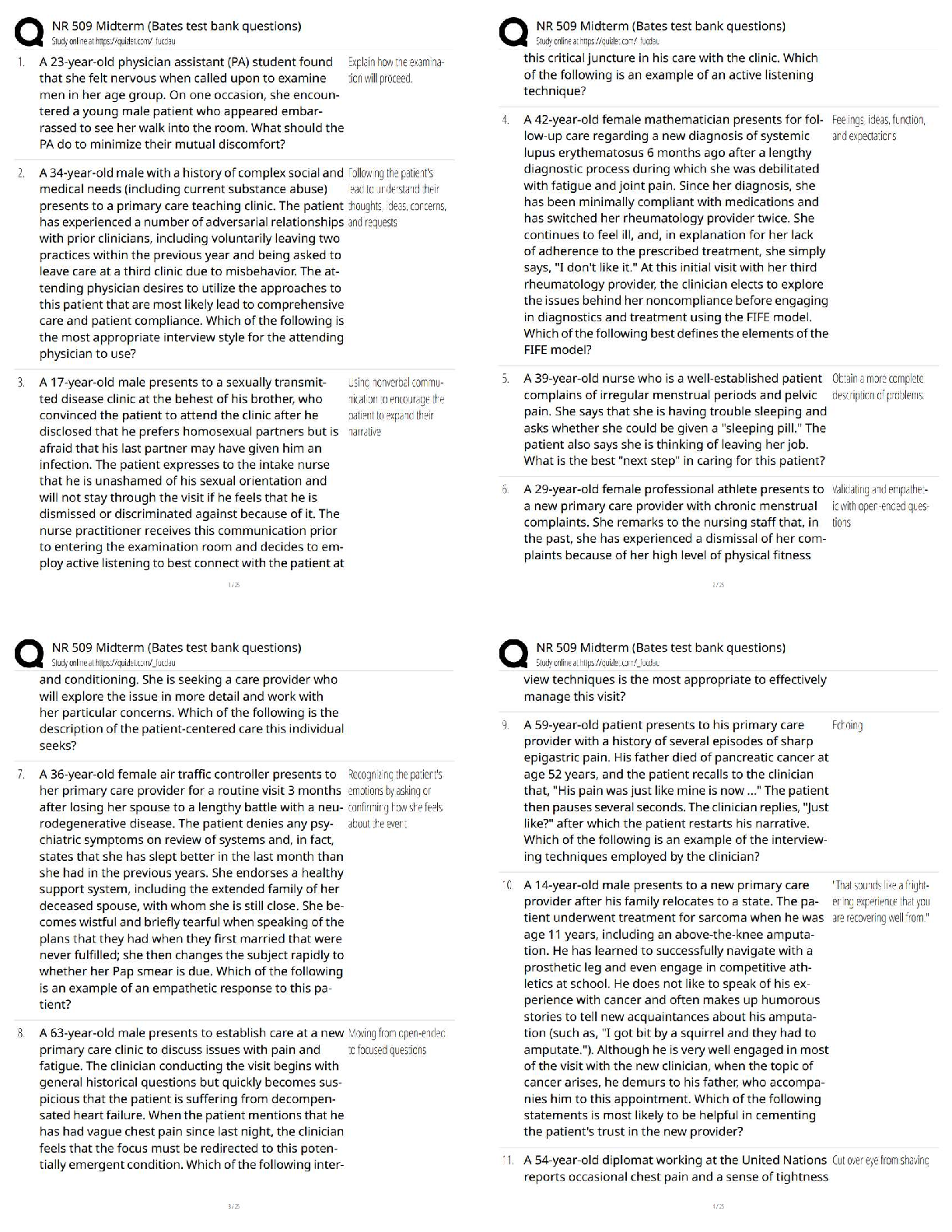
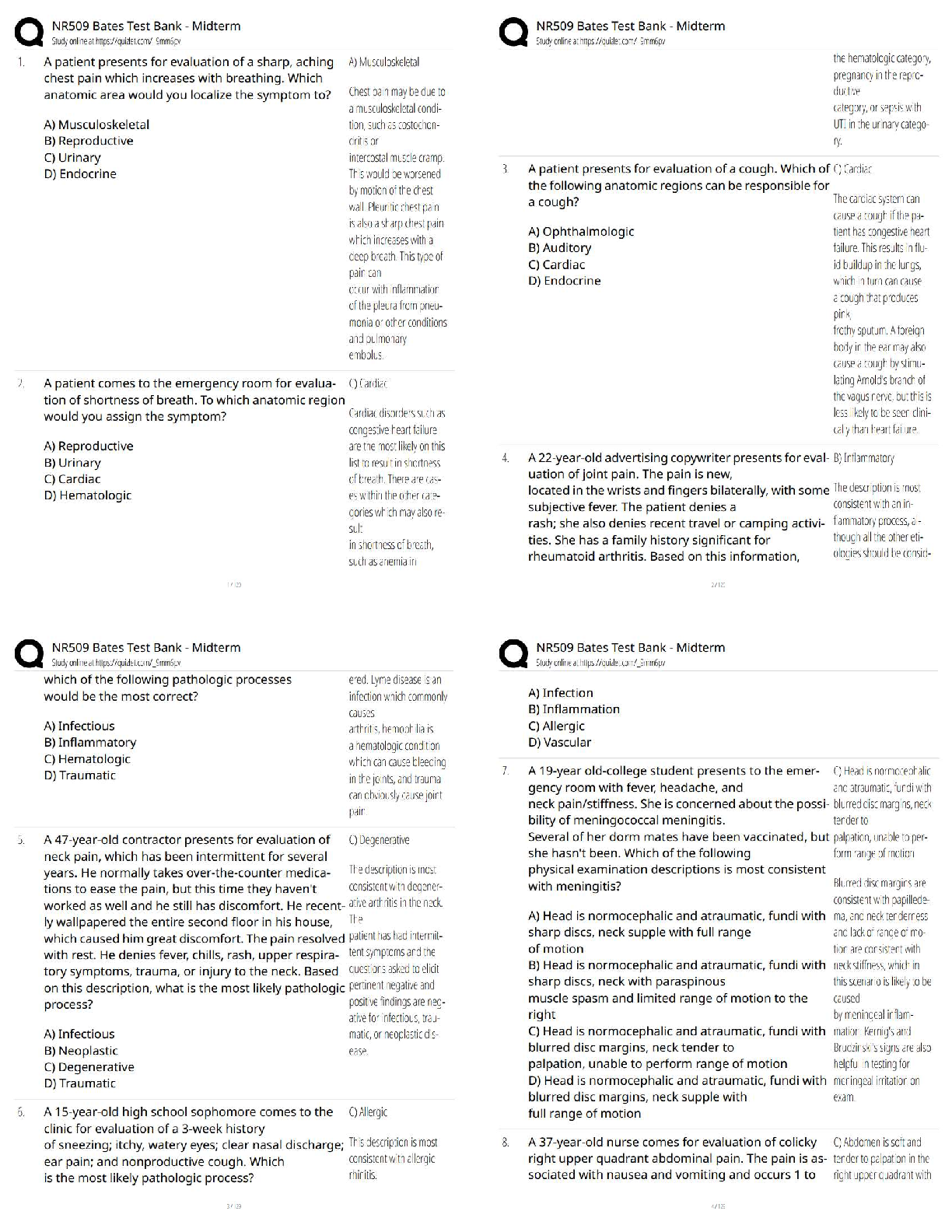
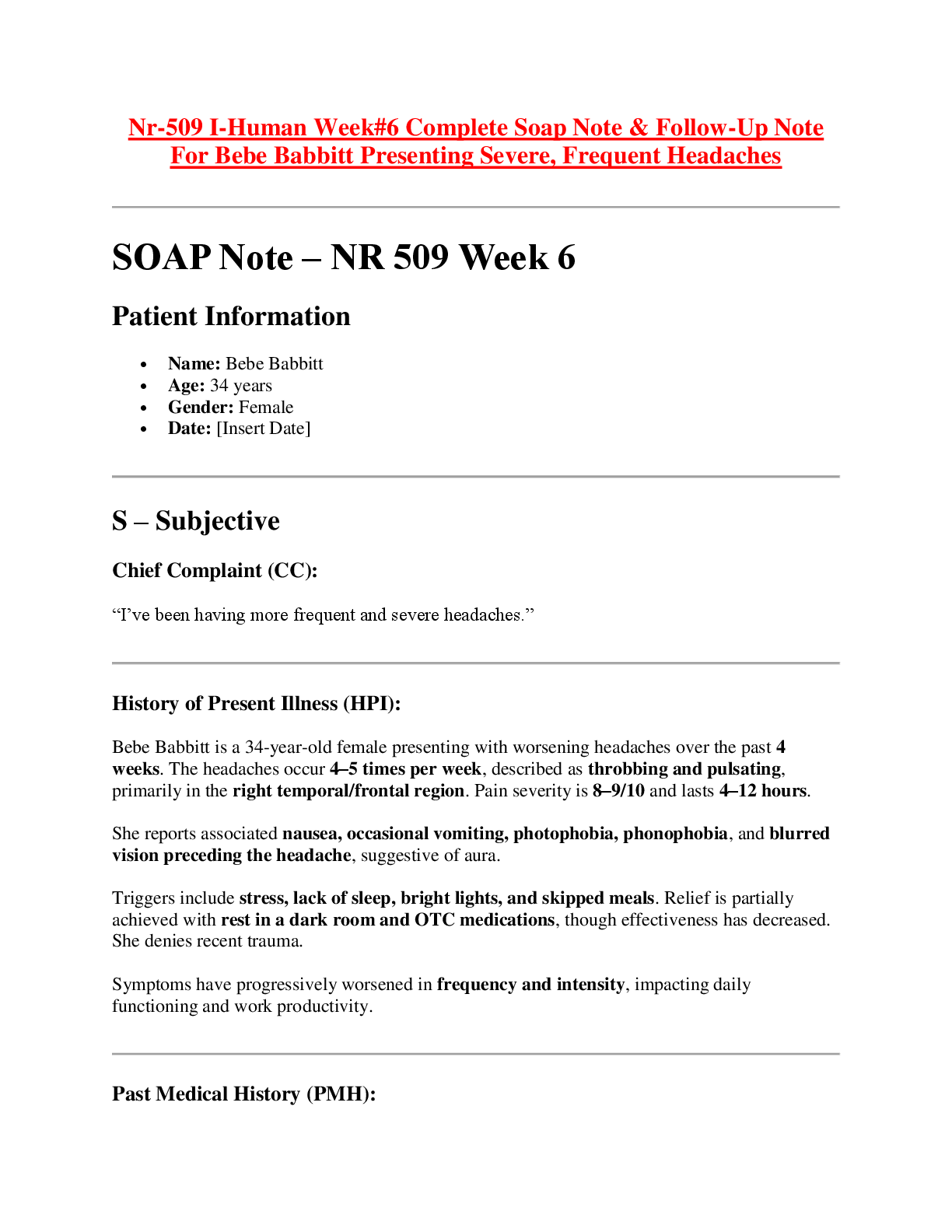
NR 509 Advanced physical assessment -Final examination
with complete solution (100% guaranteed A+)
A 37-year-old nurse comes for evaluation of colicky right upper quadrant abdominal pain. The pain is
associated with n
...
NR 509 Advanced physical assessment -Final examination
with complete solution (100% guaranteed A+)
A 37-year-old nurse comes for evaluation of colicky right upper quadrant abdominal pain. The pain is
associated with nausea and vomiting and occurs 1 to 2 hours after eating greasy foods. Which one of the
following physical examination descriptions would be most consistent with the diagnosis of
cholecystitis?
A) Abdomen is soft, nontender, and nondistended, without hepatosplenomegaly or masses.
B) Abdomen is soft and tender to palpation in the right lower quadrant, without rebound or guarding.
C) Abdomen is soft and tender to palpation in the right upper quadrant with inspiration, to the point of
stopping inspiration, and there is no rebound or guarding.
D) Abdomen is soft and tender to palpation in the mid-epigastric area, without rebound or guarding.
Correct Answer- C) Abdomen is soft and tender to palpation in the right upper quadrant with
inspiration, to the point of stopping inspiration, and there is no rebound or guarding.
When crackles, wheezes, or rhonchi clear with a cough, which of the following is a likely etiology?
A) Bronchitis
B) Simple asthma
C) Cystic fibrosis
D) Heart failure Correct Answer- A. Bronchitis
A patient with longstanding COPD was told by another practitioner that his liver was enlarged and this
needed to be assessed. Which of the following would be reasonable to do next?
A) Percuss the lower border of the liver
B) Measure the span of the liver
C) Order a hepatitis panel
D) Obtain an ultrasound of the liver Correct Answer- A) Percuss the lower border of the liverMr. Patel is a 64-year-old man who was told by another care provider that his liver is enlarged. Although
he is a life-long smoker, he has never used drugs or alcohol and has no knowledge of liver disease.
Indeed, on examination, a liver edge is palpable 4 centimeters below the costal arch. Which of the
following would you do next?
A) Check an ultrasound of the liver
B) Obtain a hepatitis panel
C) Determine liver span by percussion
D) Adopt a "watchful waiting" approach Correct Answer- c. Determine liver span by percussion
You are palpating the abdomen and feel a small mass. Which of the following would you do next?
A) Ultrasound
B) Examination with the abdominal muscles tensed
C) Surgery referral
D) Determine size by percussion Correct Answer- B) Examination with the abdominal muscles tensed
Mr. Kruger is an 84-year-old man who presents with a smooth lower abdominal mass in the midline
which is minimally tender. There is dullness to percussion up to 6 centimeters above the symphysis
pubis. What does this most likely represent?
A) Sigmoid mass
B) Tumor in the abdominal wall
C) Hernia
D) Enlarged bladder Correct Answer- D) Enlarged bladder
Which of the following is consistent with obturator sign?
A) Pain distant from the site used to check rebound tenderness
B) Right hypogastric pain with the right hip and knee flexed and the hip internally rotatedC) Pain with extension of the right thigh while the patient is on her left side or while pressing her knee
against your hand with thigh flexion
D) Pain that stops inhalation in the right upper quadrant Correct Answer- B) Right hypogastric pain with
the right hip and knee flexed and the hip internally rotated
A 57-year-old maintenance worker comes to your office for evaluation of pain in his legs. He has smoked
two packs per day since the age of 16, but he is otherwise healthy. You are concerned that he may have
peripheral vascular disease. Which of the following is part of common or concerning symptoms for the
peripheral vascular system?
A) Intermittent claudication
B) Chest pressure with exertion
C) Shortness of breath
D) Knee pain Correct Answer- A) Intermittent claudication
You are a student in the vascular surgery clinic. You are asked to perform a physical examination on a
patient with known peripheral vascular disease in the legs. Which of the following aspects is important
to note when you perform your examination?
A) Size, symmetry, and skin color
B) Muscle bulk and tone
C) Nodules in joints
D) Lower extremity strength Correct Answer- A) Size, symmetry, and skin color
As the internal diameter of a blood vessel changes, the resistance changes as well. Which of the
following descriptions depicts this relationship?
A) Resistance varies linearly with the diameter.
B) Resistance varies proportionally to the second power of the diameter.
C) Resistance varies proportionally to the third power of the diameter.
D) Resistance varies proportionally to the fourth power of the diameter. Correct Answer- D) Resistance
varies proportionally to the fourth power of the diameter.A 32-year-old warehouse worker presents for evaluation of low back pain. He notes a sudden onset of
pain after lifting a set of boxes that were heavier than usual. He also states that he has numbness and
tingling in the left leg. He wants to know if he needs to be off of work. What test should you perform to
assess for a herniated disc?
A) Leg-length test
B) Straight-leg raise
C) Tinel's test
D) Phalen's test Correct Answer- B) Straight-leg raise
A 50-year-old realtor comes to your office for evaluation of neck pain. She was in a motor vehicle
collision 2 days ago and was assessed by the emergency medical technicians on site, but she didn't think
that she needed to go to the emergency room at that time. Now, she has severe pain and stiffness in her
neck. On physical examination, you note pain and spasm over the paraspinous muscles on the left side
of the neck, and pain when you make the patient do active range of motion of the cervical spine. What is
the most likely cause of this neck pain?
A) Simple stiff neck
B) Aching neck
C) Cervical sprain
D) Cervical herniated disc Correct Answer- c. cervical sprain
A 28-year-old graduate student comes to your clinic for evaluation of pain "all over." With further
questioning, she is able to relate that the pain is worse in the neck, shoulders, hands, low back, and
knees. She denies swelling in her joints; she states that the pain is worse in the morning; there is no
limitation in her range of motion. On physical examination, she has several points on the muscles of the
neck, shoulders, and back that are tender to palpation; muscle strength and range of motion are normal.
Which of the following is likely the cause of her pain?
A) Rheumatoid arthritis
B) Osteoarthritis
C) FibromyalgiaD) Polymyalgia rheumatica Correct Answer- c. fibromyalgia
A 68-year-old retired banker comes to your clinic for evaluation of left shoulder pain. He swims for 30
minutes daily, early in the morning. He notes a sharp, catching pain and a sensation of something
grating when he tries overhead movements of his arm. On physical examination, you note tenderness
just below the tip of the acromion in the area of the tendon insertions. The drop arm test is negative,
and there is no limitation with shoulder shrug. The patient is not holding his arm close to his side, and
there is no tenderness to palpation in the bicipital groove when the arm is at the patient's side, flexed to
90 degrees, and then supinated against resistance. Based on this description, what is the most likely
cause of his shoulder pain?
A) Rotator cuff tendinitis
B) Rotator cuff tear
C) Calcific tendinitis
D) Bicipital tendinitis Correct Answer- A. rotator cuff tendinitis
Ray works a physical job and notes pain when he attempts to lift his arm over his head. When you move
the shoulder passively, he has full range of motion without pain and there is no gross swelling or
tenderness. What type of joint disease does this most likely represent?
A) Articular
B) Extra-articular
C) Neither
D) Both Correct Answer- B. extra - articular
Mark is a contractor who recently injured his back. He was told he had a "bulging disc" to account for
the burning pain down his right leg and slight foot drop. The vertebral bodies of the spine involve which
type of joint?
A) Synovial
B) Cartilaginous
C) Fibrous
D) Synostosis Correct Answer- b. cartilagenousA 58-year-old man comes to your office complaining of bilateral back pain that now awakens him at
night. This has been steadily increasing for the past 2 months. Which one of the following is the most
reassuring in this patient with back pain?
A) Age over 50
B) Pain at night
C) Pain lasting more than 1 month or not responding to therapy
D) Pain that is bilateral Correct Answer- D) Pain that is bilateral
Mrs. Fletcher comes to your office with unilateral pain during chewing, which is chronic. She does not
have facial tenderness or tenderness of the scalp. Which of the following is the most likely cause of her
pain?
A) Trigeminal neuralgia
B) Temporomandibular joint syndrome
C) Temporal arteritis
D) Tumor of the mandible Correct Answer- B) Temporomandibular joint syndrome
Phil comes to your office with left "shoulder pain." You find that the pain is markedly worse when his
left arm is drawn across his chest (adduction). Which of the following would you suspect?
A) Rotator cuff tear
B) Subacromial bursitis
C) Acromioclavicular joint involvement
D) Adhesive capsulitis Correct Answer- C) Acromioclavicular joint involvement
Two weeks ago, Mary started a job which requires carrying 40-pound buckets. She presents with elbow
pain worse on the right. On examination, it hurts her elbows to dorsiflex her hands against resistance
when her palms face the floor. What condition does she have?A) Medial epicondylitis (golfer's elbow)
B) Olecranon bursitis
C) Lateral epicondylitis (tennis elbow)
D) Supracondylar fracture Correct Answer- C) Lateral epicondylitis (tennis elbow)
A high school football player injured his wrist in a game. He is tender between the two tendons at the
base of the thumb. Which of the following should be considered?
A) DeQuervain's tenosynovitis
B) Scaphoid fracture
C) Wrist sprain
D) Rheumatoid arthritis Correct Answer- B. Scaphoid fracture
Mrs. Fletcher complains of numbness of her right hand. On examination, sensation of the volar aspect of
the web of the thumb and index finger and the pulp of the middle finger are normal. The pulp of the
index finger has decreased sensation. Which of the following is affected?
A) Median nerve
B) Ulnar nerve
C) Radial nerve
D) Brachial nerve Correct Answer- A. median nerve
A 50-year-old woman presents with "left hip pain" of several weeks duration. There is marked
tenderness when you press over her proximal lateral thigh. What do you think she has?
A) Osteoarthritis
B) Rheumatoid arthritis
C) Sciatica
D) Trochanteric bursitis Correct Answer- D) Trochanteric bursitis32
A 77-year-old retired school superintendent comes to your office, complaining of unsteady hands. He
says that for the past 6 months, when his hands are resting in his lap they shake uncontrollably. He says
when he holds them out in front of his body the shaking diminishes, and when he uses his hands the
shaking is also better. He also complains of some difficulty getting up out of his chair and walking
around. He denies any recent illnesses or injuries. His past medical history is significant for high blood
pressure and coronary artery disease, requiring a stent in the past. He has been married for over 50
years and has five children and 12 grandchildren. He denies any tobacco, alcohol, or drug use. His
mother died of a stroke in her 70s and his father died of a heart attack in his 60s. He has a younger sister
who has arthritis problems. His children are all essentially healthy. On examination you see a fine, pillrolling tremor of his left hand. His right shows less movement. His cranial nerve examination is normal.
He has some difficulty rising from his chair, his gait is slow, and it takes him time to turn around to walk
back toward you. He has almost no "arm swing" with his gait.
What type of tremor is he most likely to have?
A) Resting tremor
B) Postural tremor
C) Intention tremor
D) Movement tremor Correct Answer- A. resting tremor
A 48-year-old grocery store manager comes to your clinic, complaining of her head being "stuck" to one
side. She says that today she was doing her normal routine when it suddenly felt like her head was being
moved to her left and then it just stuck that way. She says it is somewhat painful because she cannot get
it moved back to normal. She denies any recent neck trauma. Her past medical history consists of type 2
diabetes and gastroparesis (slow-moving peristalsis in the digestive tract, seen in diabetes). She is on
oral medication for each. She is married and has three children. She denies tobacco, alcohol, or drug
use. Her father has diabetes and her mother passed away from breast cancer. Her children are healthy.
On examination you see a slightly overweight Hispanic woman appearing her stated age. Her head is
twisted grotesquely to her left but otherwise her examination is normal.
What form of involuntary movement does she have?
A) Chorea
B) AsbestosisC) Tic
D) Dystonia Correct Answer- D. dystonia
A 41-year-old real estate agent comes to your office, complaining that he feels like his face is paralyzed
on the left. He states that last week he felt his left eyelid was drowsy and as the day progressed he was
unable to close his eyelid all the way. Later he felt like his smile became affected also. He denies any
recent injuries but had an upper respiratory viral infection last month. His past medical history is
unremarkable. He is divorced and has one child. He smokes one pack of cigarettes a day, occasionally
drinks alcohol, and denies any illegal drug use. His mother has high blood pressure and his father has
sarcoidosis. On examination you ask him to close his eyes. He is unable to close his left eye. You ask him
to open his eyes and raise his eyebrows. His right forehead furrows but his left remains flat. You then
ask him to give you a big smile. The right corner of his mouth raises but the left side of his mouth
remains the same.
What type of facial paralysis does he have?
A) Peripheral CN V paralysis
B) Central CN V paralysis
C) Peripheral CN VII paralysis
D) Central CN VII paralysis Correct Answer- C) Peripheral CN VII paralysis
Steve has had a stroke and comes to you for follow-up today. On examination you find that he has
increased muscle tone, some involuntary movements, an abnormal gait, and a slowness of response in
movements. He most likely has involvement of which of the following?
A) The corticospinal tract
B) The cerebellum
C) The cerebrum
D) The basal ganglia Correct Answer- D. the basal ganglia
A patient with a history of seizure disorder and on several seizure medications says a friend noted
"jumping eye movements." The patient describes a sensation of movement at rest since his medications
were adjusted upward following a breakthrough seizure several weeks ago. On examination you notethat the eyes both slowly move to the right and then quickly jump to the left. Which of the following is
true?
A) This is called nystagmus to the left
B) This is called saccadic eye movement
C) This represents a subclinical seizure
D) This most likely has an ominous cause Correct Answer- A) This is called nystagmus to the left
You are testing the biceps strength in a young man following a spinal trauma from a motor vehicle
accident. He cannot lift his hand upward, but if the arm is abducted to 90 degrees, he can then move his
forearm side to side. This would represent which muscle strength grading?
A) I
B) II
C) III
D) IV Correct Answer- B. 11
You ask a patient to hold her arms up, with her palms up, and then to close her eyes. The right arm
begins to move downward after a few seconds and her thumb rotates upward. This is most likely a
problem with which part of the nervous system?
A) Corticospinal tract
B) Spinothalamic tract
C) Thalamus
D) Dorsal root ganglion Correct Answer- A) Corticospinal tract
You are examining a child with severe cerebral palsy. When you suddenly move his foot dorsally, a
sustained "beating" of the foot against your hand ensues. What does this represent?
A) A focal seizure
B) ClonusC) Extinction
D) Reinforcement Correct Answer- B. clonus
A patient with alcoholism is brought in with confusion. You ask him to "stop traffic" with his palms and
notice that every few seconds his palms suddenly move toward the floor. What does this indicate?
A) Stroke
B) Metabolic problems
C) Carpal tunnel syndrome
D) Severe fatigue and weakness Correct Answer- B) Metabolic problems
You examine a "sleepy" patient. You note that she will open her eyes and look at you but responds
slowly and is confused. She does not appear interested in her surroundings. How would you describe
her level of consciousness?
A) Lethargic
B) Obtunded
C) Stuporous
D) Comatose Correct Answer- B) Obtunded
A 7-year-old boy is performing poorly in school. His teacher is frustrated because he is frequently seen
"staring off into space" and not paying attention. If this is a seizure, it most likely represents which type?
A) Pseudoseizure
B) Tonic-clonic seizure
C) Absence
D) Myoclonus Correct Answer- C) Absence
A patient comes to you because she is experiencing a tremor only when she reaches for things. This
becomes worse as she nears the "target." When you ask her to hold out her hands, no tremor is
apparent. What type of tremor does this most likely represent?A) Intention tremor
B) Postural tremor
C) Resting tremor
D) Nervous tremor Correct Answer- A) Intention tremor
A young woman comes in with brief, rapid, jerky, irregular movements. They can occur at rest or during
other intentional movements and involve mostly her face, head, lower arms, and hands. How would you
describe these movements?
A) Tics
B) Dystonia
C) Athetosis
D) Chorea Correct Answer- D. chorea
Which of the following will help to optimize yield from a pediatric examination?
A) Doing the examination out of order if necessary to take advantage of quiet periods for auscultation,
etc.
B) Being very orderly, so as not to miss a portion of the examination
C) Using firmness as needed to make it through your examination
D) Making sure to place the infant on the table during the examination while mom watches close by
Correct Answer- A) Doing the examination out of order if necessary to take advantage of quiet periods
for auscultation, etc.
You are assessing an infant and notice that his nares flare, he has a soft grunt with each breath, and the
skin between his ribs is pulled inward with inhalation. What is the significance of these findings?
A) These are indicative of a CNS process.
B) These are indicative of respiratory distress.
C) These are indicative of muscular dystrophy.D) These are frequently accompanied by stridor. Correct Answer- B) These are indicative of respiratory
distress.
A 79-year-old retired banker comes to your office for evaluation of difficulty with urination; he gets up
five to six times per night to urinate and has to go at least that often in the daytime. He does not feel as
if his bladder empties completely; the strength of the urinary stream is diminished. He denies dysuria or
hematuria. This problem has been present for several years but has worsened over the last 8 months.
You palpate his prostate. What is your expected physical examination finding, based on this description?
A) Normal size, smooth
B) Normal size, boggy
[Show More]