*NURSING > QUESTIONS & ANSWERS > NR 509 Week 3 Quiz with complete solution (Real quiz 100% correct latest update 2021/2022) (All)
NR 509 Week 3 Quiz with complete solution (Real quiz 100% correct latest update 2021/2022)
Document Content and Description Below
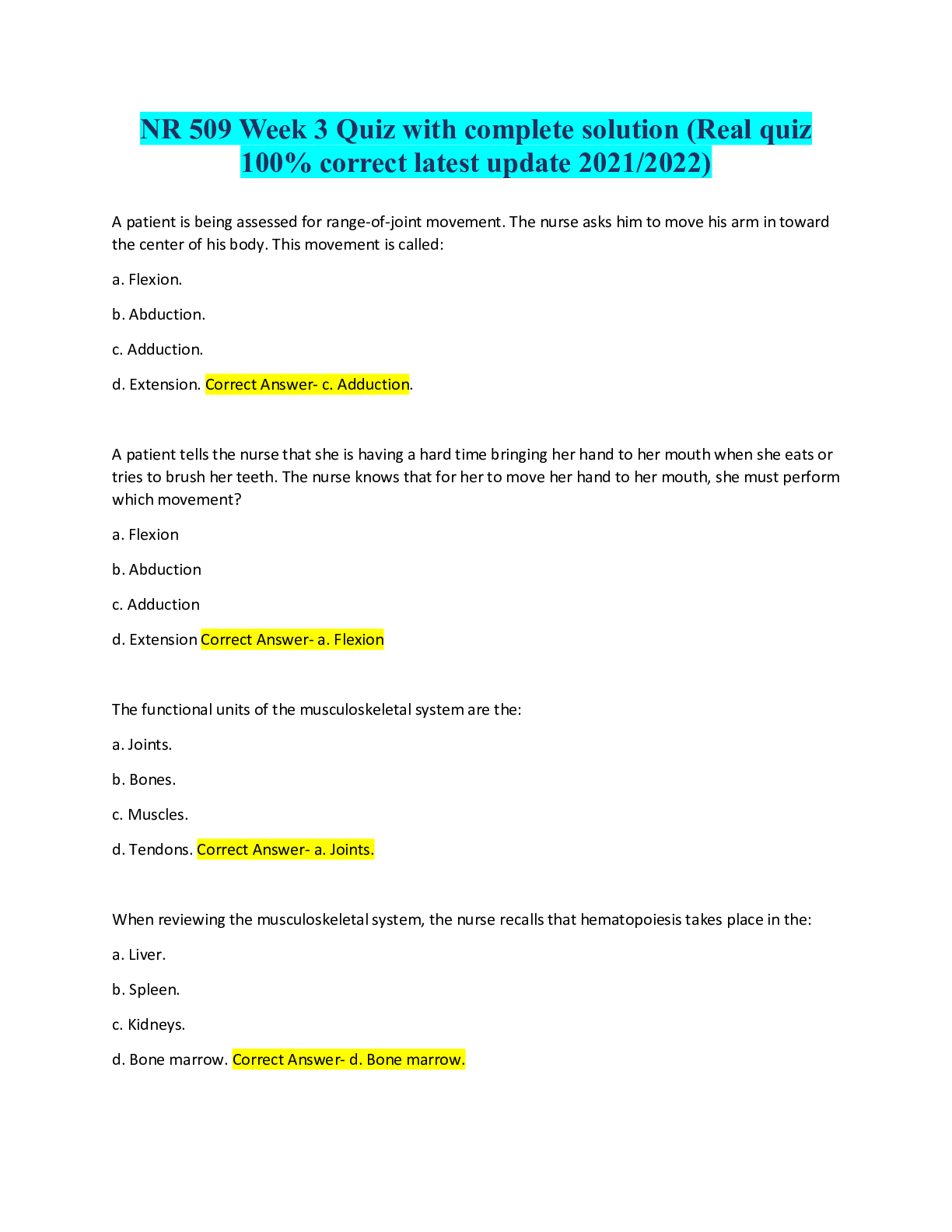
A patient is being assessed for range-of-joint movement. The nurse asks him to move his arm in toward the center of his body. This movement is called: a. Flexion. b. Abduction. c. Adduction. d. E ... xtension. Correct Answer- c. Adduction. A patient tells the nurse that she is having a hard time bringing her hand to her mouth when she eats or tries to brush her teeth. The nurse knows that for her to move her hand to her mouth, she must perform which movement? a. Flexion b. Abduction c. Adduction d. Extension Correct Answer- a. Flexion The functional units of the musculoskeletal system are the: a. Joints. b. Bones. c. Muscles. d. Tendons. Correct Answer- a. Joints. When reviewing the musculoskeletal system, the nurse recalls that hematopoiesis takes place in the: a. Liver. b. Spleen. c. Kidneys. d. Bone marrow. Correct Answer- d. Bone marrow.Fibrous bands running directly from one bone to another that strengthen the joint and help prevent movement in undesirable directions are called: a. Bursa. b... Tendons. c. Cartilage. d. Ligaments. Correct Answer- d. Ligaments. The nurse notices that a woman in an exercise class is unable to jump rope. The nurse is aware that to jump rope, one's shoulder has to be capable of: a... Inversion. b. Supination.. c. Protraction. d. Circumduction. Correct Answer- d. Circumduction. The articulation of the mandible and the temporal bone is known as the: a. Intervertebral foramen. b. Condyle of the mandible. c. Temporomandibular joint. d. Zygomatic arch of the temporal bone. Correct Answer- c. Temporomandibular joint. To palpate the temporomandibular joint, the nurse's fingers should be placed in the depression __________ of the ear. a. Distal to the helix b... Proximal to the helix c. Anterior to the tragus d. Posterior to the tragus Correct Answer- c. Anterior to the tragus Of the 33 vertebrae in the spinal column, there are: a. 5 lumbar. b. 5 thoracic.c. 7 sacral. d. 12 cervical. Correct Answer- a. 5 lumbar. An imaginary line connecting the highest point on each iliac crest would cross the __________ vertebra. a. First sacral b. Fourth lumbar c. Seventh cervical d. Twelfth thoracic Correct Answer- b. Fourth lumbar The nurse is explaining to a patient that there are shock absorbers in his back to cushion the spine and to help it move. The nurse is referring to his: a. Vertebral column. b. Nucleus pulposus. c. Vertebral foramen. d. Intervertebral disks. Correct Answer- d. Intervertebral disks. The nurse is providing patient education for a man who has been diagnosed with a rotator cuff injury. The nurse knows that a rotator cuff injury involves the: a. Nucleus pulposus. b... Articular processes.. c. Medial epicondyle. d. Glenohumeral joint. Correct Answer- d. Glenohumeral joint. During an interview the patient states, "I can feel this bump on the top of both of my shoulders—it doesn't hurt but I am curious about what it might be." The nurse should tell the patient that it is his: a. Subacromial bursa. b. Acromion process. c. Glenohumeral joint. d. Greater tubercle of the humerus. Correct Answer- b. Acromion process.The nurse is checking the range of motion in a patient's knee and knows that the knee is capable of which movement(s)? a. Flexion and extension b. Supination and pronation c. Circumduction d. Inversion and eversion Correct Answer- a. Flexion and extension A patient is visiting the clinic for an evaluation of a swollen, painful knuckle. The nurse notices that the knuckle above his ring on the left hand is swollen and that he is unable to remove his wedding ring. This joint is called the _________ joint. a. Interphalangeal b. Tarsometatarsal c. Metacarpophalangeal d. Tibiotalar Correct Answer- c. Metacarpophalangeal The nurse is assessing a patient's ischial tuberosity. To palpate the ischial tuberosity, the nurse knows that it is best to have the patient: a. Standing. b. Flexing the hip. c. Flexing the knee. d. Lying in the supine position. Correct Answer- b. Flexing the hip. The nurse is examining the hip area of a patient and palpates a flat depression on the upper, lateral side of the thigh when the patient is standing. The nurse interprets this finding as the: a. Ischial tuberosity. b. Greater trochanter. c. Iliac crest. d. Gluteus maximus muscle. Correct Answer- b. Greater trochanter. The ankle joint is the articulation of the tibia, fibula, and:a. Talus. b... Cuboid. c. Calcaneus. d. Cuneiform bones. Correct Answer- a. Talus. The nurse is explaining the mechanism of the growth of long bones to a mother of a toddler. Where does lengthening of the bones occur? a. Bursa b. Calcaneus c. Epiphyses d. Tuberosities Correct Answer- c. Epiphyses A woman who is 8 months pregnant comments that she has noticed a change in her posture and is having lower back pain. The nurse tells her that during pregnancy, women have a posture shift to compensate for the enlarging fetus. This shift in posture is known as: a. Lordosis. b. Scoliosis. c. Ankylosis. d... Kyphosis. Correct Answer- a. Lordosis. An 85-year-old patient comments during his annual physical examination that he seems to be getting shorter as he ages. The nurse should explain that decreased height occurs with aging because: a. Long bones tend to shorten with age. b. The vertebral column shortens. c. A significant loss of subcutaneous fat occurs. d. A thickening of the intervertebral disks develops. Correct Answer- b. The vertebral column shortens. A patient has been diagnosed with osteoporosis and asks the nurse, "What is osteoporosis?" The nurse explains that osteoporosis is defined as: a. Increased bone matrix.b. Loss of bone density. c. New, weaker bone growth. d. Increased phagocytic activity. Correct Answer- b. Loss of bone density. The nurse is teaching a class on preventing osteoporosis to a group of perimenopausal women. Which of these actions is the best way to prevent or delay bone loss in this group? a. Taking calcium and vitamin D supplements b. Taking medications to prevent osteoporosis c. Performing physical activity, such as fast walking d. Assessing bone density annually Correct Answer- c. Performing physical activity, such as fast walking A teenage girl has arrived complaining of pain in her left wrist. She was playing basketball when she fell and landed on her left hand. The nurse examines her hand and would expect a fracture if the girl complains of a: a. Dull ache. b. Deep pain in her wrist. c. Sharp pain that increases with movement. d. Dull throbbing pain that increases with rest. Correct Answer- c. Sharp pain that increases with movement. A patient is complaining of pain in his joints that is worse in the morning, better after he moves around for a while, and then gets worse again if he sits for long periods. The nurse should assess for other signs of what problem? a. Tendinitis b. Osteoarthritis c. Rheumatoid arthritis d. Intermittent claudication Correct Answer- c. Rheumatoid arthritis A patient states, "I can hear a crunching or grating sound when I kneel." She also states that "it is very difficult to get out of bed in the morning because of stiffness and pain in my joints." The nurse should assess for signs of what problem? a. Crepitationb. Bone spur c. Loose tendon d. Fluid in the knee joint Correct Answer- a. Crepitation A patient is able to flex his right arm forward without difficulty or pain but is unable to abduct his arm because of pain and muscle spasms. The nurse should suspect: a. Crepitation. b. Rotator cuff lesions. c. Dislocated shoulder. d. Rheumatoid arthritis. Correct Answer- b. Rotator cuff lesions. A professional tennis player comes into the clinic complaining of a sore elbow. The nurse will assess for tenderness at the: a. Olecranon bursa. b. Annular ligament. c. Base of the radius. d. Medial and lateral epicondyle. Correct Answer- d. Medial and lateral epicondyle. The nurse suspects that a patient has carpal tunnel syndrome and wants to perform the Phalen test. To perform this test, the nurse should instruct the patient to: a. Dorsiflex the foot. b. Plantarflex the foot. c. Hold both hands back to back while flexing the wrists 90 degrees for 60 seconds. d. Hyperextend the wrists with the palmar surface of both hands touching, and wait for 60 seconds. Correct Answer- c. Hold both hands back to back while flexing the wrists 90 degrees for 60 seconds. An 80-year-old woman is visiting the clinic for a checkup. She states, "I can't walk as much as I used to." The nurse is observing for motor dysfunction in her hip and should ask her to: a. Internally rotate her hip while she is sitting. b. Abduct her hip while she is lying on her back.c. Adduct her hip while she is lying on her back. d. Externally rotate her hip while she is standing. Correct Answer- b. Abduct her hip while she is lying on her back. The nurse has completed the musculoskeletal examination of a patient's knee and has found a positive bulge sign. The nurse interprets this finding to indicate: a. Irregular bony margins. b. Soft-tissue swelling in the joint. c. Swelling from fluid in the epicondyle. d. Swelling from fluid in the suprapatellar pouch. Correct Answer- d. Swelling from fluid in the suprapatellar pouch. During an examination, the nurse asks a patient to bend forward from the waist and notices that the patient has lateral tilting. When his leg is raised straight up, the patient complains of a pain going down his buttock into his leg. The nurse suspects: a. Scoliosis. b. Meniscus tear. c. Herniated nucleus pulposus. d. Spasm of paravertebral muscles. Correct Answer- c. Herniated nucleus pulposus. The nurse is examining a 3-month-old infant. While the nurse holds his or her thumbs on the infant's inner mid thighs and the fingers on the outside of the infant's hips, touching the greater trochanter, the nurse adducts the legs until the his or her thumbs touch and then abducts the legs until the infant's knees touch the table. The nurse does not notice any "clunking" sounds and is confident to record a: a. Positive Allis test. b. Negative Allis test. c. Positive Ortolani sign. d. Negative Ortolani sign. Correct Answer- d. Negative Ortolani sign. During a neonatal examination, the nurse notices that the newborn infant has six toes. This finding is documented as: a. Unidactyly.b. Syndactyly. c. Polydactyly. d. Multidactyly. Correct Answer- c. Polydactyly. A mother brings her newborn baby boy in for a checkup; she tells the nurse that he does not seem to be moving his right arm as much as his left and that he seems to have pain when she lifts him up under the arms. The nurse suspects a fractured clavicle and would observe for: a. Negative Allis test. b. Positive Ortolani sign. c. Limited range of motion during the Moro reflex. d. Limited range of motion during Lasègue test. Correct Answer- c. Limited range of motion during the Moro reflex. A 40-year-old man has come into the clinic with complaints of extreme pain in his toes. The nurse notices that his toes are slightly swollen, reddened, and warm to the touch. His complaints would suggest: a. Osteoporosis. b. Acute gout. c. Ankylosing spondylitis. d. Degenerative joint disease. Correct Answer- b. Acute gout. A young swimmer comes to the sports clinic complaining of a very sore shoulder. He was running at the pool, slipped on some wet concrete, and tried to catch himself with his outstretched hand. He landed on his outstretched hand and has not been able to move his shoulder since. The nurse suspects: a. Joint effusion. b. Tear of rotator cuff. c. Adhesive capsulitis. d. Dislocated shoulder. Correct Answer- d. Dislocated shoulder. A 68-year-old woman has come in for an assessment of her rheumatoid arthritis, and the nurse notices raised, firm, nontender nodules at the olecranon bursa and along the ulna. These nodules are most commonly diagnosed as:a. Epicondylitis. b. Gouty arthritis. c. Olecranon bursitis. d. Subcutaneous nodules. Correct Answer- d. Subcutaneous nodules. A woman who has had rheumatoid arthritis for years is starting to notice that her fingers are drifting to the side. The nurse knows that this condition is commonly referred to as: a. Radial drift. b. Ulnar deviation. c. Swan-neck deformity. d. Dupuytren contracture. Correct Answer- b. Ulnar deviation. A patient who has had rheumatoid arthritis for years comes to the clinic to ask about changes in her fingers. The nurse will assess for signs of what problems? a. Heberden nodes b. Bouchard nodules c. Swan-neck deformities d. Dupuytren contractures Correct Answer- c. Swan-neck deformities A patient's annual physical examination reveals a lateral curvature of the thoracic and lumbar segments of his spine; however, this curvature disappears with forward bending. The nurse knows that this abnormality of the spine is called: a. Structural scoliosis. b. Functional scoliosis. c. Herniated nucleus pulposus. d. Dislocated hip. Correct Answer- b. Functional scoliosis. A 14-year-old boy who has been diagnosed with Osgood-Schlatter disease reports painful swelling just below the knee for the past 5 months. Which response by the nurse is appropriate? a. "If these symptoms persist, you may need arthroscopic surgery."b. "You are experiencing degeneration of your knee, which may not resolve." c... "Your disease is due to repeated stress on the patellar tendon. It is usually self-limited, and your symptoms should resolve with rest." d. "Increasing your activity and performing knee-strengthening exercises will help decrease the inflammation and maintain mobility in the knee." Correct Answer- c... "Your disease is due to repeated stress on the patellar tendon. It is usually self-limited, and your symptoms should resolve with rest." When assessing muscle strength, the nurse observes that a patient has complete range of motion against gravity with full resistance... What grade of muscle strength should the nurse record using a 0- to 5-point scale? a. 2 b. 3 c. 4 d. 5 Correct Answer- d. 5 The nurse is examining a 6-month-old infant and places the infant's feet flat on the table and flexes his knees up. The nurse notes that the right knee is significantly lower than the left. Which of these statements is true of this finding? a. This finding is a positive Allis sign and suggests hip dislocation. b. The infant probably has a dislocated patella on the right knee. c. This finding is a negative Allis sign and normal for an infant of this age. d. The infant should return to the clinic in 2 weeks to see if his condition has changed. Correct Answera. This finding is a positive Allis sign and suggests hip dislocation. The nurse is assessing a 1-week-old infant and is testing his muscle strength. The nurse lifts the infant with hands under the axillae and notices that the infant starts to "slip" between the hands. The nurse should: a. Suspect a fractured clavicle. b. Suspect that the infant may have a deformity of the spine. c. Suspect that the infant may have weakness of the shoulder muscles. [Show More]
Last updated: 3 years ago
Preview 1 out of 27 pages
Buy this document to get the full access instantly
Instant Download Access after purchase
Buy NowInstant download
We Accept:

Also available in bundle (1)
Click Below to Access Bundle(s)

NR 509 Full Solution Pack(Over 5 different versions of exams all 100% verified)
NR 509 Full Solution Pack(Over 5 different versions of exams all 100% verified), All you need to pass the NR EXAMS. graded A, All Weeks exams and final exams questions.
By bundleHub Solution guider 3 years ago
$32
11
Reviews( 0 )
$9.00
Can't find what you want? Try our AI powered Search
Document information
Connected school, study & course
About the document
Uploaded On
Sep 14, 2022
Number of pages
27
Written in
All
Seller

Reviews Received
Additional information
This document has been written for:
Uploaded
Sep 14, 2022
Downloads
0
Views
159