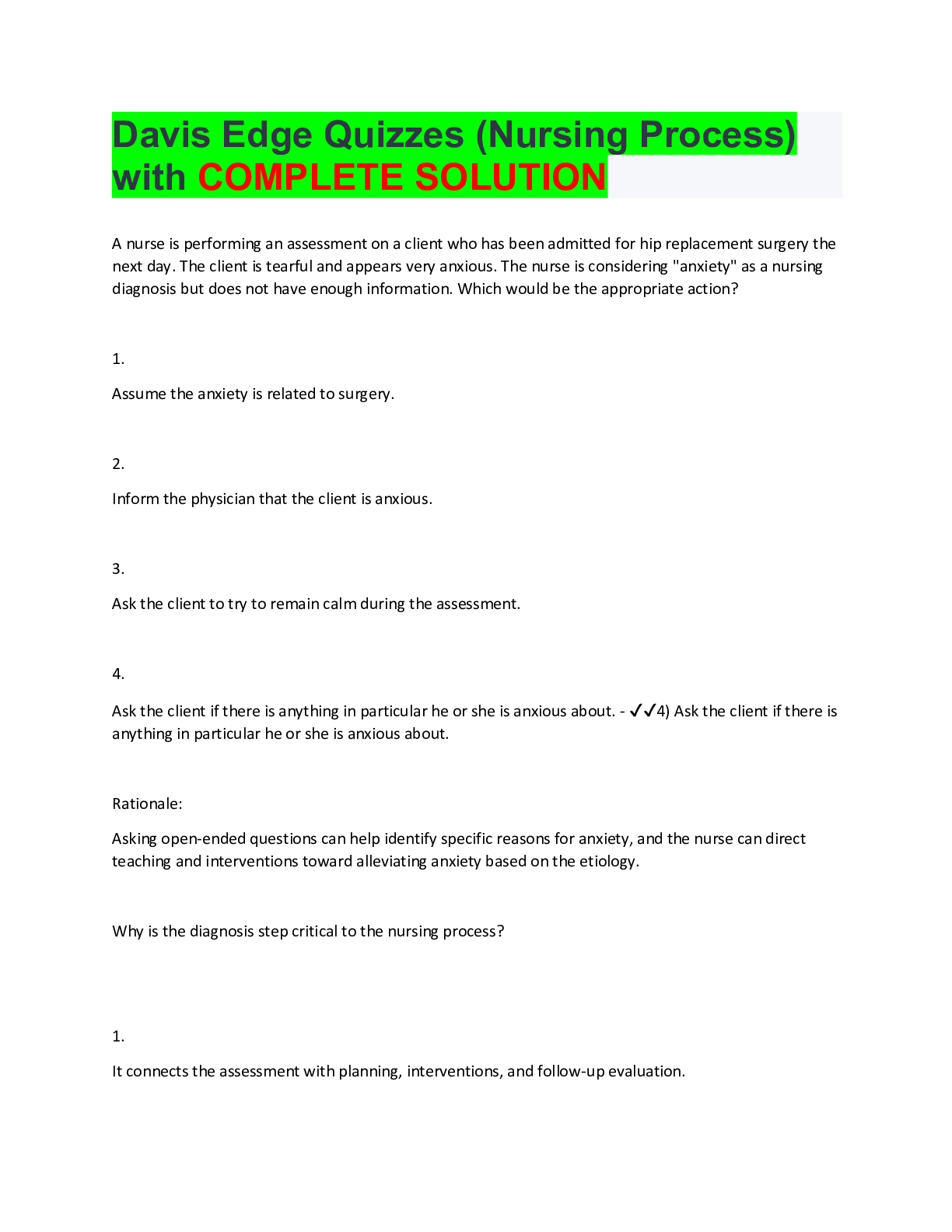
Davis Edge Quizzes (Nursing Process)
with COMPLETE SOLUTION
A nurse is performing an assessment on a client who has been admitted for hip replacement surgery the
next day. The client is tearful and appears very anxiou
...
Davis Edge Quizzes (Nursing Process)
with COMPLETE SOLUTION
A nurse is performing an assessment on a client who has been admitted for hip replacement surgery the
next day. The client is tearful and appears very anxious. The nurse is considering "anxiety" as a nursing
diagnosis but does not have enough information. Which would be the appropriate action?
1.
Assume the anxiety is related to surgery.
2.
Inform the physician that the client is anxious.
3.
Ask the client to try to remain calm during the assessment.
4.
Ask the client if there is anything in particular he or she is anxious about. - ✔✔4) Ask the client if there is
anything in particular he or she is anxious about.
Rationale:
Asking open-ended questions can help identify specific reasons for anxiety, and the nurse can direct
teaching and interventions toward alleviating anxiety based on the etiology.
Why is the diagnosis step critical to the nursing process?
1.
It connects the assessment with planning, interventions, and follow-up evaluation.2.
Without a complete nursing diagnosis, insurance will not compensate the hospital.
3.
It provides the physician with necessary information to make a medical diagnosis.
4.
Nursing diagnoses are needed to support any therapeutic treatments and diagnostic testing. - ✔✔1.
It connects the assessment with planning, interventions, and follow-up evaluation.
Rationale:
The nursing diagnosis step is critical because it links the assessment step, which precedes it, to all the
steps that follow it. However, assessment data must be complete and accurate in order to make an
accurate nursing diagnosis.
Which is the best explanation of the difference between a medical diagnosis and a nursing diagnosis?
1.
A medical diagnosis defines an illness or disease with a certain pathology, while a nursing diagnosis is
geared toward the client's health status and how a nurse can help independently.
2.
A medical diagnosis is made by a physician, and a nursing diagnosis is created by a nurse.
3.A medical diagnosis involves interventions and medical treatment, and a nursing diagnosis involves
client comfort and activities of daily living.
4.
A medical diagnosis determines the nursing diagnosis, while the nursing diagnosis has no bearing on the
medical diagnosis. - ✔✔1.
A medical diagnosis defines an illness or disease with a certain pathology, while a nursing diagnosis is
geared toward the client's health status and how a nurse can help independently.
Rationale:
A medical diagnosis describes a disease, illness, or injury, and the purpose is to find pathology. A nursing
diagnosis is a statement of client health status that nurses can identify, prevent, or treat independently.
A nurse has created a plan of care that involves assisting a client with ambulation. She attempts to get
the client out of bed, but the client is obese and unable to move without pain. What action should the
nurse take?
1.
Change the outcome goals.
2.
Document the attempt to ambulate the client.
3.
Request assistance with ambulating the client.
4.
Amend the nursing diagnosis and interventions. - ✔✔3.
Request assistance with ambulating the client.Rationale:
The nurse should obtain the necessary assistance to ambulate the client, and make every effort to meet
the outcome goals.
Which are examples of cue clusters for a nursing diagnosis? Select All That Apply.
1.
Hard, painful bowel movement approximately every 3 to 4 days; sedentary lifestyle; low dietary fiber
intake; dry skin
2.
Pain and limited range of motion in knees, use of walker, medical diagnosis of osteoarthritis
3.
Sore throat, fever, inability to ambulate, medical diagnosis of depression
4.
Dry skin, painful urination, epistaxis
5.
Urinary incontinence, lower abdominal pain, bladder spasm - ✔✔Answer: 1, 2, 5
Rationales
Option 1:
Manifestations that are similar such as hard, painful bowel movements with low dietary fiber intake and
a sedentary lifestyle are considered clusters of cues.Option 2:
Manifestations that relate to a single etiology, such as osteoporosis, are considered clusters of cues.
Option 3:
Sore throat and fever may be associated, but they are not associated with the inability to ambulate or a
medical diagnosis of depression, so these symptoms would not be considered a cluster of cues.
Option 4:
Painful urination and epistaxis are not correlated and would not be considered a cue cluster.
Option 5:
Urinary bladder spasm with incontinence as well as lower abdominal pain are cluster cues that indicate
there is an issue with the urinary tract.
Which describes the correct way to state a nursing diagnosis?
1.
Medical diagnosis and problem list linked by a connecting phrase
2.
Medical diagnosis and medical history linked by etiology
3.
A problem and an etiology linked by a connecting phrase
4.
A problem and a medical diagnosis linked by a connecting phrase - ✔✔3.
A problem and an etiology linked by a connecting phrase
Rationale:A nursing diagnosis is a statement of a problem with etiology and a connecting phrase, such as "related
to."
A statement such as "readiness for enhanced self-care" is an example of which type of nursing
diagnosis?
1.
Wellness diagnosis
2.
Syndrome diagnosis
3.
Very specific NANDA-l label
4.
Risk diagnosis - ✔✔Wellness diagnosis
Rationale:
A wellness label does not describe a problem, and there is no cause and no need for "related to"
wording.
The abbreviations "AEB" and "AMB" are considered connecting phrases for which portion of the nursing
plan?1.
Basic three-part statement
2.
Two-part NANDA-I label
3.
Collaborative problem
4.
Complex etiology - ✔✔Basic three-part statement
Rationale:
The abbreviation "PES" (problem, etiology, symptom) is used when writing a basic three-part statement,
which uses "AEB" (as evidenced by) and "AMB" (as manifested by) as connecting phrases.
A client was admitted 2 days ago has not slept well due to pain from injuries. The nurse recognizes this
while making rounds and adjusts the client's nursing diagnosis to reflect the change in status. The nurse
then creates a new plan to address the change. What type of planning is this considered?
1.
Initial planning
2.
Ongoing planning
3.Discharge planning
4.
Preexisting planning - ✔✔Ongoing planning
Rationale:
Ongoing planning is continuous throughout the duration of care and updated as the status changes.
During an assessment, the nurse notes that the client has an elevated temperature. Which type of data
is this?
1.
Subjective
2.
Objective
3.
Secondary
4.
Reported - ✔✔Objective
Which describes benefits of the comprehensive written nursing care plan? Select all that apply.1.
Provides continuity of care
2.
Establishes the discharge diagnosis
3.
Ensures that care is complete
4.
Meets accreditation requirements
5.
Promotes efficient use of nursing efforts - ✔✔Answers 1, 3, 4, 5
Rationale:
Option 1:
The nursing care plan is used by all nurses during a client's course of treatment. It is a means of
communication and ensures continuity.
Option 2:
The discharge diagnosis is a medical diagnosis established by the physician, and it is not part of the
nursing care plan.
Option 3:
The nursing care plan identifies unique needs of the client based on assessment and is unique and
changeable.
Option 4:Accreditation agencies require a comprehensive nursing care plan as evidence that nursing care is
consistent and follows best practices.
Option 5:
The nursing care plan ensures communication and continuity among nurses and thus promotes
efficiency.
Which statement correctly identifies an outcome goal from the nursing diagnosis of "potential for skin
breakdown related to immobility"?
[Show More]





.png)
.png)

.png)