NURS 629 Exam Study Guide
Test-taking skills for NURS 629
This course pulls together content from previous courses such as pathophysiology,
pharmacology, and advanced health assessment.
Use the materials provided
...
NURS 629 Exam Study Guide
Test-taking skills for NURS 629
This course pulls together content from previous courses such as pathophysiology,
pharmacology, and advanced health assessment.
Use the materials provided such as content slides, text, readings, and assignments to help you
study, comprehend, and apply the content.
In this course, you will think like a provider, determine how to diagnose based on history and
exam findings/symptoms, come up with differential diagnoses, and determine a treatment plan,
the best medication to order, lab work to order, and education to provide to the patient.
o When you study, think about these questions: “How I would make this diagnosis and
differentiate symptoms between disease processes? What lab work would I order? What
medication would I prescribe and what education would I provide to the patient?”
When taking the test, read each question carefully, then read the answers carefully (look for
patterns in the answers) to help rule out answer options.
o Take your time.
o Do NOT change your answer once you decide.
Exam 1 Information:
Open from Day 2 at 8 a.m. until Day 3 at 7:59 a.m. CST
Proctored exam—all students should already have information regarding proctored exams.
30 questions worth 30 points
You will have 60 minutes to take this exam.
Items on the exam are from Weeks 1–3, which includes information from course recordings,
assignments, readings, course text, and all other material covered.
Please note:
o If you have difficulty during the exam, call toll-free: 1-855-577-2039 or use this direct
link (this could be faster) to the Support Center.
Exam Review:
Remember this is merely an overview of what may be on the exam. Not everything that may be on the
exam is covered here.
Be sure to review guidelines for diseases and conditions and normal pregnancy care.
Risk factors for disorders during pregnancy
Presenting signs and symptoms
Diagnostic testing
Differential diagnosis
Treatment regimens utilizing updated guidelines found in your course material for common
disorders and diseases seen in women’s health care
Review patient education, when to report back to the clinic, what to watch out for, pharmacology, and
other non-pharmacological modalities.
Think back to the case studies and how you gave your rationale using updated guidelines
and diagnostic criteria.
**Please refer to the Exam Outline for additional items that may be covered on the exam.
**Remember that this outline is not exhaustive and that all material covered in Weeks 1–3 can be on the
exam.
Exam 1 Outline: Main Topics
The goal of this test is to show you can identify what is normal and abnormal in your OB physical exams.
Below is some of the information that you will be tested on. This list is not inclusive. You should be sure
to read all study material in addition to material specific to any conditions listed here. You should know
how to diagnose and treat these conditions.
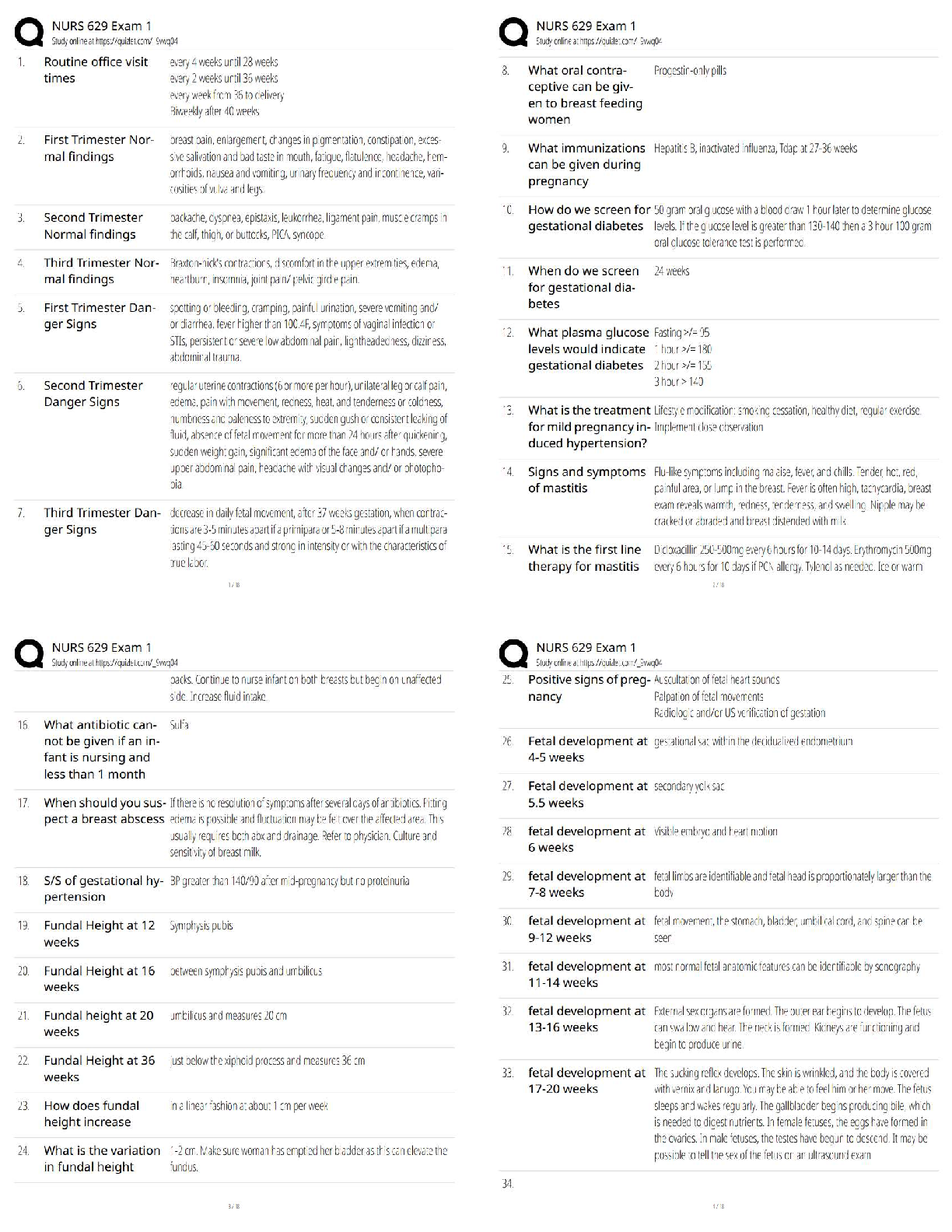
1. What are the recommended office visits (interval) for a low-risk client throughout the
pregnancy?
○ What is the recommended office visit interval during each trimester?
1. Up to 28 weeks – Every 4 Weeks
2. 28 to 36 weeks – Every 2 weeks
3. 36 weeks and on – Every week or more as necessary
○ What are appropriate findings for each trimester?
1. 1
st Trimester: week 1-12
1. Breast enlargement, darkening of areola, raise pink Montgomery’s
tubercles, nausea, vomiting, and fatigue. Heart tones with Doppler.
Positive pregnancy test. Also audible with ultrasound around 12 weeks.
Chadwicks sign, Goodell’s sign. Neural tube development for the baby,
rapid cell growth. Vital systems are beginning to form.
[Show More]