Gero HESI Practice Questions and
Answers 2022
A frail, elderly client is admitted to the unit with a diagnosis of pneumonia. Which finding is most
important for the registered nurse (RN) to report to the healthcare pr
...
Gero HESI Practice Questions and
Answers 2022
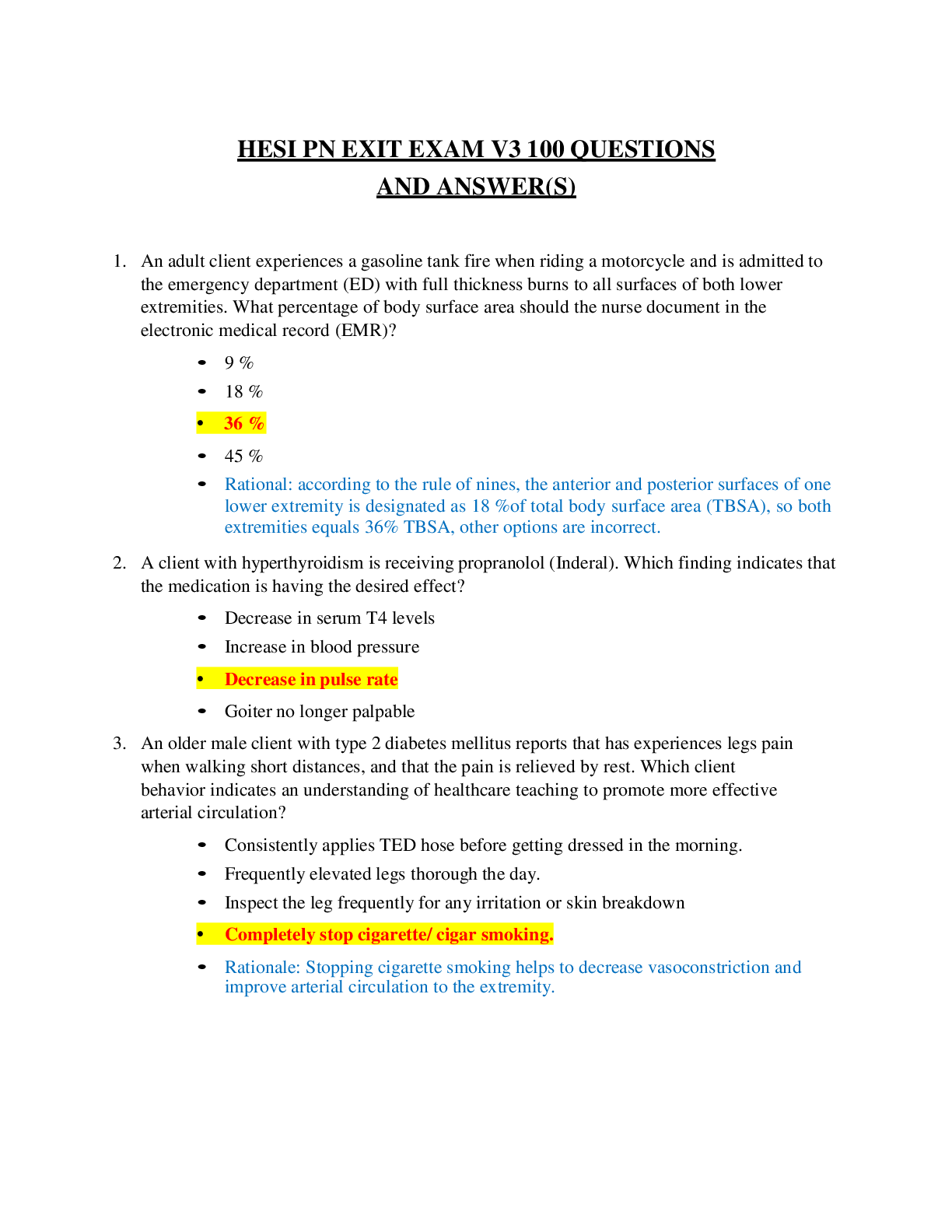
A frail, elderly client is admitted to the unit with a diagnosis of pneumonia. Which finding is most
important for the registered nurse (RN) to report to the healthcare provider?
A. Fever and chills
B. Confusion and dehydration
C. Crackles in the lung fields
D. Nausea and vomiting Correct Answer-B. Confusion and dehydration
Rationale: Confusion and dehydration (B) are findings of inadequate oxygenation and perfusion in this
frail elderly client. (A), (C) and (D) are all common with pneumonia, but the most important finding is
confusion and evidence of dehydration, which require treatment for this frail elderly client.
A frail elderly couple asks the registered nurse (RN) if they have to watch their salt intake because food
does not taste as good as it used to so they have to season most foods. What information should the RN
offer the couple?
A. Boredom may influence how the taste of food is perceived, and different seasonings can stimulate
taste.
B. With age, an increase in sodium intake is needed to compensate for a decrease in renal function.C. Short-term memory loss and confusion may be the reason they want to over-season their food.
D. Taste buds often are dull due to atrophy so older clients should use other seasonings instead of salt.
Correct Answer-D. Taste buds are often dull due to atrophy so older clients should use other seasonings
instead of salt.
Rationale: Taste buds atrophy with normal aging, which influences an older client's sensitivity to taste
and is often compensated for the use of stronger tasting seasonings. (A), (B), and (C) are not normal
aging processes related to taste.
After taking a 10-day course of an antibiotic that was ineffective, a frail, elderly client with chronic
obstructive pulmonary disease (COPD) is admitted for pneumonia. The client has a long history of
smoking and still smokes a pack of cigarettes a day. Which finding should the registered nurse (RN)
report to the healthcare provider?
A. Barrel chest with increased chest diameter
B. Crackles and pulse oximetry level of 88%
C. Low hemoglobin and hematocrit levels
D. Arterial blood gases indicating respiratory acidosis Correct Answer-B. Crackles and pulse oximetry
level of 88%
Rationale: With pneumonia, crackles in the lungs and low O2 saturation (B) can impact adequate
oxygenation, which should be reported to the HCP. (A) occurs due to chronic hyperinflation of the lungs
and is common in clients with COPD. Anemia (C) is frequently identified in clients with COPD, and
respiratory acidosis (D) due to CO2 retention contributes to a lower blood pH.An older female client recently moved to an assisted living facility. The family explains to the registered
nurse (RN) that the client is unmanageable and always confused, disoriented and depressed. The client
asks the RN repeatedly, "Where am I?". How should the RN respond?
A. Explain that she is in a new home called an assisted living community
B. Question the client about her perception of where she might be now.
C. Distract the client with a scenario that she is on an outing with her family.
D. Reassure the client not to worry because she will meet new friends. Correct Answer-A. Explain that
she is in a new home called an assisted living community.
Rationale: Reality re-orientation (A) is the best response for a client who is confused because the
response is consistent and true. (B, C, and D) do not provide the client with feedback that is reality
based.
A new resident in an assisted living facility is an older client who is experiencing short-term memory loss
and confusion. Which activity should the registered nurse (RN) schedule the client to do during the day?
A. Arts and crafts
B. Current events discussion group
C. Group sing-along
D. Daily exercise group Correct Answer-D. Daily exercise group
Rationale: A daily exercise group (D) allows the client to mirror the leader and minimizes the client's
stress to remember. (A), (C), and a current events discussion group (B) are thought-provoking activitiesthat require attention to detail and short-term memory to participate in the group activity which may be
stressful and frustrating to the resident who has difficulty remembering sequence of the details.
The hospice nurse is completing a focused assessment of an older female client with end stage
Alzheimer's disease, who recently fractured her hip. What technique should the registered nurse (RN)
use to determine the client's pain?
A. Use the FACE pain scale
B. Ask the client to rate pain on a scale of 1 to 10
C. Observe for facial grimacing
D. Review documentation of recent eating habits Correct Answer-C. Observe for facial grimacing
Rationale: Observing for facial grimacing (C) is the best method for evaluating pain for a client who
cannot communicate due to Alzheimer disease. (A) and (B) may not be understood by a client with endstage Alzheimer's disease. (D) is not a helpful tool for pain assessment.
An older male client arrives at the clinic for an annual physical examination. While the nurse assesses
the client, the client states that he is having intimacy problems with his wife. Which information should
the nurse provide to elicit more information from the client?
A. Query client to clarify the client's idea of an intimacy problem.
B. Discuss benign prostatic hypertrophy (BPH) and ejaculation.
C. Explore the frequency that he experiences erectile dysfunction (ED)D. Determine if the client's wife is young enough to get pregnant Correct Answer-A. Query client to
clarify the client's idea of an intimacy problem.
Rationale: Clarification of the client's concern is needed to appropriately address the specific concern
about intimacy issues (A). (B), (C), and (D) are details that the client should present, not the RN.
The registered nurse (RN) is caring for an older female client with a 20 year history of rheumatoid
arthritis (RA), who is admitted for carpel tunnel release. Which finding associated with RA should the RN
document?
A. Asymmetrical joint deformity
B. Small joint involvement in fingers
C. Crepitation or grating sensation in joints
D. Weight bearing joint involvement Correct Answer-B. Small joint involvement in fingers.
Rationale: Small joint involvement (B) is common in rheumatoid arthritis. (A), (C) and (D) are findings
that different OA from RA.
The registered nurse (RN) is re-enforcing discharge instructions with the family of an older client who
was recently admitted for an intestinal obstruction. Which statement indicates that the family
understands the instructions?
A. Increase protein and carbohydrates in the daily diet
B. Limit activity to bed rest for the first week and increase mobility incrementally each weekC. Report abdominal distention, constipation or any other nausea and vomiting to the healthcare
provider
D. Drink liquids 2 hours after meals instead of during meals Correct Answer-C. Report abdominal
distention, constipation, or any nausea and vomiting to the healthcare provider.
Rationale: (C) are symptoms that occur with intestinal obstruction and should be addressed
immediately. (A, B, and D) are not indicated for a client who has been discharged for intestinal
obstruction.
An older client is transferred to a telemetry unit after placement of a pacemaker. What action should
the registered nurse (RN) take first?
A. View incision site
B. Obtain a blood pressure
C. Establish telemetry monitoring
D. Evaluate client for pain Correct Answer-C. Establish telemetry monitoring.
Rationale: The first action is to establish continuous telemetry monitoring (C) to ensure the pacemaker is
functioning properly. (A, B and D) should be implemented after the client's heart rate and rhythm are
successfully being monitored.
Older clients are at highest risk for abuse and neglect due to which factors? (Select all that apply.)
A. Needs are greater than the caretaker's abilitiesB. Client's declining strength
C. Fixed income
D. Longer life expectancy
E. Lack of exposure to technology and trends Correct Answer-A. Needs regretter than the caretaker's
abilities
B. Client's declining strength
Rationale: When needs are not being met due to lack of ability of the caretaker (A), stress and feelings of
failure may be expressed through neglect and abuse. Decline in strength (B) increases the older client's
vulnerability to resist or respond to elder abuse. (C, D, E) do not increase the risk for neglect and abuse.
An older female client who has been taking hydrocodone/acetaminophen (Lortab) q4 hours for chronic
back pain for the past 5 years tells the registered nurse (RN) that she cannot live without her pain pills.
When asked if she is addicted, the client states that she is not an addict because the healthcare provider
prescribed the pain pills. Which coping mechanism should the RN determine the client is using about her
addiction?
A. Lack of knowledge about narcotic medications
B. Rationalization to support narcotic use
C. Transfer of blame to healthcare provider
D. Justification of narcotic use due to chronic pain Correct Answer-B. Rationalization to support narcotic
use.Rationale: The client is using rationalization to maintain self-esteem when she is questioned by stating
that she is not addicted because she is taking medication prescribed by a healthcare provider. (A) may
be possible, but the client is being specifically asked about possible addiction. (C) and (D) underlie the
complexity of denial in addiction, but the client is trying to maintain self-esteem through rationalization.
A family member brings their aging father to the clinic because he has been alert and oriented during
the day but agitated and disoriented in the evening. The registered nurse (RN) reviews the client's list of
current medications with the client and family. Which action taken by the RN is most important?
A. Medication review with family caregivers is the RN's responsibility
B. Multiple medications can contribute to sundowner-like symptoms
C. Medication recall is the best way to evaluate the client's memory
D. Reviewing medication actions is a component of effective client care Correct Answer-B. Multiple
medications can contribute to sundowner like symptoms.
Rationale: Older clients may see a variety of HCP which can increase the chance of polypharmacy that
compounds the workload of metabolic pathways that may be less efficient due to the aging process.
Multiple medication interactions may contribute to sundowner like symptoms; reviewing medication
actions and interactions provides the information that may indicate polypharmacy leading to sundowner
syndromes
[Show More]


.png)


.png)
 Questions, Answers & Rationale, A+ Guide.png)



![Preview of HESI Critical Care TEST BANK RN 2021 [50 Questions /Answers]](https://scholarfriends.com/storage/Critical_Care_HESI_notes___.png)