Patient Education (In Pt.) & Discharge Planning
(home needs)
Diet & Exercise Modification: Because of A.R.’s
diagnosis of chronic hypertension, it is very important
her blood pressure be continuously managed. Her
hy
...
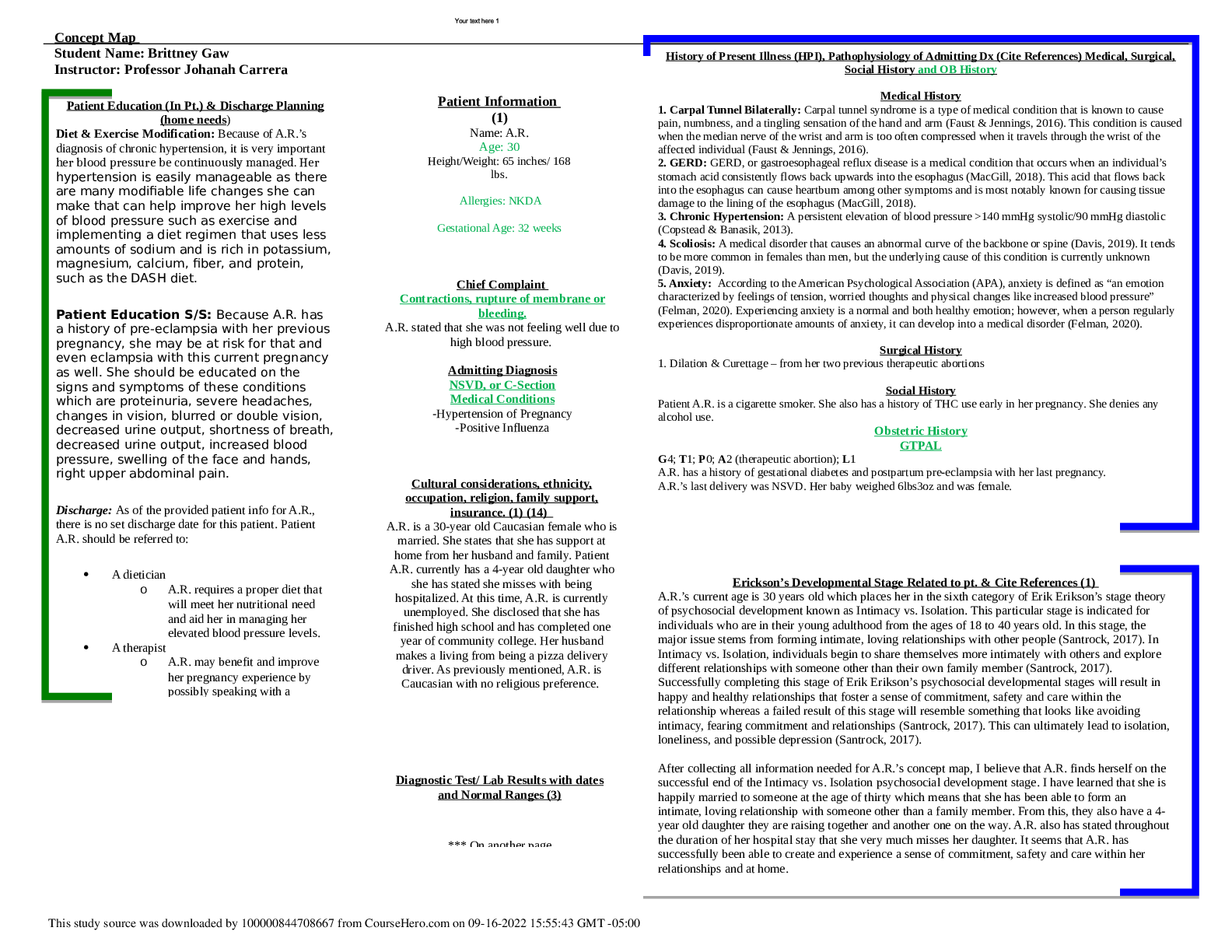
Patient Education (In Pt.) & Discharge Planning
(home needs)
Diet & Exercise Modification: Because of A.R.’s
diagnosis of chronic hypertension, it is very important
her blood pressure be continuously managed. Her
hypertension is easily manageable as there
are many modifiable life changes she can
make that can help improve her high levels
of blood pressure such as exercise and
implementing a diet regimen that uses less
amounts of sodium and is rich in potassium,
magnesium, calcium, fiber, and protein,
such as the DASH diet.
Patient Education S/S: Because A.R. has
a history of pre-eclampsia with her previous
pregnancy, she may be at risk for that and
even eclampsia with this current pregnancy
as well. She should be educated on the
signs and symptoms of these conditions
which are proteinuria, severe headaches,
changes in vision, blurred or double vision,
decreased urine output, shortness of breath,
decreased urine output, increased blood
pressure, swelling of the face and hands,
right upper abdominal pain.
Discharge: As of the provided patient info for A.R.,
there is no set discharge date for this patient. Patient
A.R. should be referred to:
A dietician
o A.R. requires a proper diet that
will meet her nutritional need
and aid her in managing her
elevated blood pressure levels.
A therapist
o A.R. may benefit and improve
her pregnancy experience by
possibly speaking with a
Erickson’s Developmental Stage Related to pt. & Cite References (1)
A.R.’s current age is 30 years old which places her in the sixth category of Erik Erikson’s stage theory
of psychosocial development known as Intimacy vs. Isolation. This particular stage is indicated for
individuals who are in their young adulthood from the ages of 18 to 40 years old. In this stage, the
major issue stems from forming intimate, loving relationships with other people (Santrock, 2017). In
Intimacy vs. Isolation, individuals begin to share themselves more intimately with others and explore
different relationships with someone other than their own family member (Santrock, 2017).
Successfully completing this stage of Erik Erikson’s psychosocial developmental stages will result in
happy and healthy relationships that foster a sense of commitment, safety and care within the
relationship whereas a failed result of this stage will resemble something that looks like avoiding
intimacy, fearing commitment and relationships (Santrock, 2017). This can ultimately lead to isolation,
loneliness, and possible depression (Santrock, 2017).
After collecting all information needed for A.R.’s concept map, I believe that A.R. finds herself on the
successful end of the Intimacy vs. Isolation psychosocial development stage. I have learned that she is
happily married to someone at the age of thirty which means that she has been able to form an
intimate, loving relationship with someone other than a family member. From this, they also have a 4-
year old daughter they are raising together and another one on the way. A.R. also has stated throughout
the duration of her hospital stay that she very much misses her daughter. It seems that A.R. has
successfully been able to create and experience a sense of commitment, safety and care within her
relationships and at home.
History of Present Illness (HPI), Pathophysiology of Admitting Dx (Cite References) Medical, Surgical,
Social History and OB History
Medical History
1. Carpal Tunnel Bilaterally: Carpal tunnel syndrome is a type of medical condition that is known to cause
pain, numbness, and a tingling sensation of the hand and arm (Faust & Jennings, 2016). This condition is caused
when the median nerve of the wrist and arm is too often compressed when it travels through the wrist of the
affected individual (Faust & Jennings, 2016).
2. GERD: GERD, or gastroesophageal reflux disease is a medical condition that occurs when an individual’s
stomach acid consistently flows back upwards into the esophagus (MacGill, 2018). This acid that flows back
into the esophagus can cause heartburn among other symptoms and is most notably known for causing tissue
damage to the lining of the esophagus (MacGill, 2018).
3. Chronic Hypertension: A persistent elevation of blood pressure >140 mmHg systolic/90 mmHg diastolic
(Copstead & Banasik, 2013).
4. Scoliosis: A medical disorder that causes an abnormal curve of the backbone or spine (Davis, 2019). It tends
to be more common in females than men, but the underlying cause of this condition is currently unknown
(Davis, 2019).
5. Anxiety: According to the American Psychological Association (APA), anxiety is defined as “an emotion
characterized by feelings of tension, worried thoughts and physical changes like increased blood pressure”
(Felman, 2020). Experiencing anxiety is a normal and both healthy emotion; however, when a person regularly
experiences disproportionate amounts of anxiety, it can develop into a medical disorder (Felman, 2020).
Surgical History
1. Dilation & Curettage – from her two previous therapeutic abortions
Social History
Patient A.R. is a cigarette smoker. She also has a history of THC use early in her pregnancy. She denies any
alcohol use.
Obstetric History
GTPAL
G4; T1; P0; A2 (therapeutic abortion); L1
A.R. has a history of gestational diabetes and postpartum pre-eclampsia with her last pregnancy.
Cultural considerations, ethnicity, A.R.’s last delivery was NSVD. Her baby weighed 6lbs3oz and was female.
occupation, religion, family support,
insurance. (1) (14)
A.R. is a 30-year old Caucasian female who is
married. She states that she has support at
home from her husband and family. Patient
A.R. currently has a 4-year old daughter who
she has stated she misses with being
hospitalized. At this time, A.R. is currently
unemployed. She disclosed that she has
finished high school and has completed one
year of community college. Her husband
makes a living from being a pizza delivery
driver. As previously mentioned, A.R. is
Caucasian wi
[Show More]



.png)