117 CFA Final Exam Prep Questions and
Answers
Given cash flow, calculate NPV and IRR. Required rate is 8 percent ->>C $3,379 10.9%
Given cash flow, calculate payback and discounted period. Required rate is 8 percent -
...
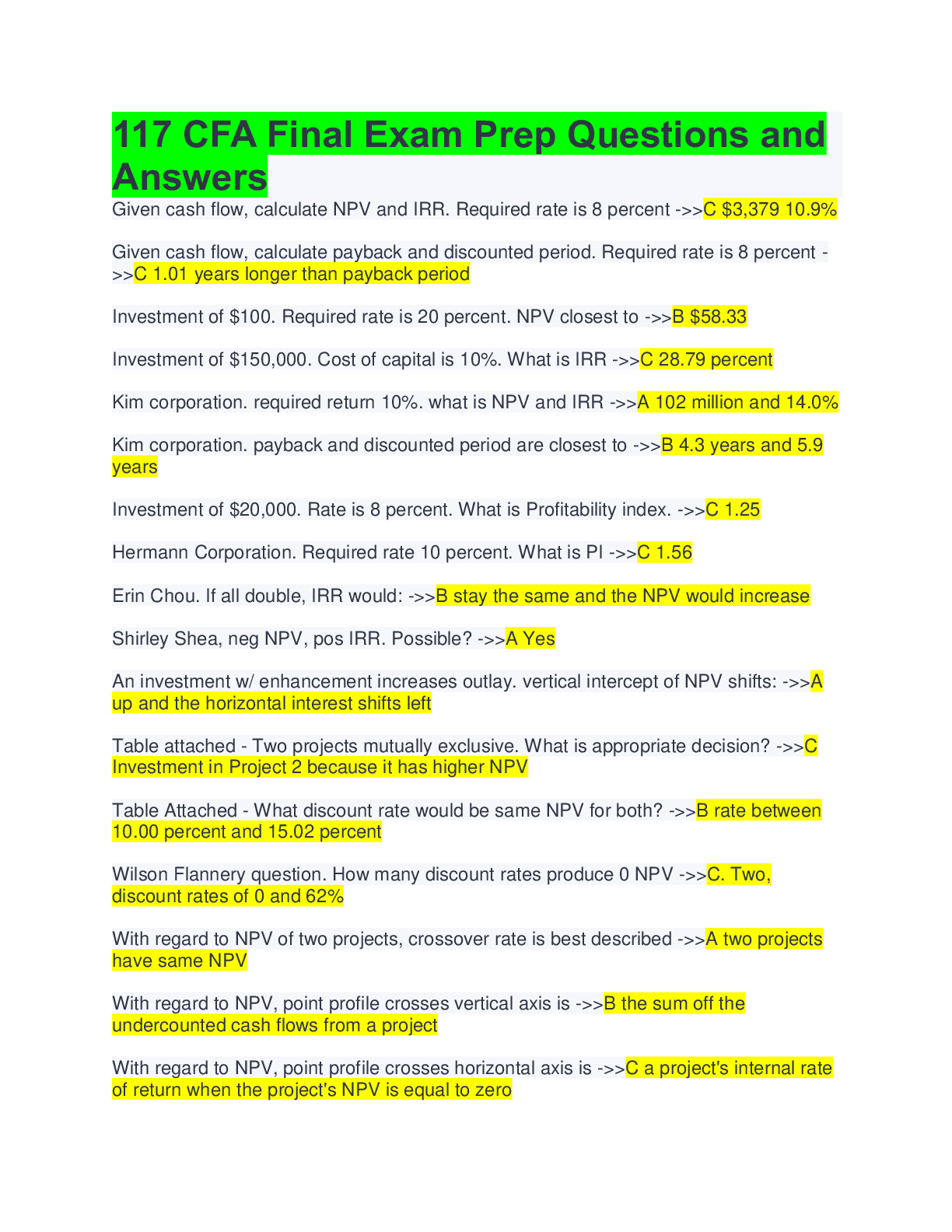
117 CFA Final Exam Prep Questions and
Answers
Given cash flow, calculate NPV and IRR. Required rate is 8 percent ->>C $3,379 10.9%
Given cash flow, calculate payback and discounted period. Required rate is 8 percent -
>>C 1.01 years longer than payback period
Investment of $100. Required rate is 20 percent. NPV closest to ->>B $58.33
Investment of $150,000. Cost of capital is 10%. What is IRR ->>C 28.79 percent
Kim corporation. required return 10%. what is NPV and IRR ->>A 102 million and 14.0%
Kim corporation. payback and discounted period are closest to ->>B 4.3 years and 5.9
years
Investment of $20,000. Rate is 8 percent. What is Profitability index. ->>C 1.25
Hermann Corporation. Required rate 10 percent. What is PI ->>C 1.56
Erin Chou. If all double, IRR would: ->>B stay the same and the NPV would increase
Shirley Shea, neg NPV, pos IRR. Possible? ->>A Yes
An investment w/ enhancement increases outlay. vertical intercept of NPV shifts: ->>A
up and the horizontal interest shifts left
Table attached - Two projects mutually exclusive. What is appropriate decision? ->>C
Investment in Project 2 because it has higher NPV
Table Attached - What discount rate would be same NPV for both? ->>B rate between
10.00 percent and 15.02 percent
Wilson Flannery question. How many discount rates produce 0 NPV ->>C. Two,
discount rates of 0 and 62%
With regard to NPV of two projects, crossover rate is best described ->>A two projects
have same NPV
With regard to NPV, point profile crosses vertical axis is ->>B the sum off the
undercounted cash flows from a project
With regard to NPV, point profile crosses horizontal axis is ->>C a project's internal rate
of return when the project's NPV is equal to zeroWith regard to capital budgeting, estimate least likely to include ->>interest costs
Equity equals ->>A Assets - Liabilities
Shareholders' equity most likely differs from market value because ->>B some factors
that affect the generation of future cash flows are excluded
All of the following are current assets except ->>B goodwill
The most likely costs included in inventory, plant, equipment are ->>C delivery costs
debt due within one year is ->>A Current
The carrying value of inventories reflects ->>C the lower of historical cost or net
realizable value
accrued expenses are ->>C expenses that have been reported on the income
statement but not yet paid
Defining total asset turnover as revenue divided...most likely result in an increase for
company ->>C both the debt-to-equity ratio and the total asset turnover
the item "retained earnings" is a part of ->>C shareholders' equity
When a company buys shares of its own stock, it records a reduction in ->>B both
assets and shareholders' equity
which of the following would an analysis most likely determine from a common-size
analysis... ->>B An increase or decrease in financial leverage
An investor concerned meeting near-term calculate the ->>A current ratio
Most stringent test of liquidity ->>A Cash ratio
An investor worried about long-term most likely examines ->>C debt-to-equity ratio
Big table - based on exhibit 1 which is correct? ->>C Company A has made one or more
acquisitions
big table - Based on exhibit 1, leverage of company B is closest to ->>C 2.22
Big table - based on exhibit 1 which ratio indicates lower risk for A compared to b ->>A
Cash ratio
In order to assess ability to fulfill long-term, analysis examine ->>C solvency ratiosWhich ratio would a company use to examine short-term ->>A Current ratio
Which of the ratio useful determine company's ability for lease and interest charges? -
>>C Fixed charge coverage
Table above - based on date, analyst least likely conclude ->>C Management of
receivables has contributed to improved liquidity
Table above - which of the following most likely conclusion ->>A the company is
becoming increasingly less solvent, as evidenced by the increase in its debt-to-equity
ratio from 0.35 to 0.50 from FY3 to Fy5
Problem 6, most reasonable for financial data ->>C. The decline in the company's
equity indicates that the company may be incurring losses, paying dividends greater
than income, and/or repurchasing shares
Analyst decrease inventory turnover, most likely explanation ->>C. the company
installed a new inventory management system but experienced some operational
difficulties resulting in duplicate orders being placed with suppliers.
Best explain increase in receivables turnover ->>B. Due to problems with an error in its
old credit scoring system, the company had accumulated a substantial amount of
uncollectible accounts and wrote off a large amount of its receivables
Brown corporation...change in average accounts receivable ->>A. +$0.41 million
Table, best described conductions to pay obligations ->>A. Company A's current ratio of
4.0 indicates it is more liquid than company B, whose current ratio is only 1.2, but
Company B is more solvent, as indicated by its lower debt-to-equity ratio.
Huge income statement...total assets, best explanation company's efficiency. ->>C.
Comparing FY14 with FY10, the company's efficiency deteriorated due to asset growth
faster than turnover revenue growth
Huge income statement...best describes company's solvency ->>B. Comparing FY14
with FY10, the company's solvency deteriorated, as indicated by a decrease in interest
coverage from 10.6 to 8.4
Huge income statement...best describes company's liquidity ->>C. Comparing FY14
with FY10, the company's liquidity improved, as indicated by an increase in its current
ratio from 0.71 to 0.75
Huge income statement...best describes company profitability ->>B. Comparing Fy14
with FY10, the company's profitability deteriorated, as indicated by a decrease in its net
profit margin from 11.0 to 5.7 percent.Assuming no changes in other variables, which of the following would decrease ROA? -
>>C. An increase in average assets
Based on information above, most appropriate FY13 to FY15 ->>C. net profit margin
has decreased but its financial leverage has increased.
What does P/E ratio measure? ->>A. The "multiple" that the stock market places on a
company's EPS
A creditor most likely consider a decrease to be good news ->>B. debt-to-total assets
When developing forecasts, analysts should most likely ->>B. Use the results of
financial analysis, analysis of other information, and judgement.
Three factor DuPont Analysis is comprised of ->>C. Asset turnover, profit margin,
financial leverage
Within the Dupont Analysis ->>B. An increase in financial leverage is met with an
increase in the use of debt
In Dupont Analysis where the financial leverage has constantly increased over the past
several years ->>D. The ROE will be higher than the ROA
The current ROA of a firm is 13% and it has an equity multiple of 3.0. The resulting
ROE... ->>B. 39%
the ACME company...Sales $2,340,000...accounts payable $98,000 ->>A. The asset
turnover and profit margin are 2.36 and 10.68%
The P/E ratio is considered to be a price multiple. True? ->>B. An increasing P/E
implies that the price of the stock is becoming more expensive
If a stock has a beta of 2.0, which of the following is true? ->>D. The stock is considered
to be more volatile than the market.
The cost of equity is each to the ->>B. rate of return required by the stockholders
Which of the following statements is correct? ->>B. For a given company, the after-tax
cost of debt is generally less than both the cost of preferred equity and the cost of
common equity.
Using the dividend discount model, stock price C$45 ->>C. 15.61 percent
[Show More]


.png)