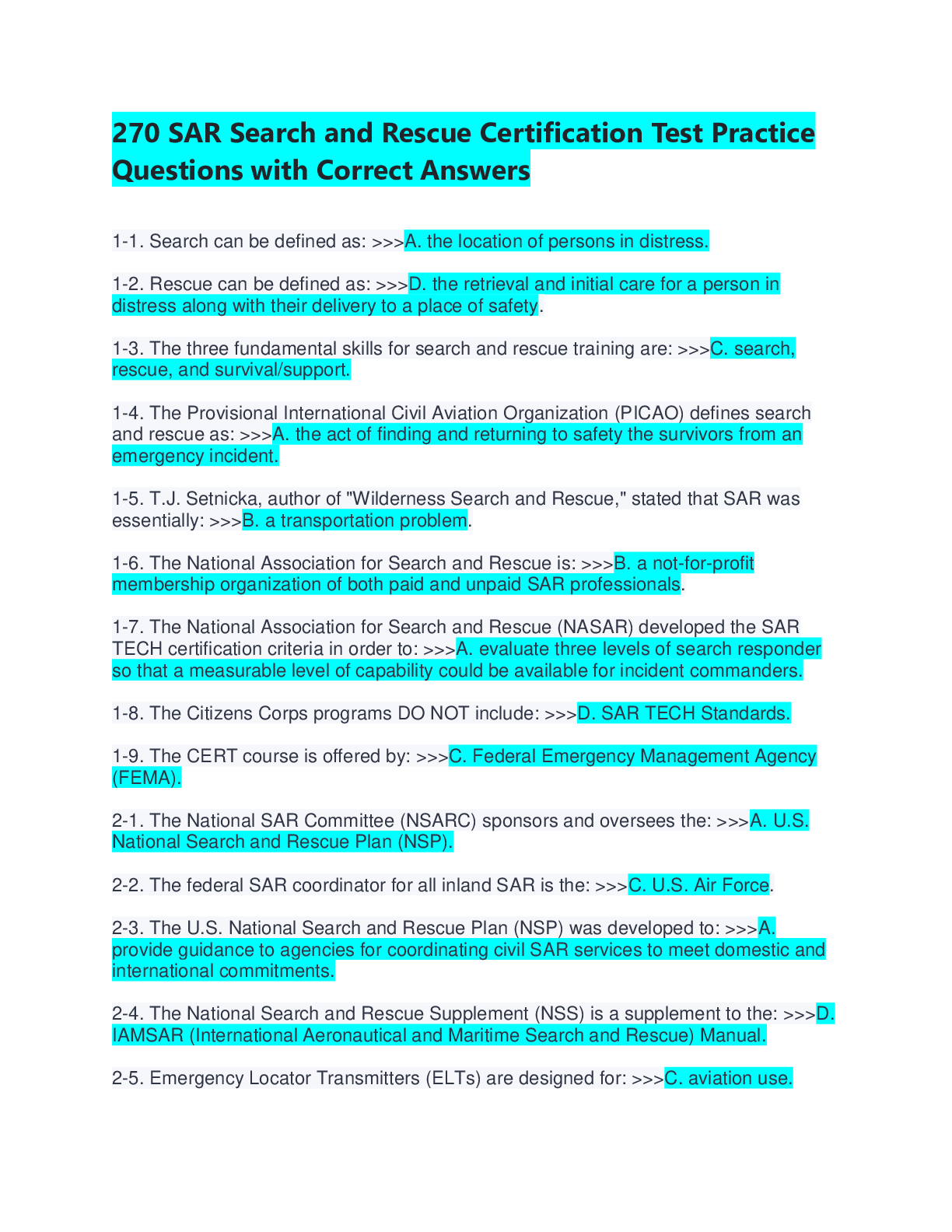
270 SAR Search and Rescue Certification Test Practice
Questions with Correct Answers
1-1. Search can be defined as: >>>A. the location of persons in distress.
1-2. Rescue can be defined as: >>>D. the retrieval and ini
...
270 SAR Search and Rescue Certification Test Practice
Questions with Correct Answers
1-1. Search can be defined as: >>>A. the location of persons in distress.
1-2. Rescue can be defined as: >>>D. the retrieval and initial care for a person in
distress along with their delivery to a place of safety.
1-3. The three fundamental skills for search and rescue training are: >>>C. search,
rescue, and survival/support.
1-4. The Provisional International Civil Aviation Organization (PICAO) defines search
and rescue as: >>>A. the act of finding and returning to safety the survivors from an
emergency incident.
1-5. T.J. Setnicka, author of "Wilderness Search and Rescue," stated that SAR was
essentially: >>>B. a transportation problem.
1-6. The National Association for Search and Rescue is: >>>B. a not-for-profit
membership organization of both paid and unpaid SAR professionals.
1-7. The National Association for Search and Rescue (NASAR) developed the SAR
TECH certification criteria in order to: >>>A. evaluate three levels of search responder
so that a measurable level of capability could be available for incident commanders.
1-8. The Citizens Corps programs DO NOT include: >>>D. SAR TECH Standards.
1-9. The CERT course is offered by: >>>C. Federal Emergency Management Agency
(FEMA).
2-1. The National SAR Committee (NSARC) sponsors and oversees the: >>>A. U.S.
National Search and Rescue Plan (NSP).
2-2. The federal SAR coordinator for all inland SAR is the: >>>C. U.S. Air Force.
2-3. The U.S. National Search and Rescue Plan (NSP) was developed to: >>>A.
provide guidance to agencies for coordinating civil SAR services to meet domestic and
international commitments.
2-4. The National Search and Rescue Supplement (NSS) is a supplement to the: >>>D.
IAMSAR (International Aeronautical and Maritime Search and Rescue) Manual.
2-5. Emergency Locator Transmitters (ELTs) are designed for: >>>C. aviation use.2-6. Cospas-Sarsat is: >>>A. an international search and rescue system that uses
satellites to detect and locate emergency beacons.
2-7. Personal Locator Beacons (PLBs) are designed for: >>>D. use by individuals.
2-8. Emergency Position Indicating Radio Beacons (EPIRBs) are designed for: >>>B.
maritime applications.
2-9. A Local User Terminal (LUT): >>>C. is the ground station that processes the signal
from an emergency beacon.
2-10. The Mission Control Center (MCC): >>>B. transmits an alert message to the
appropriate Regional Control Center (RCC).
2-11. The Department of Homeland Security (DHS) is charged with: >>>B. development
of a National Response Plan (NRP).
2-12. Outside of National Parks, domestic land SAR services are often performed by:
>>>C. state and local authorities or SAR units.
2-13. The operational capabilities of a FEMA Urban SAR Task Force include: >>>A.
physical and technical search and rescue operations in damaged collapsed structures.
2-14. FEMA US&R teams generally perform: >>>A. hazardous materials surveys and
evaluations.
2-15. According to the National Center for Missing & Exploited Children, one of the
criteria that should be met before an AMBER Alert is activated is: >>>B. law
enforcement believes the child in danger of serious bodily harm or death.
2-16. According to the National Center for Missing & Exploited Children, one of the
criteria that should be met before an AMBER Alert is activated is: >>>B. law
enforcement confirms a child has been abducted.
2-17. According to the National Center for Missing & Exploited Children, one of the
criteria that should be met before an AMBER Alert is activated is: >>>A. there is enough
descriptive information available to believe and immediate broadcast alert will help.
2-18. According to the National Center for Missing & Exploited Children, if you believe
your child is missing you should: >>>B. call law enforcement immediately.
3-1. Which ICS function approves the ordering of additional resources? >>>D.
Command
3-2. The planning section: >>>C. maintains and displays situation status.3-3. Which ICS function provides treatment of injured SAR workers? >>>C. Logistics
3-4. The standardization of job titles in ICS: >>>B. identifies to which level of the ICS
organization a person is assigned.
3-5. The type of a resource relates to: >>>B. the level of skill and capability of a
resource.
3-6. In multi-agency and multiple jurisdiction incidents, how many Incident Commands
may there be? >>>D. one
3-7. The five primary ICS management functions are: >>>A. Command, Operations,
Planning, Logistics, and Finance
3-8. In an incident with many kinds of resources, how many incident bases may be
established? >>>D. one
3-9. An Incident Action Plan: >>>A. provides specific tactical direction for a designated
operational period.
3-10. Strike Team requirements include: >>>D. all of the above. (A. the same kind and
type of resources, B. common communications, C. a leader.
3-11. Task Force requirements include: >>>B. different kinds and types of resources.
3-12. An available resource's reporting location, time, and likely length of mission is
found in: >>>C. Incident Assignments Lists.
3-13. Check-in may occur at: >>>D. all of the above. (A. staging areas, B. incident base,
C. camps.)
3-14. The Incident Command System refers to: >>>A. an on-scene incident
management model.
3-15. The Resource Unit Leader reports to: >>>A. the Planning Section Chief.
3-16. Common terminology should always be used in the ICS for: >>>D. all of the
above. (A. resources, B. position titles, C. resources and facilities.)
3-17. Every incident needs a written Incident Action Plan. >>>B. False
3-18. Essential elements of the Incident Action Plan include: >>>D. both a and b. (A.
organization details. B. a statement of objectives.DD)
3-19. Command Staff consists of: >>>C. Safety Officer, Liaison Officer, and Public
Information Officer.4-1. If the subject of a SAR mission is found unconscious, the SAR provider's
authorization to treat life-threatening injuries is called: >>>B. implied consent.
4-2. If, while on a mission, a SAR provider finds a conscious, mentally incompetent
adult subject with nonlife-threatening injuries, the provider's authority to treat and
transport: >>>B. may be authorized by a law enforcement officer.
4-3. The Good Samaritan Laws in most states: >>>D. provide an affirmative defense if a
provider is sued for rendering care.
4-4. The HIPPA standards: >>>C. protect the patient from improper release of health
information.
4-5. Searchers are obligated to leave a property if: >>>A. the land to be searched is not
posted but permission is denied.
4-6. All clues found in a search area: >>>D. should be treated as if they were evidence,
if a crime is suspected.
4-7. The policy of "do no harm" is generally imposed on: >>>C. all SAR providers.
4-8. A standard of care: >>>B. may be different for medically trained SAR providers.
4-9. If a SAR organization claims to provide a service that is only provided by a few
specially qualified members, the principle of __________may be violated. >>>B.
engendered reliance
4-10. A member's failure to respond to a SAR mission is classified as: >>>D. none of
the above. (A. abandonment, B. battery, C. negligence)
5-1. The loss of heat to the environment is referred to as: >>>C. heat transfer.
5-2. An inactive person requires a minimum of how many liters of water a day to keep
all body systems functioning properly? >>>A. 1-2
5-3. SAR providers may require as much as ____ liters of water a day in extreme
environments: >>>D. 8-10
5-4. What is the required daily caloric intake for an average (165-lb.) SAR provider?
>>>D. 3700
5-5. The body's primary method of regulating its temperature involves finely adjusting
the flow of heated blood between its core and periphery. >>>A. True5-6. To prevent convective heat loss, air movement around the body must be: >>>A.
eliminated or reduced.
6-1. The highest priority in an emergency situation is: >>>C. maintaining a positive
mental attitude.
6-2. Water is a higher priority in an emergency than: >>>A. food.
6-3. The necessities of life should be prioritized in an emergency in terms of: >>>B.
length of time a person can live without each item.
6-4. Energy conservation and waste removal are two needs satisfied by: >>>C. rest.
6-5. Select the answer that best reflects the priorities of life in terms of their importance.
>>>D. positive mental attitude, body shelter, rest, food
6-6. You and another day hiker have lost your bearings on an afternoon's walk on a
backcountry trail. To your current regret, both of you neglected to bring the essentials
and failed to stop when you realized that you were uncertain of your exact position.
Night is falling and temperatures will drop quickly. In terms of survival, what is your
HIGHEST priority? >>>C. erecting a shelter
6-7. In terms of survival, what is your LOWEST priority? >>>A. obtaining food
6-8. The stage of the human response to a life-threatening situation in which muscles
tighten, sweat glands constrict, the pulse quickens, and adrenaline begins to flow is
called: >>>B. reaction.
6-9. The sequence in which the different stages occur in response to a life-threatening
situation is: >>>C. alarm, reaction, response and options, rest.
6-10. The stage of behavior that occurs in response to a life-threatening situation and is
most commonly recognized as the "fight or flight" syndrome is: >>>A. response and
options.
6-11. You and your area search dog are searching for victims in the debris field of a
recent alpine winter avalanche. You and the dog are sharply focused when you hear a
sharp, reverberating "crack" on the mountain above you and feel the rumble of sliding
snow. The first stage of your initial response to this life-threatening situation is: >>>C.
alarm.
6-12. Relief is the only thing to sweep over you as you and your dog watch the
avalanche roar harmlessly past you and your colleagues to stop in the valley below. All
of you were able to maneuver clear of the slide's path. The excitement of the moment
combines with your earlier exertions to temporarily drain you of your energy. Your kneesfeel so weak that you sit in the snow to gather yourself back together. The stage of a
life-threatening situation into which you have now entered is: >>>B. rest.
6-13. The surroundings and patterns of behavior in which the average person
customarily operates is referred to as: >>>B. comfort zone.
6-14. A searcher placed outside of his or her "comfort zone" in an emergency is likely to
experience a sense of: >>>B. stress and anxiety.
6-15. The prepared searcher seeks to ________ his or her personal comfort zone
through __________________. >>>C. expand/self-discipline and practice
6-16. A practice that is LEAST likely to result in an increased comfort zone is: >>>C.
experiencing high levels of stress.
6-17. Means of controlling fear include: >>>D. all of the above. (A. affirmative self-talk.
B. gathering as much information as possible. C. having a number of options or
contingencies in your plan.)
6-18. Which of the following is NOT a means to help control fear? >>>D. avoiding the
fear mechanism
6-19. All of following are means to control fear EXCEPT: >>>C. removal of yourself
physically and mentally from the situation.
6-20. In the survival situation plan, the "O" stands for: >>>A. sizing up the situation
through direct Observation.
6-21. The mnemonic ____________ represents a means to find answers in an
emergency. >>>C. "STOP"
6-22. The "S" in the mnemonic for the survival situation plan stands for: >>>D. "Stop"
6-23. The correct order in which terms appear in the mnemonic taught as a means to
find answers in an emergency is: >>>B. Stop/Think/Observe/Plan
6-24. "Positive mental attitude" may be referred to as: >>>A. "Will to live."
6-25. "Will to live" and "whole person concept" are the two areas of the concept of:
>>>A. positive mental attitude.
6-26. The "whole person concept" is defined as: >>>C. the inter-relationship between
mental and physical body processes.
6-27. Two searchers have become separated from their crews at different times but
under identical circumstances: limited food, limited water, darkness, and anapproaching blizzard. One is very pessimistic about his chances of making it through
the night. He is unable to gather his thoughts and create a plan for self-preservation.
The second repeatedly tells himself, "I know I can beat this...I know I can beat this...I
KNOW I can beat this!" He keeps a clear head and manages to put together a survival
plan. Based on what you have read here, the thing that is MOST likely to contribute to
the SECOND searcher's survival is: >>>B. positive mental attitude.
6-28. Nearly all survival situations end within: >>>C. 72 hours.
6-29. What percentage of successful survival experiences last over 3 days? >>>D. less
than 5%
6-30. You and a team member are caught out on a mission in the beginning of a driving
rain and with an immobilized patient. You and the other searcher gather together your
materials: parachute cord, dead tree limbs, a plastic tarp, some fresh tree boughs, and
a heavy garbage bag. He proposes constructing a lean-to with the fresh tree boughs
plus some more that you and he will cut. You recommend instead that the two of you
construct something with the tarp. Why? >>>C. It is difficult to build a truly weatherproof
shelter from natural materials.
6-31. You and another day hiker are stranded in the desert on a hot spring afternoon,
having climbed out of a slot canyon to avoid a flash flood. The other hiker sets about
gathering sticks and rocks to build a shelter. You decide instead take cover in the
shadows beneath a nearby rock overhang spacious enough for you both. You ask the
other hiker to stop what he or she is doing because: >>>B. the rock overhang gives you
a shelter that takes best advantage of usable materials, takes no time or effort to build,
and minimizes your fluid loss through sweating.
6-32. You are improvising a shelter in a rocky forest on a chilly autumn night. You have
used your tarp, two tree limbs, and lengths of parachute line to make a simple, low
"pup"or tarp-tent. Your shelter "floor" is a quarter-acre sized piece of flat granite that
makes up the forest floor. Standing back to admire your work, you realize that it needs a
few more touches. You empty your pack at the shelter entrance. Next, you fill the pack
with dry leaves. You pour these leaves into the shelter and spread them into a thick
mat. You then spread out your empty pack and some of its larger contents (extra
plastic, poncho, etc.) into a pallet on top of the leaves. Now satisfied, you crawl into the
shelter for a restful sleep. Why did you do what you did with the leaves and pack?
>>>D. The leaves and pack contents create an insulation layer.
6-33. With which means of water purification can you use the water's odor or flavor to
gauge if the purification is likely effective? >>>B. hypochlorite (bleach)
6-34. Which means of water purification calls for different amounts of purification for
clear or cloudy water, and uses a potent poison? >>>A. iodine6-35. You've drunk all the water in your pack on a hot summer backcountry search.
Your crew finds a small stream. You dig through your pack only to find that your water
purification tablets are missingyou didn't replace the ones you used on last week's
overnight hike. Your pack has a number of other things, though. Which would be the
best for water purification? >>>D. bottle of iodine crystals
6-36. The least often occurring color in a natural environment is: >>>C. royal blue.
6-37. The optimal length-to-width ratio of ground letters or signals made to attract aerial
searchers is: >>>C. 6:1.
6-38. A means of improving the visibility of a signal is: >>>A. adding motion to the
signal.
6-39. You're explaining to a newer crew member exactly how to construct a spot for
human waste disposal in the field. How deep do you tell him or her to dig it? >>>C.
around 6 inches deep, but no deeper than the organic layer of soil
6-40. Another crew member asks where to locate a temporary spot for human waste
disposal in the field. Where do you tell him or her to do so? >>>D. in a spot that is at
least 200 feet from the campsite and water sources, with little traffic
6-41. Your crew is in the field at the site of a crashed plane. Your crew is to secure the
area overnight until investigators arrive. You, as crew leader, are giving your threemember crew some instructions for human waste disposal. You tell them to: >>>A. dig
three individual cat-holes so as to minimize impact at any one place.
6-42. At a "trench" latrine, each user should: >>>B. leave behind the shovel in order to
cover the waste with dirt.
6-43. Articles of waste such as leftover food and empty food wrappers in the field should
be disposed of by: >>>D. packing them out and disposing of them properly.
6-44. The feet should be bathed/rinsed/soaked only: >>>D. at the end of the day.
6-45. Water used for brushing your teeth or gargling: >>>B. should be purified just as
your drinking water is.
6-46. Bathing should be done in: >>>C. a spot away from the water source, and with
biodegradable soap.
7-1. What natural fiber material best maintains its insulative properties when wet? >>>B.
wool
7-2. Cotton is an inappropriate material to be worn by SAR providers. >>>B. False7-3. The rate of heat transfer in clothing depends on: >>>D. all of the above.( A. the
amount of dead air spaces trapped within the clothing and layers, B. water and moisture
within the layers., C. the amount of air that passes through the material.)
7-4. When considering clothing systems, SAR providers should also consider: >>>D. all
of the above. (A. hats, B. gloves, C. gaiters.)
7-5. What are the five layers of clothing recommended for SAR providers? >>>B.
underneath, wicking, clothing, insulation, shell
7-6. A waterproof, non-breathable shell layer could also be called a: >>>A. vapor
barrier.
7-7. The clothing layer should saturate and encourage the evaporation of perspiration.
>>>A. True
7-8. Generally when dry, nylon fleece, polyester pile and batting, goose down, and wool
all have similar insulation values for the same thickness. >>>A. True
7-9. Cordura® is a type of: >>>D. nylon
7-10. Polyester fibers are hollow, don't absorb moisture, and, much like nylon, are poor
at wicking moisture. >>>A. True
8-1. Of the following options, which is the most desirable place to be during a
thunderstorm? >>>D. under head-high clumps of trees
8-2. If left untreated, frostnip can lead to: >>>B. frostbite.
8-3. Treatment for all heat-related injuries includes: >>>B. eliminating exposure.
8-4. The best treatment for snake bites is: >>>C. to identify, immobilize, and evacuate.
8-5. When crossing a stream, which is NOT a proper technique: >>>D. traveling
perpendicular to the flow
8-6. If you find yourself in fast-moving water swimming downstream after a fall, make
sure to put your feet down and ditch your pack and try and stand up and move to safety.
>>>B. False
8-7. The three types of deserts are: >>>D. mountain, rocky plateau, and sandy.
8-8. Specific skills that are necessary for desert SAR include: >>>A. knowledge of heat
stress and the impact on body and mind.8-9. On mixed rock and ice climbs: >>>C. wear crampons throughout the entire climb if
the terrain is 50% or more suitable for crampons.
9-1. The 24-hour pack is important because: >>>D. all of the above.( A. it allows the
SAR provider to be self-reliant, B. helps the SAR provider to maximize his or her
effectiveness, C. helps the SAR provider to maintain comfort.)
9-2. Body protection equipment helps us to minimize distractions and improve comfort
and safety. >>>B. False
9-3. Weight of fresh water is: >>>C. 8.5 pounds per gallon.
9-4. Which of the following are reasons to have a SAR ready
[Show More]