Anxiety, Panic, OCD, PTSD
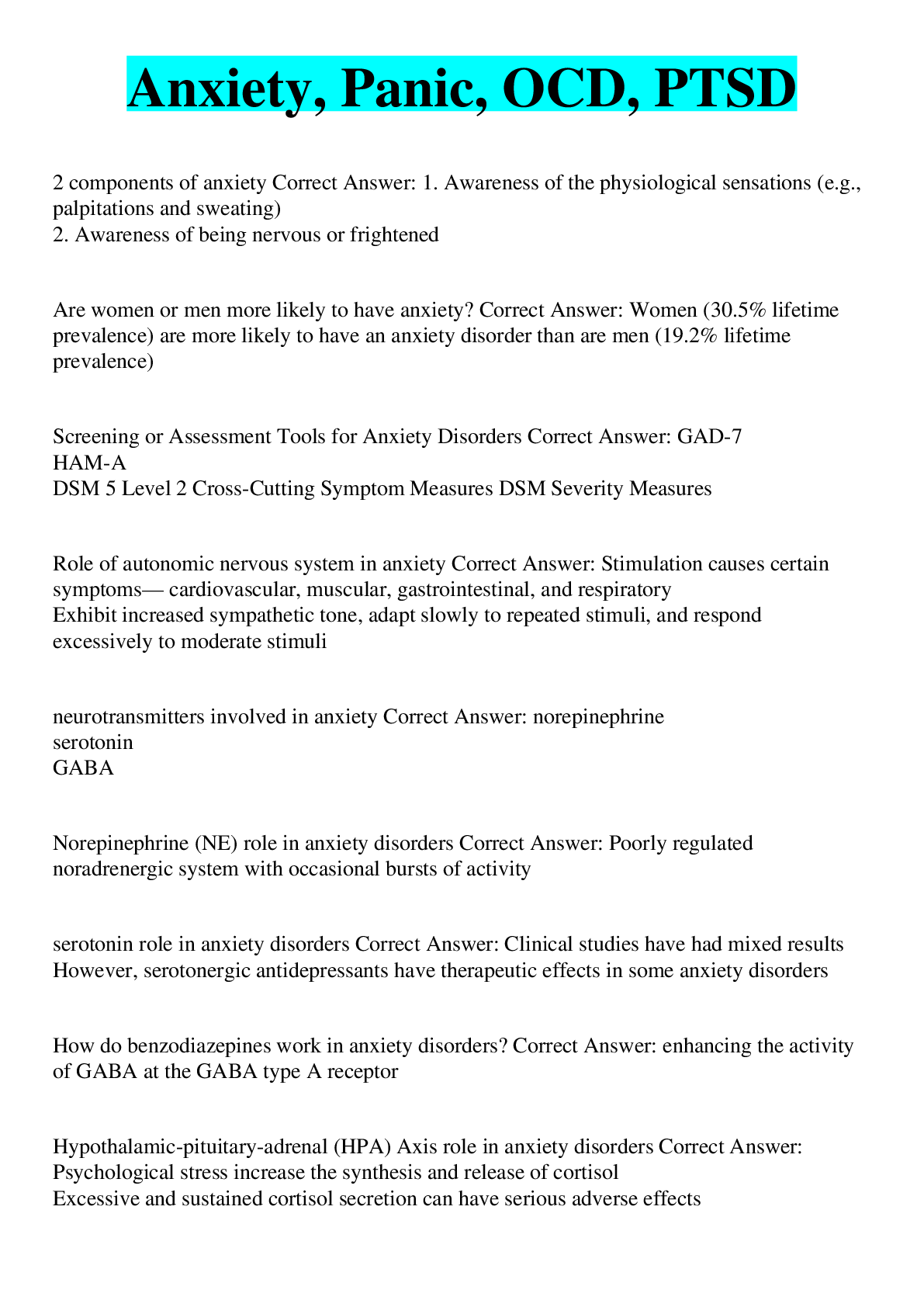
2 components of anxiety Correct Answer: 1. Awareness of the physiological sensations (e.g., palpitations and sweating)
2. Awareness of being nervous or frightened
Are women or men more
...
Anxiety, Panic, OCD, PTSD
2 components of anxiety Correct Answer: 1. Awareness of the physiological sensations (e.g., palpitations and sweating)
2. Awareness of being nervous or frightened
Are women or men more likely to have anxiety? Correct Answer: Women (30.5% lifetime prevalence) are more likely to have an anxiety disorder than are men (19.2% lifetime prevalence)
Screening or Assessment Tools for Anxiety Disorders Correct Answer: GAD-7
HAM-A
DSM 5 Level 2 Cross-Cutting Symptom Measures DSM Severity Measures
Role of autonomic nervous system in anxiety Correct Answer: Stimulation causes certain symptoms— cardiovascular, muscular, gastrointestinal, and respiratory
Exhibit increased sympathetic tone, adapt slowly to repeated stimuli, and respond excessively to moderate stimuli
neurotransmitters involved in anxiety Correct Answer: norepinephrine
serotonin
GABA
Norepinephrine (NE) role in anxiety disorders Correct Answer: Poorly regulated noradrenergic system with occasional bursts of activity
serotonin role in anxiety disorders Correct Answer: Clinical studies have had mixed results
However, serotonergic antidepressants have therapeutic effects in some anxiety disorders
How do benzodiazepines work in anxiety disorders? Correct Answer: enhancing the activity of GABA at the GABA type A receptor
Hypothalamic-pituitary-adrenal (HPA) Axis role in anxiety disorders Correct Answer: Psychological stress increase the synthesis and release of cortisol
Excessive and sustained cortisol secretion can have serious adverse effects
Corticotropin-releasing Hormone (CRH) role in anxiety disorders Correct Answer: coordinates the adaptive behavioral and physiological changes that occur during stress
Hypothalamic levels are increased by stress, resulting in activation of the HPA axis and increased release of cortisol and dehydroepiandrosterone (DHEA)
Brain Imaging studies have shown what brain changes in anxiety disorders? Correct Answer: Increased size of cerebral ventricles
abnormalities in frontal cortex, occipital and temporal areas
Brain area affected in panic disorder Correct Answer: parahippocampal gyrus abnormality
Brain area affected in OCD Correct Answer: caudate nucleus
Brain area affected in PTSD Correct Answer: increased activity in the amygdala, a brain region associated with fear
under-active medial prefrontal cortex and hippocampus
Neuroanatomical Considerations of the Limbic System in Anxiety Disorders Correct Answer: receives noradrenergic and serotonergic innervation, contains a high concentration of GABA A receptors, increased activity in the septohippocampal pathway, Cingulate gyrus
Neuroanatomical Considerations of the Cerebral Cortex in Anxiety Disorders Correct Answer: frontal area is connected with the parahippocampal region, the cingulate gyrus, and hypothalamus
2 core symptoms in anxiety Correct Answer: fear and worry
What is the key neurotransmitter involved in anxiety? Correct Answer: GABA
What is GABA? Correct Answer: Principal inhibitory neurotransmitter in the brain
What are the 3 major GABA receptor types? Correct Answer: A, B, C
Which GABA receptor type plays a critical role in mediating inhibitory neurotransmission as the target of benzos? Correct Answer: GABA A
DSM diagnostic criteria for separation anxiety disorder Correct Answer: Developmentally inappropriate and excessive fear or anxiety concerning separation from those to whom the individual is attached, as evidenced by at least three of the symptoms
Lasting at least 4 weeks in children and adolescents and typically 6 months or more in adults.
DSM diagnostic criteria for selective mutism Correct Answer: Consistent failure to speak in specific social situations in which there is an expectation for speaking despite speaking in other situations.
Duration of the disturbance is at least 1 month (not limited to the first month of school).
The failure to speak is not attributable to a lack of knowledge of, or comfort with, the spoken language required in the social situation.
What is a specific phobia? Correct Answer: Excessive fear of a specific object, circumstance, situation leading to avoidance or intense distress
commonly feared objects and situations: animals, storms, heights, illness, injury, death
DSM diagnostic criteria for specific phobia Correct Answer: Marked fear or anxiety about a specific object or situation (e.g., flying, heights, animals, receiving an injection, seeing blood). Note: In children, the fear or anxiety may be expressed by crying, tantrums, freezing, or clinging.
The phobic object or situation almost always provokes immediate fear or anxiety and is actively avoided or endured with intense fear or anxiety.
The fear or anxiety is out of proportion to the actual danger posed by the specific object or situation and to the sociocultural context.
Typically lasting for 6 months or more.
Specific phobia diagnostic specifiers Correct Answer: 1. Animal (e.g., spiders, insects, dogs).
2. Natural environment (e.g., heights, storms, water).
3. Blood-injection-injury (e.g., needles, invasive medical procedures). NOTE: Select specific fear of blood; fear of injections and transfusions; fear of other medical care; or fear of injury.
4. Situational (e.g., airplanes, elevators, enclosed places).
5. Other (e.g., situations that may lead to choking or vomiting; in children, e.g., loud sounds or costumed characters).
Treatments for specific phobias Correct Answer: behavior therapy, desensitization, anti-anxiety drugs, hypnosis, muscle relaxation, CBT, insight-oriented psychotherapy, virtual therapy, supportive psychotherapy, family therapy
What is the most studied and effective treatment for specific phobias? Correct Answer: Behavior Therapy, such as exposure therapy (desensitization)
What is social anxiety disorder or social phobia? Correct Answer: involves the fear of social situations
Patient is fearful of embarrassing themselves in social situations
May be performing specific activities or a vague, nonspecific fear of "embarrassing oneself"
Not fearful of the situation, rather potential embarrassment
DSM diagnostic criteria for social anxiety disorder Correct Answer: Marked fear or anxiety about one or more social situations in which the individual is exposed to possible scrutiny by others. Note: In children, the anxiety must occur in peer settings and not just during interactions with adults.
The individual fears that he or she will act in a way or show anxiety symptoms that will be negatively evaluated
The social situations almost always provoke fear or anxiety and are avoided or endured with intense fear or anxiety.
Typically lasting for 6 months or more.
Treatment for social anxiety disorder Correct Answer: Use of both pharmacotherapy and psychotherapy produces better results than either therapy alone
Pharmacotherapy: SSRIs; benzodiazepines; venlafaxine; buspirone; propronanlol
Psychotherapy:
Cognitive, behavioral, and exposure techniques are also useful in performance situations
Cognitive retraining, desensitization, rehearsal during sessions, homework assignments
What is panic disorder? Correct Answer: Acute intense attack of anxiety accompanied by feelings of impending doom or death
Characterized by discrete periods of intense fear that can vary from several attacks during one day to only a few attacks during a year
DSM diagnostic criteria for panic disorder Correct Answer: Recurrent unexpected panic attacks. A panic attack is an abrupt surge of intense fear or intense discomfort that reaches a peak within minutes, and during which time four (or more) symptoms occur
At least one of the attacks has been followed by 1 month (or more) of: Persistent concern or worry about additional panic attacks or their consequences AND/OR a significant maladaptive change in behavior related to the attacks
Potential symptoms of a panic attack Correct Answer: Palpitations, pounding heart, or accelerated heart rate
Chest pain or discomfort
Sweating, Chills or heat sensations
Trembling or shaking
Sensations of shortness of breath or smothering, Feelings of choking
Nausea or abdominal distress.
Feeling dizzy, unsteady, light-headed, or faint
Paresthesias (numbness or tingling sensations)
Derealization (feelings of unreality) or depersonalization (being detached from oneself)
Fear of losing control or "going crazy"
Fear of dying
Non-pharmacological treatment for panic disorder Correct Answer: Cognitive and Behavior Therapies
Is medication or CBT better treatment for panic disorder? Correct Answer: Conflicting research on which is superior—
Several studies and reports combination of the 2 is most effective
[Show More]


.png)


.png)