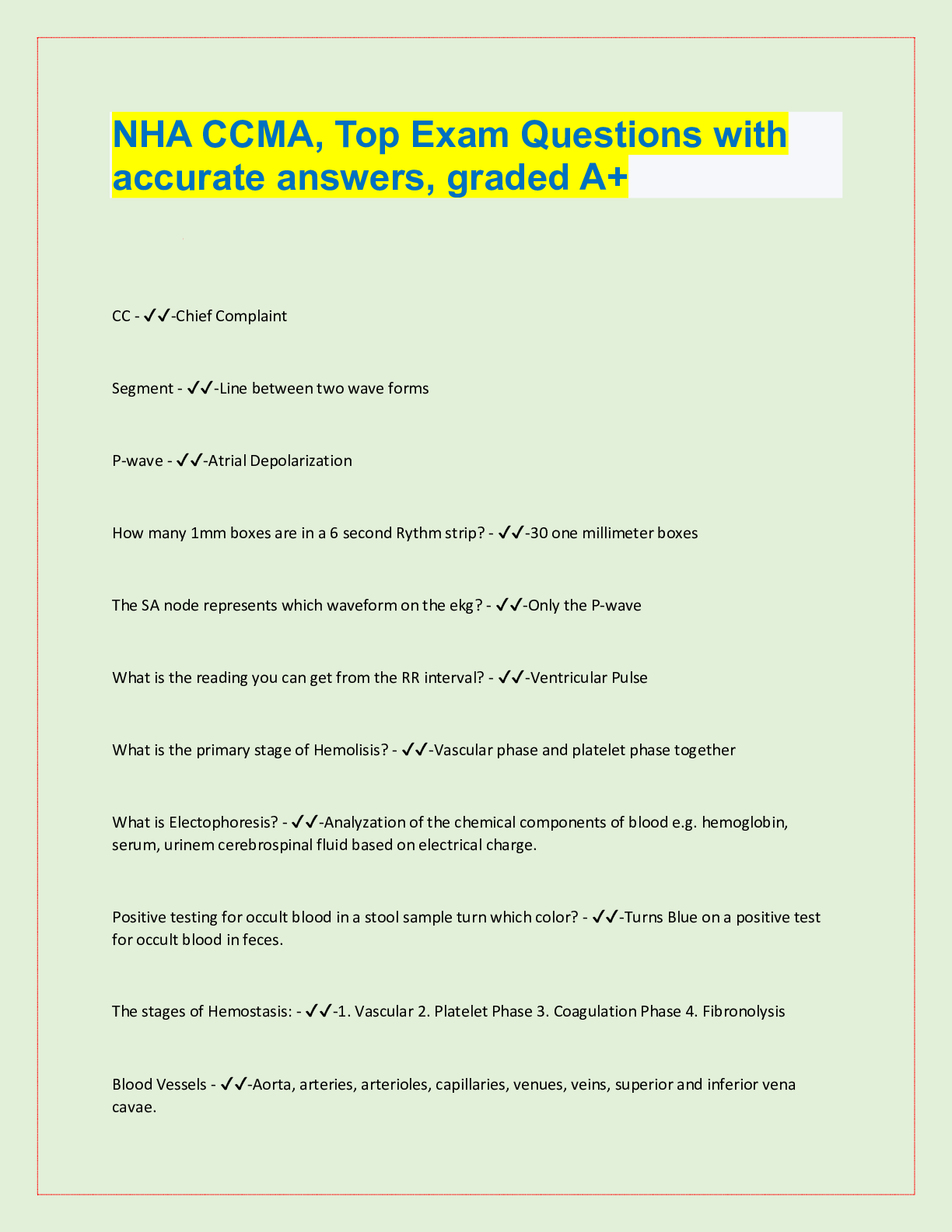
NHA CCMA, Questions with accurate answers, Graded A+. 2022/2023.
CC - ✔✔Chief Complaint
Segment - ✔✔Line between two wave forms
P-wave - ✔✔Atrial Depolarization
How many 1mm boxes are in a 6 second Rythm st
...
NHA CCMA, Questions with accurate answers, Graded A+. 2022/2023.
CC - ✔✔Chief Complaint
Segment - ✔✔Line between two wave forms
P-wave - ✔✔Atrial Depolarization
How many 1mm boxes are in a 6 second Rythm strip? - ✔✔30 one millimeter boxes
The SA node represents which waveform on the ekg? - ✔✔Only the P-wave
What is the reading you can get from the RR interval? - ✔✔Ventricular Pulse
What is the primary stage of Hemolisis? - ✔✔Vascular phase and platelet phase together
What is Electophoresis? - ✔✔Analyzation of the chemical components of blood e.g. hemoglobin, serum, urinem cerebrospinal fluid based on electrical charge.
Positive testing for occult blood in a stool sample turn which color? - ✔✔Turns Blue on a positive test for occult blood in feces.
The stages of Hemostasis: - ✔✔1. Vascular 2. Platelet Phase 3. Coagulation Phase 4. Fibronolysis
Blood Vessels - ✔✔Aorta, arteries, arterioles, capillaries, venues, veins, superior and inferior vena cavae.
Outer connective tissue layer of a blood vessel - ✔✔Tunica adventitia
Inner endothelial tissue layer of a blood vessel - ✔✔Tunica Intima
The inner smooth layer of a blood vessel - ✔✔Tunica media
The standards of right and wrong in a medical setting - ✔✔Code of Ethics
What do you find in capillaries? - ✔✔A mixture of venous and arterial blood is found
The average adult has how many liters of blood? - ✔✔5-6 liters
What is the percentage of water in blood? - ✔✔92%
Percentage of plasma in blood - ✔✔55%
Percentage of Formed Elements in the blood - ✔✔45%
99% of formed elements in blood - ✔✔RBC's or Erythrocytes
Where you find Hemoglobin - ✔✔RBC's
Where do all blood cells originate? - ✔✔Bone Marrow
How many RBC's per microliter of blood - ✔✔4.2-6.2 million
What is the second most numerous WBC? - ✔✔Lymphocyte with 20-40%
Their numbers increase in intracellular infections and TB - ✔✔Monocytes
Their numbers increase in bacterial infections and often are first on scene - ✔✔Neutrophils
These WBC's play an important role in viral infection as well as in immunity. - ✔✔Lymphocytes
Number of leukocytes for average adult per micrometer - ✔✔5000-10000
Leukopenia - ✔✔Decrease in WBC's seen with viral infection and leukemia
Comprises 3-8% of wbc or leukocytes - ✔✔Monocytes
Largest in size of the leukocytes - ✔✔Monocytes
Carries Histamine - ✔✔Basophil
Injury to a blood vessel that causes it to constrict, slowing the clot of blood - ✔✔Cascular phase of hemostasis
Preferred site for venipuncture - ✔✔Antecubital fossa
Test used to evaluate the intrinsic pathway and monitor heparin therapy - ✔✔APTT also know as PTT
Test used to evaluate the extrinsic pathway and also used to monitor warfarin therapy - ✔✔PT
Fibrinolysis - ✔✔Breakdown and removal of a clot
Converts the temorary platelet plug into a stable fibrin clot - ✔✔Coagulation phase
2nd choice vein for venipuncture most often the only one palpatable in an obese pt - ✔✔Cephalic vein
Antiseptics used in Phlebodtomy - ✔✔70% isopropyl alcohol pads most common, provolone iodine for bc, s and chlorhexidine gluconate for patients that are allergic to betadine/ iodine
Length of needle commonly used in venipuncture - ✔✔1 ince (up to 1.5")
Guage of needle that can cause hemolysis - ✔✔Smaller than 23 guage
Average gauge of needle used for drawing blood - ✔✔21-22
3 skills of the phlebotomist - ✔✔social, clerical, technical
Analytical errors during collection of blood - ✔✔extended tourniquet time, hemolysis, wrong order of draw, failure to invert tubes, faulty technique under filling tubes
Analytical errors before collection of blood - ✔✔Patient misidentification, improper time, wrong tube, not fasting, exercise (cortisol levels), PT posture, poor coordination with other treatments, improper side prep, medication interference
Analytical errors after blood collection - ✔✔Failure to separate serum from cell (glycolisis), improper use of serum separator (not inverting tubes or not spinning tubes) delays in processing, exposure to light, improper storage conditions, dimming clots
Fistula - ✔✔Permanent surgical connection between an artery and a vein, never used for venipuncture
Edima - ✔✔Accumulation of fluid in tissue
Thrombophlebitis - ✔✔Inflammation of a vein with a clot formation
Explanation of Hemoconcentration - ✔✔The increase in proportion of formed elements to plasma caused by leaving on the tourniquet for more than two minutes
Consequence of insufficient pressure applied after withdrawal of needle - ✔✔Thrombus
additives in green top tube - ✔✔heparin, sodium, litium, ammonium
Why is the green top tube never used for hematology - ✔✔Green tops additive heparin interferes with the Wright's stained blood test
Common tests for the lifht blue sodium citrate tube - ✔✔Coagulation studies, PT (extrinsic, warfarin) APTT, PTT (intrinsic, heparin) TT, BT, FDP
Common tests for the lavendar edta tube - ✔✔CBC, differential or diff., ESR, sickle cell screening
Common tests for this color tube are chemistry tests performed on plasuma such as Ammonia, carboxyhemoglobin and STAT electrolytes - ✔✔Green top tube (heparin) Tests
How long does it take for blood to clot by normal coagulation process in the red top tube? - ✔✔30-60 mins
The primary purpose is to provide reliable data about a patients health status by ensuring the accuracy of a test while detecting and eliminating error - ✔✔What is quality control
Common test for the red topped tube - ✔✔Serum chemistry tests, serology tests, blood bank (glass only)
Order of draw for cappilary specimens - ✔✔lavender first, then tubes with other additives, then tubes with out additives
[Show More]