*NURSING > QUESTIONS & ANSWERS > NHA CCMA 2021 Questions with accurate answers, 100% pass rate. (All)
NHA CCMA 2021 Questions with accurate answers, 100% pass rate.
Document Content and Description Below
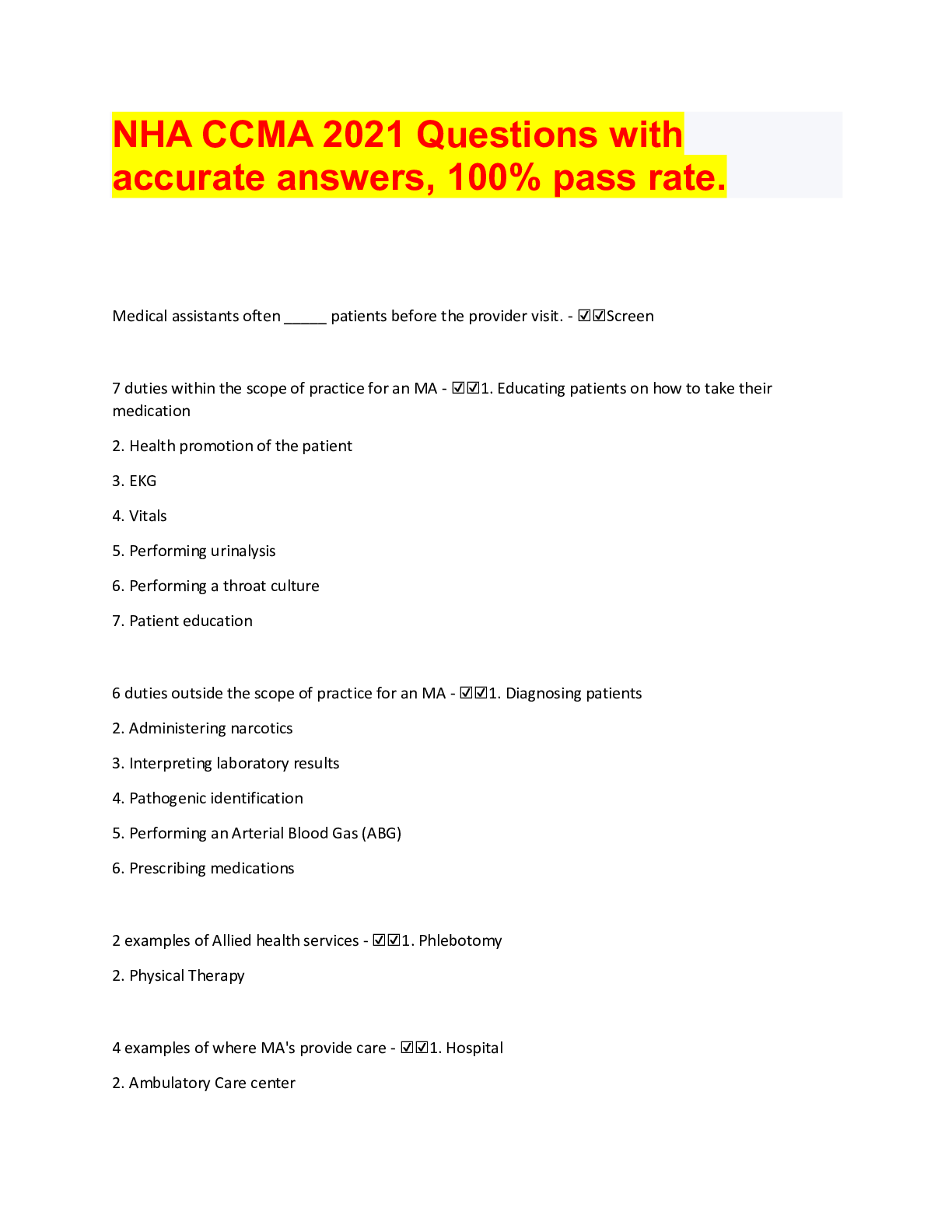
NHA CCMA 2021 Questions with accurate answers, 100% pass rate. Medical assistants often _____ patients before the provider visit. - ☑☑Screen 7 duties within the scope of practice for an ... MA - ☑☑1. Educating patients on how to take their medication 2. Health promotion of the patient 3. EKG 4. Vitals 5. Performing urinalysis 6. Performing a throat culture 7. Patient education 6 duties outside the scope of practice for an MA - ☑☑1. Diagnosing patients 2. Administering narcotics 3. Interpreting laboratory results 4. Pathogenic identification 5. Performing an Arterial Blood Gas (ABG) 6. Prescribing medications 2 examples of Allied health services - ☑☑1. Phlebotomy 2. Physical Therapy 4 examples of where MA's provide care - ☑☑1. Hospital 2. Ambulatory Care center 3. Home health agency 4. Hospice Dep't of labor predicts that the MA field will (grow/drop) 23% from 214 to 2024. This is much (faster/slower) than normal. - ☑☑grow; faster 4 additional certifications for MA's - ☑☑1. CPT (Certified Phlebotomy Tech) 2. CET (Certified EKG Tech) 3. CBCS (Certified Billing & Coding Specialist) 4. CEHRS (Certified Electronic Health Records Specialist) Health case licensure is regulated by (state, federal, international) statutes. - ☑☑State Medical assistants are required to be: a. licensed b. certified c. both d. neither - ☑☑d. neither No state requires MA licensure (though it may be required for extended services such as X-ray). Certification is generally optional, but some states may require it.) Health care ________ is the organization of individuals, establishments, and resources to deliver health care services and meet the needs of specific populations. - ☑☑Delivery What is the payment model in health care? - ☑☑It issues a single bundled payment to providers or health care facilities for all services rendered to treat a given condition or provide a given treatment. Groups of physicians, hospitals, and other health care providers come together voluntarily to provide coordinated high-quality care to their *Medicare* patients. When succeeding in delivering high-quality care and spending health dollars wisely, they will share in the savings it achieves for the Medicare program. - ☑☑Accountable Care Organizations (ACOs) In this payment model, patients are assigned a per-member, per-month payment based on their age race, sex, lifestyle, medical Hx, and benefit design. Payment rates are tied to expected use regardless of how often the patient visits. - ☑☑Capitation (partial or full) A fixed dollar amount paid annually for all care. Participating providers can determine how money is spent. This model limits the level and the rate of increase of health care cost. There is typically a quality component as well. - ☑☑Global budget This plan contracts with a medical center or group of providers to provide preventative and acute care for the insured person. They generally require referrals to specialists, as well as precertification and preauthorization for hospital admissions, outpatient procedures, and treatments. - ☑☑Health Maintenance Organization (HMO) In this care delivery model, a primary care provider (PCP) coordinates treatment to make sure patients receive the required care when and where they need it., and in a way they can understand. - ☑☑Patient-centered Medical Home (PCMH) This reimbursement model compensates providers only if they meet certain measures for quality and efficiency. Generating quality benchmark measures connects provider reimbursement directly to the quality of care they provide. - ☑☑Pay-for-performance What is an ancillary service? - ☑☑An ancillary service meets a specific medical need for a specific population. e.g. Urgent care, lab, imaging 3 examples of alternative therapies - ☑☑1. Acupuncture 2. Chiropractic 3. Dietary supplements A form provided to the patient when the provider believes Medicare will probably not pay for services received. - ☑☑Advance beneficiary notice (ABN) The maximum amount a third-party payer will pay for a particular procedure or service. - ☑☑Allowed Amount An amount of money that is paid at the time of medical service - ☑☑Copayment A specific amount of money a patient must pay out of pocket before the insurance begins paying. - ☑☑Deductible A statement from the insurance carrier detailing what was paid, denied, or reduced in payment. Also contains info about amounts applied to the deductible, coinsurance, and allowed amounts. - ☑☑Explanation of Benefits (EOB) Providers who agree to write off the difference between the amount charged by the provider and the approved fee established by the insurer. - ☑☑Participating Provider (PAR) Type of insurance which generally covers patients who are 65+ and/or disabled. - ☑☑Medicare - Part A (Hospitalization) & Part B (Routine Visits) Type of insurance which authorizes dependents of military personnel to receive treatment from civilian providers at the expense of the federal government. - ☑☑Tricare Type of insurance which covers surviving spouses and dependent children of veterans who died as a result of service-related disabilities. - ☑☑CHAMPVA Umbrella term for type of insurance plan which provides healthcare in return for preset scheduled patients and coordinated care through a defined network of providers and hospitals. - ☑☑Managed Care Type of insurance which protects wage earners against the loss of wages and the cost of medical care resulting from an occupational accident/disease as long as the employee is not proven negligent. - ☑☑Workers' Compensation This type of insurance is flexible and allows pts to go directly to specialists without being referred. Pts can see any provider, but provider in-network usually cost less. - ☑☑Preferred Provider Organization (PPO) What is the most commonly-used health insurance claim form? - ☑☑CMS-1500 What are the three sections of the CMS-1500 form? - ☑☑- Section 1: Carrier Block - Section 2: Patient/Insured Section - Section 3: Physician/Supplier Section Medicare/Medicaid claims must be filed to the appropriate carrier no later then ___ months after the date of service. - ☑☑12 CPOE - ☑☑Computerized Physician Order Entry - a process of electronic data entry of provider instructions for treatment Allopathic - ☑☑Homeopathic medicine; categorized by an effort to counteract the symptoms of a disease by administration of treatments that produce effects opposite to the symptoms. Scope of Practice - ☑☑Delegated clinical and administrative duties consistent with education, training, and experience. Contralateral - ☑☑On the opposite side of the body from another structure (Contra - against or in opposition to; Lateral - Side) BE - ☑☑Barium Enema BKA - ☑☑Below-the-knee Amputation bx - ☑☑Biopsy c̅ - ☑☑With C&S - ☑☑Culture & Sensitivity CXR - ☑☑Chest X-ray FUO - ☑☑Fever of Unknown Origin Abbreviations for before meals / after meals - ☑☑Before: ac After: pc ab- versus ad- - ☑☑ab- : away from ad-: toward caudal - ☑☑tail dorsal recumbent - ☑☑lying on back with legs bent and feet flat ung - ☑☑ointment PR - ☑☑rectally MDI - ☑☑metered dose inhaler N/V - ☑☑nausea and vomiting What is the function of anticholinergics? - ☑☑Reduce bronchospasm Schedule ___ Substances: - High potential for abuse - Illegal; may not be prescribed - e.g. Heroin, cannabis, LSD - ☑☑I (One) Schedule ___ Substances: - High potential for abuse - Considered dangerous & may lead to dependence - e.g. Morphine, Methadone, Oxycodone - Rx must be handwritten & No refills - Must be stored separate from other meds - ☑☑II (Two) Schedule ___ Substances: - Moderate to low potential for dependence - e.g. Ketamine, steroids, testosterone - Rx must be handwritten; can be refilled 5x in 6 mths - ☑☑III (Three) Schedule ___ Substances: - Low potential for abuse & dependence - e.g. Diazepam, alprazolam - Rx must be signed by provider but staff may authorize over phone; Can refill 5x in 6 mths - ☑☑IIII (Four) Schedule ___ Substances: - Includes substances which may contain limited quantities of some narcotics - e.g. Pregabalin - Rx must be signed by provider but staff may authorize over phone; Can refill 5x in 6 mths - ☑☑V (Five) Medication: -Therapeutic Effects -Side effects -Adverse event -Contraindication - ☑☑-The good effects a medication is prescribed for (indication) - Undesirable/unintended actions on the body - Unintended harmful action (e.g. Allergic reaction) - A symptom or condition that makes a particular med inadvisable What does a hematocrit measure? - ☑☑Percentage of red blood cells in a sample of blood. TIA - ☑☑Transient ischemic attack (mini stroke) - a temporary interruption of blood flow to the brain Enteral vs Parenteral - ☑☑Enternal: Meds given thru the GI Tract (e.g. by mouth) Parenteral: Meds given outside the GI tract (e.g. Intravenous, intramuscular, subcutaneous, sublingual, rectal, topical, inhalation) Pharmacokinetics - ☑☑The study of how medications move through the body 4 actions of pharmacokinetics - ☑☑1. Absorption 2. Distribution 3. Metabolism 4. Excretion Pharmacokinetics: Absorption - ☑☑Through the process of absorption, the body converts the medication into a form the body can use and moves it into the bloodstream. Process varies with route. Pharmacokinetics: Distribution - ☑☑Distribution is the transportation of the medication throughout the body. The bloodstream carried the medication to the body's tissues and organs. Pharmacokinetics: Metabolism - ☑☑Metabolism changes active forms of the medications into harmless metabolites ready for excretion through urine or feces. The liver is the primary organ of metabolism. Pharmacokinetics: Excretion - ☑☑Excretion is the removal of medication's metabolites from the body. The kidneys accomplish most of this through urine. Therapeutic Range - ☑☑The amount of medication the body must have available to produce the desirable effects for which the provider prescribed it. 7 Rights of Medication Adminsitration - ☑☑1. Right patient 2. Right medication 3. Right dose 4. Right time 5. Right route 6. Right technique 7. Right documentation Formula method of calculating medication dose - ☑☑Desired/Have x Quantity = X What does it mean if a nutrient is "essential"? - ☑☑The body cannot produce these nutrients on its own. Which three nutrients contain calories/provide energy? - ☑☑Proteins, Carbs, Lipids (Fats) Basal Metabolism - ☑☑The amount of energy necessary for maintaining life-sustaining activities for a specific period of time. BMI range for: 1. Underweight 2. Health weight 3. Overweight 4. Obese - ☑☑1. Underweight - < 18.5 2. Health weight - 18.5 - 24.9 3. Overweight - 25.0 - 29.9 4. Obese - 30.0+ Formula for calculating BMI - ☑☑Mass/Height^2 --> kg/m^2 Hyponatremia - ☑☑low sodium in the blood Benefits of Proteins - ☑☑- Function as building blocks for body (for bones, muscles, skin, cartilage, blood, etc.) - Many provide iron which helps carry oxygen in the blood - Seafood provides omega-3 fatty acids which help reduce risk of heart disease Number of calories in: - Protein - Carbs - Fat - Fiber - ☑☑- Protein: 4 - Carbs: 4 - Fat: 9 - Fiber: 0 Most important nutrient & function - ☑☑Water; transports nutrients & oxygen, helps remove waste, regulates body temp thru sweating, basic component of blood/other fluids ________ are large, complex molecules the body makes from amino acids, which are the natural compounds that plants and animal foods contain. There are ___ types. - ☑☑Proteins; 3 What are the three types of amino acids and how many are there total? - ☑☑1. Essential (Body cannot produce) 2. Nonessential (Body can make) 3. Conditional (Not usually essential but may become so when the body is stressed/ill) - There are 20 total amino acids; the body needs all 20 for optimal functioning. What is a complete protein? - ☑☑A protein that contains all 9 essential amino acids What is the only non-animal complete protein? - ☑☑Soy ________ are organic compounds that combine carbon, oxygen, and hydrogen into sugar molecules and come primarily from plant sources. The two types are _____ & _____. - ☑☑Carbohydrates Simple sugars (honey, glucose), Complex carbs (Starch, Fiber) How does the body use protein/amino acids? - ☑☑To repair and build tissues How does the body use carbohydrates? - ☑☑Primarily for energy for cells and their functions _______ is the simple sugar the bod requires for energy needs. - ☑☑Glucose Excess glucose is stored in the _____ as _____, and becomes _______. - ☑☑-Liver; glycogen -Body fat ________ are a highly concentrates source of energy that the body can use as backup for available glucose. - ☑☑Fats/lipids Three types of fatty acids and effects on cholesterol: - ☑☑1. Unsaturated; less potential to raise cholesterol (Monounsaturated - e.g. olive oil & polyunsaturated - e.g. Corn oil) 2. Trans fat; raises LDL 3. Saturated fat; raises LDL How does the body use fats? - ☑☑Essential for the absorption of fat-soluble vitamins, structure for cell membranes, promote growth, health skin, assist with protein functions, hormone formation, insulate & protect organs _______ is a complex carbohydrate that humans cannot digest. - ☑☑Fiber What is the function of fiber? - ☑☑Slows digestion, provides feeling of fullness, adds bulk to stool, absorbs some wastes, lowers cholesterol, slows glucose absorption Sources of fiber - ☑☑Beans, whole grains, brown rice, nuts, berries, vegetables ________ are organic substances the body needs for various cellular functions. - ☑☑Vitamins What are the (4) fat soluble vitamins? - ☑☑D, E, A, K What are the (9) water soluble vitamins? - ☑☑B1, B2, B3, B6, B12, folate, biotin, C, pantothenic acid Vitamin A - Name, function, source - ☑☑Retinol Night vision, cell growth, maintenance of skin/mucous membranes Milk fat, meat, butter, leafy veggies, fish oil, yellow/orange fruits Vitamin B1 - Name, function, source - ☑☑Thiamine Carb metabolism, heart/nerve/muscle function Whole grains, meat, legumes, nuts, seeds, yeast, rice Vitamin B2 - Name, function, source - ☑☑Riboflavin Fat & protein metabolism Organ meat, dairy, fortified grains, green leafy veggies, eggs Vitamin B3 - Name, function, source - ☑☑Niacin Carb/Fat metabolism Fish, meet, poultry, fortified grains Vitamin B6 - Name, function, source - ☑☑Pyridoxine Enzyme assistance in amino acid synthesis Fish, meat, poultry, grains, nuts, beans, legumes, avocados, bananas, prunes Vitamin B12 - Name, function, source - ☑☑Cobalamins Protein & fat metabolism, Nerve cell maintenance, cell development Meats, seafood, dairy products, eggs, molasses, yeast Vitamin Biotin - Name, function, source - ☑☑Biotin Carb/protein/fat metabolism Liver, cereals, grains, yeast, legumes Vitamin C - Name, function, source - ☑☑Ascorbic acid Immunity, iron absorption, structure of bones/muscle/blood vessels Berries, citrus fruits, green peppers, mangoes, broccoli, potatoes, cauliflower, tomatoes Vitamin D - Name, function, source - ☑☑Calciferol [Show More]
Last updated: 3 years ago
Preview 1 out of 37 pages
Buy this document to get the full access instantly
Instant Download Access after purchase
Buy NowInstant download
We Accept:

Also available in bundle (1)
Click Below to Access Bundle(s)

CCMA Bundle, top Exam Papers
Down load this bundle for easy revisions. ALL LATEST VERSIONS, OVER 2000 EXAM QUESTIONS WITH ACCURATE ANSWERS, VERIFIED.
By bundleHub Solution guider 2 years ago
$32
57
Reviews( 0 )
$9.00
Can't find what you want? Try our AI powered Search
Document information
Connected school, study & course
About the document
Uploaded On
Sep 19, 2022
Number of pages
37
Written in
All
Seller

Reviews Received
Additional information
This document has been written for:
Uploaded
Sep 19, 2022
Downloads
0
Views
203