AHIP All STUDY GUIDE, 2022 QUESTIONS (all
modules answered verified)
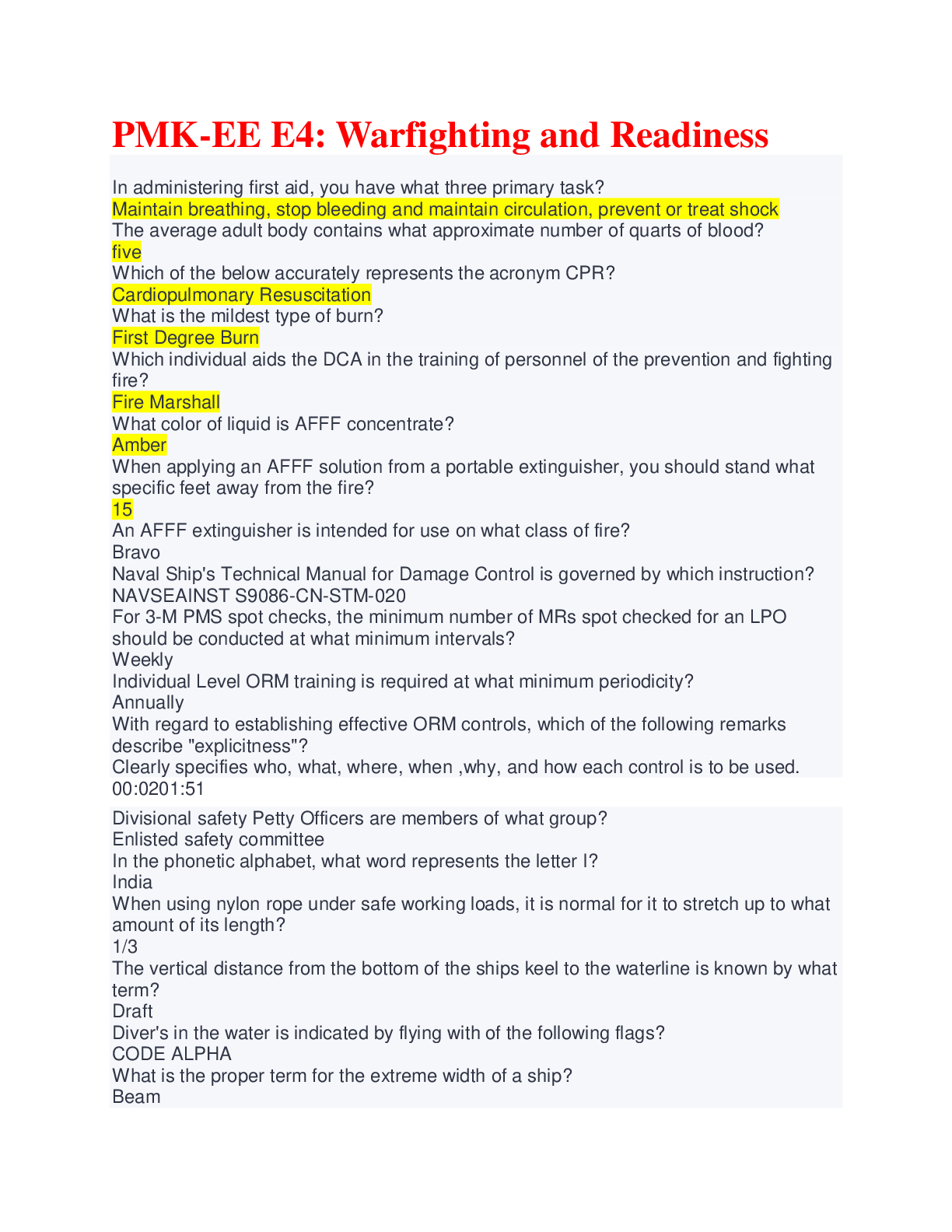
Ms. Moore plans to retire when she turns 65 in a few months. She is in excellent health
and will have considerable income when she retires.
She is
...
AHIP All STUDY GUIDE, 2022 QUESTIONS (all
modules answered verified)
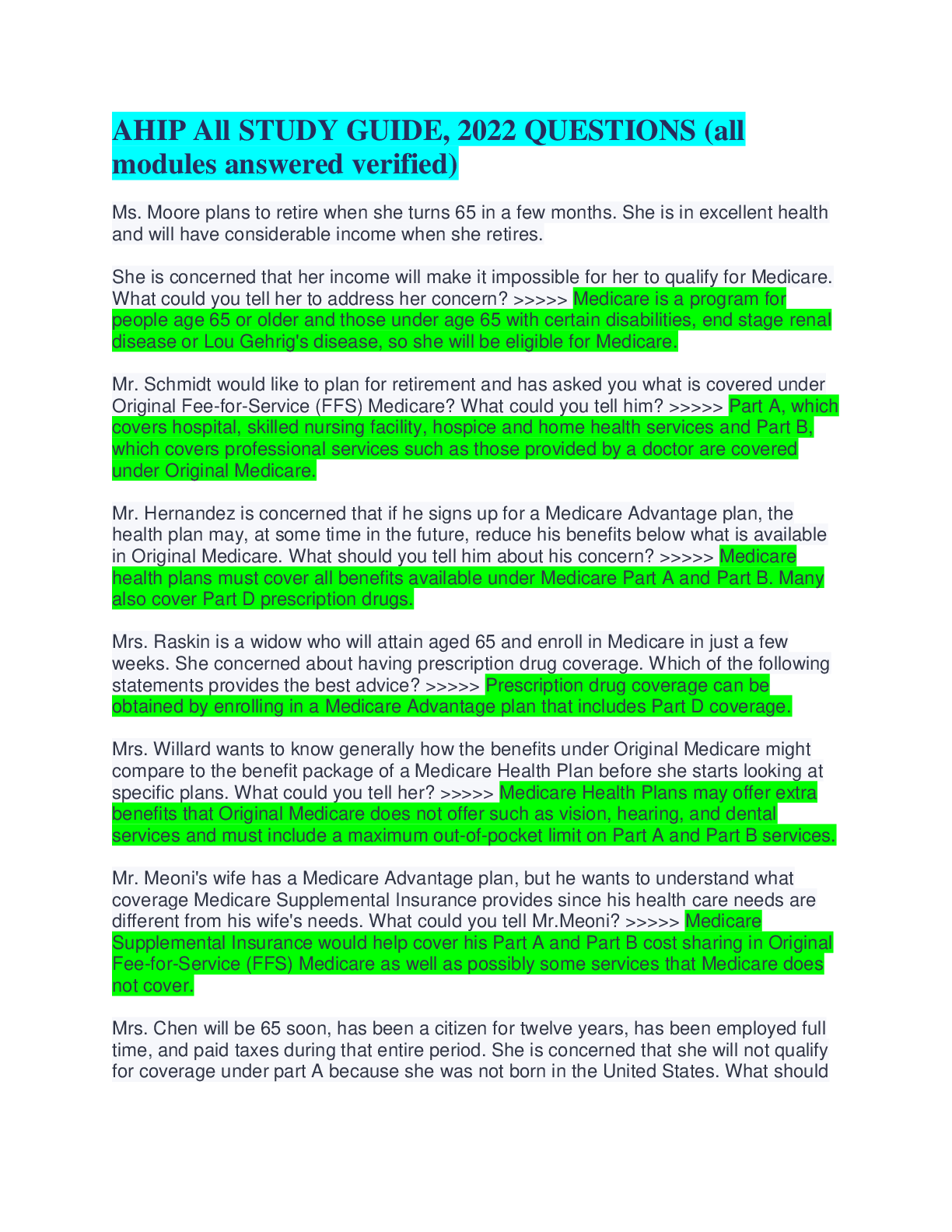
Ms. Moore plans to retire when she turns 65 in a few months. She is in excellent health
and will have considerable income when she retires.
She is concerned that her income will make it impossible for her to qualify for Medicare.
What could you tell her to address her concern? >>>>> Medicare is a program for
people age 65 or older and those under age 65 with certain disabilities, end stage renal
disease or Lou Gehrig's disease, so she will be eligible for Medicare.
Mr. Schmidt would like to plan for retirement and has asked you what is covered under
Original Fee-for-Service (FFS) Medicare? What could you tell him? >>>>> Part A, which
covers hospital, skilled nursing facility, hospice and home health services and Part B,
which covers professional services such as those provided by a doctor are covered
under Original Medicare.
Mr. Hernandez is concerned that if he signs up for a Medicare Advantage plan, the
health plan may, at some time in the future, reduce his benefits below what is available
in Original Medicare. What should you tell him about his concern? >>>>> Medicare
health plans must cover all benefits available under Medicare Part A and Part B. Many
also cover Part D prescription drugs.
Mrs. Raskin is a widow who will attain aged 65 and enroll in Medicare in just a few
weeks. She concerned about having prescription drug coverage. Which of the following
statements provides the best advice? >>>>> Prescription drug coverage can be
obtained by enrolling in a Medicare Advantage plan that includes Part D coverage.
Mrs. Willard wants to know generally how the benefits under Original Medicare might
compare to the benefit package of a Medicare Health Plan before she starts looking at
specific plans. What could you tell her? >>>>> Medicare Health Plans may offer extra
benefits that Original Medicare does not offer such as vision, hearing, and dental
services and must include a maximum out-of-pocket limit on Part A and Part B services.
Mr. Meoni's wife has a Medicare Advantage plan, but he wants to understand what
coverage Medicare Supplemental Insurance provides since his health care needs are
different from his wife's needs. What could you tell Mr.Meoni? >>>>> Medicare
Supplemental Insurance would help cover his Part A and Part B cost sharing in Original
Fee-for-Service (FFS) Medicare as well as possibly some services that Medicare does
not cover.
Mrs. Chen will be 65 soon, has been a citizen for twelve years, has been employed full
time, and paid taxes during that entire period. She is concerned that she will not qualify
for coverage under part A because she was not born in the United States. What shouldyou tell her? >>>>> Most individuals who are citizens and over age 65 are covered
under Part A by virtue of having paid
Medicare taxes while working, though some may be covered as a result of paying
monthly premiums.
Mr. Bauer is 49 years old, but eighteen months ago he was declared disabled by the
Social Security Administration and has been receiving disability payments. He is
wondering whether he can obtain coverage under Medicare. What should you tell him?
>>>>> After receiving such disability payments for 24 months, he will be automatically
enrolled in Medicare, regardless of age.
Mr. Davis is 49 years old and has been receiving disability benefits from the Social
Security Administration for 12 months. Can you sell him a Medicare Advantage or Part
D Prescription Drug policy? >>>>> No, he cannot purchase a Medicare Advantage or
Part D policy because he has not received Social Security or Railroad Retirement
disability benefits for 24 months.
Ms. Henderson believes that she will qualify for Medicare coverage when she turns 65,
without paying any premiums, because she has been working for 40 years and paying
Medicare taxes.
What should you tell her? >>>>> In order to obtain Part B coverage, she must pay a
standard monthly premium, though it is higher for
individuals with higher incomes.
Mr. Diaz continued working with his company and was insured under his employer's
group plan until he reached age 68. He has heard that there is a premium penalty for
those who did not sign up for Part B when first eligible and wants to know how much he
will have to pay. What should you tell him? >>>>> Mr. Diaz will not pay any penalty
because he had continuous coverage under his employer's plan.
Mrs. Peňa is 66 years old, has coverage under an employer plan and will retire next
year. She heard she must enroll in Part B at the beginning
of the year to ensure no gap in coverage. What can you tell her? >>>>> She may enroll
at any time while she is covered under her employer plan, but she will have a special
eight month enrollment period that differs from the standard general enrollment period,
during which she may enroll in Medicare Part B.
Mrs. Kelly is entitled to Part A, but is not yet enrolled in Part B. She is considering
enrollment in a Medicare health plan. What should you advise her to do before she will
be able to enroll into a Medicare health plan? >>>>> In order to join a Medicare health
plan, she also must enroll in Part B.
Mrs. Park has a low, fixed income. What could you tell her that might be of assistance?
>>>>> She should contact her state Medicaid agency to see if she qualifies for one of
several programs that can help with Medicare costs for which she is responsible.Mr. Yu has limited income and resources so you have encouraged him to see if he
qualifies for some type of financial assistance. Mr. Yu is not sure it is worth the trouble
to apply and wants to know what the assistance could do for him if he qualifies. What
could you tell him? >>>>> He might qualify for help with Part D prescription drug costs
and help paying Part A and/or Part B premiums, deductibles, and/or cost sharing.
Mr. Patel is in good health and is preparing a budget in anticipation of his retirement
when he turns 66. He wants to understand the health care costs he might be exposed to
under Medicare if he were to require hospitalization as a result of an illness. In general
terms, what could you tell him about his costs for inpatient hospital services under
Original Medicare? >>>>> Under Original Medicare, there is a single deductible amount
due for the first 60 days of any inpatient
hospital stay, after which it converts into a per-day amount through day 90. After day 90,
he would pay a daily
amount up to 60 days over his lifetime, after which he would be responsible for all costs
Mrs. Shields is covered by Original Medicare. She sustained a hip fracture and is being
successfully treated for that condition. However, she and her physicians feel that after
her lengthy hospital stay she will need a month or two of nursing and rehabilitative care.
What should you tell them about Original Medicare's coverage of care in a skilled
nursing facility? >>>>> Medicare will cover Mrs. Schmidt's skilled nursing services
provided during the first 20 days of her stay, after which she would have a coinsurance
until she has been in the facility for 100 days.
Mr. Rainey is experiencing paranoid delusions and his physician feels that he should be
hospitalized. What should you tell Mr. Rainey (or his representative) about the length of
an inpatient psychiatric hospital stay that Medicare will cover? >>>>> Medicare will
cover a total of 190 days of inpatient psychiatric care during Mr. Rainey's entire lifetime.
Mrs. Quinn has just turned 65 and received a letter informing her that she has been
automatically enrolled in Medicare Part B. She wants to understand what this means.
What should you tell Mrs. Quinn? >>>>> Part B primarily covers physician services. She
will be paying a monthly premium and, with the exception of many preventive and
screening tests, generally will have 20% co-payments for these services, in addition to
an
annual deductible.
Mr. Buck has several family members who died from different cancers. He wants to
know if Medicare covers cancer screening. What should you tell him? >>>>> Medicare
covers periodic performance of a range of screening tests that are meant to provide
early detection of disease. Mr. Buck will need to check specific tests before obtaining
them to see if they will be covered.
Mrs. Turner is comparing her employer's retiree insurance to Original Medicare and
would like to know which of the following services Original Medicare will cover if theappropriate criteria are met? What could you tell her? >>>>> Original Medicare covers
ambulance services.
Mrs. Wolf wears glasses and dentures and has enjoyed considerable pain relief from
arthritis through acupuncture. She is concerned about whether or not Medicare will
cover these items and services. What should you tell her? >>>>> Medicare does not
cover acupuncture, or, in general, glasses or dentures.
Mr. Hernandez is concerned that if he signs up for a Medicare Advantage plan, the
health plan may, at some
time in the future, reduce his benefits below what is available in Original Medicare. What
should you tell him about his concern? >>>>> Medicare health plans must cover all
benefits available under Medicare Part A and Part B. Many also cover Part D
prescription drugs.
Mr. Schmidt would like to plan for retirement and has asked you what is covered under
Original Fee-for-Service (FFS) Medicare? What could you tell him? >>>>> Part A, which
covers hospital, skilled nursing facility, hospice and home health services and Part B,
which covers professional services such as those provided by a doctor are covered
under Original Medicare.
Mr. Wu is eligible for Medicare. He has limited financial resources but failed to qualify
for the Part D low-income
subsidy. Where might he turn for help with his prescription drug costs? >>>>> Mr. Wu
may still qualify for help in paying Part D costs through his State Pharmaceutical
Assistance Program.
Mrs. Willard wants to know generally how the benefits under Original Medicare might
compare to the benefit
package of a Medicare Health Plan before she starts looking at specific plans. What
could you tell her? >>>>> Medicare Health Plans may offer extra benefits that Original
Medicare does not offer such as vision, hearing, and dental services and must include a
maximum out-of-pocket limit on Part A and Part B services.
Mrs. Wolf wears glasses and dentures and has enjoyed considerable pain relief from
arthritis through
acupuncture. She is concerned about whether or not Medicare will cover these items
and services. What should you tell her? >>>>> Medicare does not cover acupuncture,
or, in general, glasses or dentures.
Mr. Bauer is 49 years old, but eighteen months ago he was declared disabled by the
Social Security Administration and has been receiving disability payments. He is
wondering whether he can obtain coverage under Medicare. What should you tell him?
>>>>> After receiving such disability payments for 24 months, he will be automatically
enrolled in Medicare, regardless of age.Mrs. Quinn has recently turned 66 and decided after many years of work to begin
receiving Social Security benefits. Shortly thereafter Mrs. Quinn received a letter
informing her that she has been automatically enrolled in Medicare Part B. She wants to
understand what this means. What should you tell Mrs. Quinn? >>>>> Part B primarily
covers physician services. She will be paying a monthly premium and, with the
exception of many preventive and screening tests, generally will have 20% co-payments
for these services, in addition to an annual deductible.
Mrs. Lyons is in good health, uses a single prescription, and lives independently in her
own home. She is attracted by the idea of maintaining control over a Medical Savings
Account (MSA), but is not sure if the plan associated with the account will fit her needs.
What specific piece of information about a Medicare MSA plan would it be important for
her to know, prior to enrolling in such a plan? >>>>> All MSAs cover Part A and Part B
benefits, but not Part D prescription drug benefits, which could be obtained by also
enrolling in a separate prescription drug plan.
Mr. Diaz continued working with his company and was insured under his employer's
group plan until he reached
age 68. He has heard that there is a premium penalty for those who did not sign up for
Part B when first eligible
and wants to know how much he will have to pay.
What should you tell him? >>>>> Mr. Diaz will not pay any penalty because he had
continuous coverage under his employer's plan.
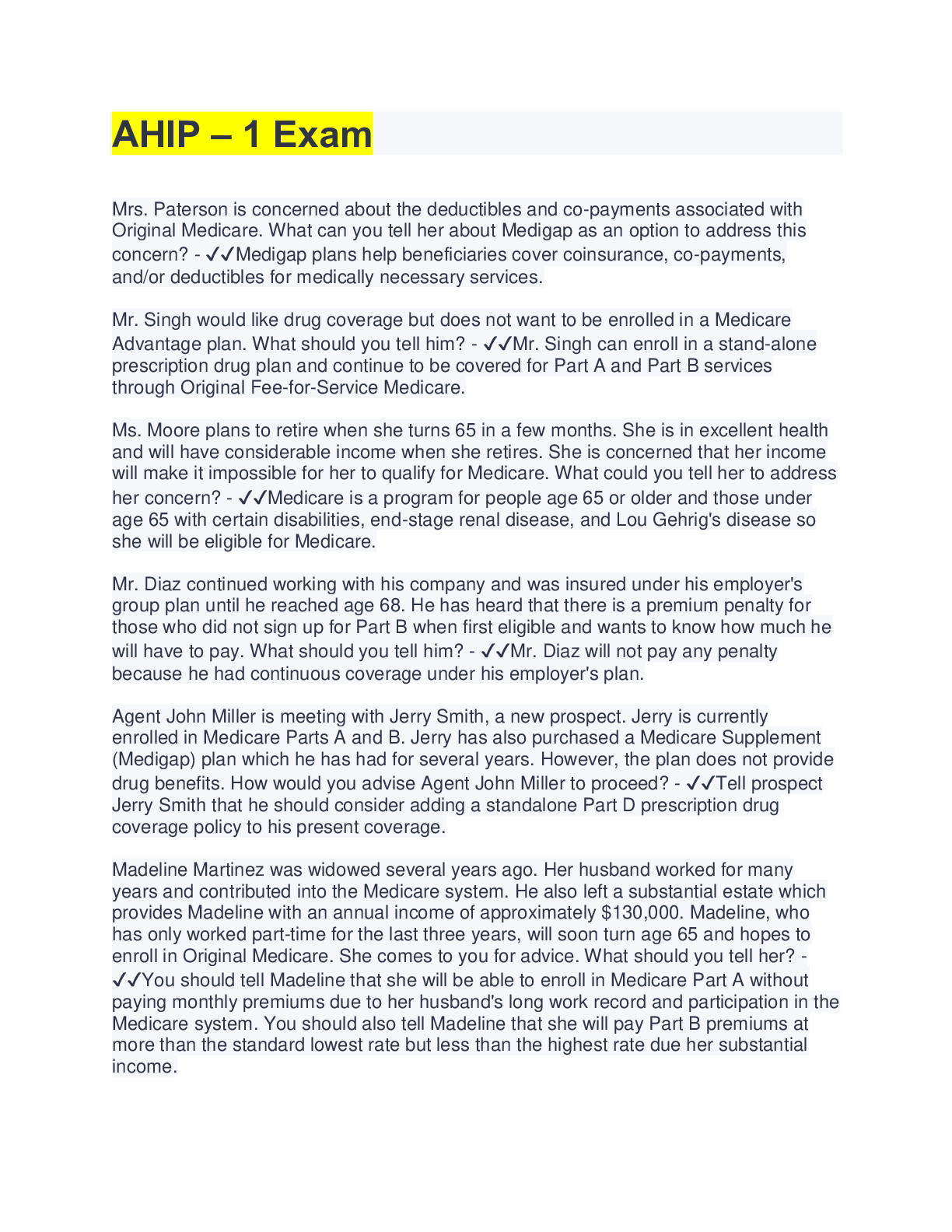
Mrs. Paterson is concerned about the deductibles and co-payments associated with
Original Medicare.
What can you tell her about Medigap as an option to address this concern? >>>>>
Medigap plans help beneficiaries cover coinsurance, co-payments, and/or deductibles
for medically necessary services.
Mr. Patel is in good health and is preparing a budget in anticipation of his retirement
when he turns 66. He wants to understand the health care costs he might be exposed to
under Medicare if he were to require hospitalization as a result of an illness. In general
terms, what could you tell him about his costs for inpatient hospital services under
Original Medicare? >>>>> Under Original Medicare, there is a single deductible amount
due for the first 60 days of any inpatient hospital stay, after which it converts into a perday coinsurance amount through day 90. After day 90, he would pay a daily amount up
to 60 days over his lifetime, after which he would be responsible for all costs.
Mrs. Shields is covered by Original Medicare. She sustained a hip fracture and is being
successfully treated for that condition. However, she and her physicians feel that after
her lengthy hospital stay she will need a month or two of nursing and rehabilitative care.
What should you tell them about Original Medicare's coverage of care in a skilled
nursing facility? >>>>> Medicare will cover Mrs. Shields' skilled nursing services
provided during the first 20 days of her stay, after which she would have a coinsurance
until she has been in the facility for 100 days.Mr. Rainey is experiencing paranoid delusions and his physician feels that he should be
hospitalized. What should you tell Mr. Rainey (or his representative) about the length of
an inpatient psychiatric hospital stay that Medicare will cover? >>>>> Medicare will
cover a total of 190 days of inpatient psychiatric care during Mr. Rainey's entire lifetime.
Mrs. Quinn has recently turned 66 and decided after many years of work to begin
receiving Social Security benefits. Shortly thereafter Mrs. Quinn received a letter
informing her that she has been automatically enrolled in Medicare Part B. She wants to
understand what this means. What should you tell Mrs. Quinn? >>>>> Part B primarily
covers physician services. She will be paying a monthly premium and, with the
exception of many preventive and screening tests, generally will have 20% co-payments
for these services, in addition to an annual deductible.
Mr. Buck has several family members who died from different cancers. He wants to
know if Medicare covers cancer screening. What should you tell him? >>>>> Medicare
covers periodic performance of a range of screening tests that are meant to provide
early detection of disease. Mr. Buck will need to check specific tests before obtaining
them to see if they will be covered.
Mrs. Turner is comparing her employer's retiree insurance to Original Medicare and
would like to know which of the following services Original Medicare will cover if the
appropriate criteria are met? What could you tell her? >>>>> Original Medicare covers
ambulance services.
Mrs. Wolf wears glasses and dentures and has enjoyed considerable pain relief from
arthritis through acupuncture. She is concerned about whether or not Medicare will
cover these items and services. What should you tell her? >>>>> Medicare does not
cover acupuncture, or, in general, glasses or dentures.
Mr. Singh would like drug coverage, but does not want to be enrolled into a health plan.
What should you tell him? >>>>> Mr. Singh can enroll in a stand-alone prescription drug
plan and continue to be covered for Part A and Part B services through Original Fee-forService Medicare.
Mr. Alonso receives some help paying for his two generic prescription drugs from his
employer's retiree coverage, but he wants to compare it to a Part D prescription drug
plan. He asks you what costs he would generally expect to encounter when enrolling
into a standard Medicare Part D prescription drug plan.
What should you tell him? >>>>> He generally would pay a monthly premium, annual
deductible, and per-prescription cost-sharing.
Mrs. Geisler's neighbor told her she should look at her Part D options during the annual
Medicare enrollment period because features of Part D might have changed. Mrs.
Geisler can't remember what Part D is so she called you to ask what her neighbor was
talking about. What could you tell her? >>>>> Part D covers prescription drugs and sheshould look at her premiums, formulary, and cost sharing among other factors to see if
they have changed.
Mrs. Paterson is concerned about the deductibles and co-payments associated with
Original Medicare. What can you tell her about Medigap as an option to address this
concern? >>>>> Medigap plans help beneficiaries cover coinsurance, co-payments,
and/or deductibles for medically necessary services.
Mrs. Gonzalez is enrolled in Original Medicare and has a Medigap policy as well, but it
provides no drug coverage. She would like to keep the coverage she has, but replace
her existing Medigap plan with one that provides drug coverage. What should you tell
her? >>>>> Mrs. Gonzalez cannot purchase a Medigap plan that covers drugs, but she
could keep her Medigap policy and enroll in a Part D prescription drug plan.
Mr. Kelly has substantial financial means. He enrolled in Original Medicare and
purchased a Medigap policy
many years ago that offered prescription drug coverage. The prescription drug coverage
has not been comparable to that offered by Medicare Part D for several years and
despite notification, Mr. Kelly took no action.
Which of the following statements best describes what will occur if Mr. Kelly now
decides to enroll in Medicare Part D? >>>>> He will incur a late enrollment penalty.
Mr. Capadona would like to purchase a Medicare Advantage (MA) plan and a Medigap
plan to pick up costs not covered by that plan.
What should you tell him? >>>>> It is illegal for you to sell Mr. Capadona a Medigap
plan if he is enrolled in an MA plan, and besides, Medigap only works with Original
Medicare.
What impact, if any, will the Medicare Access and CHIP Reauthorization Act of 2015
(MACRA) have upon Medigap plans? >>>>> The Part B deductible will no longer be
covered for individuals newly eligible for Medicare starting January 1, 2020.
Mr. Lopez has heard that he can sign up for a product called "Medicare Advantage" but
is not sure about what
type of plan designs are available through this program. What should you tell him about
the types of health
plans that are available through the Medicare Advantage program? >>>>> They are
Medicare health plans such as HMOs, PPOs, PFFS, and MSAs.
Mr. Wells is trying to understand the difference between Original Medicare and
Medicare Advantage.
What would be a correct description? >>>>> Medicare Advantage is a way of covering
all the Original Medicare benefits through private health insurance companies.
Mrs. Radford asks whether there are any special eligibility requirements for Medicare
Advantage.What should you tell her? >>>>> Mrs. Radford must be entitled to Part A and enrolled in
Part B to enroll in Medicare Advantage.
Mr. Castillo, a naturalized citizen, previously enrolled in Medicare Part B but has
recently stopped paying his
Part B premium. Mr. Castillo is still covered by Part A. He would like to enroll in a
Medicare Advantage (MA) plan and is still covered by Part A. What should you tell him?
>>>>> He is not eligible to enroll in a Medicare Advantage plan until he re-enrolls in
Medicare Part B.
Mrs. Billings enrolled in the ABC Medicare Advantage (MA) plan several years ago. Her
doctor recently confirmed a diagnosis of end-stage renal disease (ESRD). What options
does Mrs. Billings have in regard to her MA plan during the next open enrollment
season? >>>>> She may remain in her ABC MA plan or enroll in a Special Needs Plan
(SNP) for individuals suffering from ESRD if one is available in her area.
Daniel is a middle-income Medicare beneficiary. He has chronic bronchitis, putting him
at severe risk for pneumonia. Otherwise, he has no problems functioning.
Which type of SNP is likely to be most appropriate for him? >>>>> C-SNP
Mr. Kumar is considering a Medicare Advantage HMO and has questions about his
ability to access providers. What should you tell him? >>>>> In most Medicare
Advantage HMOs, Mr. Kumar must obtain his services only from providers who have a
contractual relationship with the plan (except in an emergency).
Mrs. Ramos is considering a Medicare Advantage PPO and has questions about which
providers she can go to for her health care. What should you tell her? >>>>> Mrs.
Ramos can obtain care from any provider who participates in Original Medicare, but
generally will have a higher cost-sharing amount if she sees a provider who/that is not
part of the PPO network.
Mr. Sinclair has diabetes and heart trouble and is generally satisfied with the care he
has received under Original Medicare, but he would like to know more about Medicare
Advantage Special Needs Plans (SNPs). What could you tell him? >>>>> SNPs have
special programs for enrollees with chronic conditions, like Mr. Sinclair, and they
provide prescription drug coverage that could be very helpful as well.
Mr. Greco is in excellent health, lives in his own home, and has a sizeable income from
his investments. He has a friend enrolled in a Medicare Advantage Special Needs Plan
(SNP). His friend has mentioned that the SNP charges very low cost-sharing amounts
and Mr. Greco would like to join that plan. What should you tell him? >>>>> SNPs limit
enrollment to certain sub-populations of beneficiaries. Given his current situation, he is
unlikely to qualify and would not be able to enroll in the SNP.
Mr. Gomez notes that a Private Fee-for-Service (PFFS) plan available in his area has
an attractive premium. He wants to know if he must use doctors in a network like hiscurrent HMO plan requires him to do. What should you tell him? >>>>> He may receive
health care services from any doctor allowed to bill Medicare, as long as he shows the
doctor the plan's identification card and the doctor agrees to accept the PFFS plan's
payment terms and conditions, which could include balance billing.
Mrs. Lee is discussing with you the possibility of enrolling in a Private Fee-for-Service
(PFFS) plan. As part of that discussion, what should you be sure to tell her? >>>>>
PFFS plans may choose to offer Part D benefits but are not required to do so.
Mr. McTaggert notes that a Private Fee-for-Service (PFFS) plan available in his area
has an attractive premium. He wants to know what makes them different from an HMO
or a PPO. What should you tell him? >>>>> Enrollees in a PFFS plan can obtain care
from any provider in the U.S. who accepts Original Medicare, as long as the provider
has a reasonable opportunity to access the plan's terms and conditions and agrees to
accept them.
Dr. Elizabeth Brennan does not contract with the PFFS plan but accepts the plan's
terms and conditions for payment. Mary Rodgers sees Dr. Brennan for treatment. How
much may Dr. Brennan charge? >>>>> Dr. Brennan can charge Mary Rogers no more
than the cost sharing specified in the PFFS plan's terms and condition of payment which
may include balance billing up to 15 percent of the Medicare rate.
Mrs. Lyons is in good health, uses a single prescription, and lives independently in her
own home. She is attracted by the idea of maintaining control over a Medical Savings
Account (MSA), but is not sure if the plan associated with the account will fit her needs.
What specific piece of information about a Medicare MSA plan would it be important for
her to know, prior to enrolling in such a plan? >>>>> ll MSAs cover Part A and Part B
benefits, but not Part D prescription drug benefits, which could be obtained by also
enrolling in a separate prescription drug plan.
Which of the following statement is correct about Medicare Savings Account (MSA)
Plans?
I. MSAs may have either a partial network, full network, or no network of providers.
II. MSA plans cover Part A and Part B benefits but not Part D prescription drug benefits
.
III. An individual who is eligible for health care benefits through the Veteran's
Administration may enroll in an MSA.
IV. Non-network providers must accept the same amount that Original Medicare would
pay them as payment in full. >>>>> I, II, and IV only.
Mr. Davies is turning 65 next month. He would like to enroll in a Medicare health plan,
but does not want to be limited in terms of where he obtains his care. What should youtell him about how a Medicare Cost Plan might fit his needs? >>>>> Cost plan enrollees
can choose to receive Medicare covered services under the plan's benefits by going to
plan network providers and paying plan cost sharing, or may receive services from nonnetwork providers and pay cost-sharing due under Original Medicare.
For which of the following individuals would a Cost Plan be most appropriate? >>>>>
Ms. Baker who is enrolled in Medicare Part B and is willing to continue paying Part B
premiums plus any plan premiums.
Which statement best describes PACE plans? >>>>> It includes comprehensive
medical and social service delivery systems using an interdisciplinary team approach in
an adult day health center, supplemented by in-home and referral services.
Mr. Romero is 64, retiring soon, and considering enrollment in his employer-sponsored
retiree group health plan that includes drug coverage with nominal copays. He heard
about a neighbor's MA-PD plan that you represent and because he takes numerous
prescription drugs, he is considering signing up for it. What should you tell him? >>>>>
Beneficiaries should check with their employer or union group benefits administrator
before changing plans to avoid losing coverage they want to keep.
Mrs. Walters is enrolled in her state's Medicaid program in addition to Medicare. What
should she be aware of when considering enrollment in a Medicare Health Plan? >>>>>
She can enroll in any type of Medicare Advantage (MA) plan except an MA Medical
Savings Account (MSA) plan.
Mrs. Andrews asked how a Private Fee-for-Service (PFFS) plan might affect her access
to services since she receives some assistance for her health care costs from the State.
What should you tell her? >>>>> Medicaid may provide additional benefits, but
Medicaid will coordinate benefits only with Medicaid participating providers.
Mr. Rivera has Qualified Medicare Beneficiary (QMB) eligibility and is thus covered by
both Medicare and Medicaid. He decides to enroll in a Medicare Advantage (MA) PPO
plan. Later he sees an out-of-network doctor to receive a Medicare covered service.
How much may the doctor collect from Mr. Rivera? >>>>> The doctor may only collect
from Mr. Rivera the cost sharing allowable under the state's Medicaid program.
Mr. Lombardi is interested in a Medicare Advantage (MA) PPO plan that you represent.
It is one of three plans operated by the same organization in Mr. Lombardi's area. The
MA PPO plan does not include drug coverage, but the other two plans do. Mr. Lombardi
likes the PPO plan that does not include drug coverage and intends to obtain his drug
coverage through a stand-alone Medicare prescription drug plan. What should you tell
him about this situation? >>>>> He could enroll in one of the MA plans that include
prescription drug coverage or a Medigap plan and a stand-alone prescription drug plan,
but he cannot enroll in the MA-only PPO plan and a stand-alone prescription drug plan.Mrs. Chou likes a PFFS plan available in her area that does not include drug coverage.
She wants to enroll in the plan and enroll in a stand-alone prescription drug plan. What
should you tell her? >>>>> She could enroll in a PFFS plan and a stand-alone Medicare
prescription drug plan.
Mrs. Walters is enrolled in her state's Medicaid program in addition to Medicare. What
should she be aware of when considering enrollment in a Medicare Health Plan? >>>>>
She can enroll in any type of Medicare Advantage (MA) plan except an MA Medical
Savings Account (MSA) plan.
Mr. Lopez has heard that he can sign up for a product called "Medicare Advantage" but
is not sure about what type of plan designs are available through this program. What
should you tell him about the types of health plans that are available through the
Medicare Advantage program? >>>>> They are Medicare health plans such as HMOs,
PPOs, PFFS, and MSAs.
Mr. Wells is trying to understand the difference between Original Medicare and
Medicare Advantage. What would be a correct description? >>>>> Medicare Advantage
is a way of covering all the Original Medicare benefits through private health insurance
companies.
Mrs. Chou likes a PFFS plan available in her area that does not include drug coverage.
She wants to enroll in the plan and enroll in a stand-alone prescription drug plan. What
should you tell her? >>>>> She could enroll in a PFFS plan and a stand-alone Medicare
prescription drug plan.
Mrs. Lee is discussing with you the possibility of enrolling in a Private Fee-for-Service
(PFFS) plan. As part of that discussion, what should you be sure to tell her? >>>>>
PFFS plans may choose to offer Part D benefits but are not required to do so.
Dr. Elizabeth Brennan does not contract with the PFFS plan but accepts the plan's
terms and conditions for payment. Mary Rodgers sees Dr. Brennan for treatment. How
much may Dr. Brennan charge? >>>>> Dr. Brennan can charge Mary Rogers no more
than the cost sharing specified in the PFFS plan's terms and condition of payment which
may include balance billing up to 15 percent of the Medicare rate.
Mr. Sinclair has diabetes and heart trouble and is generally satisfied with the care he
has received under Original Medicare, but he would like to know more about Medicare
Advantage Special Needs Plans (SNPs). What could you tell him? >>>>> SNPs have
special programs for enrollees with chronic conditions, like Mr. Sinclair, and they
provide prescription drug coverage that could be very helpful as well.
Mr. Davies is turning 65 next month. He would like to enroll in a Medicare health plan,
but does not want to be limited in terms of where he obtains his care. What should you
tell him about how a Medicare Cost Plan might fit his needs? >>>>> Cost plan enrollees
can choose to receive Medicare covered services under the plan's benefits by going toplan network providers and paying plan cost sharing, or may receive services from nonnetwork providers and pay cost-sharing due under Original Medicare.
Daniel is a middle-income Medicare beneficiary. He has chronic bronchitis, putting him
at severe risk for pneumonia. Otherwise, he has no problems functioning.
Which type of SNP is likely to be most appropriate for him? >>>>> C-SNP.
Mr. Castillo, a naturalized citizen, previously enrolled in Medicare Part B but has
recently stopped paying his Part B premium. Mr. Castillo is still covered by Part A. He
would like to enroll in a Medicare Advantage (MA) plan and is still covered by Part A.
What should you tell him? >>>>> He is not eligible to enroll in a Medicare Advantage
plan until he re-enrolls in Medicare Part B.
Mr. Carlini has heard that Medicare prescription drug plans are only offered through
private companies under a program known as Medicare Advantage (MA), not by the
government. He likes Original Medicare and does not want to sign up for an MA
product, but he also wants prescription drug coverage. What should you tell him? >>>>>
Mr. Carlini can stay with Original Medicare and also enroll in a Medicare prescription
drug plan through a private company that has contracted with the government to
provide only such drug coverage to eligible Medicare beneficiaries.
Mrs. Mulcahy is concerned that she may not qualify for enrollment in a Medicare
prescription drug plan because, although she is entitled to Part A, she is not enrolled
under Medicare Part B. What should you tell her? >>>>> Everyone who is entitled to
Part A or enrolled under Part B is eligible to enroll in a Medicare prescription drug plan.
As long as Mrs. Mulcahy is entitled to Part A, she does not need to enroll under Part B
before enrolling in a prescription drug plan.
Mrs. Lopez is enrolled in a cost plan for her Medicare benefits. She has recently lost
creditable coverage previously available through her husband's employer. She is
interested in enrolling in a Medicare Part D prescription drug plan (PDP). What should
you tell her? >>>>> If a Part D benefit is offered through her plan she may choose to
enroll in that plan or a standalone PDP.
Which of the following statements about Medicare Part D are correct?
I. Part D plans must enroll any eligible beneficiary who applies regardless of health
status except in limited circumstances.
II. Private fee-for-service (PFFS) plans are not required to use a pharmacy network but
may choose to have one.
III. Beneficiaries enrolled in a MA-Medical Savings Account (MSA) plan may only obtain
Part D benefits through a standalone PDP.
IV. Beneficiaries enrolled in a MA-PPO may obtain Part D benefits through a standalone
PDP or through their plan. >>>>> I, II, and III only.
All plans must cover at least the standard Part D coverage or its actuarial equivalent.
What costs would a beneficiary incur for prescription drugs in 2019 under the standardcoverage? >>>>> Standard Part D coverage would require payment of an annual
deductible, 25% cost-sharing up to the coverage gap, a portion of costs for both
generics and brand-name drugs in the coverage gap, and co-pays or co-insurance after
the coverage gap.
Mrs. Andrews was preparing a budget for next year because she takes quite a few
prescription drugs, she will reach the coverage gap, and wants to be sure she has
enough money set aside for those months. She received assistance calculating her
projected expenses from her daughter who is a pharmacist, but she doesn't think the
calculations are correct because her out-of-pocket expenses would be lower than last
year. She calls to ask if you can help. What might you tell her? >>>>> It would not be
unusual for her costs to be a bit less because the Bipartisan Budget Act of 2018 moved
up the date for closing the so-called "donut hole" for brand name drugs to 2019.
Mr. Jacob understands that there is a standard Medicare Part D prescription drug
benefit, but when he looks at information on various plans available in his area, he sees
a wide range in what they charge for deductibles, premiums and cost sharing. How can
you explain this to him? >>>>> Medicare Part D drug plans may have different benefit
structures, but on average, they must all be at least as good as the standard model
established by the government.
Ms. Edwards is enrolled in a Medicare Advantage plan that includes prescription drug
plan (PDP) coverage. She is traveling and wishes to fill two of her prescriptions that she
has lost. How would you advise her? >>>>> She may fill prescriptions for covered drugs
at non-network pharmacies, but likely at a higher cost than paid at an in-network
pharmacy.
What types of tools can Medicare Part D prescription drug plans use that affect the way
their enrollees can access medications? >>>>> Part D plans do not have to cover all
medications. As a result, their formularies, or lists of covered drugs, will vary from plan
to plan. In addition, they can use cost containment techniques such as tiered copayments and prior authorization.
Mrs. Allen has a rare condition for which two different brand name drugs are the only
available treatment. She is concerned that since no generic prescription drug is
available and these drugs are very high cost, she will not be able to find a Medicare Part
D prescription drug plan that covers either one of them.
What should you tell her? >>>>> Medicare prescription drug plans are required to cover
drugs in each therapeutic category. She should be able to enroll in a Medicare
prescription drug plan that covers the medications she needs.
Mr. and Mrs. Vaughn both take a specialized multivitamin prescription each day. Mr.
Vaughn takes a prescription for helping to regrow his hair. They are anxious to have
their Medicare prescription drug plan cover these drug needs.What should you tell them? >>>>> Medicare prescription drug plans are not permitted to
cover the prescription medications the Vaughns are interested in under Part D
coverage, however, plans may cover them as supplemental benefits and the Vaughn's
could look into that possibility.
Under what conditions can a Medicare prescription drug plan reduce its coverage for a
given drug during the first 60 days of the year? >>>>> When a formulary change is in
response to a drug's removal from the market.
Which of the following steps may a Part D sponsor adopt for beneficiaries who are at
risk of misusing or abusing frequently abused drugs?
I. Identifying at risk individuals by using criteria that includes the number of opioid
prescriptions the beneficiary has and the number of p
[Show More]



.png)