AORN Periop 101 Questions with
Complete solution
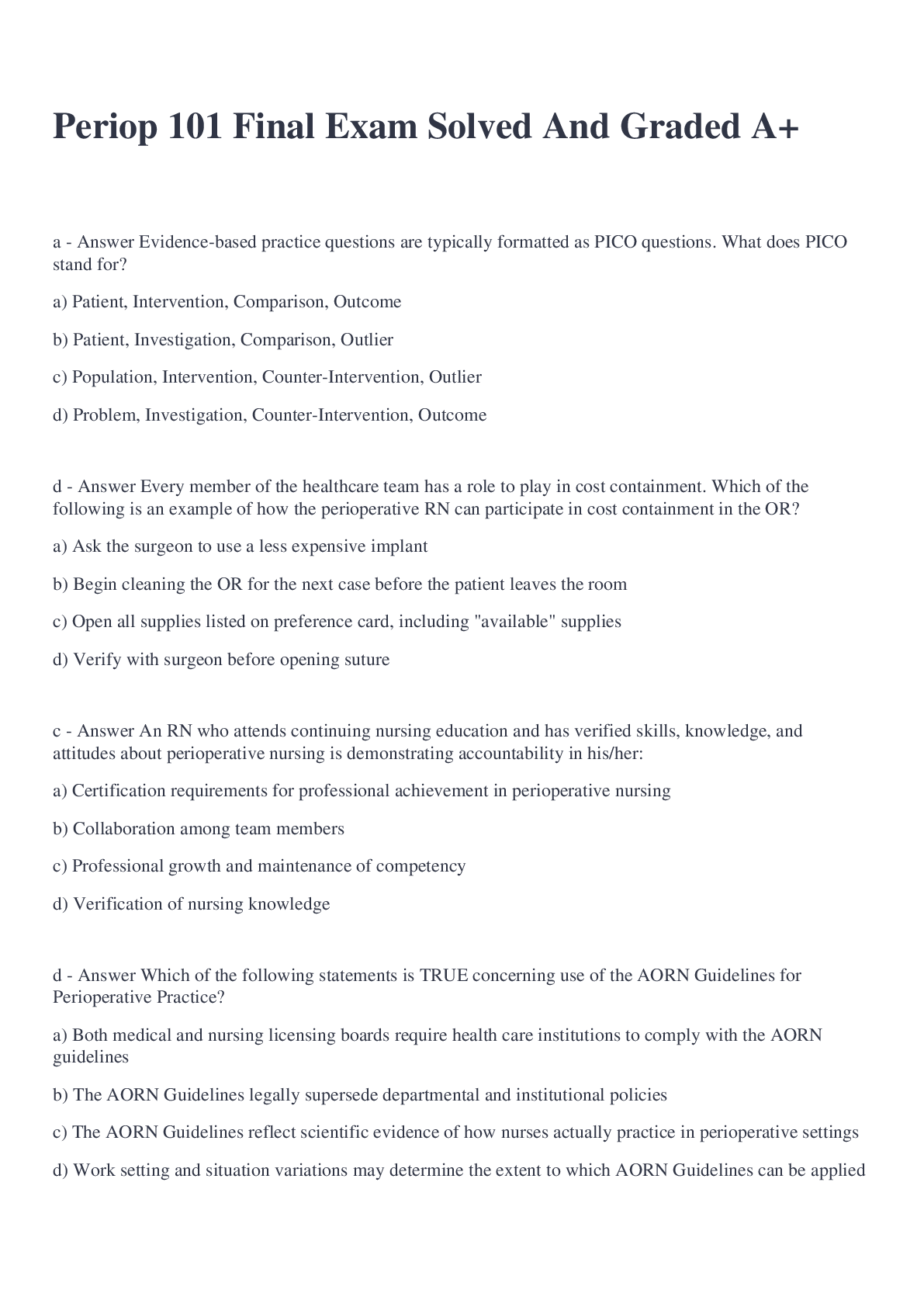
In addition to the surgeon, which surgical team members wear sterile gowns and gloves
during the procedure? -Answer- Scrub Person AND Surgical assistant
The pathology
...
AORN Periop 101 Questions with
Complete solution
In addition to the surgeon, which surgical team members wear sterile gowns and gloves
during the procedure? -Answer- Scrub Person AND Surgical assistant
The pathology laboratory and blood bank are usually situated in which of the following
areas? -Answer- Unrestricted area
What phases of the nursing process does the periopeartive nurse practice during the
preoperative phase of the surgical experience? -Answer- Assessment, Identification of
desired outcome, Nursing diagnosis, Planning
Data collection is part of which phase in the nursing process -Answer- Assessment
Which of the following is considered a critical perioperative nursing diagnosis within the
PNDS? -Answer- Risk for perioperative positioning injury
Competency statements -Answer- Direct a nurse's activity in the perioperative arena;
Provide a basic model to evaluate the quality of nursing practice; Ascertain a level of
skills and abilities necessary to fulfill the professional role (All of the above)
Defining nursing goals and intervention strategies is a part of which phase in the nursing
process -Answer- Outcome identification
Match each staff member with the appropriate responsibility -Answer- Scrub personMonitors aseptic technique; RN circulator- Creates and maintains a safe environment;
Housekeeping- Cleans the furniture at the end of the OR day; Nurse anesthetistadministers anesthesia to the patient
Creating cultures that supports patient safety through which of the following
mechanisms? -Answer- Convene and communicate with members about safety;
Incorporate attention to patient safety into training programs; Collaborate across
disciplines.
The IOM report describes the importance of setting standards and expectations for
patient safety. Setting standards can_____ -Answer- Set expectations for the health
professionals; Establish consistency across individuals and organizations; Help set
expectations of consumers and purchases.
Which of the following AORN Position Statement on Correct site of surgery is true? -
Answer- The staff member should verbally verify the correct site with each member of
the surgical teamMaintaining a safe OR environment, staff members are required to -Answer- Monitor,
identify, and reports safety hazards; Understand and comply with the emergency power
outage plan; Practice sound, basic and OR specific electrical and fire safety.
The elements required to create a cultures of safety include -Answer- A sense of trust
among team members; A sincere commitment of affirming safety as the first priority;
Development and support of a proactive approach rather than a reactive blaming
approach; Dissemination of receipt of information to all levels of staff.
Which of the following practices should be used ti implement the Joint Commission's
Universal Protocol for preventing Wrong Site, Wrong Procedure, Wrong Person
Surgery? -Answer- Using a time-out procedure before beginning the procedure
The purpose of the National Patient Safety Goals is to -Answer- Promote specific
improvements in patient safety; Highlight problematic areas in health care; Describe
evidence and expert-based system-wide solutions to the problems
AORN's Guidelines for Perioperative Practice provides -Answer- Information on
administrative topics; Information that can be used to develop institution-specific
policies; Scientific evidence for clinical practices.
Which of the following are true about AORN's Guidelines for Perioperative Practice? -
Answer- They are based on what nurses do in ideal situations; They may be fulfilled to
varying degrees in different situations.
Why is it important for perioperative nurses to have a basic understanding of business
principles? -Answer- To enable them to plan safe and effective care that is also costeffective; To facilitate competition for patient volume; To manage and allocate resources
wisely
Match the type of budget with its description -Answer- Gross revenue- All monies
received by the facility for goods and services; Fixed expenses- Medical records and
administration; Net revenue- gross revenue minus expenses; Variable costs- Costs
directly related to patient volume
Which of the following definitions are correct? -Answer- Liable means to bind or to be
responsible to or to be under obligation to; Negligence means the failure to exercise
care that a prudent person would perform under the same circumstances.
Professionalism in nursing means -Answer- Showing personal accountability in
understanding the Nurse Practice Act; Maintaining a current knowledge base;
Participating in professional organizations.
Which of the following social media practices are important for the professional nurse to
follow? -Answer- Acknowledge that anything you post on the internet is there forever;Do no speak on behalf of your employer unless you have been authorized to do so;
Facebook mixes your personal and professional lives and requires careful attention.
Benefits of evidence based practice include which of the following? -Answer- The
professional perioperative nurse can base his or her practice on evidence; Provides
point of care clinicians with tools that can assist in improving patient care, The evidence
collected is rated for quality and strength.
Which of the following statements reflects the findings from a research study of more
than 11,000 nurses conducted in 2007 related to the importance of certification? -
Answer- Enhances feelings of personal accomplishment; Validates specialized
knowledge.
For a professional nurse, personal accountability means -Answer- Willingness to take
responsibility for one's actions;
Being dependable in all situations;
Making the best decisions with the input available;
Willingness to bare consequences for one's actions
Which of the following statements are true about objective data? -Answer- Data that is
the information written in the patient's record and nursing notes;
History, physical, and laboratory data are examples of objective data
Match the age groups with their ability for learning and understanding -Answer- Birth to
one month- The child is able to express only through crying;
1-12 months- The baby will smile, babble, and gurgle;
One to three years- The baby is able to understand and respond to simple commands;
Three to six years- The child is able to literally interpret terms.
Patients in which of the following age groups have the greatest blood volume per unit of
body weight? -Answer- Children
During the preoperative interview, why should the perioperative nurse ask patients
about their use of herbal preparations, alcohol, tobacco, and recreational drugs? -
Answer- Herbal supplements may affect the metabolism of drugs administered;
Recreational drug use may affect the choice of preoperative sedation;
Smoking may affect circulatory and respiratory system assessment results.
Which items are included in a psychosocial assessment? -Answer- Coping styles;
cultural beliefs and practices;
Expectations of perioperative care;
Spiritual or religious beliefs
Which of the following statements is true? -Answer- Lung capacity decreases with
increasing ageWhich of the following factors make geriatric patients more sensitive to injury and cold?
-Answer- Decrease in subcutaneous fat
Why is it important to assess the use of herbal supplements or recreational drugs before
surgery? -Answer- Herbal preparations can affect bleeding times;
Herbal preparations can interfere with drug metabolism;
Recreational drug use can result in withdrawal symptoms;
Recreational drug users may require higher doses of anesthetic medications.
What interventions can the perioperative nurse perform to protect elderly patients? -
Answer- Employ DVT prophylactic devices;
Position the patient for effective air exchange;
Use warming devices to maintain the normothermia
A child in which of the following age groups can be described as "likes to socialized and
can interpret terms"? -Answer- 3 to 6 years
The goal of patient and family education is to -Answer- Provide information to the
patient;
Improve knowledge;
Achieve long lasting changes in behavior;
Take ownership of the patient's care;
Improve the patient's outcome.
The importance of patient and family education is reflected by which of the following
phrases? -Answer- Improvement in quality of care;
Increase in patient satisfaction;
Increase in patient compliance;
Ethical and legal mandates for patient education
Which of the following form part of patient's ongoing education needs as a patient? -
Answer- Contact information for questions or concerns after surgery;
Counseling on modified diet to be followed after surgery;
List of foods that might interfere with prescribed mediation;
Medications to be given and time intervals for taking.
Factors that affect the patient's ability to learn include -Answer- Disability;
Fear of dying;
Pain;
Self-esteem
The perioperative nurse provides care to each patient undergoing a surgical intervention
in a manner that preserves and protects -Answer- Patient autonomy, dignity, and
human rightsPatient and family education is a combination process involving -Answer- Influencing
behavior;
Producing changes in knowledge;
Producing change in attitudes and skills
Factors that may affect an adult patient's ability to learn include -Answer- Age;
Attitude;
Emotional state;
Intellectual ability;
Physical ability
The perioperative nurse should use the directive interview technique over a nondirective
interview technique when the information he or she needs -Answer- Consists of
predetermined questions;
Consists of questions in a predetermined order;
Is to document the patient's health history
A preoperative patient's DNR order is -Answer- Reconsidered to ensure that the risks
and benefits of anesthesia and surgery are discussed before surgery
Obtaining informed consent is a two step process of -Answer- Communicating
information and documenting the decision
How does the perioperative nurse test the patient's level of understanding? -Answer- By
asking questions about the procedure and evaluating the answer
A directive interview is -Answer- Structures with predetermined questions
Factors that may affect the amount of pain the patient will experience postoperatively
are -Answer- The surgical site;
The nature and intended purpose of the surgery;
the patient's fears regarding anesthesia or surgery
Which of the three elements required for an infection to occur is related to inanimate
environmental surfaces? -Answer- Source or Reservoir
One of the most effective ways to prevent disease transmission and control infections in
health care settings is -Answer- Hand Hygiene
Match the three types of transmission based precautions with the correct examples of
precautions that should be implemented -Answer- Contact- Donning PPE and
environmental cleaning;
Droplet- Donning PPE and patient placement
Airborne- Donning PPE and waring a surgical mask with a respirator level of N95 or
higherThe OSHA Bloodborne Pathogen standard requires health care personnel to wear the
following when splashes, spray, spatter, or droplets occur -Answer- Masks;
Shoe coverings;
Eye protection devices;
Gloves
Which factors determine the likelihood of transmission and persistence of multi drug
resistant organisms -Answer- Effectiveness of prevention methods;
Numbers of colonized patients;
Vulnerability of the patients
Several types of infections may be acquired in the perioperative settting -AnswerSurgical site infections- SSIs;
Multidrug resistant organisms- MDROs;
Central line associated blood stream nfections- CLABSIs;
Catheter associated urinary tract infections- CAUTIs
Effective methods for preventing SIs include -Answer- Effective environmental cleaning
procedures;
Performance of sterile technique;
Use of surgical attire and other barriers (All of the above)
Immunizations and testing for health care workers should include all of the following
except -Answer- Shingles
Match the correct wound elements with the wound classification -Answer- Class I
Clean- Procedure does not involve the respiratory, alimentary, or genitourinary tract and
no infection or inflammation is present.
Class 2 Clean Contaminated- alimentary, or genitourinary tract is entered under
controlled condition.
Class 3 Contaminated- Gross spillage from GI tract occurs or unsterile instruments are
used .
Class 4 Dirty- A clinical infection exists or an internal organ perforation is present.
Droplet precautions include all of the following except -Answer- Consulting with the risk
manager
The single most important factor in preventing the spread of infection is -Answer- Hand
Hygiene
Damp dusting of the OR as part of the preliminary room preparation should be done -
Answer- In the morning before bringing in any surgical supplies
Which methods are most effective for terminal cleaning floors in the OR -Answer- Wet
vacuum or single use mopWhich of the following is correct regarding the disposal of contents from reusable
suction systems? -Answer- done according to federal, state, and local regulations
Correct statements about spray bottles -Answer- Spray bottles can aerosolize
potentially infectious materials;
Spray bottles are not used to apply disinfectant
The proper device for the disposal of blades, needles, stapling devices, pins, and
cautery tips should be -Answer- A sharps disposal container
The goals of performing post procedure cleaning of the OR/procedure room include the
following -Answer- It renders the environment safe for the patient following in that room
to prevent cross contamination;
It breaks the cycle of contamination from the patient to the environment and from the
environment to OR personnel and then to subsequent patients;
It is the patient's right to have a clean and safe environment.
Terminal cleaning must be done -Answer- Once during each 24 hour period
During post procedure cleaning -Answer- All kick buckets, hampers, and similar
receptacles must be inspected and disinfected as needed;
Transport vehicles are to be considered contaminated after patient contact;
All horizontal surfaces of tables and equipment, including the anesthesia machine,
should be wiped down with a lint free cloth moistened with a hospital approved
disinfectant.
Identify the pathogens that can be commonly found in the OR environement -AnswerEscherichia coli;
Methicilin resistant STaph aureus;
Serratia marcescens.
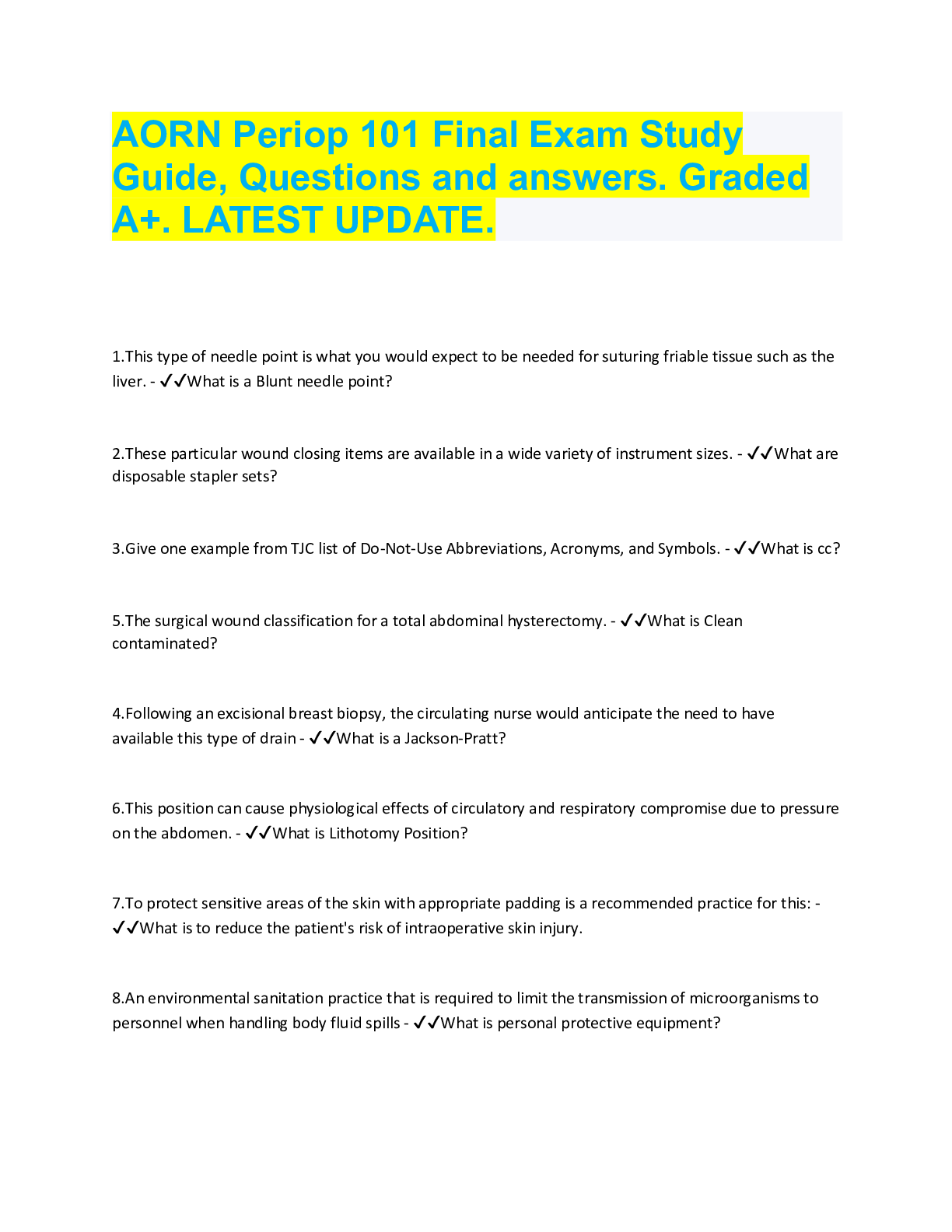
In which surgical wound category should a total abdominal hysterectomy be classified?
-Answer- Clean contaminated wound
Match terms -Answer- Disinfection- A chemical or physical process of destroying all
pathogenic microorganisms, except spores, on inanimate objects.
Decontamination- The use of physical or chemical means to remove, inactivate, or
destroy bloodborne or other pathogens on a surface or item.
Sterilization- The process of destroying all microorganisms on a substance by exposure
to physical and chemical agents; the complete elimination of all forms of
microorganisms.
High level disinfection- A process that destroys all microorganisms with the exception of
high numbers of bacterial spores.
Immediate use steam sterilization can be used -Answer- In urgent situationsA packing system for items undergoing sterilization should -Answer- Permit aseptic
delivery of contents to the sterile field
Complete sterilization in ethylene oxide is dependent upon four primary variables:
proper time, gas concentration, temperature, and -Answer- Chamber humidity
Which of the following is true about ethylene oxide sterilization -Answer- EO exposure is
potentially carcinogenic and mutagenic to personnel and patients
Which of the following is true about the use of peracetic acid on surgical items -AnswerItems must be immersible
An integrator is a multiparameter indicator designed to measure which of the following
parameters -Answer- Temperature, time, and presence of steam
Which of the following are true about low temperature hydrogen peroxide gas plasma
sterilization -Answer- Items can be stored for future use;
No toxic residue is produced;
The sterilant is bactericidal, viruicidal, and fungicidal;
It can be used for items that are heat sensitive.
Shelf life is related to -Answer- Exposure to external events;
Type of packaging material used;
Number of personnel who may have handled the package.
Match the basic categories of surgical instrument with their uses -Answer- Graspers- To
handle tissues and dressings.
Retractors- To provide exposure of the operative site.
Cutting instruments- To incise, cut, dissect, or separate tissue.
Clamps- To hold join, or compress parts together.
A mosquito is classified as a -Answer- Clamp
When passing sharps during a procedure, the best way to protect yourself and surgeon
is by using -Answer- A neutral zone
Curved Mayo scissors are used for which of the following? -Answer- To cut heavy tissue
What biting instrument is used for cutting tough tissue or bone? -Answer- A Rongeur
while passing scissors, which of their parts should be visible to the surgeon? -AnswerTip
Which of the concepts are appropriate for the care of forceps during a procedure? -
Answer- Cleaning the tips of blood or tissue frequently.Handing them off the sterile field to the circulating RN if the surgeon says that they are
not working properly.
Atraumatic forceps are most often used in -Answer- Cardiovascular surgery
the point of the forceps should be facing __________ when passing it to the surgeon? -
Answer- Downward
Which powered cutting instruments are used in orthopedic surgery? -Answer- Tissue
shavers;
Bone reamers.
Plastic incise drapes -Answer- May increase moisture and bacterial growth under the
drape;
Are NOT recommended for use.
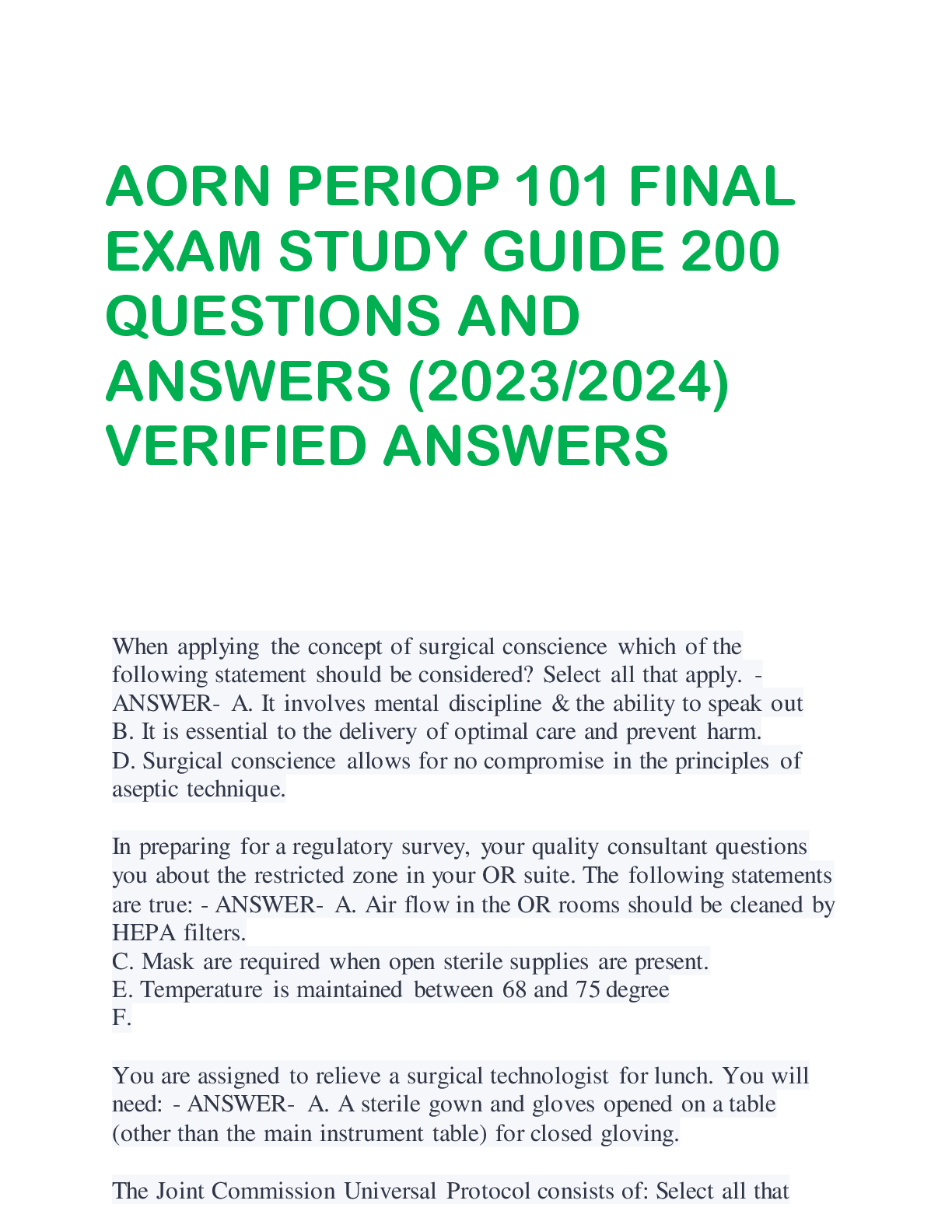
Which of the following best describes sterile technique -Answer- Implemented during
surgical procedures to prevent microbial contamination
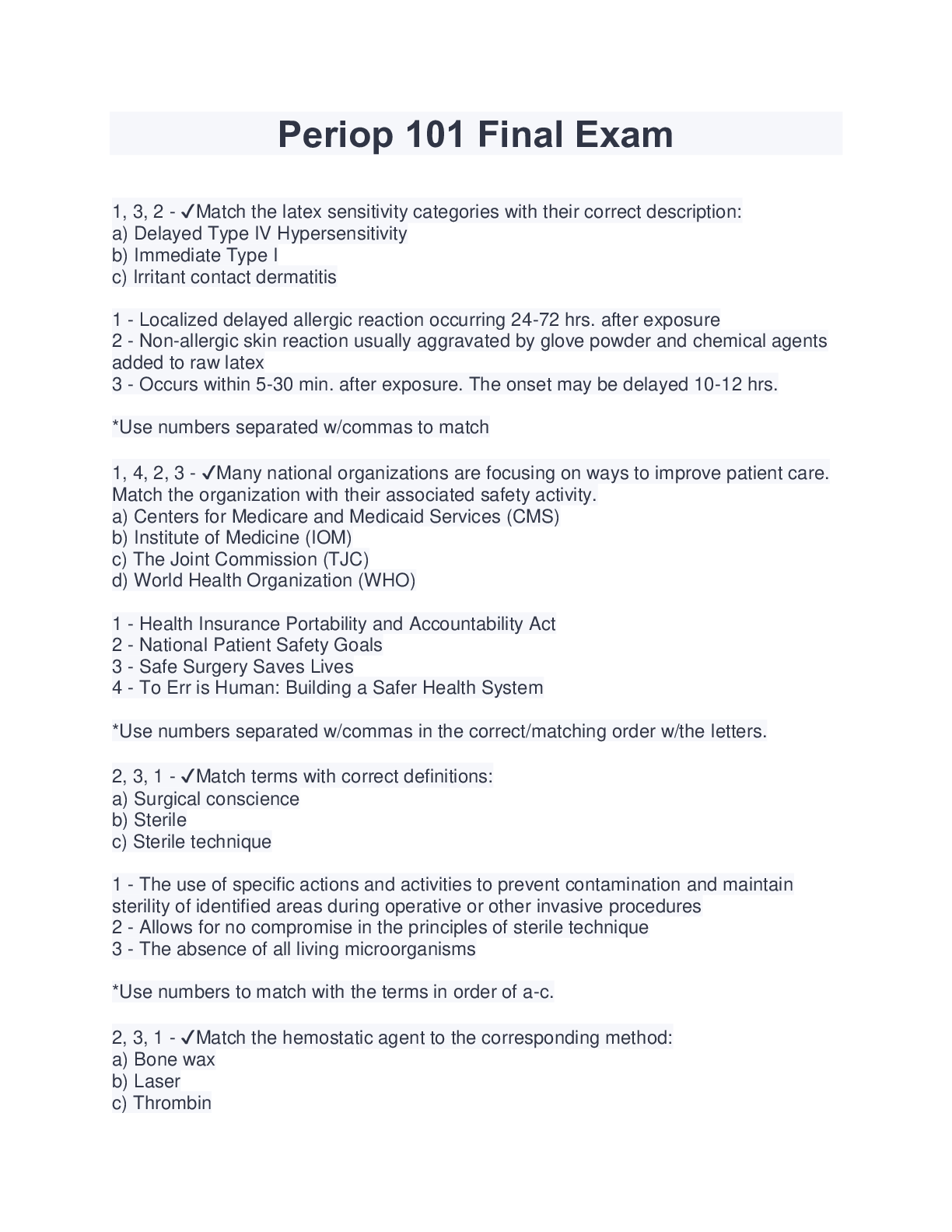
Match the terms given below with their definitions. -Answer- 1. Surgical conscienceAllows for no compromise in the principles of sterile technique
2. Sterile- The absence of all living microorganisms.
3. Sterile Technique- The use of specific actions and activities to prevent contamination
and sterility of identified areas during operative or other invasive procedures.
Recommendations for draping include -Answer- -handling sterile drapes as little as
possible
- cuffing the drape material over the gloved hands
- holding the drapes in a controlled manner
Select the areas of the sterile gown that are considered sterile. -Answer- - Gown
sleeves from two inches above the elbow to the cuff, circumferential.
- The front of the gown from the chest to the level of the sterile field.
Select the statements below that are correct -Answer- closed assisted gloving should be
used to glove team members during initial gowning and gloving;
Once the scrubbed team member's hands pass through the cuff, the cuffs are
considered contaminated;
Scrubbed team members should wear two pairs of surgical gloves.
In creating a sterile field, which of the following are recommended by AORN? -Answera. Cuff the drapes over your gloved hand to prevent contamination.
c. Place drapes in sequence from the surgical site to peripheral areas.
d. Place drapes on the patient and any furniture and equipment that will be in the sterile
field.
e. When placing drapes do not lean across unsterile areas.What action below is the best course to take when a hair is found in an instrument tray
on the back table? -Answer- c. The entire sterile field should be broken down and a
sterile field reestablished.
Which of the following practices are NOT examples of the recommendation that "A
sterile field should be maintained and monitored constantly"? -Answer- A sterile field
that has been set up for more than 1 hour before the procedures begins should be
broken down and a new set up prepared.
If a delay occurs after a sterile field is set up, the personnel may leave the room as long
as the room as been secured.
When transferring medication and solutions to the sterile field the perioperative nurse
should -Answer- Avoid removing stoppers from vials.
Discard unused, opened irrigation or IV solutions at the end of the procedures.
Dispense the entire contents to the container slowly.
Use a sterile transfer device.
Accurate preoperative documentation of the patient admission is an integral part of the
nursing process. This includes -Answer- Patient identification;
Preoperative orders;
Patient assessment.
The primary purpose of documentation is to -Answer- Record the chronological order of
events during the nursing are of a patient.
When documenting the placement of a surgical drain, which of the following
components should be included? -Answer- Where the drain was placed on the patient.
Which of the following is true about the use of abbreviations in perioperative
documentation? -Answer- They can put patients at risk for medication errors.
When documenting, the perioperative nurse should -Answer- Document in a timely
manner;
Use nursing diagnoses based on sound judgement;
Use patient statements to verify the nurse's findings.
Which of the following statements are true about informed consent? -Answer- Needs to
state the indications for the proposed intervention;
Is a physician's duty, and RNs are witnesses to the patient's signature;
Must contain the name of the health care facility.
When documenting the use of a pneumatic tourniquet, which items must be included? -
Answer- Cuff pressure;
Location where the cuff was placed;
Name of person who applied the tourniquet cuff;Serial number of the unit
The concept of a standard of care related to documentation -Answer- Requires the
nurse to document and act as a reasonably qualified nurse would in a similar situation
An individualized patient care plan that was initiated during the preoperative phase
includes -Answer- A cultural or religious preferences;
Emotional considerations;
Psychosocial considerations
The primary reason for documenting sharp, sponge, and instrument counts is -Answerto prevent injury to the patient from a retained foreign object
Scrubbing Procedures Steps -Answer- 1. Inspection of hands and arms
2. Open the gown and place on the table
3. Open the sterile scrub sponge package
4. Wet and later the hands and forearms
5. Clean under the fingernails of both hands with the nail cleaner
6. Scrub fingertips, nails, palm, and wrist to two inches above elbow
7. Repeat the procedure for other hand
8. Rinse hands and arms keeping the fingers pointed upward
The purpose of performing a surgical hand scrub include -Answer- To reduce the
resident microbial count to a minimum;
To inhibit rapid rebound growth of microorganisms;
To remove soil, debris, and transient microorganisms
After the surgical hand scrub, the scrub person should keep the fingers pointed in which
direction to allow water to drip off away from the attire? -Answer- Upwards
What actions can the RN circulator take to assist the scrub personnel during gowning? -
Answer- Touch only the ties, Velcro, or snaps to secure the back of the gown at the
neck and the waist;
Adjust the gown by grasping the bottom edge and pulling down to eliminate any
blousing.
Because skin is a major source of contamination in the surgical environment, which of
the following statements is true? -Answer- Health care personnel who have cuts on their
hands should not provide direct patient care
You have just finished a surgical procedures and are removing your gown and gloves. -
Answer- 1. Pull the gown downward from the shoulders and off the arms.
2. Fold the contaminated side of the gown to the inside, roll it up, and discard it.
3. Remove and discard the gloves using a glove
[Show More]