CCRN PEDS AACN 2022 POSSIBLE QUESTIONS AND
ANSWERS (100% Verified)
1. In caring for a patient with salicylate intoxication, the critical care nurse would
anticipate which of the following as a primary treatment measur
...
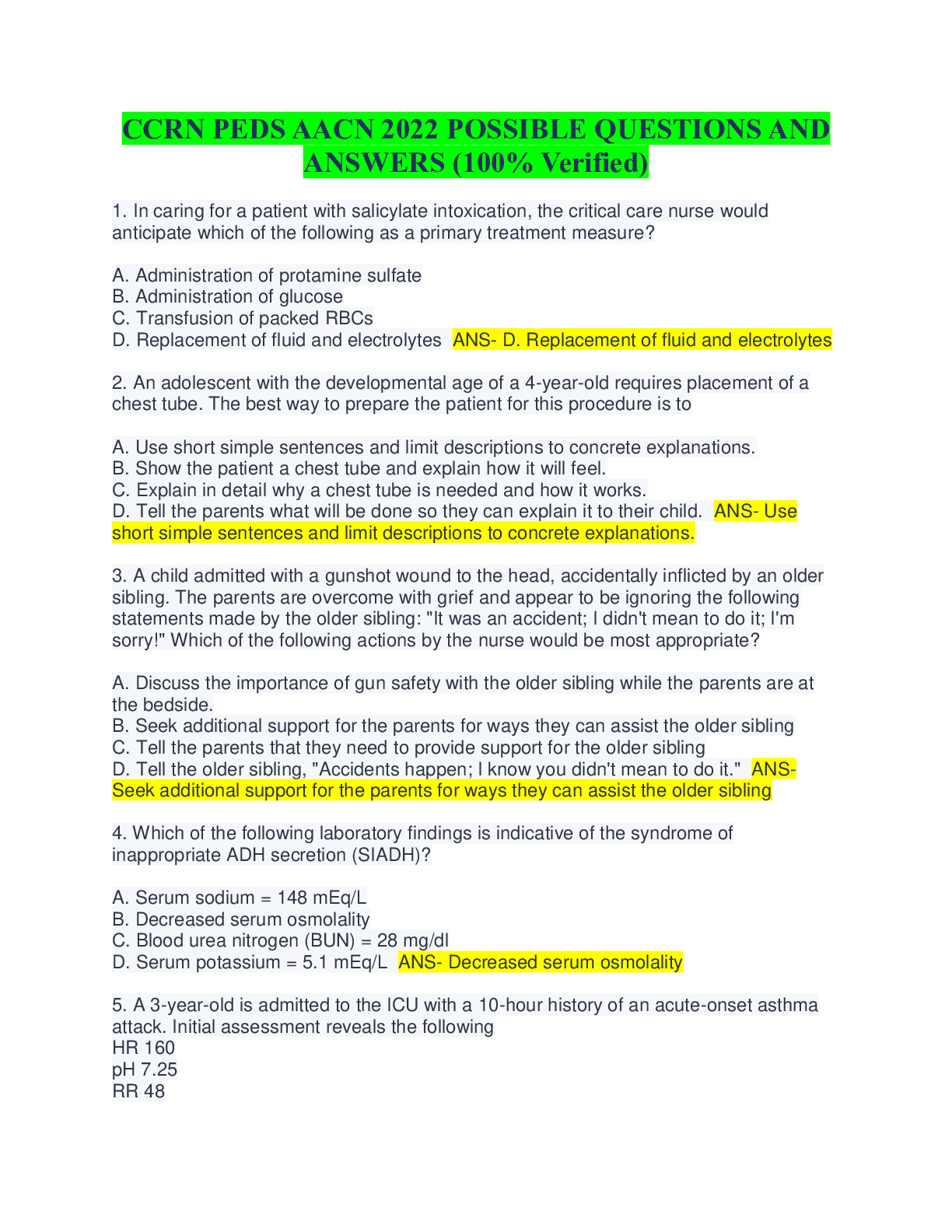
CCRN PEDS AACN 2022 POSSIBLE QUESTIONS AND
ANSWERS (100% Verified)
1. In caring for a patient with salicylate intoxication, the critical care nurse would
anticipate which of the following as a primary treatment measure?
A. Administration of protamine sulfate
B. Administration of glucose
C. Transfusion of packed RBCs
D. Replacement of fluid and electrolytes ANS- D. Replacement of fluid and electrolytes
2. An adolescent with the developmental age of a 4-year-old requires placement of a
chest tube. The best way to prepare the patient for this procedure is to
A. Use short simple sentences and limit descriptions to concrete explanations.
B. Show the patient a chest tube and explain how it will feel.
C. Explain in detail why a chest tube is needed and how it works.
D. Tell the parents what will be done so they can explain it to their child. ANS- Use
short simple sentences and limit descriptions to concrete explanations.
3. A child admitted with a gunshot wound to the head, accidentally inflicted by an older
sibling. The parents are overcome with grief and appear to be ignoring the following
statements made by the older sibling: "It was an accident; I didn't mean to do it; I'm
sorry!" Which of the following actions by the nurse would be most appropriate?
A. Discuss the importance of gun safety with the older sibling while the parents are at
the bedside.
B. Seek additional support for the parents for ways they can assist the older sibling
C. Tell the parents that they need to provide support for the older sibling
D. Tell the older sibling, "Accidents happen; I know you didn't mean to do it." ANSSeek additional support for the parents for ways they can assist the older sibling
4. Which of the following laboratory findings is indicative of the syndrome of
inappropriate ADH secretion (SIADH)?
A. Serum sodium = 148 mEq/L
B. Decreased serum osmolality
C. Blood urea nitrogen (BUN) = 28 mg/dl
D. Serum potassium = 5.1 mEq/L ANS- Decreased serum osmolality
5. A 3-year-old is admitted to the ICU with a 10-hour history of an acute-onset asthma
attack. Initial assessment reveals the following
HR 160
pH 7.25
RR 48pCO2 35
BP 112/76
pO2 40
T 32*C
HCO3 22
A. Administration of NaHCO3
B. Fluid resuscitation
C. Racemic epinephrine
D. Intubation ANS- Intubation
6. A 2-year-old is experiencing manifestations of digoxin (Lanoxin) toxicity. BP is 94/60,
capillary refill time is 2 seconds and the electrocardiogram reveals AV block with a heart
rate of 60. The critical care nurse would anticipate which of the following interventions?
A. Performance of cardioversion
B. Administration of Atropine
C. Performance of vasovagal maneuvers
D. Monitoring of HR and rhythm and perfusion status ANS- Monitoring of HR and
rhythm and perfusion status
7. An adolescent with asthma is readmitted just a week after discharge from the
hospital. On questioning, the nurse learns that the patient refuses to use the inhalers at
school. The nurse should
A. Talk to the teen about long-term consequences of the disease if the treatment plan is
not followed
B. Talk to the school nurse to find out why they are not monitoring the medications at
school
C. Help the parents set up a disciplinary contract with the teen
D. Arrange for the teen to attend an asthma support group ANS- Arrange for the teen to
attend an asthma support group
8. An unconscious 5-month-old is admitted. The parent reports the baby fell off the table
during a diaper change by an older sibling. What findings would indicate further inquiry
of the history?
A. A reddened or bruised are on the skull
B. Poorly reactive pupils
C. Retinal hemorrhage
D. A linear skull fracture ANS- Retinal hemorrhage
1. A 1-month-old infant presents with poor feeding, vomiting and diarrhea since birth.
The infant is lethargic and in mild respiratory distress. The mother reports having
another infant with the same symptoms who died at 2 months of age. Which finding
would cause the nurse to suspect an inborn error of metabolism?
A. micrognathiaB. microglossia
C. petite facial features
D. abnormal urine odor ANS- abnormal urine odor
2. Cardiac defects associated with increased pulmonary blood flow place the patient at
greatest risk for
A. heart failure.
B. systemic air emboli.
C. hypoxemia.
D. syncope. ANS- heart failure
3. Which ventilator parameters would be weaned first in a patient with
bronchopulmonary dysplasia (BPD)?
A. VT and FiO2
B. peak inspiratory pressure and IMV
C. FiO2 and IMV
D. FiO2 and peak inspiratory pressure ANS- FiO2 and peak inspiratory pressure
4. Amrinone lactate (Inocor) produces which of the following effects?
A. vasodilation
B. phospholipid inhibition
C. decreased myocardial contractility
D. antagonism to other catecholamines ANS- vasodilation
5. Which of the following procedures would be most valuable in aiding management of a
child requiring PEEP of 14 cm of water?
A. ECMO therapy
B. placement of a thoracostomy tube
C. placement of a pulmonary artery catheter
D. high-frequency ventilation ANS- high-frequency ventilation
6. A 15-year-old patient underwent a classic Fontan repair of tricuspid atresia 12 hours
ago. The patient is cool, diaphoretic, restless, mottled peripherally, with no pedal pulses
and faint femoral pulses.
Vital signs are:
HR 140
MAP 60 mm Hg
CVP 20 mm Hg
Cardiac Index 2.1 L/min/m2
SVR 2000 dynes/sec/cm-5
The nurse should suspect
A. a pulmonary embolus.B. cardiac tamponade.
C. cardiogenic shock.
D. hypovolemic shock. ANS- cardiogenic shock.
7. The nurse is providing patient education for a family whose child has cerebral palsy
and will be receiving a Baclofen (Lioresal) pump to control spasticity. Which of the
following is most important for the nurse to include in the discussion?
A. The drug acts to inhibit the neurotransmitter gamma-amniobutyric acid (GABA).
B. Parents can be taught to regulate the dosage based on symptoms.
C. The child will have a normal gait after insertion of the pump.
D. Parents must bring the child back to the clinic to have the medicine
added to the pump. ANS- Parents must bring the child back to the clinic to have the
medicine
added to the pump.
8. A nurse is interested in including other disciplines in the educational process of
developmental care in the NICU. The best way to convince administration that this
venture is financially worthwhile is to
A. present a report summarizing research relating developmental care to
decreased length of stay.
B. request that the neonatologist present the plan.
C. present case studies demonstrating favorable outcomes to
developmental care.
D. invite members of administration to attend the classes. ANS- present a report
summarizing research relating developmental care to decreased length of stay.
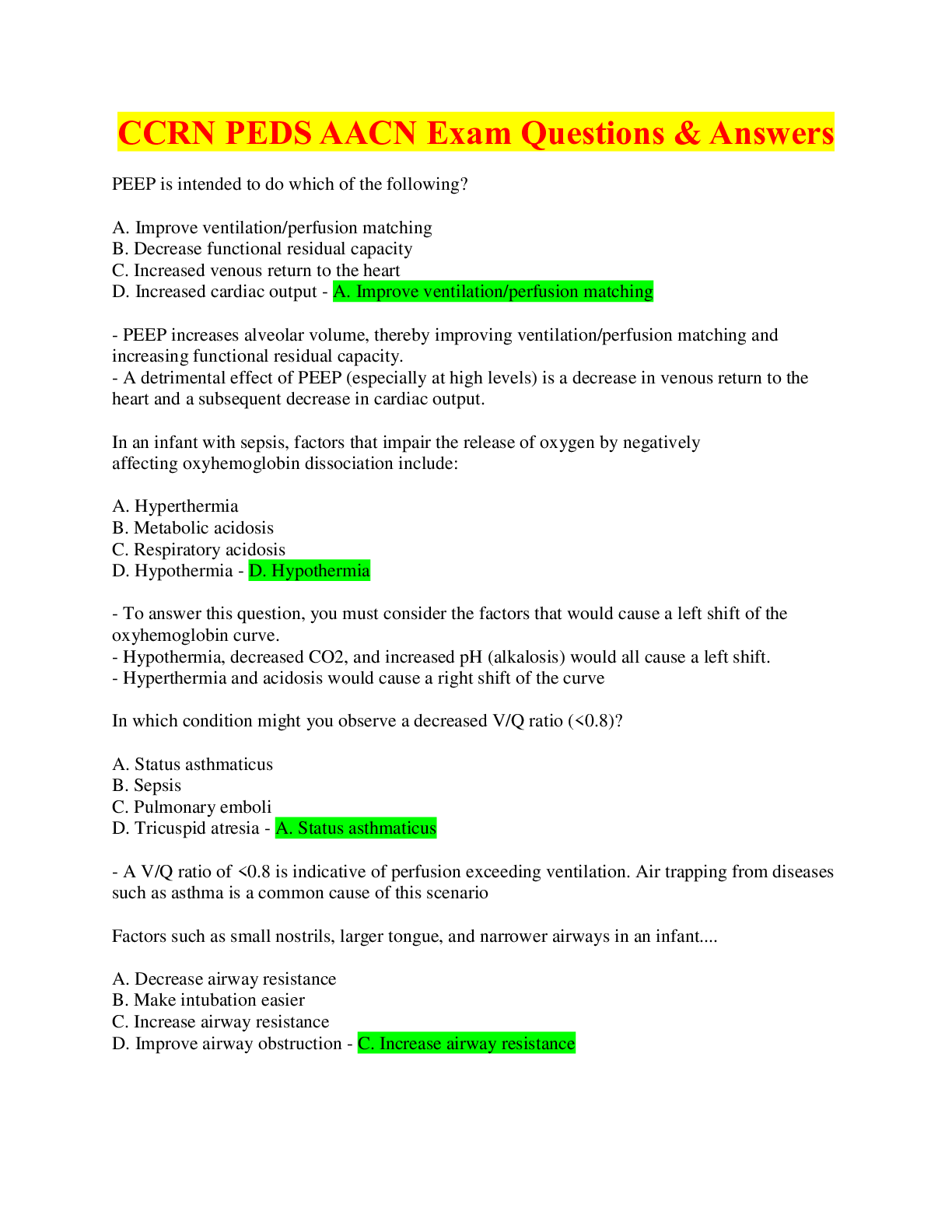
9. PEEP is intended to do which of the following?
A. increase functional residual capacity
B. decrease functional residual capacity
C. increase venous return to the heart
D. increase cardiac output ANS- increase functional residual capacity
An 8-month-old with bronchopulmonary dysplasia (BPD) is admitted with
heart failure. Nursing interventions should be done to
A. decrease preload.
B. increase afterload.
C. decrease heart rate.
D. increase contractility. ANS- decrease preload
11. A 2-month-old with a history of unrepaired Tetralogy of Fallot begins to cry
while intravenous access is attempted. Cyanosis, diaphoresis and
tachypnea are noted. Nursing interventions are aimed atA. Increasing pulmonary flow and relaxing the infundibulum.
B. Decreasing systemic flow and increasing pulmonary vascular
resistance.
C. Decreasing pulmonary flow and increasing systemic vascular resistance
(SVR).
D. Increasing systemic flow and relaxing the left ventricular outflow tract. ANSIncreasing pulmonary flow and relaxing the infundibulum.
During surgery on a 2-month-old with Tetralogy of Fallot, a trans-thoracic
PA catheter was placed. Upon removal of this line, the PA pressure is 29
mm Hg systolic. As the line is 'pulled back' into the right ventricle, the
pressure measures 72 mm Hg systolic. RA Sat=72, PA Sat=72. This
change in measurement may indicate a/an
A. right bundle branch block.
B. residual VSD.
C. incompetent pulmonic valve.
D. residual right ventricular outflow obstruction ANS- residual right ventricular outflow
obstruction
A 4-year-old has been admitted twice in the past six months for status
asthmaticus. The parents smell of smoke when they come to the hospital,
but state they don't smoke in the house. The most appropriate discharge
planning intervention would be to
A. discuss with the parents how to avoid asthma triggers at home.
B. give the parents literature about smoking cessation treatment and
support groups.
C. call Child Protective Services to report a medically unsafe home
environment.
D. remind parents they shouldn't smoke around the child. ANS- give the parents
literature about smoking cessation treatment and support groups.
A 4-year-old presents with a chief complaint of blood in her urine. A
review of the medical records shows multiple admissions for the same
symptom. No etiology has been found. The patient is symptomatic only
when the mother is present. The most appropriate diagnosis for this
patient would be
A. Munchausen syndrome by proxy.
B. non-accidental trauma.
C. physical abuse
D. sexual abuse. ANS- Munchausen syndrome by proxy
A 13-year-old male with diabetes is admitted after collapsing in class. Onadmission, he is tachycardic, has shallow respirations, dilated pupils, and
is hyperreflexic. The plan of care would be to administer
A. glucagon IM.
B. naloxone (Narcan IV).
C. 50% dextrose IV.
D. regular insulin SQ. ANS- 50% dextrose IV.
The initial therapy for children at risk for pulmonary embolus related to
venous thromboembolism from a central venous line (CVL) is
A. placement of an inferior vena cava filter.
B. administration of anticoagulants.
C. immediate removal of the CVL.
D. thrombectomy by a surgeon. ANS- administration of anticoagulants
In an infant with bronchopulmonary dysplasia (BPD), factors that impair
the release of oxygen by negatively affecting oxyhemoglobin dissociation
include
A. hyperthermia.
B. metabolic acidosis
C. respiratory acidosis
D. hypothermia ANS- hypothermia
When inhaled nitric oxide (iNO) is administered to infants with congenital
heart disease complicated by pulmonary artery hypertension, the desired
result is
A. smooth muscle relaxation.
B. pulmonary vasoconstriction.
C. pulmonary vasodilation.
D. systemic vasodilation. ANS- pulmonary vasodilation
19. A patient with hypovolemic shock is receiving fluid resuscitation.
Dopamine (Intropin) is started at 3 mcg/kg/min for
A. hypotension.
B. decreased cardiac contractility.
C. decreased heart rate.
D. renal perfusion. ANS- renal perfusion
20. A patient admitted following an acute asthma attack has been given
multiple albuterol (Proventil) inhalation treatments. The following
measurements are obtained:BP 130/78
HR 160
RR 48
FiO2 60% (by non-rebreather mask)
O2 Sat 88%
Physical findings could include which of the following?
A. wheezing and agitation
B. coughing and grunting
C. pleural rub and wheezing
D. stridor and bronchospasm ANS- wheezing and agitation
21. Respiratory therapists, physical therapists, occupational therapists and
nurses are all responsible for discharge teaching, with each discipline
currently documenting on its own flow sheet. The best way to coordinate
teaching would be to have
A. daily care conferences to review and discuss patient teaching and the
flow sheets.
B. each discipline distribute copies of its flow sheets to each team member.
C. nurses review the flow sheets of all disciplines during shift change.
D. all disciplines document patient teaching on the same flow sheet. ANS- all
disciplines document patient teaching on the same flow sheet
A 10-day-old infant is admitted with a suspected congenital heart defect, a
history of poor feeding, and sudden onset of respiratory distress and
cyanosis. Initial assessment shows:
HR 180
pH 7.28
RR 72
pCO2 30
BP 48/Doppler
pO2 48
CRT greater than 5 sec.
HCO3 16
The patient is intubated and placed on mechanical ventilation at a rate of 20;
PIP/PEEP=24/4 cm water; FiO2=100%. Subsequent ABG results show:
pH 7.27
pCO2 28
pO2 50
HCO3 15
The most probable etiology of the patient's cardiopulmonary status is
A. Tetralogy of Fallot.
B. hypoplastic left heart syndrome.C. persistent pulmonary hypertension.
D. diaphragmatic hernia. ANS- hypoplastic left heart syndrome
A teenager post cardiac arrest has a new diagnosis of hypertrophic
cardiomyopathy. The parents are concerned about what to do if their son
collapses again. The nurse's best response would be
A. "Now that your son has been diagnosed and treated, you need not
worry."
B. "Would teaching you CPR help ease your anxieties?"
C. "Do you know how to access the EMS system?"
D. "I will have your son's cardiologist talk to you." ANS- "Would teaching you CPR help
ease your anxieties?"
A child is admitted after sustaining a head injury. The most important
aspect of the nurse's continuing neurological assessment is
A. level of consciousness.
B. papillary response.
C. motor response.
D. assessment of the cranial nerves. ANS- level of consciousness
A survey reveals that all of a hospital's nurses feel that the routine 4 a.m.
chest x-rays cause an interruption in children's sleep patterns. The best
strategy for addressing this issue would be to
A. Assemble a work group to discuss the current hospital policy.
B. Reschedule all non-emergent 4 a.m. chest x-rays during daytime hours.
C. Request an in-service for the radiology department on the effects of
sleep deprivation in children.
D. Send the results of the survey to the hospital administrator. ANS- Assemble a work
group to discuss the current hospital policy
The chest x-ray of a patient with status asthmaticus will reveal
A. hyperinflation.
B. foreign-body aspiration.
C. perihilar infiltrations.
D. an elevated diaphragm ANS- hyperinflation
Which of the following rhythms is expected one day post cardiac
catheterization for repair of an arterial septal defect (ASD)?
A. premature atrial contraction
B. junctional ectopic tachycardia
C. sinus bradycardiaD. sinus tachycardia ANS- premature atrial contraction
A patient who does not speak or understand English is admitted.
Guidelines for using a translator may include
A. having the translator ask questions that you don't feel comfortable asking.
B. standing next to the translator and as close to the patient as possible.
C. providing all of the information, then allowing for translation and asking of
questions.
D. allowing time for the translator to decode the medical jargon used in the
teaching. ANS- standing next to the translator and as close to the patient as possible
An infant post cardiac surgery is displaying signs of hypovolemia. The
nurse suspects there is an increased insensible fluid loss due to
A. decreased activity.
B. hypothermia.
C. the radiant warmer.
D. sedation. ANS- the radiant warmer
The primary objective in the treatment of an infant with persistent
pulmonary hypertension is to
A. maintain the pH level at less than 7.40.
B. dilate the pulmonary vascular bed.
C. dilate the systemic vascular bed.
D. constrict the pulmonary vascular bed. ANS- dilate the pulmonary vascular bed
31. A 26-week-gestation infant with multiple congenital abnormalities dies
shortly after admission to the NICU. The parents saw the infant briefly in
the delivery room, but decline to come to the NICU. The nurse should first
A. Take the infant to the parents.
B. Refer the parents to a genetic counselor.
C. Prepare a memory box for the parents.
D. Take an instant photo of the infant to the parents. ANS- Take an instant photo of the
infant to the parents.
For an acetaminophen level of 140 mcg/mL, the treatment choice is
A. activated charcoal.
B. N-acetylcysteine (Acetadote).
C. deferoxamine (Desferal).
D. pralidoxime chloride (Protopam). ANS- N-acetylcysteine (Acetadote).33. Which of the following actions would be appropriate after the administration of
desmopressin (DDAVP) to a patient with diabetes insipidus?
A. Decreasing IV fluid rate
B. Maintaining current fluid rate
C. Increasing sodium intake
D. Decreasing glucose intake ANS- Decreasing IV fluid rate
34. A 15-year-old with acute myelogenous leukemia has undergone multiple rounds of
chemotherapy. One night, the patient tells the nurse, "I'm tired of all the chemo and I
want to stop." The nurse should
A. Explain the adolescent patients cannot legally make healthcare decisions
B. Encourage the patient to, "express these feelings to your parents."
C. Arrange for the patient to discuss the treatment plan with the physicians
D. Ask the patient, "Do you realize you could die if you stop chemotherapy?" ANSEncourage the patient to, "express these feelings to your parents."
35. A 9-year-old presents with recurrent episodes of intermittent palpitations associated
with weakness. Physical examination is unremarkable. An ECG reveals a heart rate of
125 beats per minute, a shortened PR interval and a slurred upstroke prior to each
widened QRS complex. This slurred upstroke (Delta wave) can be explained by
A. Atrial pre-excitation
B. Atrial depolarization
C. Ventricular repolarization
D. Ventricular pre-excitation ANS- Ventricular pre-excitation
36. A patient with end-stage liver failure secondary to Hepatitis C virus has been
declared brain dead. The parents decide to discontinue feedings and donate their
daughter's organs. In response to the parents' request, the most appropriate action by
the nurse would be to
A. Contact the organ procurement agency
B. Convene a multidisciplinary care conference
C. Tell the parents that their daughter's condition precludes organ donation
D. Discontinue feedings per the parents' request ANS- Contact the organ procurement
agency
37. Which of the following tests will confirm brain death in a 6-month-old?
A. Absence of spontaneous breathing when PaCO2 goes above 60 mmHg
B. Eyes deviate toward the right when ice water is injected into the ears
C. Radionuclide scan shows cerebral arterial blood flow into the brain stem
D. Low voltage amplitude observed on electroencephalogram (EEG) ANS- Absence of
spontaneous breathing when PaCO2 goes above 60 mmHg38. The acute treatment of esophageal varices includes
A. Placement of a large NGT to low intermittent suction
B. Immediate surgical intervention
C. Administration of vasopressin (Pitressin) or octreotide (Sandostatin)
D. Placement of a central venous line for hyperalimentation (TPN) ANS- Administration
of vasopressin (Pitressin) or octreotide (Sandostatin)
39. A 1-year-old who in ventilator dependent has been hospitalized since birth. He is
now being discharged home with a tracheostomy and a gastrostomy. In order to
determine the discharge needs of the patient, the should arrange for
A. Home nursing care for the first few days following discharge
B. A social worker to meet with the family and assess the adequacy of the home
environment
C. An outreach educator to determine the learning needs of the family
D. A multidisciplinary care conference prior to discharge ANS- A multidisciplinary care
conference prior to discharge
40. A 10-year old patient is intubated due to a sudden deterioration in respiratory status.
ABGs post intubation are as follows:
pH 7.31
pCO2 50
pO2 80
HCO3 22
O2 Sat 95%
The blood gases reflect
A. Respiratory acidosis
B. Respiratory alkalosis
C. Metabolic alkalosis
D. Metabolic acidosis ANS- Respiratory acidosis
41. A 4-year-old has been admitted following repair of coarctation of the aorta. The
child's vital signs are:
HR 80
BP 150/80
RR 20
CVP 10
The arterial blood gas results are:
pH 7.32
pCO2 42
pO2 96
[Show More]