CHIA Certification Exam with Complete
Solution.
What are the different kinds of affiliations a single hotel can have? -Answer- Chain
Parent Company
Operation: Corporate, Franchise, or Independent
Management Company
...
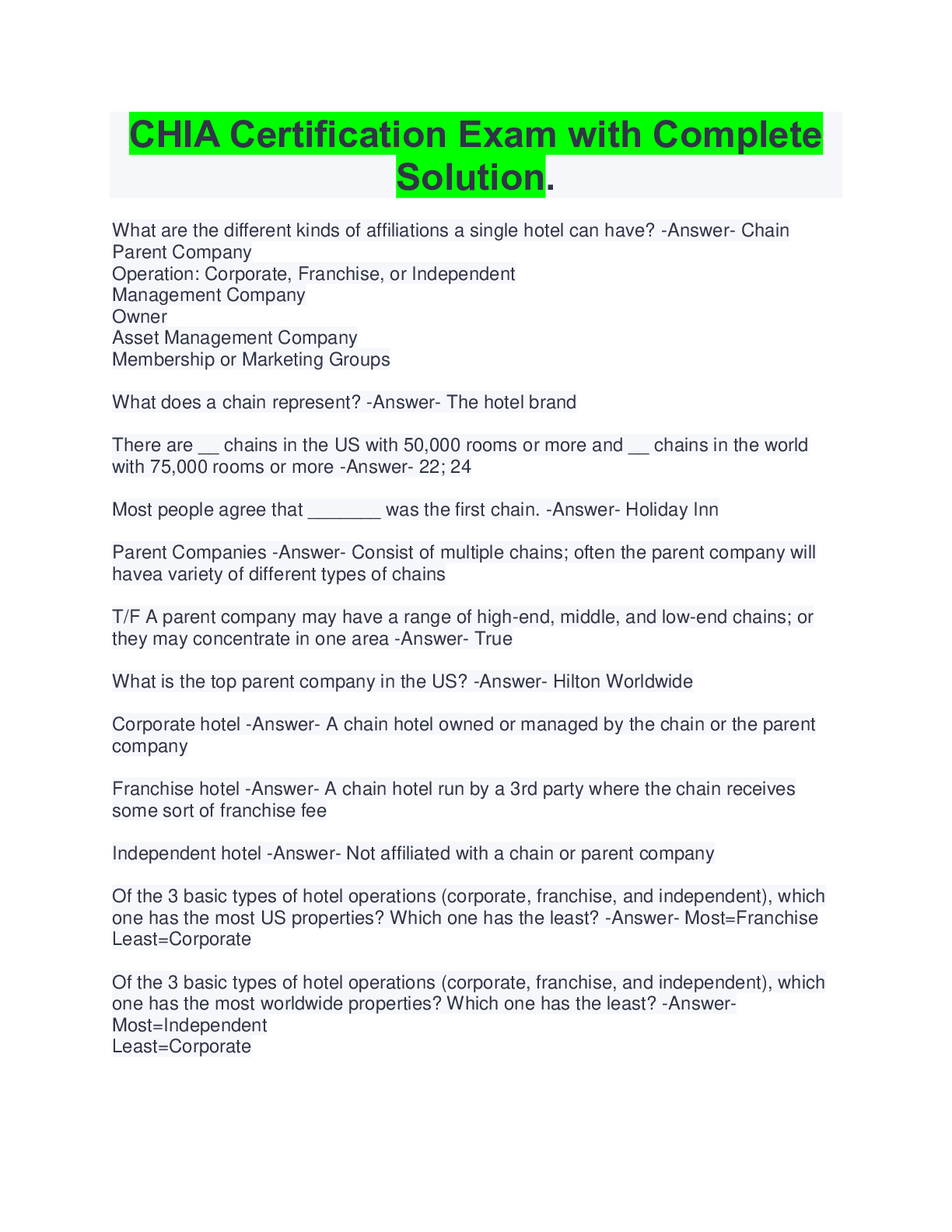
CHIA Certification Exam with Complete
Solution.
What are the different kinds of affiliations a single hotel can have? -Answer- Chain
Parent Company
Operation: Corporate, Franchise, or Independent
Management Company
Owner
Asset Management Company
Membership or Marketing Groups
What does a chain represent? -Answer- The hotel brand
There are __ chains in the US with 50,000 rooms or more and __ chains in the world
with 75,000 rooms or more -Answer- 22; 24
Most people agree that _______ was the first chain. -Answer- Holiday Inn
Parent Companies -Answer- Consist of multiple chains; often the parent company will
havea variety of different types of chains
T/F A parent company may have a range of high-end, middle, and low-end chains; or
they may concentrate in one area -Answer- True
What is the top parent company in the US? -Answer- Hilton Worldwide
Corporate hotel -Answer- A chain hotel owned or managed by the chain or the parent
company
Franchise hotel -Answer- A chain hotel run by a 3rd party where the chain receives
some sort of franchise fee
Independent hotel -Answer- Not affiliated with a chain or parent company
Of the 3 basic types of hotel operations (corporate, franchise, and independent), which
one has the most US properties? Which one has the least? -Answer- Most=Franchise
Least=Corporate
Of the 3 basic types of hotel operations (corporate, franchise, and independent), which
one has the most worldwide properties? Which one has the least? -AnswerMost=Independent
Least=CorporateWhat is the ratio of chain hotels vs. independent hotels in the US? -Answer- 70% are
chain; 30% are independent
What is the ratio of chain hotels vs. independent hotels worldwide? -Answer- 40% are
chain; 60% are independent
Management company -Answer- Operates a hotel for another party; the company has a
management contract where it receives payment/some portion of profits
T/F Some chains or parent companies manage their own hotels -Answer- True
Owner companies -Answer- There are many companies that own multiple hotels
Asset management company -Answer- Represents the owner in the operation of a hotel
T/F A hotel cannot have both a management company and an asset management
company -Answer- False. They can.
T/F The Holiday Inn and Holiday Inn Express are 2 different chains -Answer- True
What are the 3 classifications of operation types? -Answer- 1. Corporate
2. Franchise
3. Independent
T/F There is a very strong trend for US hotels to expand internationally because the
opportunity for large US chains is there -Answer- True
Describe the average independent hotel in the US -Answer- Classified as Economy,
Located in a Suburban area, and has 25 rooms or less
Most of the entities below are classified as chains. Which one is a parent company
consisting of multiple chains?
A. Hampton Inn
B. Motel 6
C. Choice
D. Holiday Inn Express -Answer- C. Choice
Which is a true statement about parent companies?
A. They and their related chains have changed over time
B. They must consist of no more than 5 chains.
C. They can only consist of chains in a single Scale.
D. They can only have hotels in a single country. -Answer- A. They and their related
chains have changed over time
Which is a true statement about independent hotels?
A. Independent hotels are not affiliated with a specific chain.B. Chain hotels outnumber independent hotels in every country of the world.
C. Independent hotels are mostly Luxury class hotels in Urban locations with more than
150 rooms
D. Independent hotels may never be managed by an outside entity. -Answer- A. They're
not affiliated with a specific chain.
Which is a true statement about management companies?
A. They have contracts where they receive payment for their services and/or some
portion of the profits.
B. They may manage only one chain.
C. They will always own the hotels they manage.
D. They serve the exact same role as asset management companies. -Answer- A. They
have contracts...
What are the major geographic categories? -Answer- World
Continent
Sub-continent
Country
Market
Tract or Submarket
What are the 4 continents (according to STR)? -Answer- Americas, Europe,
Mideast/Africa, and Asia Pacific
Each continent includes how many sub-continents? -Answer- 3-4
What are the 9 US regions? -Answer- New England
Middle Atlantic
South Atlantic
East North Central
East South Central
West North Central
West South Central
Mountain
Pacific
What are the 2 most important types of classifications if you're a hotel manager (not a
corporation)? -Answer- Market and Tract/Sub-market
What is STR's definition of a region? -Answer- It refers to a specific region WITHIN a
country
How are markets created? -Answer- Based on the number of hotels in the area and
participation
The US is broken up into _____ geographic areas called markets -Answer- 163T/F Markets can cross state borders -Answer- True
There are _____ tracts in the US -Answer- 628
Revisions to markets and tracts are made at the _______. -Answer- end of the year
(after Dec. and before Jan.); changes are not made during the year
Tracts -Answer- Geographic sub-divisions of a market
There may be anywhere from ___ to ___ tracts in a market -Answer- 2-10
In a metro market, there is usually a tract from the downtown area, sometimes called
the _________ -Answer- Central Business District
Outside of North America, the term ______ is used instead of Tract. -AnswerSubmarket
What are the revisions to markets and tracts based upon? -Answer- -Supply (new hotels
opening)
-Participation (new hotels submitting performance data)
-Client feedback
T/F STR uses the UNWTO definitions when it comes to recognizing countries -AnswerTrue
T/F No market will ever cross country borders -Answer- True
What are the 7 Scale categories? -Answer- 1. Luxury chains
2. Upper upscale chains
3. Upscale chains
4. Upper midscale chains
5. Midscale chains
6. Economy chains
7. Independents
What is the average ADR for Luxury chains? -Answer- $300
What is the average ADR for Economy chains? -Answer- $50
What is the average ADR of the Independent Scale group? -Answer- $100
T/F When a chain is categorized in a specific Scale group, that means every hotel in
that chain is in that Scale group everywhere in the world, in every country and market. -
Answer- TrueChains are positioned in Scale groups based upon what? -Answer- ADR
How are chains sorted by their ADR amount? -Answer- From high to low
T/F Breakpoints between Scale groups stay the same every year -Answer- False. They
may move up and down slightly from year to year
What's the difference between Class and Scale categories? -Answer- The class
category has no "independent" class group; so there's only 6 class categories, instead
of 7
How do Independent hotels fit into different Class categories? -Answer- They're slotted
into the Scale categories (Luxury through Economy) at similar ADR levels
T/F Chain hotels are always in the same Class as Scale. -Answer- True. A Ritz-Carlton
will always be in the Luxury class group since it's in the Luxury Scale group
Class is used globally, but is especially popular where? -Answer- Outside of North
America where there are more independent hotels
When are independent hotels grouped into Classes? -Answer- At the beginning of the
year based on the annual data for the prior year
What is the ADR range for Luxury chains? -Answer- $150-$220
What is the ADR range for Upper Upscale chains? -Answer- $120-$150
What is the ADR range for Upscale chains? -Answer- $100-$120
What is the ADR range for Upper Midscale chains? -Answer- $85-$100
What is the ADR range for Midscale chains? -Answer- $70-$85
What is the ADR range for Economy chains? -Answer- $55-$70
Urban area -Answer- Large metro cities
Suburban area -Answer- The suburbs of metro cities
Airport area -Answer- Close to a major airport
Interstate area -Answer- Close to a major highway
Resort area -Answer- Primarily leisure destination hotels
Small Metro/Town area -Answer- Smaller metro areasT/F Extended stay is a Scale category -Answer- False
Typical guests of extended stay hotels stay _____ night(s) -Answer- 4-7
T/F A single hotel can be categorized as multiple types -Answer- True
What are the Type categories used by STR? -Answer- All Inclusive
All Suite
B&B/Inn
Boutique
Condo
Conference
Convention
Corporate Housing
Destination Resort
Timeshare
Boutique hotels -Answer- Properties with rooms and public spaces that offer unique,
contemporary, and distinctive design/decor
Boutique hotels generally have an estimated room rate of _______ and ______ rooms -
Answer- $175 or higher; fewer than 200 rooms
Destination resorts appeal to what kind of traveler? -Answer- Leisure travelers
There are ___ destination resorts in the US -Answer- 334
What is benchmarking in the hotel industry? -Answer- Individual hotels compare their
performance to the performance of a "competitive set" of hotels
Competitive set -Answer- A group of hotels used primarily for comparison against a
subject property for performance benchmarking purposes
How are comp sets used? -Answer- -Benchmarking
-Aids the sales and marketing dept.
-Used in management contracts for performance requirments (often determines
managers' compensation)
-Used for internal and external analysis
Hotel staff historically performed _______, where they would talk to staff from
competitive hotels -Answer- "call arounds"; They also used to count cars in parking lots
or windows with lights on_________ means finding the averages based on the data from a group of hotels so
that each individual hotel is protected from exploitation of their specific data -AnswerAggregating
What is the most recent case that involved anti-competition actions? -Answer- 5 La
Quinta hotels in Conneticut in April 2010
When are comp sets created? -Answer- They're created by the time the hotel opens.
Sometimes they're created long before the hotel opens while it is still under
construction. that way the new hotel staff can track the performance of the comp set
prior to the opening of the hotel
Who are the stakeholders when choosing a comp set? -Answer- -Management
company
-GM
-Chain company
-The sales and marketing team
What are the 4 P's you must think of when deciding upon a comp set? -AnswerParticipation
Proximity
Pricing
Product
Participation means 4 different types of data. What are they? -Answer- Monthly
Daily
Segmentation (many hotels submit Rooms Sold and Revenue broken down by
Transient, Group, and Contract)
Additional Revenue (some hotels submit Food and Bev and Other Revenue in addition
to Room Revenue)
T/F When it comes to Class (and Scale), higher end hotels tend to select competitors
that are below them in their Comp Set and vice versa. -Answer- True
What are the key elements of Product (when choosing a comp set)? -Answer- Number
of Rooms
Open Date
Hotel Type
Meeting Space
Amenities
What is the first rule in creating comp sets? -Answer- Sufficiency. In North America,
comp sets must include 3 or more hotels in addition to the subject (though they're
encouraged to have at least 4 or more). Outside of North America, comp sets must
include 4 or more hotels in addition to the subject.Explain the rule of "percentage checks" when creating comp sets. -Answer- Help to
ensure that the data of a single hotel, chain, or company is not isolated.
Comp set rule: No single property or chain can account for more than ____% of the total
participating room supply of a comp set (____% outside of America). -Answer- 40%;
50%
Comp set rule: No single company can account for more than ____% of the total
participating room supply of a comp set. -Answer- 60%
The average number of hotels in a primary comp set is between ____ -Answer- 5-6
Explain the "Nameback" percentage -Answer- In the US, only 45.13% of the properties
in your primary comp set name you in their primary comp set
Explain the "Reverse Comp Set" -Answer- The specific properties that name your hotel
in their comp set
The avg. US hotel is named as a competitor by ____ hotels that aren't in its comp set -
Answer- 2.8
Why are comp sets changed? -Answer- -Changes in the subject hotel (i.e. renovation,
new management, contract changes, etc.)
-Changes in the market (i.e. new competitive hotels open)
-Strategic changes (i.e. repositioning, improving comp set strength)
When are comp sets changed? -Answer- You can change your comp set at any time,
although many people wait until the beginning of the year
What are the rules related to changes that address "isolation" issues (comp sets)? -
Answer- -If a property wishes to change their comp set, they must do so by a net
change of 2 or more properties
-If only making a change with 2 properties, both must be in a different chain, parent
company and management company from the subject hotel
What are the exceptions to the "change rules" for comp sets? -Answer- -A hotel can add
a brand new property which has been open less than 6 months
-A hotel can remove a property from its comp set that has stopped participating after 3
months
What does a Trend Report show? -Answer- Performance information (5+ years) for a
potential set of competitive hotels
What does a "One-time Run" show? -Answer- Less performance information (18
months) for a potential comp set in the form of a STAR reportT/F There are many cases where hotels have more than one comp set -Answer- True
T/F A second comp set must differ from the primary comp set by at least 2 properties -
Answer- True
What are the reasons for additional comp sets? -Answer- -Local vs. regional
-Subject hotel is b/w 2 markets or cities
-Aspirational
-Diff. sets focusing on diff. chains
-Diff. set for special niche
-Index-focused
-Diff. sets for weekday/weekend or group/transient mix
-Diff. entities may not agree (chain vs. management company)
-An old comp set is linked to a prior contract
-Hotel wants to be compared to a diff. industry segment
Scale categorization is based on worldwide _________ -Answer- ADR
Benchmarking in the hotel industry takes place at what level?
A. Property level for an individual hotel vs. their comp set
B. Corporate level for a hotel company, for ex. one brand vs. others
C. Geographic level for tourism organizations, for ex. city vs. comparable cities
D. All of the above levels -Answer- D.
Comp sets are used for many purposes in hotel operations, which one of the following is
one of these purposes?
A. Comp sets can be used to aid the sales and marketing depts. in determining the
effectiveness of various pricing decisions
B. Comp sets can be used in management contracts for performance requirements
C. Comp sets can have an effect on a general manager's compensation
D. All of the above are examples of how they're used -Answer- D.
All of the following are good reasons for a hotel to have an additional comp set, except
which one?
A. Have a local comp set based upon geography and another based upon a special
feature or nice, for ex: waterpark, boutique, or conference
B. Have diff. sets for weekday/weekend or group/transient business
C. Have one set that you can easily beat and another which is a realistic target
D. Different entities may not agree, for ex., chain vs. management company -AnswerC.
When can a comp set be created?
A. Once the hotel has opened
B. While the hotel is under construction
C. On the one year anniversary of a hotel's opening
D. 3 months before the hotel opens -Answer- BWho creates a comp set for a chain hotel?
A. Only the general manager
B. Only the revenue manager
C. Only the sales and marketing managers
D. It is a joint effort involving many stakeholders -Answer- D.
Which is a valid rule related to creating a comp set?
A. Comp sets must include 5 or more hotels
B. No single property or chain can account for more than 50% of the total participating
room supply of a comp set
C. No single company can account for more than 75% of the total participating rom
supply of a comp set
D. when percentages are calculated, the rooms of the subject hotel, as well as the same
chain and parent company, are excluded -Answer- D.
What is a Reverse Comp Set?
A. Properties that have seen a significant decline in occupancy
B. Properties that have recently changed affiliations
C. Properties that you use to have included in your comp set
D. Properties that name your hotel in their comp set -Answer- D.
Which is NOT a valid rule related to changing a comp set?
A. If adding 2 hotels to a comp set, both must be in diff. chains
B. A single hotel may be added to a comp set if it has been open less than 6 months
C. A single hotel may be added to a comp set at any time
D. Any change must involve 2 or more hotels, i.e. add one/drop one, add 2, drop 2, etc.
-Answer- C.
How does STR obtain raw data? -Answer- Most raw property sales data is directly
exported from the systems of the hotel companies. Companies send STR a raw data file
each month, week, and/or day
How does STR calculate Supply (Rooms Available)? -Answer- The number of rooms in
a hotel multiplied by the days in the month
How does STR calculate Demand (Rooms Sold)? -Answer- The number of rooms sold
by a hotel, does not include complimentary rooms or "no shows"
How does STR calculate Revenue? -Answer- Total room revenue generated from the
sale of rooms, not including taxes; Includes service charges not resort fees, nothing
else such as F&B
What are the 3 hotel industry key performance indicators (KPIs)? -Answer- 1.
Occupancy (%)
2. ADR ($)3. Revenue per Available Room/RevPAR ($)
__________ is the percentage of available rooms that were sold during a specific time
period -Answer- Occupancy
How is occupancy calculated? -Answer- Demand/Supply or Rooms sold/Rooms
available
In what scenario could a hotel have a monthly occupancy greater than 100%? -AnswerAn airport hotel that could actually sell the same room twice in the same day
Is it more common for a hotel to have a daily occupancy exceeding 100% or a monthly
occupancy exceeding 100% -Answer- Daily
_________ is a measure of the average rate paid for rooms sold during a specific time
period -Answer- ADR
How is ADR calculated? -Answer- Revenue/Demand
_________ is a measure of the revenue that is generated by a property in terms of each
room available. -Answer- RevPAR
How does RevPAR differ from ADR? -Answer- RevPAR is affected by the amount of
unoccupied rooms, while ADR only shows the avg rate of rooms actually sold
How is RevPAR calculated? -Answer- Revenue/Supply or ADR*Occupancy
In most cases, the RevPAR amount should be ________ than the ADR amount -
Answer- lower
Frequently, when a hotel is evaluated or measured, ________ is the metric that's being
looked at -Answer- RevPAR
How do you calculate percent changes (when comparing this year and last year)? -
Answer- (This year-Last year)/Last Year*100
If the Occupancy was 83% this year compared to 82% last year, the Point Change
would be ______ and the Percent Change would be ______ -Answer- 1 and 2
If Occupancy Percent Change is 4% and ADR Percent Change is 4%, then RevPAR
Percent Change will roughly be ______ -Answer- 8%
If Occupancy Percent Change is 2% and ADR Percent Change is -2%, then RevPAR
Percent Change will roughly be _______ -Ans
[Show More]