Management > EXAMs > OT Code of Ethics QUESTIONS AND ANSWERS (All)
OT Code of Ethics QUESTIONS AND ANSWERS
Document Content and Description Below
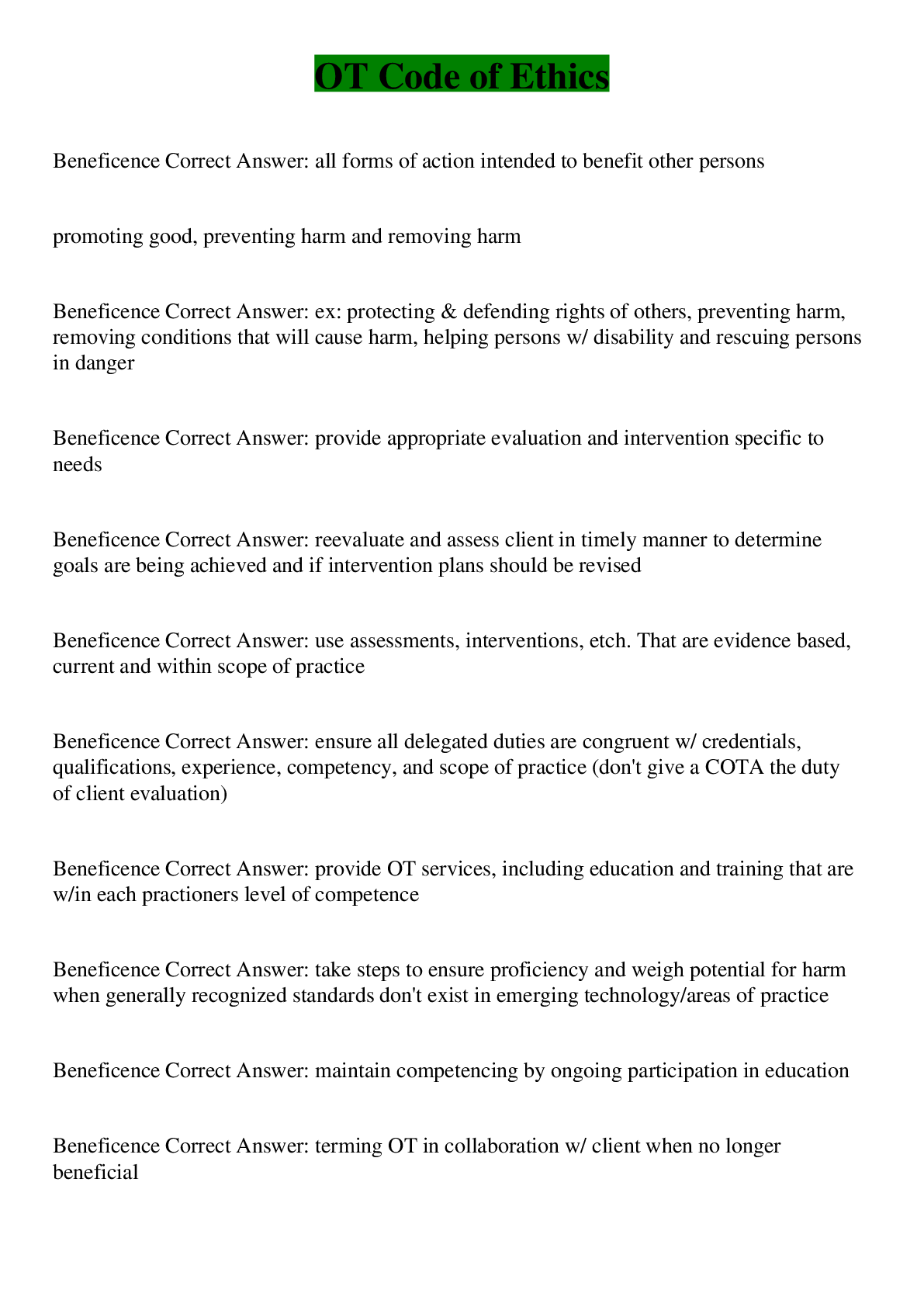
Beneficence Correct Answer: all forms of action intended to benefit other persons promoting good, preventing harm and removing harm Beneficence Correct Answer: ex: protecting & defending right ... s of others, preventing harm, removing conditions that will cause harm, helping persons w/ disability and rescuing persons in danger Beneficence Correct Answer: provide appropriate evaluation and intervention specific to needs Beneficence Correct Answer: reevaluate and assess client in timely manner to determine goals are being achieved and if intervention plans should be revised Beneficence Correct Answer: use assessments, interventions, etch. That are evidence based, current and within scope of practice Beneficence Correct Answer: ensure all delegated duties are congruent w/ credentials, qualifications, experience, competency, and scope of practice (don't give a COTA the duty of client evaluation) Beneficence Correct Answer: provide OT services, including education and training that are w/in each practioners level of competence Beneficence Correct Answer: take steps to ensure proficiency and weigh potential for harm when generally recognized standards don't exist in emerging technology/areas of practice Beneficence Correct Answer: maintain competencing by ongoing participation in education Beneficence Correct Answer: terming OT in collaboration w/ client when no longer beneficial Beneficence Correct Answer: refer to other providers when indicated by needs of client Beneficence Correct Answer: conduct research while following ethical guidelines, including determination of potential risks and benefits Nonmaleficence Correct Answer: abstain from causing harm to others obligation to not impose risks of harm even if potential risk is w/out malicious or harmful intent often examined under context of due care: requires that goals pursued justify the risks that must be imposed to achieve those goals Nonmaleficence Correct Answer: ex. In OT, this standard applies to situations in which the ct might feel pain from a treatment intervention, however acture pain in justified by potential evidence based benefits, using due care to avoid harm during transfers by locking w/c and bed brakes, not practicing OT under influence of drugs/alcohol Nonmaleficence Correct Answer: avoid inflicting harm or injury Nonmaleficence Correct Answer: avoid abandoning the client by facilitating appropriate transitions when unable to provide services Nonmaleficence Correct Answer: recognize and take action to remedy personal problems and limitations that might cause harm to client, students, etc. Nonmaleficence Correct Answer: avoid any undue influences that may impair practice (drugs?) Nonmaleficence Correct Answer: address impaired practice and report to appropriate authorities Nonmaleficence Correct Answer: avoid dual relations, conflicts of interest or any situations when a OT is unable to maintain professional boundaries Nonmaleficence Correct Answer: avoid engaging in sexual acuity w/ client (including client family member, student or employee) while professional relationship exists Nonmaleficence Correct Answer: avoid compromisiting rights or well being of others based on arbitrary directives (unrealistic productivity, falsification of documentation, inaccurate coding) Nonmaleficence Correct Answer: avoid exploiting any relationship Nonmaleficence Correct Answer: avoid bartering for services when there is the potentials for exploitation and conflict of interest Autonomy (Client HAS RIGHT TO MAKE DECISIONS, HIPPA) Correct Answer: practitioners have a duet to treat the cleint according to clients desires, w/in boundaries of accepted standard of care and to protect clients confidential info often referred to as self-determination principle: acknowledges persons right to hold views, make choices an take actions based on their values & beliefs Autonomy Correct Answer: in event that a person lacks decision-making capacity, their ________ should be respected through an authorized agent or surrogate decision maker Autonomy Correct Answer: respect and honor wishes of client Autonomy Correct Answer: fully disclose benefits, risks and potential outcomes of any intervention and any reasonable alternatives Autonomy Correct Answer: obtain consent after disclosing appropriate info and answering questions Autonomy Correct Answer: establish collaborative relationship Autonomy Correct Answer: respects clients right to refuse therapy even when refusal has potential to result in poor outcomes Autonomy Correct Answer: refrain from threatening, coercing or deceiving clients to promote compliance with recommendations Autonomy Correct [Show More]
Last updated: 3 years ago
Preview 1 out of 8 pages
Buy this document to get the full access instantly
Instant Download Access after purchase
Buy NowInstant download
We Accept:

Reviews( 0 )
$6.00
Can't find what you want? Try our AI powered Search
Document information
Connected school, study & course
About the document
Uploaded On
Sep 22, 2022
Number of pages
8
Written in
All

Additional information
This document has been written for:
Uploaded
Sep 22, 2022
Downloads
0
Views
47