NR 507 Anemia pathophysiology
Anemia - ans --_______ is a hematological disorder characterized by a reduction in the
total number of circulating red blood cells (RBCs) and/or a decrease in hemoglobin (Hb)
amount or
...
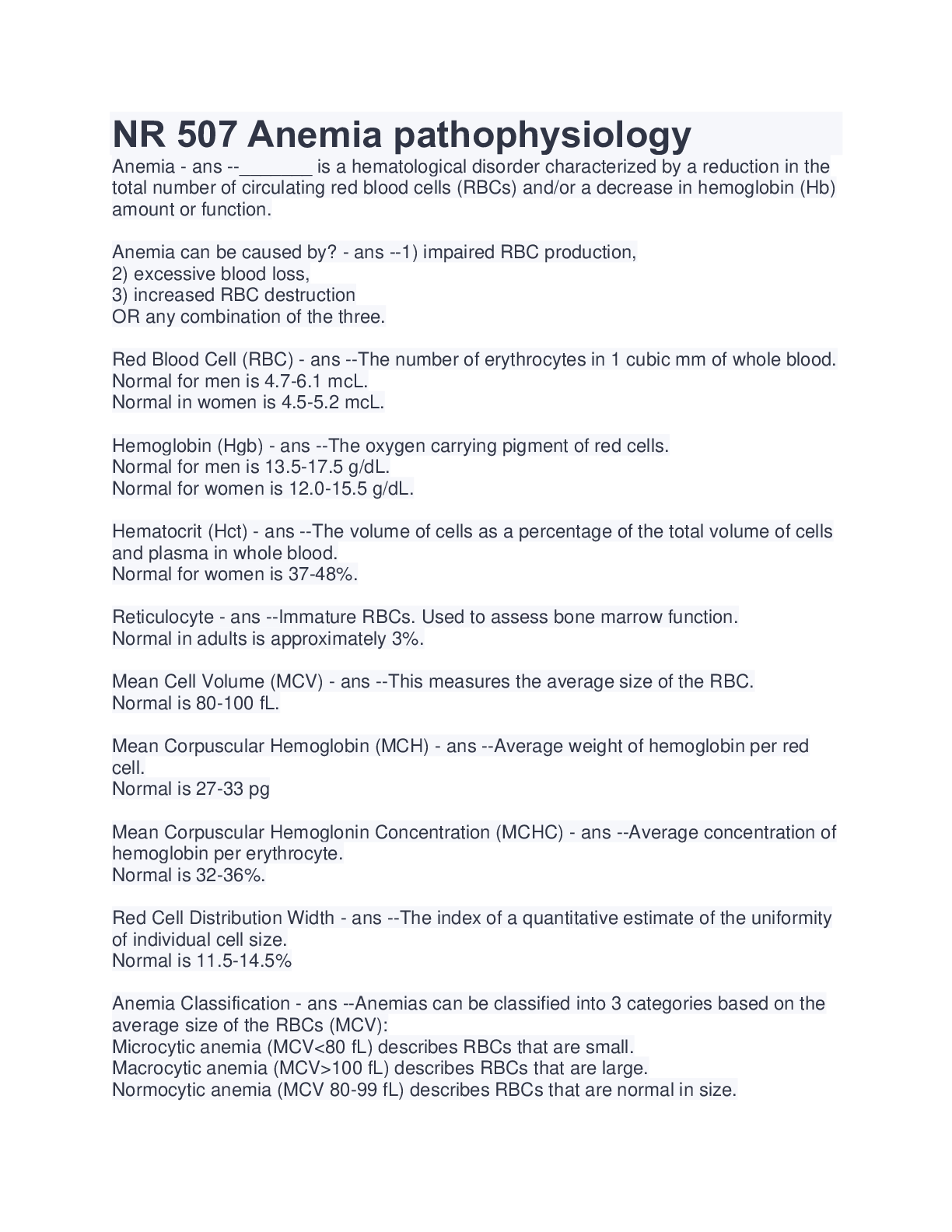
NR 507 Anemia pathophysiology
Anemia - ans --_______ is a hematological disorder characterized by a reduction in the
total number of circulating red blood cells (RBCs) and/or a decrease in hemoglobin (Hb)
amount or function.
Anemia can be caused by? - ans --1) impaired RBC production,
2) excessive blood loss,
3) increased RBC destruction
OR any combination of the three.
Red Blood Cell (RBC) - ans --The number of erythrocytes in 1 cubic mm of whole blood.
Normal for men is 4.7-6.1 mcL.
Normal in women is 4.5-5.2 mcL.
Hemoglobin (Hgb) - ans --The oxygen carrying pigment of red cells.
Normal for men is 13.5-17.5 g/dL.
Normal for women is 12.0-15.5 g/dL.
Hematocrit (Hct) - ans --The volume of cells as a percentage of the total volume of cells
and plasma in whole blood.
Normal for women is 37-48%.
Reticulocyte - ans --Immature RBCs. Used to assess bone marrow function.
Normal in adults is approximately 3%.
Mean Cell Volume (MCV) - ans --This measures the average size of the RBC.
Normal is 80-100 fL.
Mean Corpuscular Hemoglobin (MCH) - ans --Average weight of hemoglobin per red
cell.
Normal is 27-33 pg
Mean Corpuscular Hemoglonin Concentration (MCHC) - ans --Average concentration of
hemoglobin per erythrocyte.
Normal is 32-36%.
Red Cell Distribution Width - ans --The index of a quantitative estimate of the uniformity
of individual cell size.
Normal is 11.5-14.5%
Anemia Classification - ans --Anemias can be classified into 3 categories based on the
average size of the RBCs (MCV):
Microcytic anemia (MCV<80 fL) describes RBCs that are small.
Macrocytic anemia (MCV>100 fL) describes RBCs that are large.
Normocytic anemia (MCV 80-99 fL) describes RBCs that are normal in size.
Microcytic (MCV<80 fL) - ans --Iron deficiency
Sideroblastic
Thalassemia
Anemia of chronic disease
Normocytic (MCV 80-99 fL) - ans --Anemia of inflammation and chronic disease
Hereditary spherocytosis**
G6PD deficiency
Paroxysmal nocturnal hemoglobinuria
[Show More]