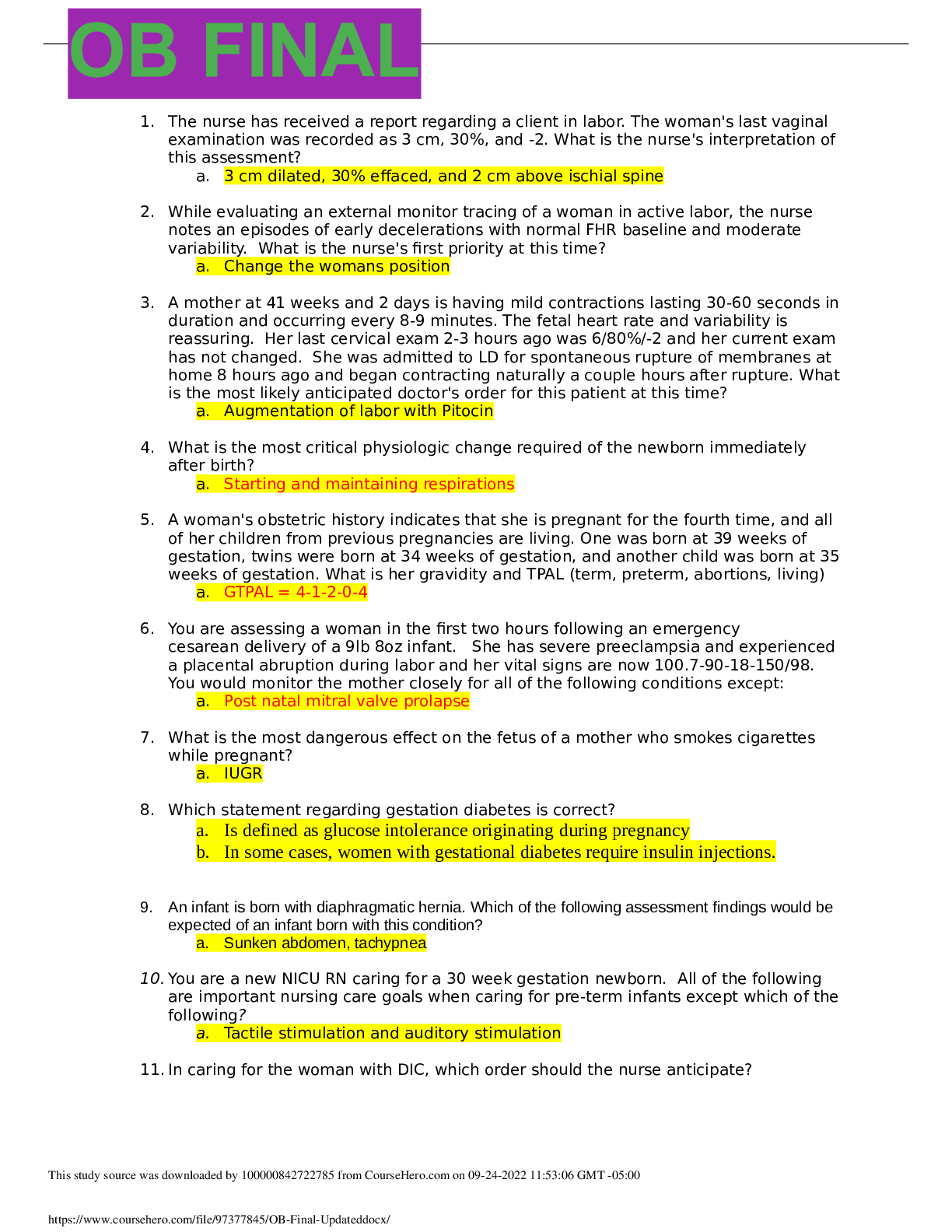
1. The nurse has received a report regarding a client in labor. The woman's last vaginal
examination was recorded as 3 cm, 30%, and -2. What is the nurse's interpretation of
this assessment?
a. 3 cm dilated, 30% effac
...
1. The nurse has received a report regarding a client in labor. The woman's last vaginal
examination was recorded as 3 cm, 30%, and -2. What is the nurse's interpretation of
this assessment?
a. 3 cm dilated, 30% effaced, and 2 cm above ischial spine
2. While evaluating an external monitor tracing of a woman in active labor, the nurse
notes an episodes of early decelerations with normal FHR baseline and moderate
variability. What is the nurse's first priority at this time?
a. Change the womans position
3. A mother at 41 weeks and 2 days is having mild contractions lasting 30-60 seconds in
duration and occurring every 8-9 minutes. The fetal heart rate and variability is
reassuring. Her last cervical exam 2-3 hours ago was 6/80%/-2 and her current exam
has not changed. She was admitted to LD for spontaneous rupture of membranes at
home 8 hours ago and began contracting naturally a couple hours after rupture. What
is the most likely anticipated doctor's order for this patient at this time?
a. Augmentation of labor with Pitocin
4. What is the most critical physiologic change required of the newborn immediately
after birth?
a. Starting and maintaining respirations
5. A woman's obstetric history indicates that she is pregnant for the fourth time, and all
of her children from previous pregnancies are living. One was born at 39 weeks of
gestation, twins were born at 34 weeks of gestation, and another child was born at 35
weeks of gestation. What is her gravidity and TPAL (term, preterm, abortions, living)
a. GTPAL = 4-1-2-0-4
6. You are assessing a woman in the first two hours following an emergency
cesarean delivery of a 9lb 8oz infant. She has severe preeclampsia and experienced
a placental abruption during labor and her vital signs are now 100.7-90-18-150/98.
You would monitor the mother closely for all of the following conditions except:
a. Post natal mitral valve prolapse
7. What is the most dangerous effect on the fetus of a mother who smokes cigarettes
while pregnant?
a. IUGR
8. Which statement regarding gestation diabetes is correct?
a. Is defined as glucose intolerance originating during pregnancy
b. In some cases, women with gestational diabetes require insulin injections.
9. An infant is born with diaphragmatic hernia. Which of the following assessment findings would be
expected of an infant born with this condition?
a. Sunken abdomen, tachypnea
10. You are a new NICU RN caring for a 30 week gestation newborn. All of the following
are important nursing care goals when caring for pre-term infants except which of the
following?
a. Tactile stimulation and auditory stimulation
11. In caring for the woman with DIC, which order should the nurse anticipate?
This study source was downloaded by 100000842722785 from CourseHero.com on 09-24-2022 11:53:06 GMT -05:00
https://www.coursehero.com/file/97377845/OB-Final-Updateddocx/
a. Administration of blood
b. Preparation of the client for invasive hemodynamic monitoring
c. Restriction of intravascular fluids
d. Administration of steroids
12. An 18-year-old client who has reached 21 weeks of gestation was recently diagnosed
with pregestational diabetes. She attends her appointment accompanied by one of
her girlfriends. This young woman appears more concerned about how her pregnancy
will affect her social life than her recent diagnosis of diabetes. A number of nursing
diagnoses are applicable to assist in planning adequate care. What is the most
appropriate diagnosis at this time?
a. Knowledge deficit related to maternal gestational diabetes
13. A premature infant with respiratory distress syndrome (RDS) receives artificial
surfactant. How does the nurse explain surfactant therapy to the parents?
a. Helps keep the alveoli open to promote exchange of oxygen and carbon
dioxide
14. A premature infant never seems to sleep longer than an hour at a time. Each time a
light is turned on, an incubator closes, or people talk near her crib, she wakes up and
inconsolably cries until held. What is the correct nursing diagnosis beginning with
"ineffective coping, related to"?
a. Environmental stress
15. A pregnant woman arrives at the birth unit in labor at term, having had no prenatal
care. After birth, her infant is noted to be small for gestational age with small eye
openings, flat nasal bridge, and a thin upper lip. The infant is also microcephalic.
Based on her infant's physical findings, this woman should be questioned about her
use of which substance during pregnancy?
a. Alcohol
[Show More]










.png)

