Extra Credit HESI Module 2 – Health Promotion and Disease Prevention
1. Questions
1. 1.ID: 9477077870
A nurse performing a physical assessment of a client gathers both subjective
and objective data. Which finding wou
...
Extra Credit HESI Module 2 – Health Promotion and Disease Prevention
1. Questions
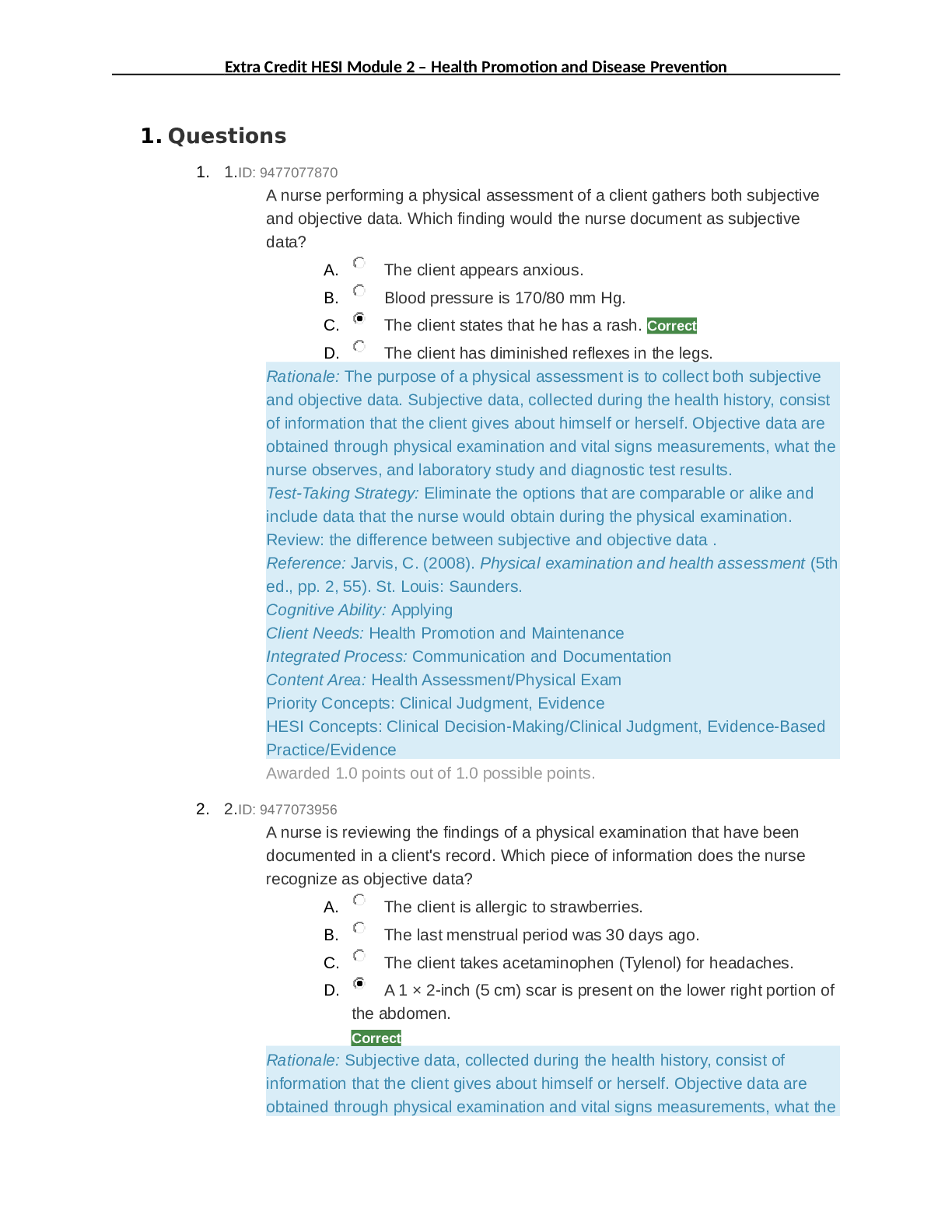
1. 1.ID: 9477077870
A nurse performing a physical assessment of a client gathers both subjective
and objective data. Which finding would the nurse document as subjective
data?
A. The client appears anxious.
B. Blood pressure is 170/80 mm Hg.
C. The client states that he has a rash. Correct
D. The client has diminished reflexes in the legs.
2. 2.ID: 9477073956
A nurse is reviewing the findings of a physical examination that have been
documented in a client's record. Which piece of information does the nurse
recognize as objective data?
A. The client is allergic to strawberries.
B. The last menstrual period was 30 days ago.
C. The client takes acetaminophen (Tylenol) for headaches.
D. A 1 × 2-inch (5 cm) scar is present on the lower right portion of
the abdomen.
3. 3.ID: 9477071188
A nurse is making an initial home visit to a client with chronic obstructive
pulmonary disease who was recently discharged from the hospital. Which type
of database does the nurse use to obtain information from the client?
A. Episodic
B. Follow-up
C. Emergency
D. Complete Correct
4. 4.ID: 9477071128
A nurse is examining a 25-year-old client who was seen in the clinic 2 weeks
ago for symptoms of a cold and is now complaining of chest congestion and
cough. The nurse should proceed with the examination by collecting which?
A. Data related to follow-up care
B. A complete (total health) database Incorrect
C. Data related to the respiratory system Correct
D. Data related to the treatment for the cold
5. 5.ID: 9477071111
A client is brought to the emergency department after a motor vehicle accident.
The client is alert and cooperative but has sustained multiple fractures of the
legs. How should the nurse proceed with data collection?
A. Collect health history information first, then perform the
physical examination
Extra Credit HESI Module 2 – Health Promotion and Disease Prevention
B. Ask health history questions while performing the examination
and initiating emergency measures Correct
C. Collect all information requested on the history form, including
social support, strengths, and coping patterns
D. Perform emergency measures and not ask any health history
questions until the client's fractures have been treated in the
operating room
6. 6.ID: 9477073919
A client who was given a diagnosis of hypertension 3 months ago is at the clinic
for a checkup. Which type of database does the nurse use in performing an
assessment?
A. Emergency
B. Follow-up Correct
C. Complete (total)
D. Problem-centered
7. 7.ID: 9477073943
A Mexican-American client with epilepsy is being seen at the clinic for an initial
examination. What is the primary purpose of including cultural information in
the health assessment?
A. Confirm the medical diagnosis
B. Make accurate nursing diagnoses
C. Identify any hereditary traits related to the epilepsy
D. Determine what the client believes has caused the
epilepsy Correct
8. 8.ID: 9477071171
A nurse performing a skin assessment uses the back of the hand to feel the
client's skin on both arms and notes that the skin is warm. What does the nurse
determine?
A. The client has a fever
B. The skin temperature is normal Correct
C. The client needs to drink additional fluids
D. The client needs to have the blanket removed
9. 9.ID: 9477071124
A nurse performing a skin assessment notes that the client's skin is very dry.
How should the nurse document this finding?
A. Xerosis Correct
B. Pruritus
Extra Credit HESI Module 2 – Health Promotion and Disease Prevention
C. Seborrhea
D. Actinic keratoses
\
10. 10.ID: 9477073962
A nurse is preparing to perform a skin examination with the use of a Wood light.
Which action should the nurse perform to prepare for this diagnostic test?
A. Darken the room Correct
B. Obtain informed consent from the client
C. Obtain a scalpel and a slide for diagnostic evaluation
D. Obtain medication to anesthetize the skin area before
proceeding with the examination
[Show More]