Extra Credit HESI Module 5
1. Questions
1. 1.ID: 9477027534
A client with leukemia is being considered for a bone marrow transplant. The
healthcare team is discussing the risks and benefits of this treatment and othe
...
Extra Credit HESI Module 5
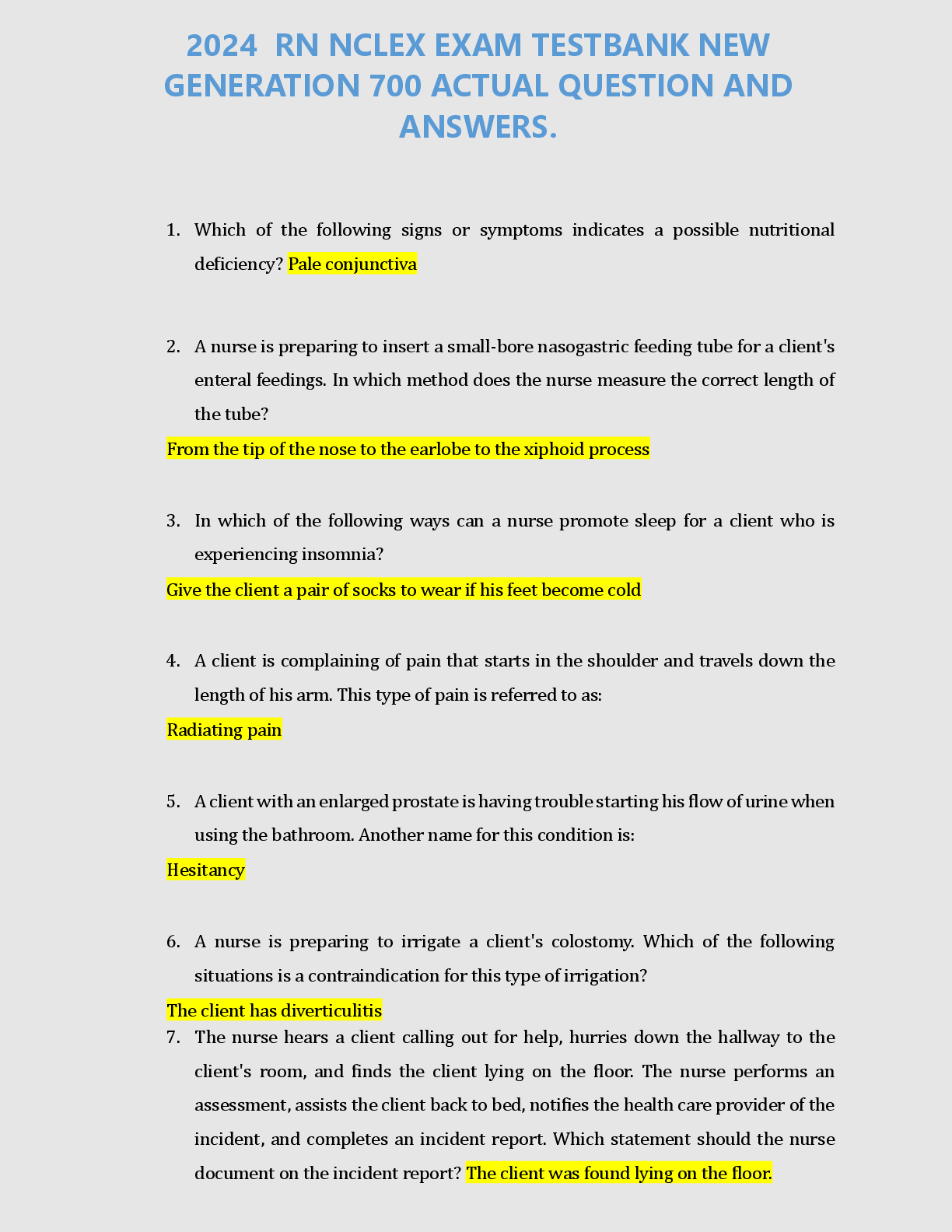
1. Questions
1. 1.ID: 9477027534
A client with leukemia is being considered for a bone marrow transplant. The
healthcare team is discussing the risks and benefits of this treatment and other
possible treatments with the goal of inflicting the least possible harm on the
client. Which principle of healthcare ethics is the team practicing?
A. Justice
B. Fidelity
C. Autonomy
D. Nonmaleficence Correct
2. 2.ID: 9477024200
Which action by the nurse represents the ethical principle of beneficence?
A. The nurse upholds a client’s decision to refuse chemotherapy
for lung cancer.
B. The nurse follows a plan of care designed to relieve pain in a
client with cancer.
C. The nurse administers an immunization to a child even though
it may cause discomfort. Correct
Extra Credit HESI Module 5
D. The nurse provides equal amounts of care to all assigned
clients on the basis of illness acuity.
3. 3.ID: 9477029451
The nursing instructor asks a student to name an example of false
imprisonment. Which situation reflects a violation of this client right?
A. Performing a procedure without consent
B. Telling the client that he or she may not leave the
hospital Correct
C. Threatening to give a client a medication against his or her will
D. Observing the provision of care to the client without the client’s
permission
4. 4.ID: 9477017756
The nurse and an unlicensed assistive personnel (UAP)enter a client’s room to
provide care and find the client lying on the floor. Which action should the nurse
take first?
A. Ask the nursing assistant to complete an incident report
B. Check the client’s level of consciousness and vital
signs Correct
C. Ask the nursing assistant to assist in getting the client back to
bed
D. Contact the unit secretary on the intercom and ask that the
client’s health care provider be called
5. 5.ID: 9477020809
Which action exemplifies the use of evidence-based practice in the delivery of
client care?
A. Donning sterile gloves to change an abdominal wound
dressing Correct
B. Encouraging a client to take an herbal substance to treat his
insomnia
C. Advising a client to agree to the treatment recommended by
her health care provider
D. Taking a rectal temperature from a client for whom bleeding
precautions have been instituted.
6. 6.ID: 9477020817
The registered nurse has accepted a new position as case manager in a
hospital. Which responsibilities are part of the nurse’s new role? Select all that
apply.
Extra Credit HESI Module 5
A. Evaluating and updating the plan of care as needed Correct
B. Prescribing treatments specific to the client’s needs
C. Assessing the client’s needs for home supplies and
equipment Correct
D. Coordinating consultations and referrals to facilitate
discharge Correct
E. Establishing a safe and cost-effective plan of care with the
client Correct
The nurse manager of a quality improvement program asks a nurse in the
neurological unit to conduct a retrospective audit. Which action should the
auditing nurse plan to perform in this type of audit?
Extra Credit HESI Module 5
A. Checking the documentation written by a new nursing
graduate on her assigned clients at the end of the shift
B. Checking the crash cart to ensure that all needed supplies are
readily available should an emergency arise
C. Reviewing neurological assessment checklists for all clients on
the unit to ensure that these assessments are being conducted as
prescribed
D. Obtaining the assigned medical record from the hospital’s
medical record room to review documentation made during a
client’s hospital stay Correct
The nurse preparing a client for a bronchoscopy notes that the client is wearing
a gold necklace. What should the nurse do to safeguard the client’s necklace?
Extra Credit HESI Module 5
A. Ask the client whether the necklace is gold
B. Ask the client for permission to lock the necklace in the
hospital safe Correct
C. Ask the client to remove the necklace and place it in the top
drawer of the bedside table
D. Ask the client to sign a release to free the hospital of
responsibility if the necklace is damaged or lost during the
procedure
The nurse providing preoperative care to a client who is scheduled for a left
mastectomy and axillary lymph node dissection notes that the client is wearing
a wedding band on her left ring finger. Which action should the nurse take?
A. Tape the wedding band in place
B. Explain to the client why the wedding band must be
removed Correct
C. Ask the client whether she would like to remove the wedding
band or wear it to surgery
D. Ask the client to sign a release to free the hospital of
responsibility if the wedding band is lost during surgery
Extra Credit HESI Module 5
10. 10.ID: 9477014230
The nurse preparing a client to go to the radiology department for a chest x-ray
notes that the client is wearing a religious medal on a chain around the neck.
The client, a Catholic, expresses a concern about removing the medal. What is
the most appropriate action for the nurse to take?
A. Asking the client to remove the medal until the x-ray has been
completed
B. Assisting the client in pinning the medal and chain to the
waistband of the client’s pajama bottoms Correct
C. Asking the client to place the medal in the top drawer of the
bedside stand just before leaving for the radiology department
D. Telling the client that the medal and chain will be kept at the
nurses’ station for safekeeping while the client is undergoing the xray
Awarded 1.0 points out of 1.0 possible points.
11. 11.ID: 9477030405
A health care provider writes a medication prescription in a client’s record.
While transcribing the prescription, the nurse notes that the prescribed dose is
three times higher than the recommended dose. The nurse calls the health
care provider, who states that this is the dose that the client takes at home and
that it is acceptable for this client’s condition. What is the appropriate action for
the nurse to take?
A. Contacting the nursing supervisor Correct
B. Continuing to transcribe the prescription
C. Asking the nurse assigned to care for the client to administer
the medication
D. Verifying the prescribed dose with the client before
administering the medication.
12. 12.ID: 9477016885
The nurse monitoring a client with a chest tube notes that there is no tidaling of
fluid in the water seal chamber. After further assessment, the nurse suspects
that the client’s lung has reexpanded and notifies the health care provider. The
health care provider verifies with the use of a chest x-ray that the lung has
reexpanded, then calls the nurse to asks that the chest tube be removed.
Which action should the nurse take first?
A. Call the nursing supervisor
B. Explain the procedure to the client, then remove the chest tube
C. Inform the health care provider that removal of a chest tube is
not a nursing procedure Correct
D. Obtain petrolatum-impregnated gauze and ask another nurse
to assist in removing the chest tube
The nurse calls a health care provider to report that a client with congestive
heart failure (CHF) is exhibiting dyspnea and worsening of wheezing. The
health care provider, who is in a hurry because of a situation in the emergency
department, gives the nurse a telephone prescription for furosemide (Lasix) but
does not specify the route of administration. What is the appropriate action on
the part of the nurse?
A. Calling the health care provider who gave the telephone
prescription to clarify the prescription Correct
B. Calling the nursing supervisor for assistance in determining the
route of administration
C. Administering the medication intravenously, because this route
is generally used for clients with CHF
D. Administering the medication orally and clarifying the
prescription once the health care provider has finished caring for
the client in the emergency department
14. 14.ID: 9477026697
A nurse is assisting a health care provider in assessing a hospitalized client.
During the assessment, the health care provider is paged to report to the
recovery room. The health care provider leaves the client’s bedside after giving
the nurse a verbal prescription to change the solution and rate of the
intravenous (IV) fluid being administered. What is the appropriate nursing
action in this situation?
A. Calling the nursing supervisor to obtain permission to accept
the verbal prescription
B. Changing the solution and rate of the IV fluid per the
physician’s verbal prescription
C. Asking the health care provider to write the prescription in the
client’s record before leaving the nursing unit Correct
D. Telling the health care provider that the prescription will not be
implemented until it is documented in the client’s record
15. 15.ID: 9477014249
A client scheduled for surgery tells the nurse that he signed an informed
consent for the surgical procedure but was never told about the risks of the
surgery. The nurse serves as the client’s advocate by taking which action?
A. Reassuring the client that the risks are minimal
B. Calling the surgeon and asking that the risks be explained to
the client Correct
C. Noting in the client’s record that the client was not told about
the risks of the surgery
D. Writing a note on the front of the client’s record so that the
surgeon will see it when the client arrives in the operating room
Awarded 1.0 points out of 1.0 possible points.
16. 16.ID: 9477030471
The nurse is planning to administer an oral antibiotic to a client with a
communicable disease. The client refuses the medication and tells the nurse
Extra Credit HESI Module 5
that the medication causes abdominal cramping. The nurse responds, “The
medication is needed to prevent the spread of infection, and if you don’t take it
orally I will have to give it to you in an intramuscular injection.” Which statement
accurately describes the nurse’s response to the client?
A. The nurse could be charged with battery.
B. The nurse could be charged with assault. Correct
C. The nurse is justified in administering the medication by way of
the intramuscular route, because the client has a communicable
disease.
D. The nurse will be justified in administering the medication by
the intramuscular route once a prescription has been obtained from
the physician..
17. 17.ID: 9477030487
The nurse discovers that another nurse has administered an enema to a client
even though the client told the nurse that he did not want one. Which action is
the most appropriate for the nurse to take?
A. Contact the client’s health care provider
B. Report the incident to the nursing supervisor Correct
C. Tell the client that the nurse did the right thing in giving the
enema
D. Confront the nurse who gave the enema and tell the nurse that
she is going to be charged with battery
Extra Credit HESI Module 5
18. 18.ID: 9477027505
The nurse calls a health care provider to question a prescription written for a
higher-than-normal dosage of morphine sulfate. The health care provider
changes the prescription to a dosage within the normal range, and the nurse
documents the new telephone prescription in accordance with the agency’s
guidelines in the client’s record. Which other statement does the nurse
document in the nursing notes?
A. The health care provider was called to clarify the prescription
for morphine sulfate. Correct
B. The health care provider made an error in the written
prescription for morphine sulfate.
C. The health care provider was called to correct an error in the
dosage of morphine sulfate.
D. An incorrect dosage of morphine sulfate was prescribed and
the health care provider was notified.
19. 19.ID: 9477031437
The charge nurse on the 11 pm–to–7 am shift is gathering the nursing staff
together to listen to the 3-to-11 pm intershift report. The charge nurse notes
that a staff member has an odor of alcohol on her breath, slurred speech, and
an unsteady gait and suspects alcohol intoxication. Which is the most
appropriate action for the charge nurse to take?
A. Send the staff member home Correct
B. Ask the staff member how much alcohol she has consumed
C. Tell the staff member that she is not allowed to administer
medications
D. Ask the staff member to rest in the nurses’ lounge until the
effects of the alcohol wear off
A client asks the nurse about the procedure for becoming an organ donor.
What should the nurse tell the client?
A. That anatomical gifts should be made in writing and signed by
the client Correct
B. To speak with the chaplain about the psychosocial aspects of
becoming a donor
C. That this decision must be made by the next of kin at the time
of the client’s death
D. To let the health care provider know about the request so that it
may be documented in the client’s record
The nurse enters a client’s room to administer a medication that has been
prescribed by the health care provider. The client asks the nurse about the
medication. Which response by the nurse is appropriate?
A. “It’s to help get rid of the swelling in your feet.”
B. “You need to discuss this medication with your physician.”
C. “I know that it’s for fluid buildup, and I think you’ve taken it
before.”
D. “It’s called furosemide (Lasix), and it will promote urination and
rid your body of the excess fluid. It can cause an alteration in
electrolyte levels, so we’ll need to increase the potassium in your
diet.” Correct.
Extra Credit HESI Module 5
22. 22.ID: 9477025856
A nursing student is assigned to care for a client who requires a total bed bath.
When the student explains to the client that she is going to gather supplies to
administer the bath, the client states, “I don’t want a bath. I’ve been up all night,
and I’m clean enough.” The student reports the client’s refusal to the nurse in
charge. Which action by the nurse in charge is appropriate?
A. Telling the nursing student to allow the client to rest Correct
B. Telling the nursing student to give the client the bath anyway
C. Telling the client that the health care provider will be informed
of the refusal of care
D. Telling the nursing student to persuade the client to have a
bath so that the evening shift staff will not have to do it
Awarded 1.0 points out of 1.0 possible points.
23. 23.ID: 9477031472
A client with cancer is transported to the radiology department for a bone scan
to determine whether the cancer has metastasized to bone. While the client is
in the radiology department, the client’s wife arrives for a visit and asks what
test is being performed on the client. What should the nurse tell the wife?
A. A bone scan is being performed.
B. She will have to discuss the prescribed test with the
client. Correct
C. The radiology department is not clear as to which test has
been prescribed.
Extra Credit HESI Module 5
D. She can read the client’s medical record to determine what the
health care provider prescribed.
A married couple is attending a hospital program about in vitro fertilization.
During the program, a crew from a local television station arrives to film the
proceedings because the station is publicizing a series on hospital services.
The nurse conducting the program should:
A. Allow the television crew to videotape the program
B. Explain to the television crew that videotaping is not
allowed Correct
C. Ask the television crew to interview the individuals attending
the program individually
D. Allow the television crew to videotape the program as long as
they do not publicize that the program is about in vitro fertilization
.
25. 25.ID: 9477018553
A nurse is taking a morning break with the unit secretary in the nurses’ lounge.
The unit secretary says to the nurse, “I read in Mr. Gage’s medical record that
he has gonorrhea.” How should the nurse respond to the secretary?
A. “Oh, really? I didn’t see that!”
B. “We can’t discuss a client’s medical condition.” Correct
C. “Yes, that’s why we’ve imposed contact precautions.”
D. “Yes, he does, but be sure not to discuss this with anyone
else.”
[Show More]