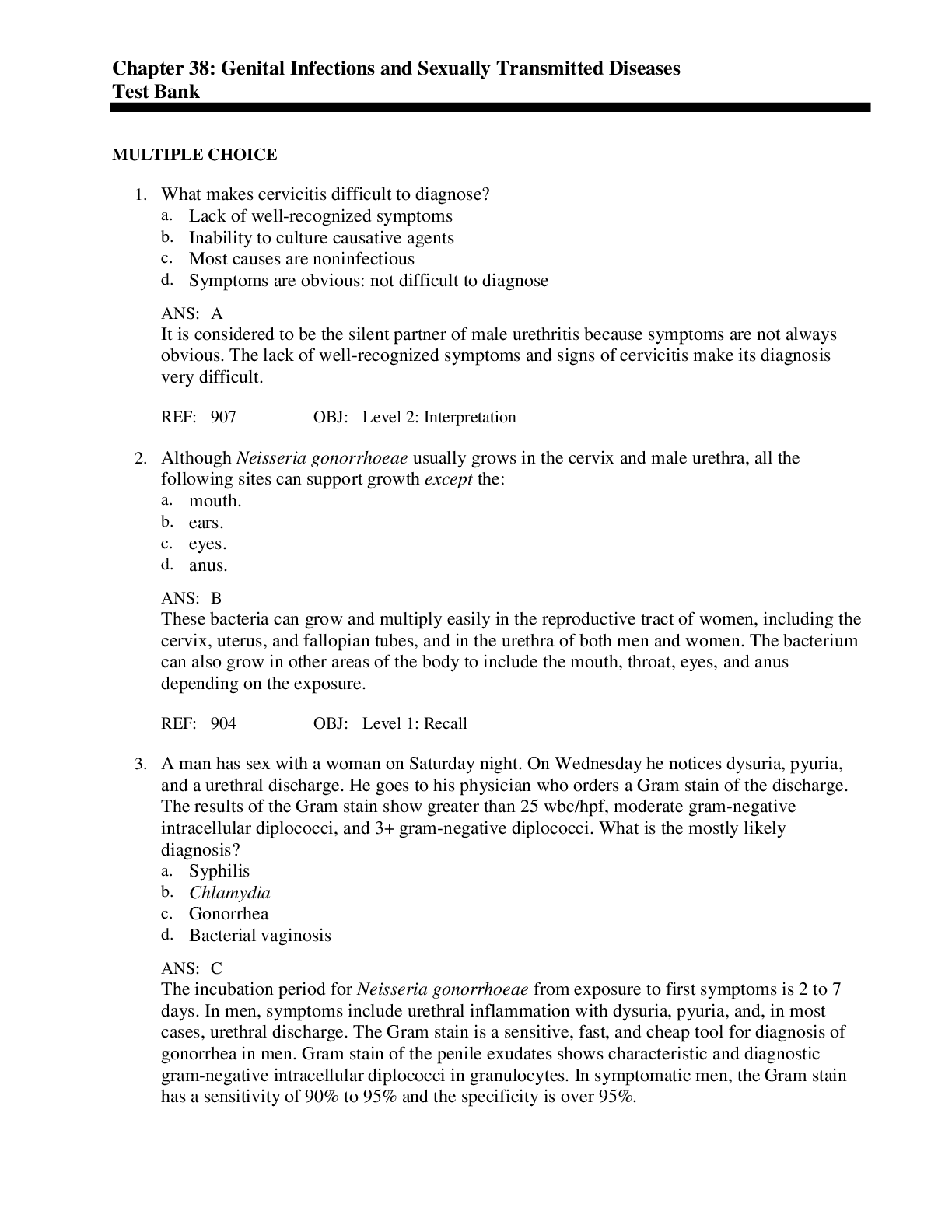
MULTIPLE CHOICE
1. What makes cervicitis difficult to diagnose?
a. Lack of well-recognized symptoms
b. Inability to culture causative agents
c. Most causes are noninfectious
d. Symptoms are obvious: not difficult
...
MULTIPLE CHOICE
1. What makes cervicitis difficult to diagnose?
a. Lack of well-recognized symptoms
b. Inability to culture causative agents
c. Most causes are noninfectious
d. Symptoms are obvious: not difficult to diagnose
A
It is considered to be the silent partner of male urethritis because symptoms are not always obvious. The lack of well-recognized symptoms and signs of cervicitis make its diagnosis very difficult.
REF: 907 OBJ: Level 2: Interpretation
2. Although Neisseria gonorrhoeae usually grows in the cervix and male urethra, all the following sites can support growth except the:
a. mouth.
b. ears.
c. eyes.
d. anus.
B
These bacteria can grow and multiply easily in the reproductive tract of women, including the cervix, uterus, and fallopian tubes, and in the urethra of both men and women. The bacterium can also grow in other areas of the body to include the mouth, throat, eyes, and anus depending on the exposure.
REF: 904 OBJ: Level 1: Recall
3. A man has sex with a woman on Saturday night. On Wednesday he notices dysuria, pyuria, and a urethral discharge. He goes to his physician who orders a Gram stain of the discharge. The results of the Gram stain show greater than 25 wbc/hpf, moderate gram-negative intracellular diplococci, and 3+ gram-negative diplococci. What is the mostly likely diagnosis?
a. Syphilis
b. Chlamydia
c. Gonorrhea
d. Bacterial vaginosis
C
The incubation period for Neisseria gonorrhoeae from exposure to first symptoms is 2 to 7 days. In men, symptoms include urethral inflammation with dysuria, pyuria, and, in most cases, urethral discharge. The Gram stain is a sensitive, fast, and cheap tool for diagnosis of gonorrhea in men. Gram stain of the penile exudates shows characteristic and diagnostic gram-negative intracellular diplococci in granulocytes. In symptomatic men, the Gram stain has a sensitivity of 90% to 95% and the specificity is over 95%.
REF: 904 OBJ: Level 3: Synthesis
4. All of the following conditions can occur in women with undiagnosed cervical gonorrhea except:
a. salpingitis.
b. endometritis.
c. pelvic inflammatory disease (PID).
d. pharyngitis.
D
Ascending infection occurs in 10% to 20% of women with undiagnosed gonorrhea infections. These women are in danger of developing pelvic inflammatory disease (PID) presenting as salpingitis (infection of the fallopian tubes), endometritis, and internal abscesses and chronic pelvic pain.
REF: 904 OBJ: Level 1: Recall
5. What percentage of women patients that are positive for Neisseria gonorrhoeae typically also have genital chlamydiosis?
a. 30%
b. 42%
c. 60%
d. 77%
B
Gonococcal and nongonococcal urethritis infections are not mutually exclusive of each other. Many patients are often co-infected with both N. gonorrhoeae and C. trachomatis with rates as high as 20% in men and 42% in women.
REF: 903 OBJ: Level 1: Recall
6. What test is sufficient for a diagnosis of Neisseria gonorrhoeae in men?
a. Culture
b. Gram stain
c. Enzyme immunoassay (EIA)
d. Radioimmunoassay (RIA)
B
The Gram stain is a sensitive, fast, and cheap tool for diagnosing gonorrhea in men. Gram stain of the penile exudate shows characteristic and diagnostic gram-negative intracellular diplococci in granulocytes. In symptomatic men, the Gram stain has a sensitivity of 90% to 95% and the specificity is over 95%.
REF: 905 OBJ: Level 1: Recall
7. What is an advantage to using PACE 2C method for detection of Neisseria gonorrhoeae?
a. There is no advantage.
b. You can also find syphilis.
c. You can also find Cryptosporidium.
d. You can also find Chlamydia.
D
The PACE 2C is a DNA probe that hybridizes the gonococcal rRNA. This is a sensitive test that allows test batching, which is another advantage because the Chlamydia trachomatis can be simultaneously detected from the same specimen with the PACE 2C (Table 38-3).
REF: 906 OBJ: Level 3: Synthesis
8. What is the advantage of performing NAAT for cases of gonococcal urethritis?
a. There is no advantage.
b. You can also find syphilis.
c. You can also find Cryptosporidium.
d. You can also find Chlamydia.
D
There are several Food and Drug Administration (FDA)-approved NAAT assays available with very high rates of sensitivity and specificity (more than 95%) and allow combination testing for N. gonorrhoeae and C. trachomatis (Table 38-3).
REF: 906 OBJ: Level 1: Recall
9. What is required for culturing Chlamydia?
a. Embryonated chicks
b. Thayer-Martin, modified (MTM) media
c. Martin-Lewis (ML) media
d. Tissue cultures
D
Isolation of viable C. trachomatis from specimens requires tissue culture using HeLa-229 or McCoy cell lines. Tissue culture used to be considered the gold standard, but the method is no longer widely used because of its difficulty to perform and sensitivity issues.
REF: 920 OBJ: Level 1: Recall
10. What is the infective particle of Chlamydia?
a. Elementary body
b. Initial body
c. Negri body
d. Entire Chlamydia organism
A
The infective particle is the elementary body, which is the metabolically inert form of the organism.
REF: 907 OBJ: Level 1: Recall
11. Nonculture methods available for detecting Chlamydia include all the following except:
a. enzyme immunoassay (EIA).
b. polymerase chain reaction (PCR).
c. fluorescence polarization immunoassay (FPIA).
d. ligase chain reaction (LCR).
C
Culture can be laborious and expensive. A wide variety of nonculture methods is also available for the detection of Chlamydia trachomatis, such as EIA, PCR, and LCR. All nonculture methods detect C. trachomatis antigen.
REF: 914 OBJ: Level 1: Recall
12. What cells are found in bacterial vaginosis?
a. Clue cells
b. Lymphocytes
c. Macrophages
d. Squamous epithelial cells
A
Bacterial vaginosis can be diagnosed within the clinic by observing and performing tests on the vaginal discharge typically using Amsel criteria. The discharge should be homogeneous with a thin consistency. Microscopic observation of patient discharge is to look for the presence of “clue cells,” which are vaginal squamous epithelial cells typically coated with Gardnerella vaginalis.
REF: 908 OBJ: Level 1: Recall
13. What condition is an overgrowth of anaerobic bacteria and a decrease in lactobacillus in the vagina?
a. Endometritis
b. Syphilis
c. Gonorrhea
d. Bacterial vaginosis
D
Bacterial vaginosis (BV) occurs when the delicate balance of normal vaginal flora is disrupted, and replaced by an overgrowth of specific organisms. BV occurs when vaginal lactobacilli are depleted and vaginal pH increases, allowing the overgrowth of various species of anaerobic organisms such as Prevotella, Porphyromonas, Peptostreptococcus, Mobiluncus, Gardnerella vaginalis, Mycoplasma hominis, and Ureaplasma spp.
REF: 908 OBJ: Level 2: Interpretation
14. Many women who have bacterial vaginosis (BV) complain of a fishy odor from vaginal secretions. What causes the odor?
a. Carbolic acid
b. Amines
c. Urea
d. Alcohols
B
Women with BV complain of a fishlike odor associated with the vagina. The odor is caused by volatilization of amines, as a by-product of anaerobic metabolism.
REF: 908 OBJ: Level 1: Recall
15. What is the main symptom for primary syphilis?
a. Purulent discharge
b. Asymptomatic
c. Chancre
d. Genital warts
C
The initial lesion of syphilis is called the chancre, and its appearance signals primary syphilis.
REF: 915 OBJ: Level 1: Recall
16. Which of the following is a symptom for secondary syphilis?
a. Chancre
b. Purulent discharge
c. Petechiae
d. Perianal condylomata lata
D
A result of secondary syphilis is the appearance of condylomata lata, which are mucoid, fleshy, wartlike growths. These lesions often occur in the perianal region but can occur in other moist regions of the body.
REF: 915 OBJ: Level 1: Recall
17. Which of the following is a symptom of tertiary syphilis?
a. Gummas
b. Chancre
c. Genital warts
d. Strokes
A
Patients with late syphilis may develop neurologic symptoms or cardiovascular effects, or they may experience late benign syphilis. In the latter condition, the patient develops gummas, which are nonspecific granulomatous lesions. Gummas can occur in skin, bone, or viscera.
REF: 916 OBJ: Level 1: Recall
18. What organism causes chancroid?
a. Treponema pallidum
b. Haemophilus ducreyi
c. Mobiluncus
d. Gardnerella vaginalis
B
Chancroid, or soft chancre, is a sexually transmitted infection caused by a fastidious gram-negative coccobacillus, H. ducreyi.
REF: 917 OBJ: Level 1: Recall
19. Why are there so many cases of genital herpes in the Unites States?
a. Condoms cannot prevent spread of genital herpes.
b. No protection is available against genital herpes.
c. Lesions shed virus when asymptomatic.
d. Lesions shed virus only when symptomatic.
C
Because herpes simplex virus 2 (HSV-2) lesions are often painful, they would seem to deter sexual activity. Even so, many patients at least know to use barrier contraception when there is any sign of ulceration. What many patients with genital herpes may not know is that they shed virus even in the absence of symptoms. Studies indicate that patients are infective up to 30% of their symptom-free days.
REF: 913 OBJ: Level 1: Recall
20. How is genital herpes spread?
a. Hot tubs infected with herpes
b. Towels used by people with herpes
c. Contaminated toilet seats
d. Sexual contact with secretions from infected sites
D
Genital herpes is transmitted by sexual contact with secretions from infected sites. The virus is spread only rarely, if at all, by touching infected objects such as a toilet seat, towel, or hot tub.
REF: 912 OBJ: Level 1: Recall
21. Which of the following methods is considered the gold standard for diagnosing genital herpes?
a. Viral isolation
b. Enzyme immunoassay (EIA)
c. Polymerase chain reaction (PCR)
d. GenProbe
A
Viral isolation is considered the gold standard method by CDC for the diagnosis of herpes simplex virus (HSV) infections. The best specimens for culture are vesicle fluids collected with a syringe or swab.
REF: 913 OBJ: Level 1: Recall
22. Nontreponemal antibody tests for syphilis include all of the following except:
a. rapid plasma reagin (RPR).
b. toluidine red unheated serum test (TRUST).
c. Venereal Disease Research Laboratory (VDRL).
d. enzyme immunoassay (EIA).
D
Serologic tests for the diagnosis of syphilis are divided into two general types: the nontreponemal (nonspecific) antibody tests and the treponemal (specific) antibody tests. The nontreponemal antibody tests, such as the rapid plasma reagin (RPR), reagin screen test (RST), unheated serum reagin (USR), toluidine red unheated serum test (TRUST), and Venereal Disease Research Laboratory (VDRL).
REF: 917 OBJ: Level 1: Recall
23. All of the following are a cause of ulcerative sexually transmitted infections (STIs) except:
a. syphilis.
b. gonorrhea.
c. genital herpes.
d. chancroid.
B
Sexually transmitted infections cover a diverse field of causative agents, signs and symptoms, prognoses, and methods for laboratory testing. STIs are classified on clinical symptoms into exudative (gonorrhea, chlamydia, vulvovaginitis), ulcerative (syphilis, chancroid, genital herpes), HIV, and other (human papillomavirus [HPV]) STIs.
REF: 903 OBJ: Level 1: Recall
24. Nongonococcal urethritis is most commonly caused by which of the following organisms?
a. Haemophilus ducreyi
b. Trichomonas vaginalis
c. Chlamydia trachomatis
d. Ureaplasma urealyticum
C
Infection with C. trachomatis is the most common attributable cause of NGU (15% to 55% of cases) and is the most commonly reported infectious disease in the United States. Lesser known causative agents of NGU include: Ureaplasma urealyticum, Mycoplasma genitalium, Trichomonas vaginalis, herpes simplex virus (HSV), and adenovirus.
REF: 903 OBJ: Level 1: Recall
25. What percentage of hepatitis B infections are transmitted through sexual contact?
a. 10%
b. 25%
c. 50%
d. 80%
C
There are five hepatitis viruses that can be transmitted in different ways, three of which, Hepatitis A, B, and C, can all be sexually transmitted. Sexual transmission is responsible for nearly 50% of all HBV infections in the United States. Hepatitis C is spread through contact with an infected person’s blood and sexual transmission of HCV infection occurs at a much lower frequency at less than 5%.
REF: 927 OBJ: Level 1: Recall
[Show More]


.png)


 Correct Study Guide, Download to Score A.png)



.png)
 Med Surg test Latest Verified Questions and all Correct Answers with Explanations Chapter 38 Assessment and Management of Patients with Rh.png)


, Latest Questions and Answers with Explanations.png)