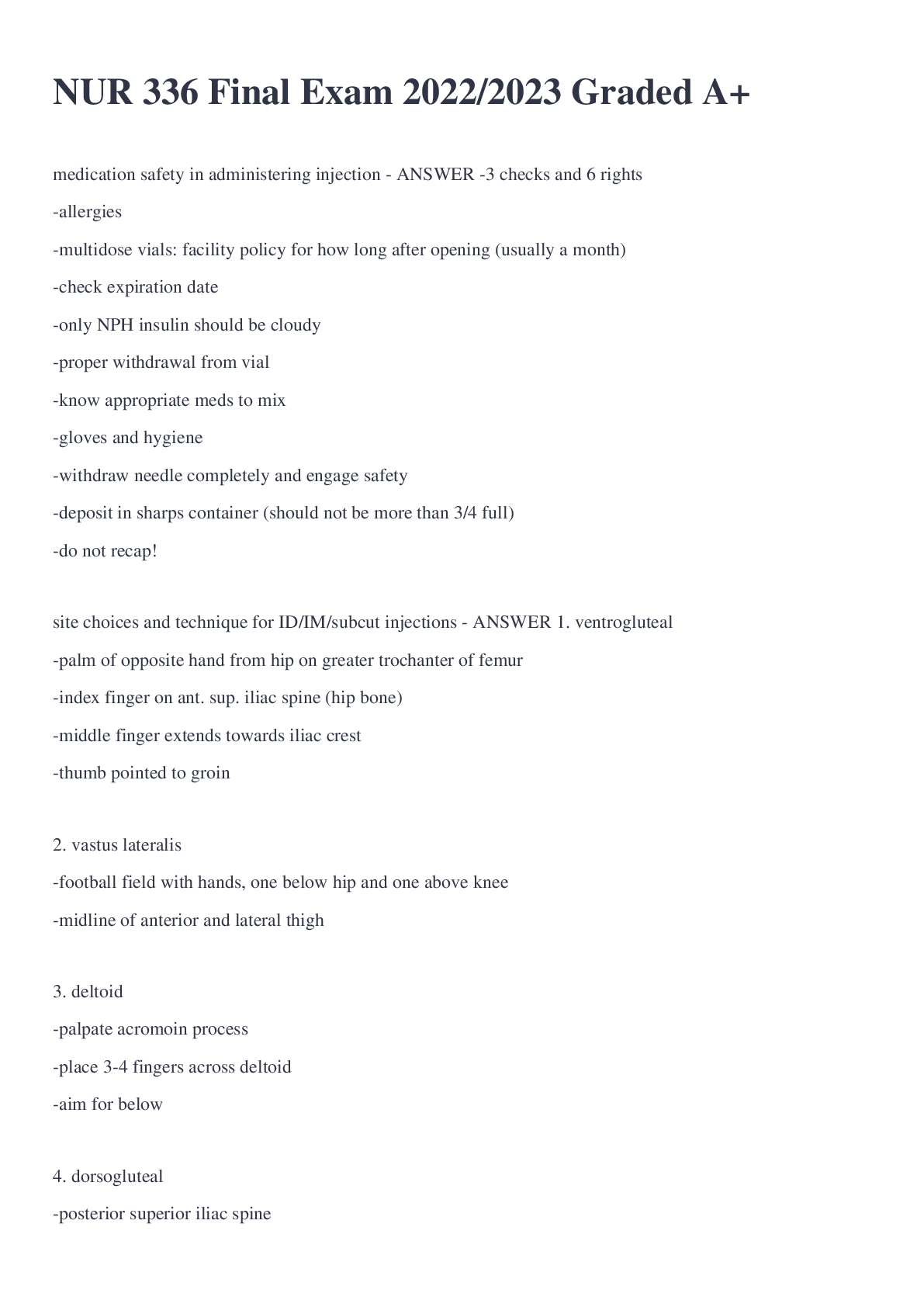
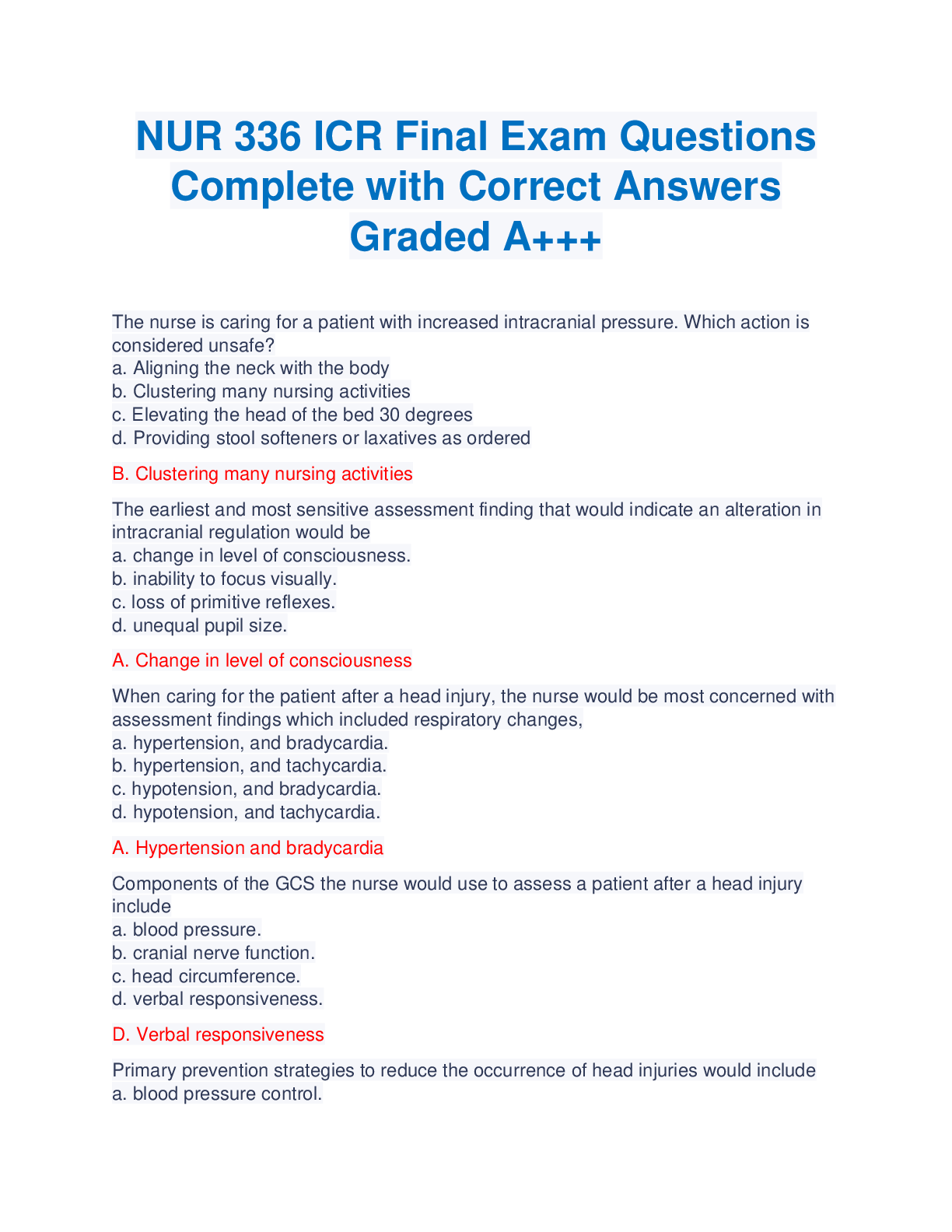
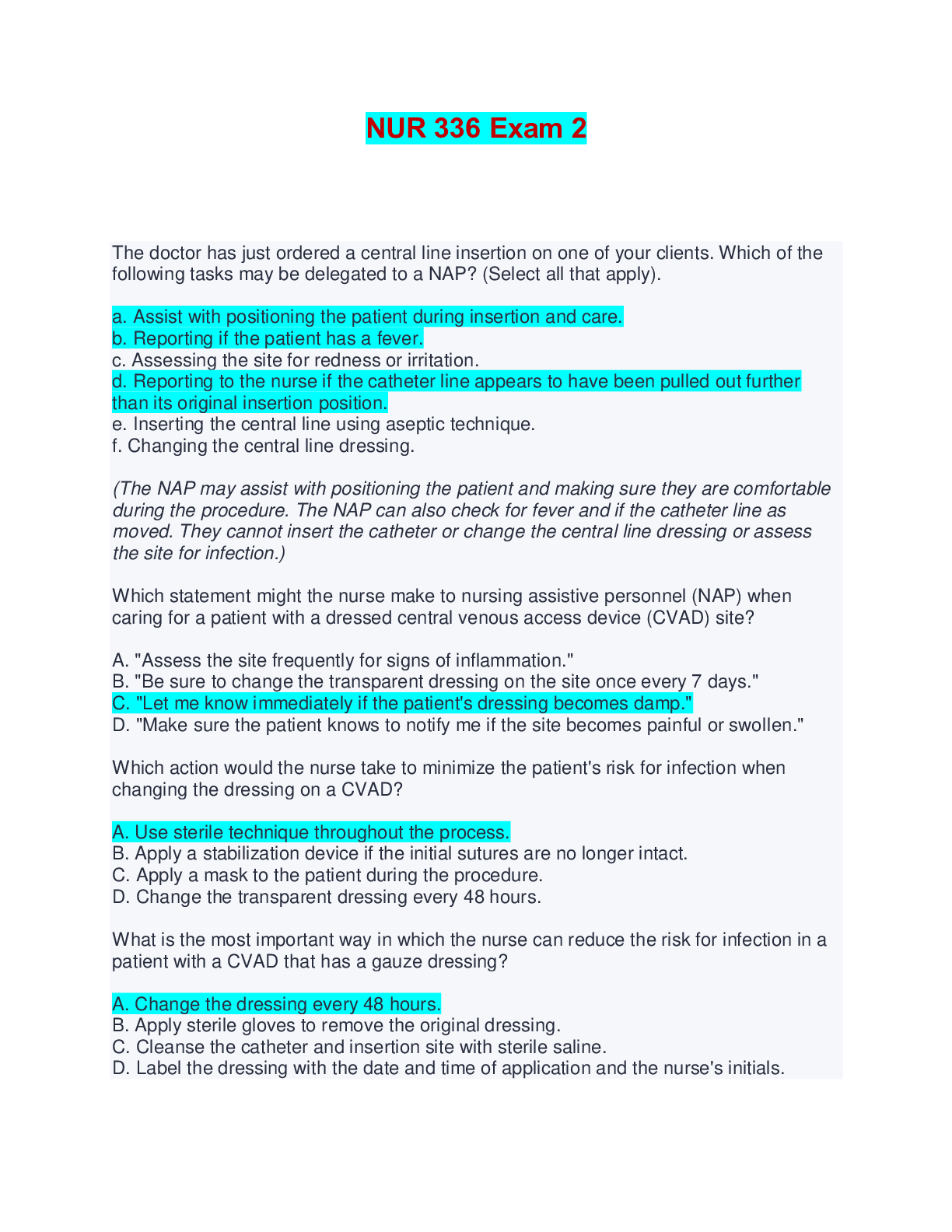
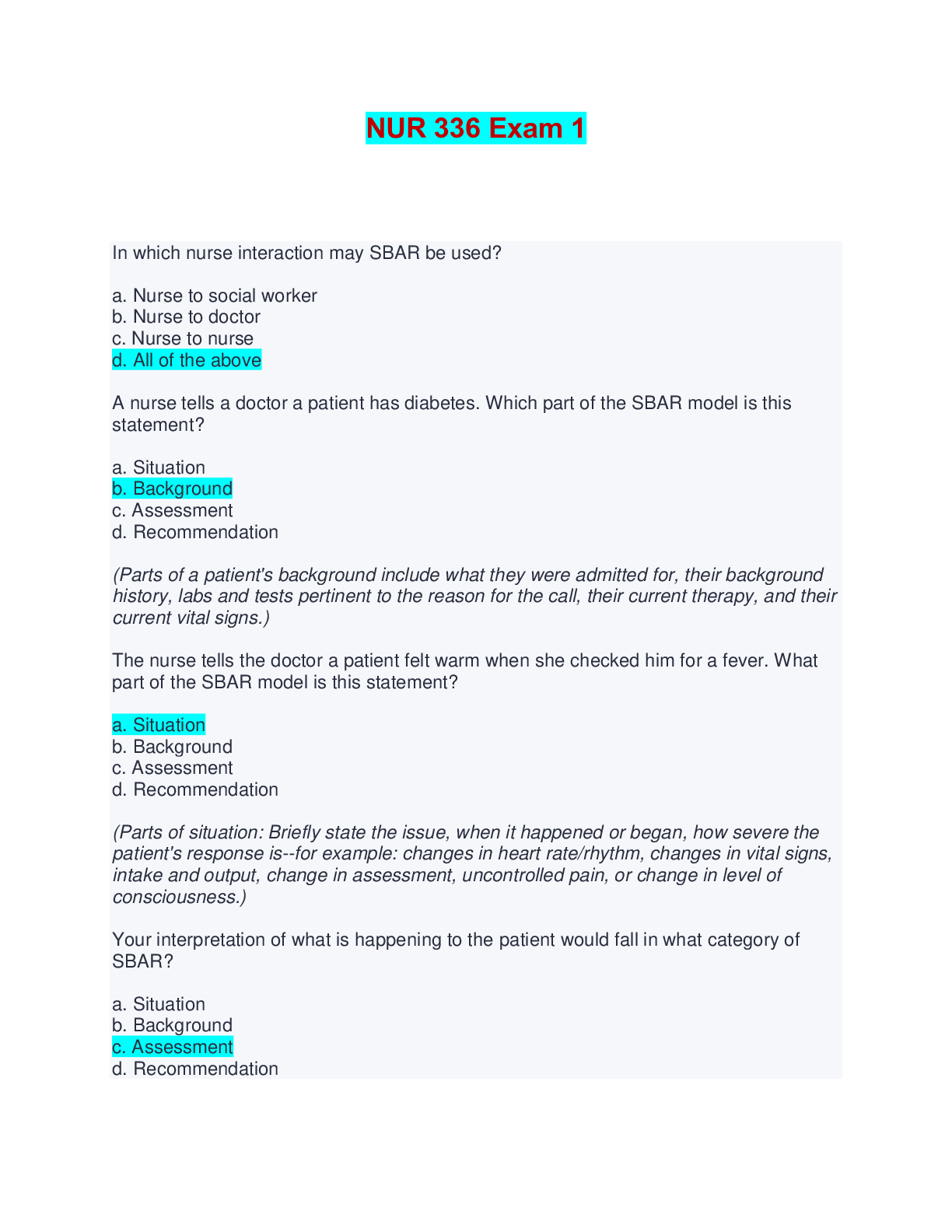
normal BP for a healthy adult - ANSWER 120/80
normal RR for a healthy adult - ANSWER 12-20/min
normal HR for a healthy adult - ANSWER 60-100 bpm
normal temperature for a healthy adult (all types) - ANSWER Tympan
...
normal BP for a healthy adult - ANSWER 120/80
normal RR for a healthy adult - ANSWER 12-20/min
normal HR for a healthy adult - ANSWER 60-100 bpm
normal temperature for a healthy adult (all types) - ANSWER Tympanic: 36.8-37.8C
Oral: 36-38C
Temporal: 37.1-38.1C
Rectal: 0.5C greater than oral
Axillary: 0.5C less than oral
normal pulse ox for a healthy adult - ANSWER 95%-100%
How do you assess for pain? - ANSWER P- provoking factors
Q- quality
R- radiation/region
S- severity
T- time
What does AC stand for? - ANSWER before meals
What does PC stand for? - ANSWER after meals
What does p stand for - ANSWER after
What does c stand for? - ANSWER with
What does s stand for? - ANSWER without
Examples of parenteral routes? - ANSWER IM, IV, SC, ID, epidural, intrathecal, inhalations
Examples of non parenteral routes? - ANSWER PO, SL, top, transdermal, ophthalmic, otic, nasal, rectal, vaginal
Conversion of tsp to mL - ANSWER 1 tsp = 5 mL
Conversion of mg to g - ANSWER 1000mg = 1g
Conversion of mcg to mg - ANSWER 1000mcg = 1mg
Conversion of lbs to kg - ANSWER 2.2 lbs = 1 kg
Conversion of mL to L - ANSWER 1000mL = 1L
Conversion of tbsp to mL - ANSWER 1 tbsp = 15 mL
Conversion of mL to oz - ANSWER 30mL = 1 oz
List the rights of medication administration - ANSWER Right patient
Medication
Dose
Route
Time
ALSO
Documentation
Education
Assessment
Evaluation
Refusal
Then- right expiration date, reason, response
What 5 things should an incident report include? - ANSWER 1. client info
2. location and time of incident
3. description of what happened and what was done about it
4. condition of client
5. nurse's signature
Review of PO Medication Administration Checklist - ANSWER 1. Verify facility policy
2. Verify MAR, 5 rights
3. Wash hands and assemble equipment
4. 1st safety check at PYXIS; verify MAR, 5 rights
5. 2nd safety check preparing medication; verify MAR, 5 rights
6. Pre-exam Behaviors (i.e. initial interactions)
7. 3rd safety check; verify MAR, 5 rights
8. Administer
9. Chart
10. Post-exam behaviors (i.e. initial interaction 8-10)
Review of Initial Interaction - ANSWER 1. Gel in, wear gloves appropriately (provide privacy, assemble equipment, and verify policy)
2. Introduce self & reason for visit
3. Identify pt. using 2 identifiers
4. Check allergy band, have pt. state allergy & reaction to it
5. Check fall band & ascertain pt. understanding of fall risk
6. Use therapeutic comm., ask pt. about pain
7. Perform brief situational assess. (i.e. raise bed to working level)
8. At end of encounter, summarize visit & time you will return
9. Ensure call light within reach & bed in lowest position
10. Gel out, enurse gloves were removed
MED MATH EXAMPLE
Ordered Lamictal 2.5mg/kg p.o. daily; available in 25mg tablets, how many tablets? (pt. wt: 44lbs) - ANSWER 2 tablets
Ordered Prozac 10mg solution daily; available in 20mg/1tsp, how much mL to administer? - ANSWER 2.5 mL
Ordered Cleocin 300mg IV Q6H; available 0.6g/4mL, how much mL to administer? - ANSWER 2 mL
Review of NG Tube Insertion - ANSWER 1. Pre-exam Behaviors (i.e. initial interactions 1-5) + ensure wall suction is working
2. Assessment: auscultate bowel; inspect and palpate abdomen for distention; gag and cough reflexes
3. Inspect nares for patency & provide tissues and have pt. blow nose
4. Raise bed to working height, place pt. into high-Fowler's position w/pillows under head and shoulders
5. Place towel over pt. chest and have pt. blow nose
6. Measure tube from tip of pt. nose to earlobe and then to xiphoid process
7. Prepare tape or fixation device
8. Gloves
9. Lubricate tip ot tube and apply anesthetics if policy indicates
10. Give pt. cup of water w/straw and keep pt. neck in neutral position or have them flex head back on pillow
11. Insert tube following nasal passage and rotate to ease insertion
12. Provide reassurance to pt. if gagging occurs; make sure tube is not coiled
13. Have pt. flex chin to chest and encourage to sip via straw while tube advances
14. Stop procedure if pt. becomes cyanotic, unable to speak/hum, continuous coughing/gagging, or unable to advance after rotation
15. Stop advancement once measured mark is reached & secure w/tape
16. Verify facility policy for NG placement (definitive placement: chest x-ray to verify placement)
17. Apply skin barrier & secure tube to pt. gown
18. Apply clean gloves & provide oral hygiene
19. Document
20. Post-Exam Behaviors (i.e. initial interaction 8-10)
Define decompression in relation to NG tube insertion - ANSWER remove fluid and air via gravity
NG tube administers what? - ANSWER feedings, medications, and contrast
What is NG tube compression? - ANSWER compression of bleeding sites until endoscopy
What are contraindications of NG tube insertions? - ANSWER facial trauma, recent brain surgery, recent nasal surgery, polyps, deviated septum, esophageal varices
How do you confirm placement of NG tube? - ANSWER x-ray or fluid aspiration of stomach pH
What are barriers inhibiting a patient's ability to eat a healthy diet? - ANSWER lack of knowledge, cost, busy schedule, location, culture/religion limitations, swallowing, large families, healthy food more perishable
Is BMI a good indicator of health? Why or why not? - ANSWER BMI is not a good indicator of health because it does not differentiate between muscle/fat, sex, genetics, race, bone density, etc.
What is fat bias? - ANSWER attitude toward people being overweight like "it's the person's fault," viewed as a trait rather than a medical condition
Why is oral care important? - ANSWER Prevent halitosis (bad smelling breath), tooth decay, gingivitis, periodontitis, infection prevention, swallow/eating impairment
How often does independent oral care occur? - ANSWER at least 2x daily with flossing
How often does dependent oral care occur? - ANSWER at least once per shift but consider before or after meals; clear debris & make it easier to eat
how often does unconscious oral care occur? - ANSWER every 2 hrs & PRN; use suction, swabs, chlorhexidine rinses if prescribed
What are side effects of chlorhexidine when ingested? - ANSWER Chlorhexidine can cause changes in taste and nausea if ingested; usually need an order
How do you do oral care for an NPO patient? - ANSWER can brush teeth just be careful w/NG tube; ask if they can have swabs soaked in water; dry mouth gels may help especially w/oxygen
What are some reasons a client may need help with feeding? - ANSWER risk for aspiration, decreased cough/gag reflexes, altered LOC, motor deficits, visual impairments
[Show More]