Name Branches/vessels of Aortic Arch* Correct Answer: C) Innominate Artery*
a) Rt CCA
b) Rt Subclavian
D) Lt CCA*
E) Lt Subclavian*
Most common anatomic variant of the AO Arch* is: Correct Answer: Common ori
...
Name Branches/vessels of Aortic Arch* Correct Answer: C) Innominate Artery*
a) Rt CCA
b) Rt Subclavian
D) Lt CCA*
E) Lt Subclavian*
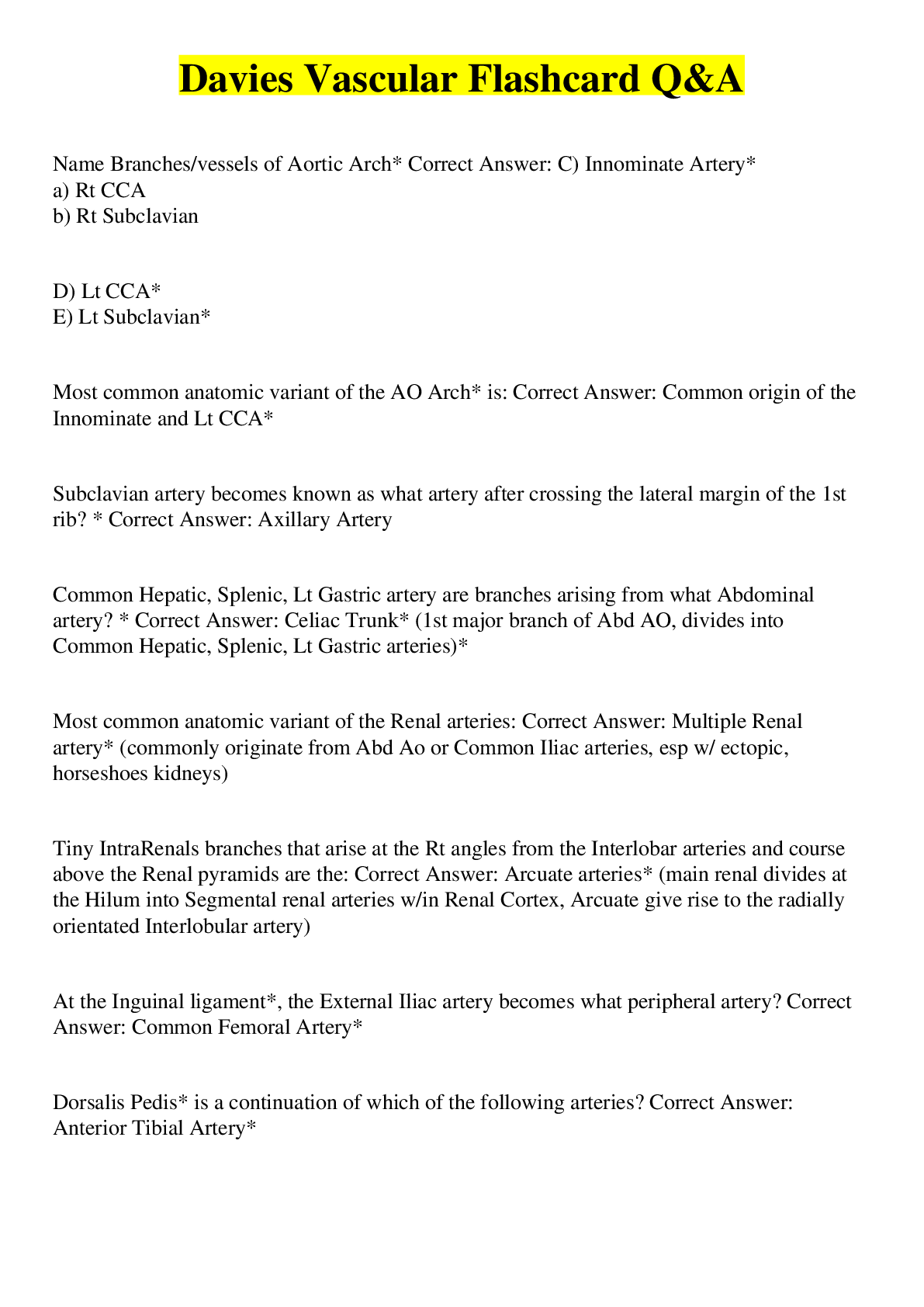
Most common anatomic variant of the AO Arch* is: Correct Answer: Common origin of the Innominate and Lt CCA*
Subclavian artery becomes known as what artery after crossing the lateral margin of the 1st rib? * Correct Answer: Axillary Artery
Common Hepatic, Splenic, Lt Gastric artery are branches arising from what Abdominal artery? * Correct Answer: Celiac Trunk* (1st major branch of Abd AO, divides into Common Hepatic, Splenic, Lt Gastric arteries)*
Most common anatomic variant of the Renal arteries: Correct Answer: Multiple Renal artery* (commonly originate from Abd Ao or Common Iliac arteries, esp w/ ectopic, horseshoes kidneys)
Tiny IntraRenals branches that arise at the Rt angles from the Interlobar arteries and course above the Renal pyramids are the: Correct Answer: Arcuate arteries* (main renal divides at the Hilum into Segmental renal arteries w/in Renal Cortex, Arcuate give rise to the radially orientated Interlobular artery)
At the Inguinal ligament*, the External Iliac artery becomes what peripheral artery? Correct Answer: Common Femoral Artery*
Dorsalis Pedis* is a continuation of which of the following arteries? Correct Answer: Anterior Tibial Artery*
Small intestine, right colon, transverse colon are supplied by: Correct Answer: Superior Mesentric Artery* (2nd major artery of Abd Ao, arises below origin of Celiac Trunk)*
The largest branch of the Celiac Trunk* is the: Correct Answer: Splenic artery*
Hypogastric artery* is another name for the: Correct Answer: Internal Iliac artery*
Which of the following vessels courses along the medial aspect of the Psoas Muscle*? Correct Answer: External Iliac Artery*
1st branch of the External Carotid Artery* is usually the: Correct Answer: Superior Thyroid Artery*
Vertebral Artery enters the Transverse Foramina of the Cervical spine at what level? Correct Answer: C6*
Name the Vessels of the Circle of Willis* Correct Answer: a) Middle Cerebral Artery
b) Anterior Communicating
c) Anterior Cerebral
d) Internal Carotid
e) Posterior Communicating
f) Posterior Cerebral
g) Basilar
h) Vertebral
3 major branches of the Ophthmalmic artery* are: Correct Answer: Frontal
Supraorbital
Nasal
Basilar artery* divides into which artery? Correct Answer: Posterior Cerebral Arteries
ECA provides an anastomotic link* to the ICA through the Orbit via which of the following vessels? Correct Answer: Superior Temporal Artery*
(ECA can supply ICA thru periorbital circulation.
- Ophthalmic artery have anatosmotic links w/ ECA branches, these connections can provide blood flow to the intracranial circulation in cases of ICA occlusion via retrograde flow thru the Ophthmalic.
- Surpraorbital and frontal connect ECA thru Superficial temporal.
- Nasal becomes angular artery as it descends along lateral border of the nose and connects the ECA via facial artery)
All of the following arise from the Intracranial ICA EXCEPT: Correct Answer: Ascending Pharyngeal
- MCA
- ACA
- PCoA
Opthmalmic Artery is a branch of the: Correct Answer: Internal Carotid artery (ICA)*
In the case of the ICA occlusion, all of the following are potential collateral pathways to perfuse the Ipsilateral Cerebral hemisphere EXCEPT: Correct Answer: Contralateral Subclavian Artery to the Internal Mammary Artery (This is NOT a collateral pathway to the Cerebral hemisphere)
- Contralateral ICA thru reversed flow in Ipslateral ACA
- VB system thru the PCoA
- Ipslateral ECA thru the orbit to the Ophthalmic artery
Which branch of the ECA provides a collateral pathway to the Vertebral artery? Correct Answer: Occipital*
In case of the Vertebral artery occlusion, which vessel is likely to be enlarged? Correct Answer: Contralateral Vertebral!
(compensatory enlargement of the contralateral vertebral is common)
48 yr old male presents w/ retrograde flow in Lt Vertbral A. most likely related to occlusion of the: Correct Answer: Lt Subclavian Artery*
-prox lt subclavian occlusion, lt VA flow will reverse to
-provide BF to the left arm
-condition termed SUBCLAVIAN STEAL***
-occurs more commonly on left side
What is the most common anomaly of the Circle of Willis? Correct Answer: Absence of Hypoplasia of 1 or both communicating arteries
Which of the following is NOT a branch of t
[Show More]