MicroBio 351 Exam 2
Describe the key molecular processes that occur when a cell grows and divides (Section 5.1). - ANS -
Cell division is a complex process requiring several proteins referred to as Fts proteins. Fts pr
...
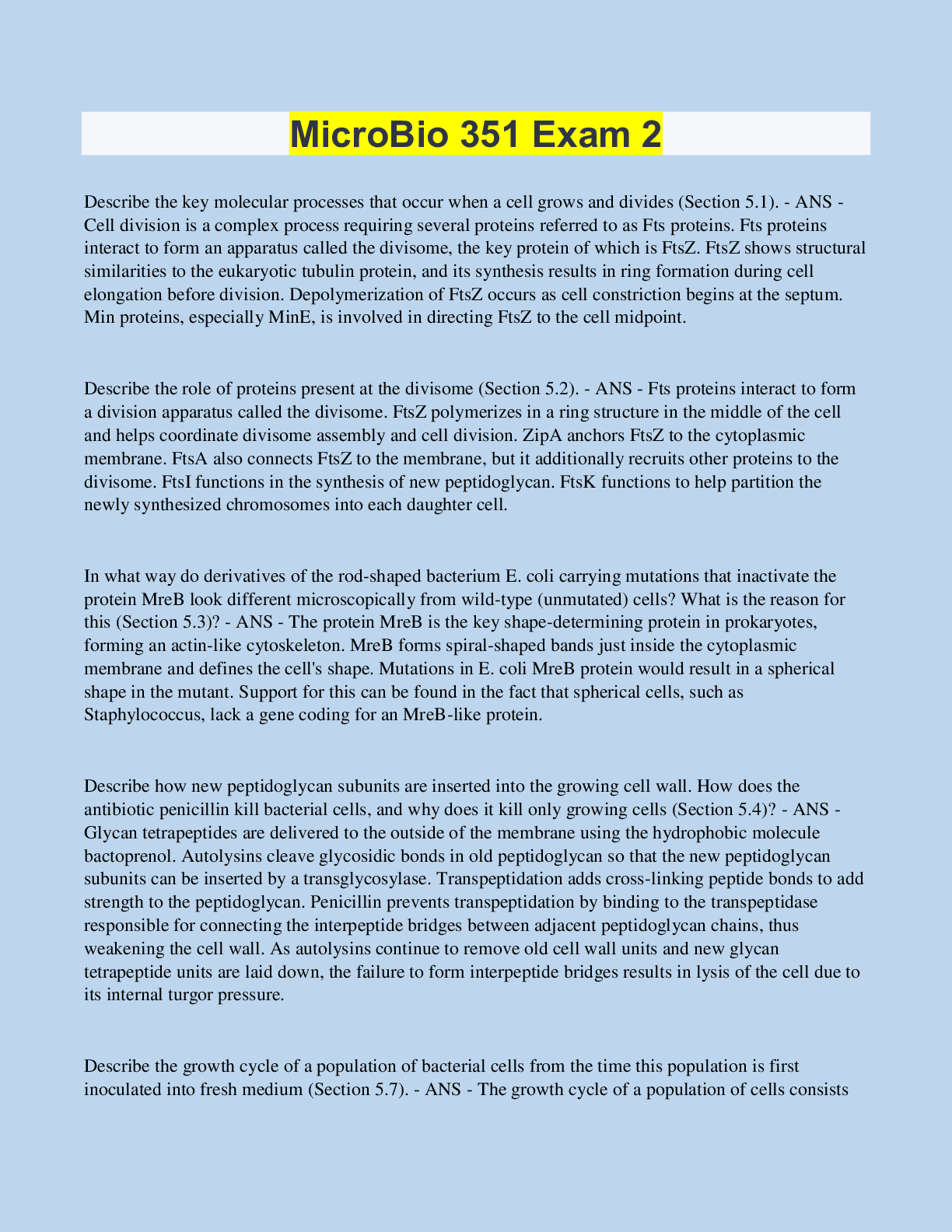
MicroBio 351 Exam 2
Describe the key molecular processes that occur when a cell grows and divides (Section 5.1). - ANS -
Cell division is a complex process requiring several proteins referred to as Fts proteins. Fts proteins
interact to form an apparatus called the divisome, the key protein of which is FtsZ. FtsZ shows structural
similarities to the eukaryotic tubulin protein, and its synthesis results in ring formation during cell
elongation before division. Depolymerization of FtsZ occurs as cell constriction begins at the septum.
Min proteins, especially MinE, is involved in directing FtsZ to the cell midpoint.
Describe the role of proteins present at the divisome (Section 5.2). - ANS - Fts proteins interact to form
a division apparatus called the divisome. FtsZ polymerizes in a ring structure in the middle of the cell
and helps coordinate divisome assembly and cell division. ZipA anchors FtsZ to the cytoplasmic
membrane. FtsA also connects FtsZ to the membrane, but it additionally recruits other proteins to the
divisome. FtsI functions in the synthesis of new peptidoglycan. FtsK functions to help partition the
newly synthesized chromosomes into each daughter cell.
In what way do derivatives of the rod-shaped bacterium E. coli carrying mutations that inactivate the
protein MreB look different microscopically from wild-type (unmutated) cells? What is the reason for
this (Section 5.3)? - ANS - The protein MreB is the key shape-determining protein in prokaryotes,
forming an actin-like cytoskeleton. MreB forms spiral-shaped bands just inside the cytoplasmic
membrane and defines the cell's shape. Mutations in E. coli MreB protein would result in a spherical
shape in the mutant. Support for this can be found in the fact that spherical cells, such as
Staphylococcus, lack a gene coding for an MreB-like protein.
Describe how new peptidoglycan subunits are inserted into the growing cell wall. How does the
antibiotic penicillin kill bacterial cells, and why does it kill only growing cells (Section 5.4)? - ANS -
Glycan tetrapeptides are delivered to the outside of the membrane using the hydrophobic molecule
bactoprenol. Autolysins cleave glycosidic bonds in old peptidoglycan so that the new peptidoglycan
subunits can be inserted by a transglycosylase. Transpeptidation adds cross-linking peptide bonds to add
strength to the peptidoglycan. Penicillin prevents transpeptidation by binding to the transpeptidase
responsible for connecting the interpeptide bridges between adjacent peptidoglycan chains, thus
weakening the cell wall. As autolysins continue to remove old cell wall units and new glycan
tetrapeptide units are laid down, the failure to form interpeptide bridges results in lysis of the cell due to
its internal turgor pressure.
Describe the growth cycle of a population of bacterial cells from the time this population is first
inoculated into fresh medium (Section 5.7). - ANS - The growth cycle of a population of cells consists
of four stages: lag, logarithmic (exponential), stationary, and death phases. The lag phase is the period of
time in which cells are synthesizing necessary enzymes to begin exponential growth. The exponential
phase is the period of maximal growth rate in which the cells are in their healthiest state. At stationary
phase, cell growth levels off as nutrients are consumed and toxic metabolic byproducts build up in the
culture. Finally, the death phase is characterized by an increasing number of nonviable cells that may
also undergo lysis.
How can a chemostat regulate growth rate and cell numbers inde- pendently (Section 5.8)? - ANS - A
chemostat can regulate growth rate and cell numbers independently because over a broad range of
dilution rates, the bacterial concentration in the chemostat remains relatively constant. Thus, as the
dilution rate increases, the growth rate also increases. At a constant dilution rate, increasing the limiting
substrate will also increase the growth rate.
What is the difference between a total cell count and a viable cell count (Sections 5.9 and 5.10)? - ANS -
Total microbial cell counts include both viable (living) and intact but nonviable (dead) cells, whereas
viable cell counts include only live cells.
Why is acetyl phosphate considered an energy-rich compound but glucose 6-phosphate is not (Section
4.7)? - ANS - Acetyl phosphate is considered an energy-rich compound because the energy released via
hydrolysis of the phosphoanhydride bond in this compound (-44.8 kJ/mol) is far greater than that
contained in the phosphoester bond in glucose 6-phosphate (-13.8 kJ/mol).
How is ATP made in fermentation and in respiration (Section 4.8)? - ANS - In fermentation, ATP is
made via substrate-level phosphorylation; in respiration, most of the ATP synthesized is via electron
transport coupled to oxidative phosphorylation.
Where in glycolysis is NADH produced? Where is NADH con- sumed (Section 4.8)? - ANS - In
glycolysis, NADH is produced when glyceraldehyde 3-phosphate is oxidized to
1,3-bisphosphoglycerate. It is consumed at the end of the fermentation step (stage III), when pyruvate is
reduced via NADH to a fermentation product.
List some of the important electron carriers found in electron transport chains (Section 4.9). - ANS -
Important electron carriers found in electron transport chain
[Show More]