RDA State Board Exam-Infection control
Questions with COMPLETE SOLUTIONA group of infection prevention practices that apply to all patients regardless of suspected or confirmed
infection status, in any setting in which
...
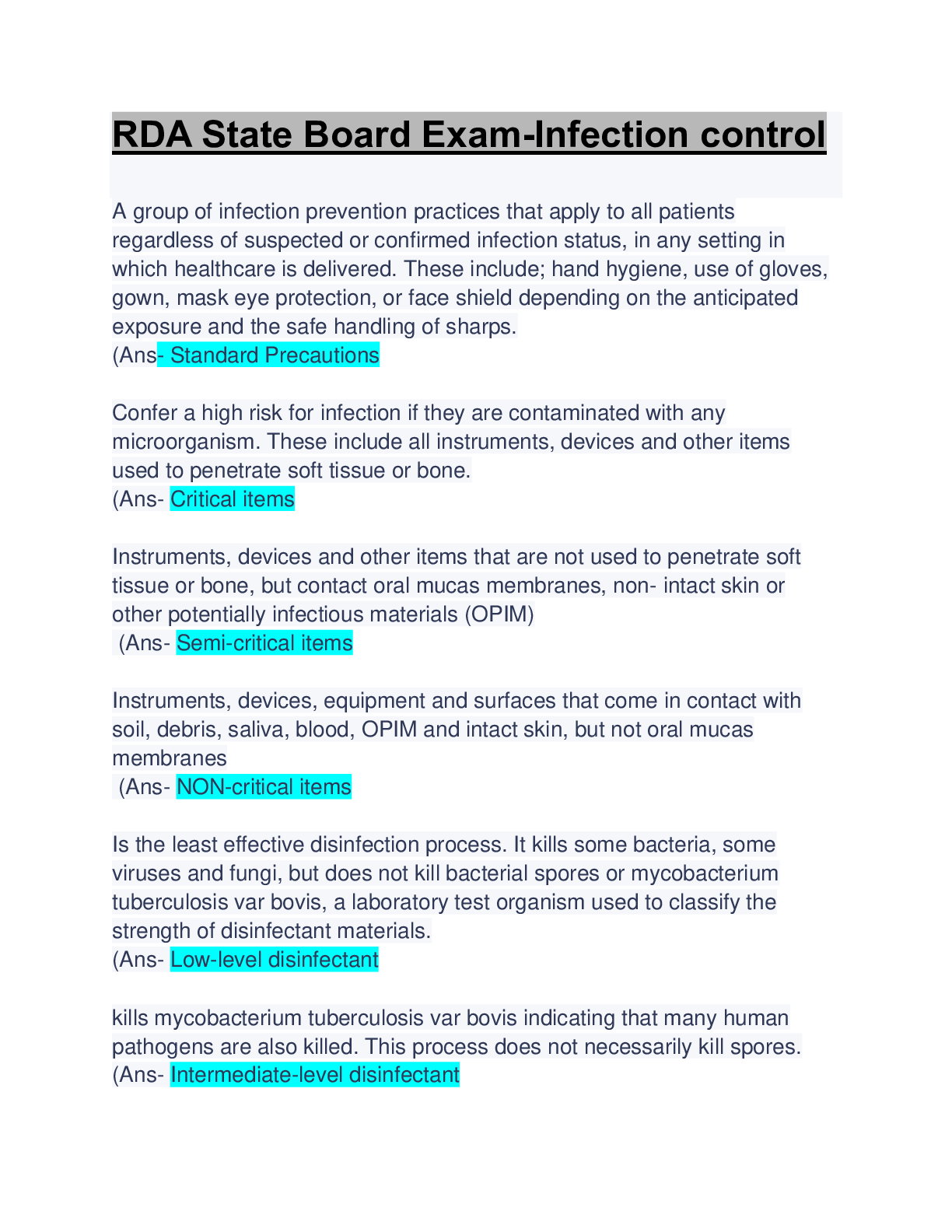
RDA State Board Exam-Infection control
Questions with COMPLETE SOLUTIONA group of infection prevention practices that apply to all patients regardless of suspected or confirmed
infection status, in any setting in which healthcare is delivered. These include; hand hygiene, use of
gloves, gown, mask eye protection, or face shield depending on the anticipated exposure and the safe
handling of sharps. - ✔✔Standard Precautions
Confer a high risk for infection if they are contaminated with any microorganism. These include all
instruments, devices and other items used to penetrate soft tissue or bone. - ✔✔Critical items
Instruments, devices and other items that are not used to penetrate soft tissue or bone, but contact oral
mucas membranes, non- intact skin or other potentially infectious materials (OPIM) - ✔✔Semi-critical
items
Instruments, devices, equipment and surfaces that come in contact with soil, debris, saliva, blood, OPIM
and intact skin, but not oral mucas membranes - ✔✔NON-critical items
Is the least effective disinfection process. It kills some bacteria, some viruses and fungi, but does not kill
bacterial spores or mycobacterium tuberculosis var bovis, a laboratory test organism used to classify the
strength of disinfectant materials. - ✔✔Low-level disinfectant
kills mycobacterium tuberculosis var bovis indicating that many human pathogens are also killed. This
process does not necessarily kill spores. - ✔✔Intermediate-level disinfectant
kills some, but not necessarily all bacterial spores. This process kills mycobaterium tuberculosis var
bovis, bacteria, fungi, and viruses. - ✔✔High-level disinfectant
is a chemical agent that can be used to disinfect items and surfaces based on the level of contamination.
- ✔✔Germicide
[Show More]