RDA State Board Exam-Infection control
Questions with COMPLETE SOLUTION
A group of infection prevention practices that apply to all patients regardless of suspected or confirmed
infection status, in any setting in whi
...
RDA State Board Exam-Infection control
Questions with COMPLETE SOLUTION
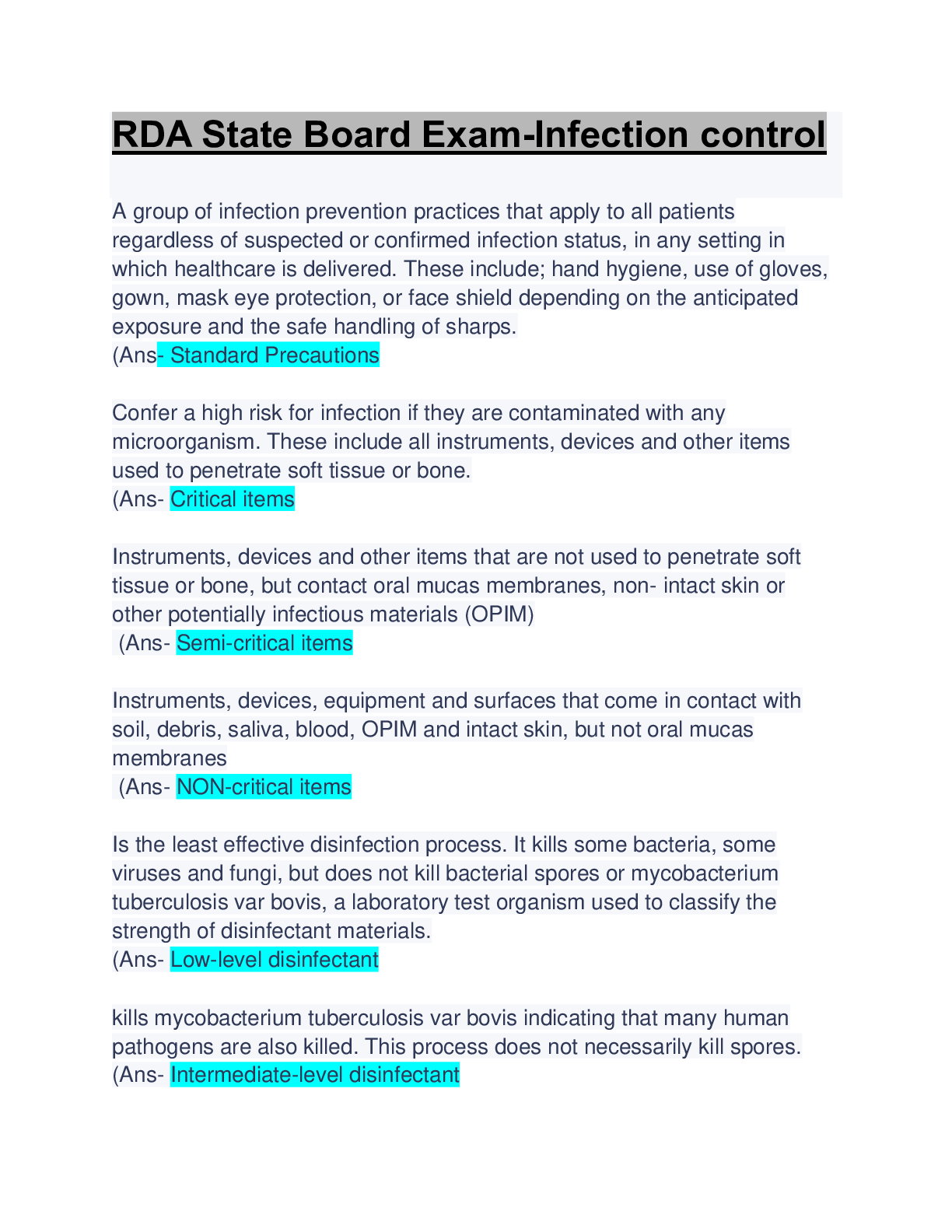
A group of infection prevention practices that apply to all patients regardless of suspected or confirmed
infection status, in any setting in which healthcare is delivered. These include; hand hygiene, use of
gloves, gown, mask eye protection, or face shield depending on the anticipated exposure and the safe
handling of sharps. - ✔✔Standard Precautions
Confer a high risk for infection if they are contaminated with any microorganism. These include all
instruments, devices and other items used to penetrate soft tissue or bone. - ✔✔Critical items
Instruments, devices and other items that are not used to penetrate soft tissue or bone, but contact oral
mucas membranes, non- intact skin or other potentially infectious materials (OPIM) - ✔✔Semi-critical
items
Instruments, devices, equipment and surfaces that come in contact with soil, debris, saliva, blood, OPIM
and intact skin, but not oral mucas membranes - ✔✔NON-critical items
Is the least effective disinfection process. It kills some bacteria, some viruses and fungi, but does not kill
bacterial spores or mycobacterium tuberculosis var bovis, a laboratory test organism used to classify the
strength of disinfectant materials. - ✔✔Low-level disinfectant
kills mycobacterium tuberculosis var bovis indicating that many human pathogens are also killed. This
process does not necessarily kill spores. - ✔✔Intermediate-level disinfectant
kills some, but not necessarily all bacterial spores. This process kills mycobaterium tuberculosis var
bovis, bacteria, fungi, and viruses. - ✔✔High-level disinfectant
is a chemical agent that can be used to disinfect items and surfaces based on the level of contamination.
- ✔✔Germicideis a validated process used to render a product free of all forms of viable microorganisms. -
✔✔Sterilization
is the removal of visable soil debris and OPIM from objects and surfaces and shall be accomplished
manually or mechanically using water with detergents or enzymatic products. - ✔✔Cleaning
is specialized clothing or equipment worn or used for protection against a hazard. - ✔✔PPE's
(personal protective equipment)
means any one of the following:
human bodily fluids.
any unfixed tissue or organ (other than intact skin) from a human living or dead. or any of the following
if known or rerasoably known to contain or be infected with HIV, HEP B, OR HEP C:cell, tissue, or organ
cultures from humans or experimental animalsa, blood organs, or other tissues from experimental
animals, or culture medium or other solutions - ✔✔Other Potentially Infectious Materials (OPIM)
Are all paid and non-paid personnel in the dental healthcare setting.who might be occupationally
exposed to infectious materials, including bodily substances and contaminated supplies, equipment,
enviornmental surfaces, water, or air, includes all persons directly involved in patient care as well as
those persons who are not involved directly.. - ✔✔Dental Healthcare Personnel (DCHP)
all DHCP shall comply with infection control precautions and enforce the following minimum
precautions to protect patients and DCHP and to minimize the transmission of pathogens in health care
settings: - ✔✔Standard precautions shall be practiced in the care of all patients.
A written protocol shall be developed and maintained and periodically updated for: - ✔✔*instrument
processing
*opertory clenliness
*management of injuries
*protocol shall be made available to all DCHP at the dental office.as well as having a copy of this
regulation conspicuously posted in each dental office.
[Show More]


.png)
.png)


.png)

