Back to Status page
contains 21 Questions
1) The detailed tasks required to be completed and identified in the time-based Integrated
Master Schedule (IMS) are directly linked to what element of the event-based Integra
...
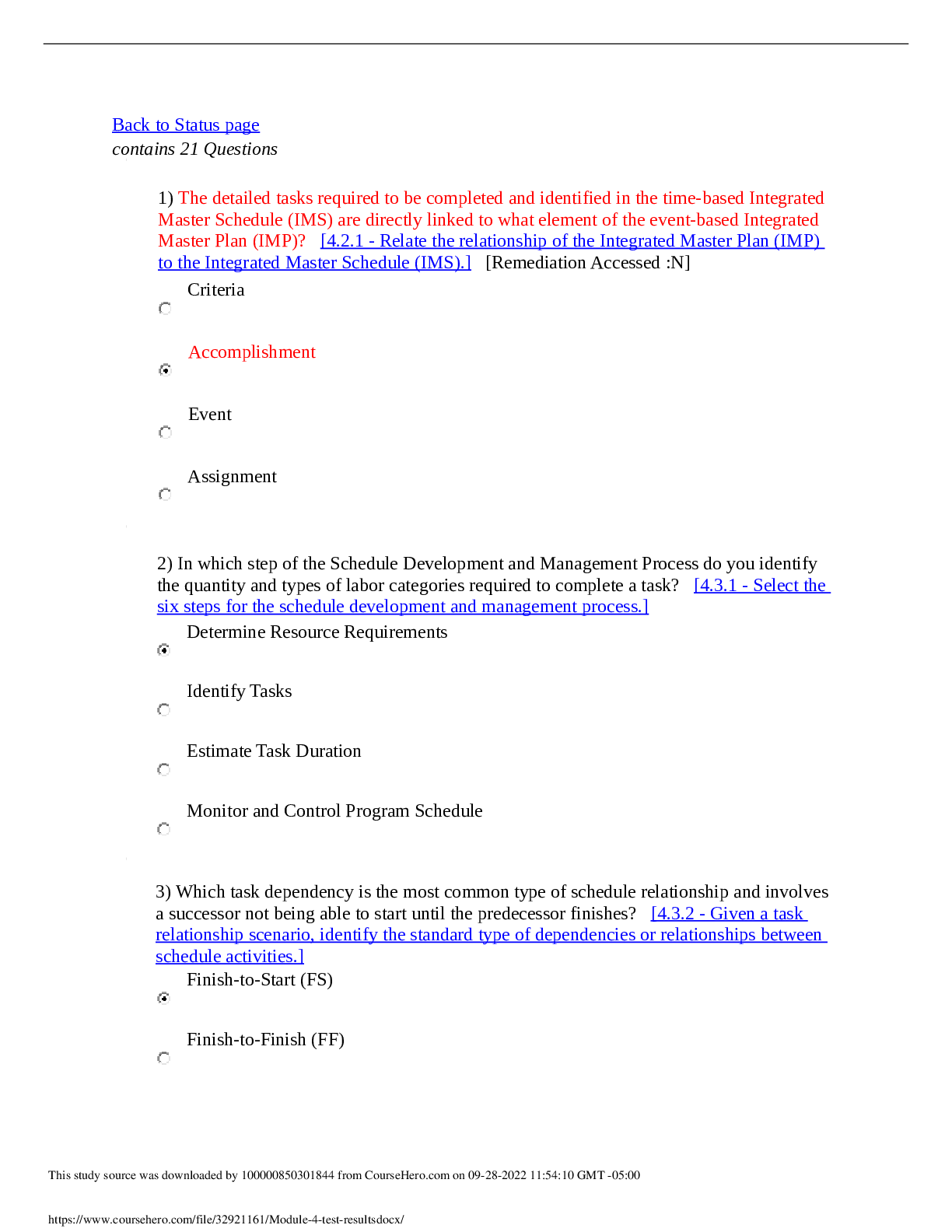
Back to Status page
contains 21 Questions
1) The detailed tasks required to be completed and identified in the time-based Integrated
Master Schedule (IMS) are directly linked to what element of the event-based Integrated
Master Plan (IMP)? [4.2.1 - Relate the relationship of the Integrated Master Plan (IMP)
to the Integrated Master Schedule (IMS).] [Remediation Accessed :N]
Criteria
Accomplishment
Event
Assignment
2) In which step of the Schedule Development and Management Process do you identify
the quantity and types of labor categories required to complete a task? [4.3.1 - Select the
six steps for the schedule development and management process.]
Determine Resource Requirements
Identify Tasks
Estimate Task Duration
Monitor and Control Program Schedule
3) Which task dependency is the most common type of schedule relationship and involves
a successor not being able to start until the predecessor finishes? [4.3.2 - Given a task
relationship scenario, identify the standard type of dependencies or relationships between
schedule activities.]
Finish-to-Start (FS)
Finish-to-Finish (FF)
Start-to-Start (SS)
Start-to-Finish (SF)
4) After starting the Schedule Development and Management Process by identifying a
comprehensive list of program tasks, assigning identifiers, and including additional
information such as potential constraints, what sort of product should the program manager
(PM) expect to have? [4.3.3 - Identify the end result of the identification of schedule tasks
step.]
A visual representation of the task list showing the breakdown of work packages into
tasks and the listing of all tasks in a task list
A visual representation of the task list showing the sequencing of each task and the
listing of all tasks in a work package
A visual representation of the task list showing all resources needed for each task and
the listing of all tasks in a control account
A visual representation of the task list showing all available float for each task and the
listing of all tasks in a task list
5) Which schedule duration estimating method uses statistical relationships determined
from historical data to calculate the estimate for certain tasks? [4.3.4 - Using a task
duration estimating calculation, select the correct estimating technique.]
Parametric Estimate
Analogous Estimate
Three-Point Estimate
Single-Point Estimate
6) The summary schedule is generally associated with levels 1-3 of the Work Breakdown
Structure (WBS), whereas the intermediate schedule is generally associated with which
WBS levels? [4.3.5 - Identify the differences in schedules produced, as an output of
constructing program schedules.]
Levels 3-5
Levels 2-3
Levels 2-5
Levels 3-4
7) How are schedules in a schedule change management system similar to project elements
under configuration management (CM)? [4.3.6 - Identify the key factors of a schedule
change management system, as part of monitoring and control of program schedules.]
In both a schedule change management system and CM, each version needs to be
managed, controlled, and constantly monitored.
In both a schedule change management system and CM, the first version is used
consistently throughout the entire project.
In both a schedule change management system and CM, versions are monitored only
by the program manager (PM).
In both a schedule change management system and CM, changes to versions can be
made without notifying team members.
8) When is Agile Project Management typically used during the scheduling process?
[4.3.7 - Explain the effects of agile project management on scheduling.]
When requirements are likely to change as the project progresses
When the schedule is stable and low-risk
When requirements are likely to be fixed throughout the entire project
When the schedule requires only one sprint
9) Which schedule type is also referred to as a bar chart since it depicts a task as a
horizontal bar imposed over a time line or calendar? [4.4.1 - Identify the types of
schedules commonly used in program management.]
Gantt chart
Network diagram
Milestone chart
Internal schedule
10) In a Gantt chart, which of the following is signified as a simple, solid bar with distinct
start and finish designators? [4.4.2 - Using symbology on a Gantt chart, interpret the
different types of relationships.]
Summary Task
Summary Task, In Progress
Critical Task
Non-Critical Task
11) Which of the following are advantages of network diagrams? (Select three that apply.)
[4.4.3 - Identify the advantages/disadvantages of network diagrams.]
Enables early detection of resource constraints
Graphically depicts the relationship between project activities/events and their
impacts
Allows planners to do quick "what if" analyses of changes to the schedule
Generally useful for information briefings and reviews
12) Consider the characteristics of the three types of network schedules: Program
Evaluation and Review Technique (PERT), Arrow Diagram Method (ADM), and
Precedence Diagramming Method (PDM). Which of the following is a true statement?
[4.4.4 - Contrast the three network schedule types.] [Remediation Accessed :N] 4.4 pg.
54 of 73
PDM was developed to overcome the disadvantages of PERT and ADM, and doesn't
treat all task relationships as "Finish-to-Start (FS)."
PDM and ADM are seldom used due to the increase of computer-based scheduling
tools.
All three types of network schedules rely on time estimates for each activity to build
an accurate schedule.
PERT and PDM use the FS task relationship while ADM can use any type of task
relationship.
13) Which of the following components of the Precedence Diagramming Method (PDM) is
identified by expanding the schedule to display the Start and Finish columns? [4.5.1 -
Using a simple PDM schedule format, identify the earliest and latest start and finish dates,
critical path, and float (or slack).]
Earliest and Latest Start and Finish Dates
Critical Path
Float/Slack
Task identifiers
14) Which of the following are characteristics of the forward pass, one of the components
of the Critical Path Method (CPM)? (Select three that apply.) [4.5.2 - Identify the
components of the Critical Path Method (CPM).]
Results in the earliest start dates for all the tasks
Results in the latest finish dates for all the tasks
Continues to the last task in accordance with task relationships
Begins with the first task in the schedule
15) Consider the differences between a resource-constrained schedule and a timeconstrained schedule. Which constraint occurs when there is a shortage of people,
equipment, facilities, or materials; and which constraint occurs when the length of the
critical path surpasses the allotted time for the project? [4.6.1 - Identify the differences
between a resource-constrained schedule and a time-constrained schedule.]
Resource constraint, time constraint
Time constraint, resource constraint
Management constraint, time constraint
Resource constraint, schedule constraint
16) Which of the following is a viable solution to schedule time constraint issues? [4.6.2 -
Identify four solutions to time constraint issues.] [Remediation Accessed :N] 4.6 pg. 12
of 63
Shortening task durations for tasks on the critical path
Accepting a shorter length of time for the project
Cutting resources
Adding more tasks to the critical path
17) Which schedule resource constraint solution is best used when there is a program
benefit to using resources other than those originally planned? [4.6.3 - Identify four
possible methods for working with resource constraints.]
Substituting resources
Adding resources
Reducing program scope
Adjusting the schedule to accommodate slack
18) A proposal manager asks the team to provide "80%" estimates for their schedule. The
team believes that they have an 80% chance of finishing on time, when in reality, they do
not. In this example, the team clearly does not take into account the overall uncertainty of
the program. Which of the following causes for schedule risks and delays is being
described? [4.7.1 - Identify the potential causes for schedule risks and delays.]
Uncertainty in task duration estimates
Unrealistic milestones or deadlines
Incorrect schedule relationships or logic
Inability to change the number of tasks
19) Prior to using the 14-Point Schedule Metrics, the number of each type of the four
relationships (Finish-to-Start [FS], Finish-to-Finish [FF], Start-to-Start [SS], and Start-toFinish [SF]) for incomplete tasks needs to be calculated. This describes which of the
following data types? [4.8.1 - Choose the type of data that needs to be calculated in
preparation for using 14-Point Schedule Metrics.]
Relationship Count
Baseline Count
Complete Tasks
Incomplete Tasks
20) Which 14-Point Schedule Metric verifies that all tasks with durations greater than zero
have dollars or hours assigned? [4.8.2 - Identify some of the 14-Point Schedule
Metrics.]
Resources
High Float
Leads
Baseline Execution Index (BEI)
21) What are the first three steps in the process for building a Precedence Diagramming
Method (PDM) schedule? [4.9.1 - Construct a simple network schedule using the PDM
format.] [Remediation Accessed :N] 4.5
Identify the tasks, sequence the tasks, determine resource requirements
Estimate task durations, determine resource requirements, sequence the tasks
Sequence the tasks, identify the tasks, estimate task durations
Determine resource requirements, estimate task durations, identify the tasks
[Show More]



.png)