Module 7 Exam
• Here is your test result.The dots represent the choices you have made.
• The highlighted questions are the questions you have missed.
• Remediation Accessed shows whether you accessed those links.'N' r
...
Module 7 Exam
• Here is your test result.The dots represent the choices you have made.
• The highlighted questions are the questions you have missed.
• Remediation Accessed shows whether you accessed those links.'N' represents links not
visited and 'Y' represents visited links.
Back to Status page
contains 7 Questions
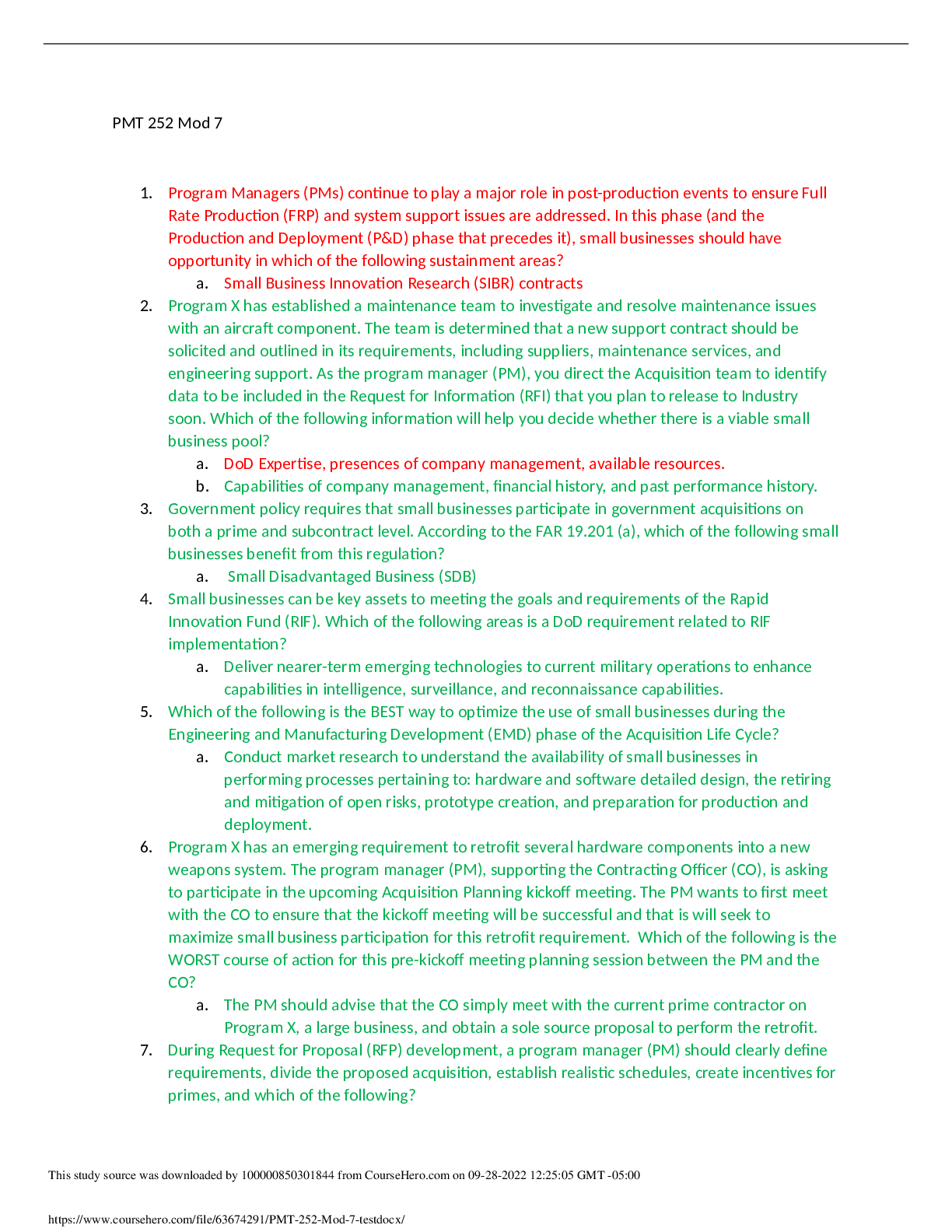
1) Government policy requires that small businesses participate in government
acquisitions on both a prime and subcontract level. According to the Federal Acquisition
Regulation (FAR) 19.201(a), which of the following small businesses benefit from this
regulation? [7.2.1 - Summarize the interrelationship and importance of small business
to the acquisition team and Acquisition Life Cycle process.]
Small Disadvantaged Business (SDB)
Utilized Business Zone Small Business (UBZone)
Recent Graduates Program Business (RGP)
First Generation American-owned businesses (FGA)
2) Which of the following statements is true regarding the application of market research
to recognize appropriate small business resources? [7.3.1 - As Acquisition Team
members, apply market research to recognize appropriate small business resources.]
The program manager (PM) uses market research to determine both the degree of
small business opportunity and their likelihood of success in the program.
The process of identifying small businesses through market research begins in the
post-award stages.
Market research is useful to determine small business opportunities up until the
Engineering and Manufacturing Development (EMD) phase, at which point it is no longer
needed.
The PM uses market research to determine if a small business has a strong past
performance history and proven company management; a solid financial history is
optional.
3) Program X has an emerging requirement to retrofit several hardware components into a
new weapons system. The program manager (PM), supporting the Contracting Officer
(CO), is asked to participate in the upcoming Acquisition Planning kickoff meeting. The
PM wants to first meet with the CO to ensure that the kickoff meeting will be successful
and that it will seek to maximize small business participation for this retrofit requirement.
Which of the following actions is most appropriate for this pre-kickoff meeting planning
session between the PM and the CO? [7.3.2 - As Acquisition Team members, apply
acquisition planning to recognize appropriate small business resources.]
The PM should recommend that the CO invite the Small Business Specialist to the
kickoff meeting.
The PM should advise that the CO simply meet with the current prime contractor of
Program X, a large business, and obtain a sole source proposal to perform the retrofit.
The PM should suggest to bypass market research and instead select small businesses
he/she seems promising as soon as possible.
The PM and CO should proceed to select small business contenders based on prior
financial history only.
4) Which of the following statements is true regarding ways the program manager (PM)
can use small businesses during the Acquisition Life Cycle? [7.4.1 - Identify ways to use
small businesses during the phases of the Acquisition Life Cycle.]
PMs should incorporate small businesses early in the Life Cycle so that a detailed
strategy to achieve a win-win situation for both parties can be established right away.
PMs need to begin market research at Milestone (MS) B in order to identify suitable
small businesses with the appropriate resources for the program.
The PM can expect small businesses to be most useful during the Materiel Solution
Analysis (MSA) phase, as opposed to the other Acquisition Life Cycle phases.
Communication with industry during the incorporation of small businesses into the
Acquisition Life Cycle is not mandatory.
5) During Request for Proposal (RFP) development, a program manager (PM) should
clearly define requirements, divide the proposed acquisition, establish realistic schedules,
create incentives for primes, and which of the following? [7.4.2 - Apply small businesses
and remove barriers in RFP development and source selection planning.]
Use more than one small business
Decide if small business incorporation is appropriate
Identify realistic concessions for small business participants
Review cost schemes to ensure that the requirements are within budget constraints
6) Which of the following statements is true regarding the role of small businesses in
sustainment? [7.5.1 - Identify how small business sustainment affects the acquisition
process.]
Sustainment helps small businesses meet their participation goals, especially in
knowledge-based, electronic and communication, and facility-related services.
Small business set-aside contracts are a source of additional risk above other phases,
and should be considered with care.
While sustainment provides plenty of opportunities, small businesses are usually not
needed for system modifications or upgrades during this phase.
Small businesses are in an especially advantageous position during the sustainment
phase.
7) What is one of the effects of the Rapid Acquisition Process (RAP) on the use of small
businesses? [7.5.2 - Identify the effect of small business use on rapid acquisition.]
Mentor-protégé relationships are established that subsequently result in contract
awards to small businesses.
A set of guidelines is provided to get small businesses started quickly in the
acquisition process.
Small businesses gain an even hand in bidding due to their flexible nature.
Increased business for small businesses results from faster bid-award cycles.
[Show More]








.png)