BCF130
Fundamentals of Cost Analysis
Module 3-5 Exam (Step 2)
1) What combination of data is most useful and preferred? [Discuss the data types and
data sources used in creating DoD cost estimates.] [Remediation Acce
...
BCF130
Fundamentals of Cost Analysis
Module 3-5 Exam (Step 2)
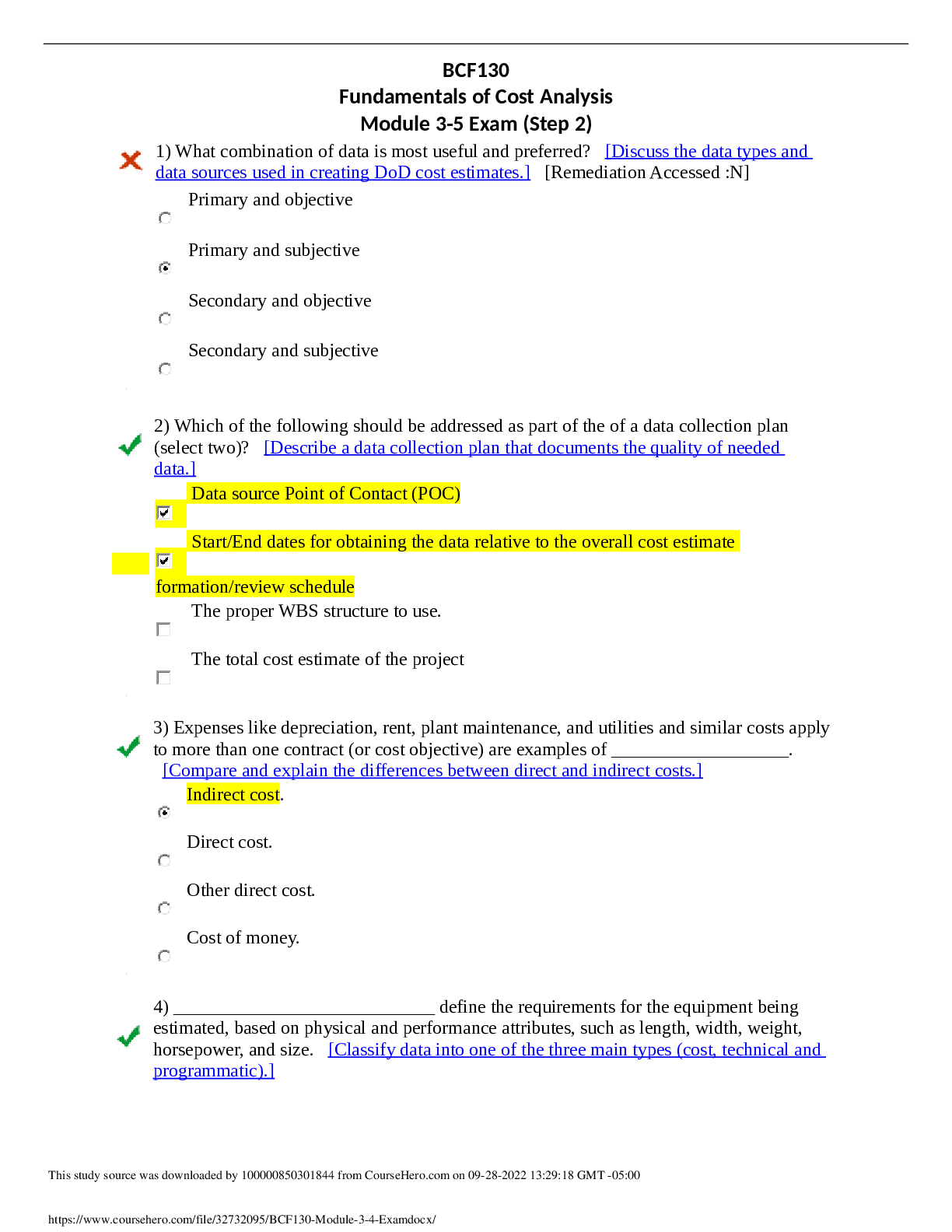
1) What combination of data is most useful and preferred? [Discuss the data types and
data sources used in creating DoD cost estimates.] [Remediation Accessed :N]
Primary and objective
Primary and subjective
Secondary and objective
Secondary and subjective
2) Which of the following should be addressed as part of the of a data collection plan
(select two)? [Describe a data collection plan that documents the quality of needed
data.]
Data source Point of Contact (POC)
Start/End dates for obtaining the data relative to the overall cost estimate
formation/review schedule
The proper WBS structure to use.
The total cost estimate of the project
3) Expenses like depreciation, rent, plant maintenance, and utilities and similar costs apply
to more than one contract (or cost objective) are examples of ___________________.
[Compare and explain the differences between direct and indirect costs.]
Indirect cost.
Direct cost.
Other direct cost.
Cost of money.
4) ____________________________ define the requirements for the equipment being
estimated, based on physical and performance attributes, such as length, width, weight,
horsepower, and size. [Classify data into one of the three main types (cost, technical and
programmatic).]
BCF130
Fundamentals of Cost Analysis
Module 3-5 Exam (Step 2)
Technical performance measures
Schedule or program data
Cost data
None of the above
5) There are many Cost and Software Data Reporting (CSDR) formats. Which of the
following is one of those formats? [Recognize data collection sources from government
databases (e.g., CADE, EVM-CR, VAMOSC).]
Software Resource Data Reports (SRDRs)
Contract Work breakdown Structure Dictionary (CWBS)
Learning Curve Report (LCR)
Cost Performance Report (CPR)
6) When normalizing data for unit sizing, the sizing metric must be defined so that the data
can be converted to a common standard before being used in later steps in the estimation
process. [Describe different methods to normalize data (e.g., grouping into homogeneous
data groups, inflation, and quantity adjustments).]
False
True
7) ____________ represent the relative change in general price level from one year to
another. [Define inflation terminology including Constant Year (CY), Then Year (TY),
Raw Inflation Indices and Weighted Inflation Indices.]
Raw indices
A weighted index
A constant year index
A then year index
BCF130
Fundamentals of Cost Analysis
Module 3-5 Exam (Step 2)
8) You observe that the flight hour cost in Account 3400 - Operations & Maintenance is
$100 in FY 2014. What is the proper value if expressed in CY 2018 dollars (pick the
closest answer)? [Calculate a Constant Year (CY) to Constant Year (CY) conversion using
the correct indices and operations.] [Remediation Accessed :N]
$106.0 K
$94.3 K
$100.2 K
$103.6 K
9) With respect to Price Escalation, which of the following is not considered a commodityspecific price adjustment? [Identify the difference between inflation and price
escalation.] [Remediation Accessed :N]
Inflation
Changes in Supply/Demand
Industry Factors
None of these are correct
10) __________________________ provides comprehensive economic, financial, and
political coverage of countries, regions, and industries - covering over 200 countries and
spanning more than approximately 170 industries. [Recognize the sources of inflation and
price escalation indices (e.g. OSD Comptroller, Bureau of labor Statistics, IHS Global
Insight)]
IHS Global Insight
Bureau of Labor Statistics
Office of Management and Budget
OSD Comptroller
BCF130
Fundamentals of Cost Analysis
Module 3-5 Exam (Step 2)
11) You have collected the following cost data on 5 personnel shelters: $7450; $6700;
$7000; $7005; and $5425. Based on this information, you could say: [Define and
calculate the measures of central tendency (i.e. the mean, median, and mode).]
The mean cost for a shelter is $6716.
The mean cost for a shelter is $7000.
The median cost for a shelter is $6716.
The mode cost for a shelter is $7000.
12) You want to make a statement about the variability in the costs of personnel shelters.
After collecting sample data (cost in $K) on 8 shelters you perform some preliminary
calculations.
Given the information provided:
[Image Description: Xbar = $48.25K, Summation of (Xi - Xbar)2 =575.50] [Define and
calculate the measures of dispersion (i.e. the range, variance, standard deviation, and
coefficient of variation).]
The coefficient of variation is about 18.79%
The variance is about $71.94 K
The standard deviation is about $82.21 K
The coefficient of variation is about 0.1879 %
13) Outliers are observations that fall more than how many standard deviations from the
mean. [Recognize outliers in a data set and determine origin and disposition of the
outliers.]
Two
One
Three
BCF130
Fundamentals of Cost Analysis
Module 3-5 Exam (Step 2)
Four
1) What are examples of a Secondary data source (select two)? [Discuss the data
types and data sources used in creating DoD cost estimates.]
Basic Accounting
Records
Research
papers
Data Collection input
forms
Cost
studies
2) You observe that the flight hour cost in Account 3600 - Research,
Development, and Testing, Evaluation is $100 in FY 2013. What is the
proper value if expressed in CY 2018 dollars (pick the closest answer)?
[Calculate a Constant Year (CY) to Constant Year (CY) conversion using the correct indices and
operations.]
$107.6
K
$93.0
K
$100.3
K
$103.6
K
3) The OSD CAPE guide on Inflation and Escalation Best Practices for Cost
Analysis includes which of the following? [Identify the difference between inflation and
price escalation.]
All of these are
BCF130
Fundamentals of Cost Analysis
Module 3-5 Exam (Step 2)
correct.
Standard terminology to distinguish between inflation and
escalation.
Minimum standards for documenting and labeling indices used in an
analysis.
Use of realistic escalation rates to estimate investment and
sustainment costs.
[Show More]