WGU C961 Ethics in Technology
Glossary Terms Already Passed
acceptable use policy (AUP) ✔✔A document that stipulates restrictions and practices that a user
must agree in order to use organizational computing and netwo
...
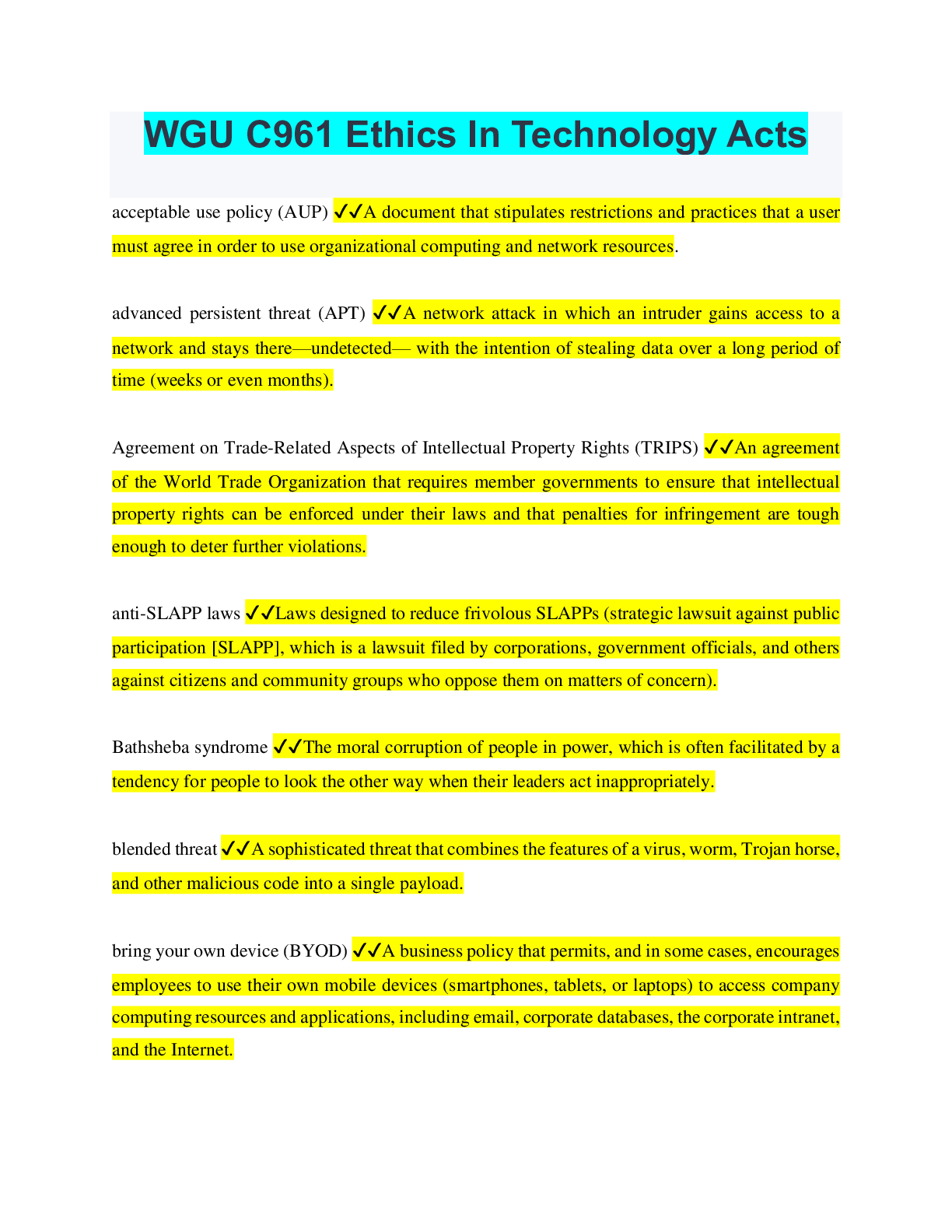
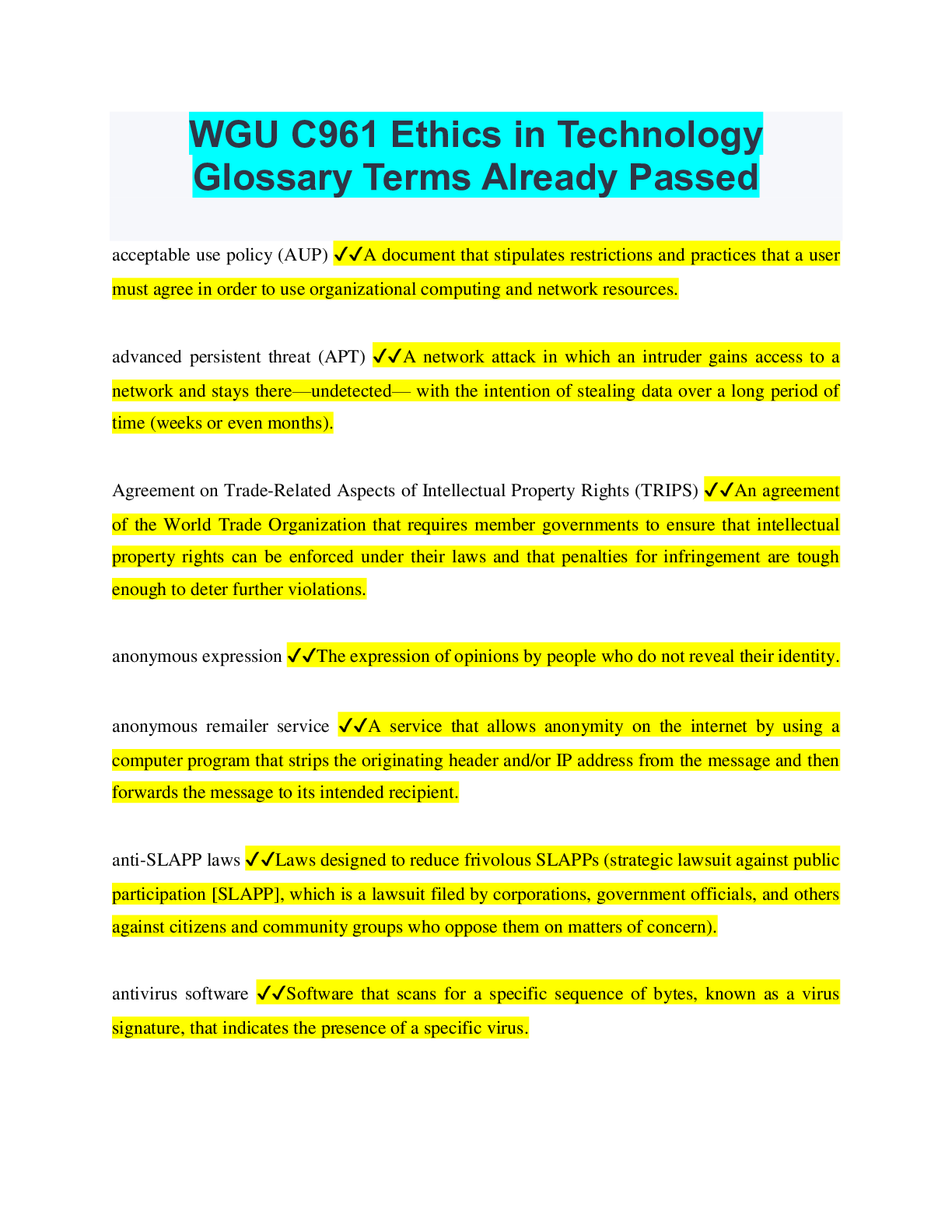
WGU C961 Ethics in Technology
Glossary Terms Already Passed
acceptable use policy (AUP) ✔✔A document that stipulates restrictions and practices that a user
must agree in order to use organizational computing and network resources.
advanced persistent threat (APT) ✔✔A network attack in which an intruder gains access to a
network and stays there—undetected— with the intention of stealing data over a long period of
time (weeks or even months).
Agreement on Trade-Related Aspects of Intellectual Property Rights (TRIPS) ✔✔An agreement
of the World Trade Organization that requires member governments to ensure that intellectual
property rights can be enforced under their laws and that penalties for infringement are tough
enough to deter further violations.
anonymous expression ✔✔The expression of opinions by people who do not reveal their identity.
anonymous remailer service ✔✔A service that allows anonymity on the internet by using a
computer program that strips the originating header and/or IP address from the message and then
forwards the message to its intended recipient.
anti-SLAPP laws ✔✔Laws designed to reduce frivolous SLAPPs (strategic lawsuit against public
participation [SLAPP], which is a lawsuit filed by corporations, government officials, and others
against citizens and community groups who oppose them on matters of concern).
antivirus software ✔✔Software that scans for a specific sequence of bytes, known as a virus
signature, that indicates the presence of a specific virus.artificial intelligence systems ✔✔The people, procedures, hardware, software, data, and
knowledge needed to develop computer systems and machines that can simulate human
intelligence processes, including learning (the acquisition of information and rules for using the
information), reasoning (using rules to reach conclusions), and self-correction (using the outcome
from one scenario to improve its performance on future scenarios).
audit committee ✔✔A group that provides assistance to the board of directors in fulfilling its
responsibilities with respect to the oversight of the quality and integrity of the organization's
accounting and reporting practices and controls, including financial statements and reports; the
organization's compliance with legal and regulatory requirements; the qualifications,
independence, and performance of the company's independent auditor; and the performance of the
company's internal audit team.
Bathsheba syndrome ✔✔The moral corruption of people in power, which is often facilitated by a
tendency for people to look the other way when their leaders act inappropriately.
blended threat ✔✔A sophisticated threat that combines the features of a virus, worm, Trojan horse,
and other malicious code into a single payload.
body of knowledge ✔✔An agreed-upon sets of skills and abilities that all licensed professionals
must possess.
botnet ✔✔A large group of computers, which are controlled from one or more remote locations
by hackers, without the knowledge or consent of their owners.
breach of contract ✔✔The failure of one party to meet the terms of a contract.
breach of the duty of care ✔✔The failure to act as a reasonable person would act.bribery ✔✔The act of providing money, property, or favors to someone in business or government
in order to obtain a business advantage.
bring your own device (BYOD) ✔✔A business policy that permits, and in some cases, encourages
employees to use their own mobile devices (smartphones, tablets, or laptops) to access company
computing resources and applications, including email, corporate databases, the corporate intranet,
and the Internet.
BSA | The Software Alliance (BSA) ✔✔A trade group that represent the world's largest software
and hardware manufacturers.
business continuity plan ✔✔A risk-based strategy that includes an occupant emergency evacuation
plan, a continuity of operations plan, and an incident management plan with an active governance
process to minimize the potential impact of any security incident and to ensure business continuity
in the event of a cyberattack or some form of disaster.
CAPTCHA (Completely Automated Public Turing Test to Tell Computers and Humans Apart)
✔✔Software that generates and grades tests that humans can pass and all but the most sophisticated
computer programs cannot.
certification ✔✔Indicates that a professional possesses a particular set of skills, knowledge, or
abilities, in the opinion of the certifying organization. Certification can also apply to products (e.g.,
the Wi-Fi CERTIFIED logo assures that the product has met rigorous interoperability testing to
ensure that it will work with other Wi-Fi-certified products) and is generally voluntary.
Child Online Protection Act (COPA) ✔✔An act signed into law in 1998 with the aim of prohibiting
the making of harmful material available to minors via the internet; the law was ultimately ruled
largely unconstitutional.Children's Internet Protection Act (CIPA) ✔✔An act passed in 2000; it required federally financed
schools and libraries to use some form of technological protection (such as an internet filter) to
block computer access to obscene material, pornography, and anything else considered harmful to
minors.
CIA security triad ✔✔Refers to confidentiality, integrity, and availability.
clinical decision support (CDS) ✔✔A process and a set of tools designed to enhance healthcarerelated decision making through the use of clinical knowledge and patient-specific information to
improve healthcare delivery.
code of ethics ✔✔A statement that highlights an organization's key ethical issues and identifies
the overarching values and principles that are important to the organization and its decisionmaking.
Communications Decency Act (CDA) ✔✔Title V of the Telecommunications Act, it aimed at
protecting children from pornography, including imposing $250,000 fines and prison terms of up
to two years for the transmission of "indecent" material over the internet.
compliance ✔✔To be in accordance with established policies, guidelines, specifications, or
legislation.
computer forensics ✔✔A discipline that combines elements of law and computer science to
identify, collect, examine, and preserve data from computer systems, networks, and storage
devices in a manner that preserves the integrity of the data gathered so that it is admissible as
evidence in a court of law.
computerized provider order entry (CPOE) system ✔✔A system that enables physicians to place
orders (for drugs, laboratory tests, radiology, physical therapy) electronically, with the orders
transmitted directly to the recipient.conflict of interest ✔✔A conflict between a person's (or firm's) self-interest and the interests of a
client.
contingent work ✔✔A job situation in which an individual does not have an explicit or implicit
contract for long-term employment.
Controlling the Assault of Non-Solicited Pornography and Marketing (CAN-SPAM) ✔✔A law
that specifies that it is legal to spam, provided the messages meet a few basic requirements—
spammers cannot disguise their identity by using a false return address, the email must include a
label specifying that it is an ad or a solicitation, and the email must include a way for recipients to
indicate that they do not want future mass mailings.
Controlling the Assault of Non-Solicited Pornography and Marketing (CAN-SPAM) Act ✔✔A
law that specifies that it is legal to spam, provided the messages meet a few basic requirements
spammers cannot disguise their identity by using a false return address, the email must include a
label specifying that it is an ad or a solicitation, and the email must include a way for recipients to
indicate that they do not want future mass mailings.
copyright ✔✔The exclusive right to distribute, display, perform, or reproduce an original work in
copies or to prepare derivative works based on the work; granted to creators of original works of
authorship.
copyright infringement ✔✔A violation of the rights secured by the owner of a copyright; occurs
when someone copies a substantial and material part of another's copyrighted work without
permission.
corporate compliance officer ✔✔AKA corporate ethics officer - A senior-level manager who
provides an organization with vision and leadership in the area of business conduct.corporate ethics officer ✔✔A senior-level manager who provides an organization with vision and
leadership in the area of business conduct.
corporate social responsibility (CSR) ✔✔The concept that an organization should act ethically by
taking responsibility for the impact of its actions on its shareholders, consumers, employees,
community, environment, and suppliers.
cost per click (CPC) ✔✔One of the two common methods of charging for paid media, where ads
are paid for only when someone actually clicks on them.
cost per thousand impressions (CPM) ✔✔One of the two common methods of charging for paid
media, where ads are billed at a flat rate per 1,000 impressions, which is a measure of the number
of times an ad is displayed whether it was actually clicked on or not.
cyberabuse ✔✔Any form of mistreatment or lack of care, both physical and mental, based on the
use of an electronic communications device that causes harm and distress to others.
cyberespionage ✔✔The deployment of malware that secretly steals data in the computer systems
of organizations, such as government agencies, military contractors, political organizations, and
manufacturing firms.
cyberharassment ✔✔A form of cyberabuse in which the abusive behavior, which involves the use
of an electronic communications device, is degrading, humiliating, hurtful, insulting, intimidating,
malicious, or otherwise offensive to an individual or group of individuals causing substantial
emotional distress.
cybersquatter ✔✔A person or company that registers domain names for famous trademarks or
company names to which they have no connection, with the hope that the trademark's owner will
buy the domain name for a large sum of money.cyberstalking ✔✔Threatening behavior or unwanted advances directed at an adult using the
Internet or other forms of online and electronic communications; the adult version of
cyberbullying.
cyberterrorism ✔✔The intimidation of government or civilian population by using information
technology to disable critical national infrastructure (e.g., energy, transportation, financial, law
enforcement, and emergency response) to achieve political, religious, or ideological goals.
decision support system (DSS) ✔✔A type of business information system used to improve
decision making in a variety of industries.
defamation ✔✔Making either an oral or a written statement of alleged fact that is false and that
harms another person.
Defend Trade Secrets Act of 2016 ✔✔An act passed in 2016 that amended the Economic
Espionage Act to create a federal civil remedy for trade secret misappropriation.
Department of Homeland Security (DHS) ✔✔A large federal agency with more than 240,000
employees and a budget of almost $65 billion whose goal is to provide for a "safer, more secure
America, which is resilient against terrorism and other potential threats."
design patent ✔✔A type of patent that permits its owner to exclude others from making, using, or
selling the design in question.
Digital Millennium Copyright Act (DMCA) ✔✔Signed into law in 1998, the act addresses a
number of copyright-related issues, with Title II of the act providing limitations on the liability of
an Internet service provider for copyright infringement.
[Show More]


.png)