WGU C961 Ethics In Technology Acts
acceptable use policy (AUP) ✔✔A document that stipulates restrictions and practices that a user
must agree in order to use organizational computing and network resources.
advanced pe
...
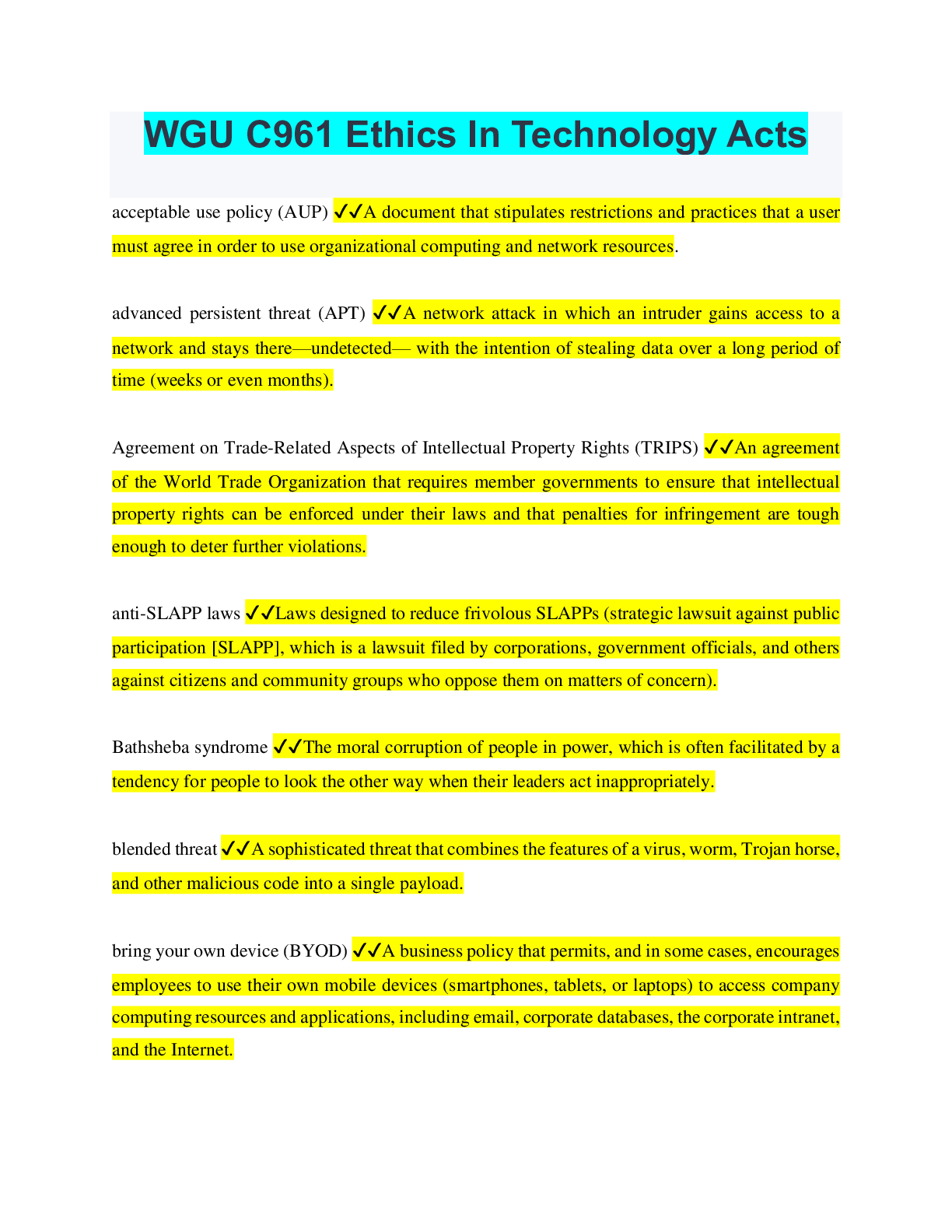
WGU C961 Ethics In Technology Acts
acceptable use policy (AUP) ✔✔A document that stipulates restrictions and practices that a user
must agree in order to use organizational computing and network resources.
advanced persistent threat (APT) ✔✔A network attack in which an intruder gains access to a
network and stays there—undetected— with the intention of stealing data over a long period of
time (weeks or even months).
Agreement on Trade-Related Aspects of Intellectual Property Rights (TRIPS) ✔✔An agreement
of the World Trade Organization that requires member governments to ensure that intellectual
property rights can be enforced under their laws and that penalties for infringement are tough
enough to deter further violations.
anti-SLAPP laws ✔✔Laws designed to reduce frivolous SLAPPs (strategic lawsuit against public
participation [SLAPP], which is a lawsuit filed by corporations, government officials, and others
against citizens and community groups who oppose them on matters of concern).
Bathsheba syndrome ✔✔The moral corruption of people in power, which is often facilitated by a
tendency for people to look the other way when their leaders act inappropriately.
blended threat ✔✔A sophisticated threat that combines the features of a virus, worm, Trojan horse,
and other malicious code into a single payload.
bring your own device (BYOD) ✔✔A business policy that permits, and in some cases, encourages
employees to use their own mobile devices (smartphones, tablets, or laptops) to access company
computing resources and applications, including email, corporate databases, the corporate intranet,
and the Internet.BSA | The Software Alliance (BSA) ✔✔A trade group that represent the world's largest software
and hardware manufacturers.
CAPTCHA (Completely Automated Public Turing Test to Tell Computers and Humans Apart)
✔✔Software that generates and grades tests that humans can pass and all but the most sophisticated
computer programs cannot.
Child Online Protection Act (COPA) ✔✔An act signed into law in 1998 with the aim of prohibiting
the making of harmful material available to minors via the internet; the law was ultimately ruled
largely unconstitutional.
Children's Internet Protection Act (CIPA) ✔✔An act passed in 2000; it required federally financed
schools and libraries to use some form of technological protection (such as an internet filter) to
block computer access to obscene material, pornography, and anything else considered harmful to
minors.
CIA security triad ✔✔Refers to confidentiality, integrity, and availability.
clinical decision support (CDS) ✔✔A process and a set of tools designed to enhance healthcarerelated decision making through the use of clinical knowledge and patient-specific information to
improve healthcare delivery.
Communications Decency Act (CDA) ✔✔Title V of the Telecommunications Act, it aimed at
protecting children from pornography, including imposing $250,000 fines and prison terms of up
to two years for the transmission of "indecent" material over the internet.
computerized provider order entry (CPOE) system ✔✔A system that enables physicians to place
orders (for drugs, laboratory tests, radiology, physical therapy) electronically, with the orders
transmitted directly to the recipient.Controlling the Assault of Non-Solicited Pornography and Marketing (CAN-SPAM) ✔✔A law
that specifies that it is legal to spam, provided the messages meet a few basic requirements—
spammers cannot disguise their identity by using a false return address, the email must include a
label specifying that it is an ad or a solicitation, and the email must include a way for recipients to
indicate that they do not want future mass mailings.
Controlling the Assault of Non-Solicited Pornography and Marketing (CAN-SPAM) Act ✔✔A
law that specifies that it is legal to spam, provided the messages meet a few basic requirements
spammers cannot disguise their identity by using a false return address, the email must include a
label specifying that it is an ad or a solicitation, and the email must include a way for recipients to
indicate that they do not want future mass mailings.
corporate social responsibility (CSR) ✔✔The concept that an organization should act ethically by
taking responsibility for the impact of its actions on its shareholders, consumers, employees,
community, environment, and suppliers.
Defend Trade Secrets Act of 2016 ✔✔An act passed in 2016 that amended the Economic
Espionage Act to create a federal civil remedy for trade secret misappropriation.
Department of Homeland Security (DHS) ✔✔A large federal agency with more than 240,000
employees and a budget of almost $65 billion whose goal is to provide for a "safer, more secure
America, which is resilient against terrorism and other potential threats."
Digital Millennium Copyright Act (DMCA) ✔✔Signed into law in 1998, the act addresses a
number of copyright-related issues, with Title II of the act providing limitations on the liability of
an Internet service provider for copyright infringement.
distributed denial-of-service (DDoS) attack ✔✔An attack in which a malicious hacker takes over
computers via the Internet and causes them to flood a target site with demands for data and other
small tasks.Economic Espionage Act (EEA) of 1996 ✔✔An act passed in 1996 to help law enforcement
agencies pursue economic espionage. It imposes penalties of up to $10 million and 15 years in
prison for the theft of trade secrets.
Electronic Product Environmental Assessment Tool (EPEAT) ✔✔A system that enables
purchasers to evaluate, compare, and select electronic products based on a total of 51
environmental criteria.
[Show More]


.png)
.png)
.png)