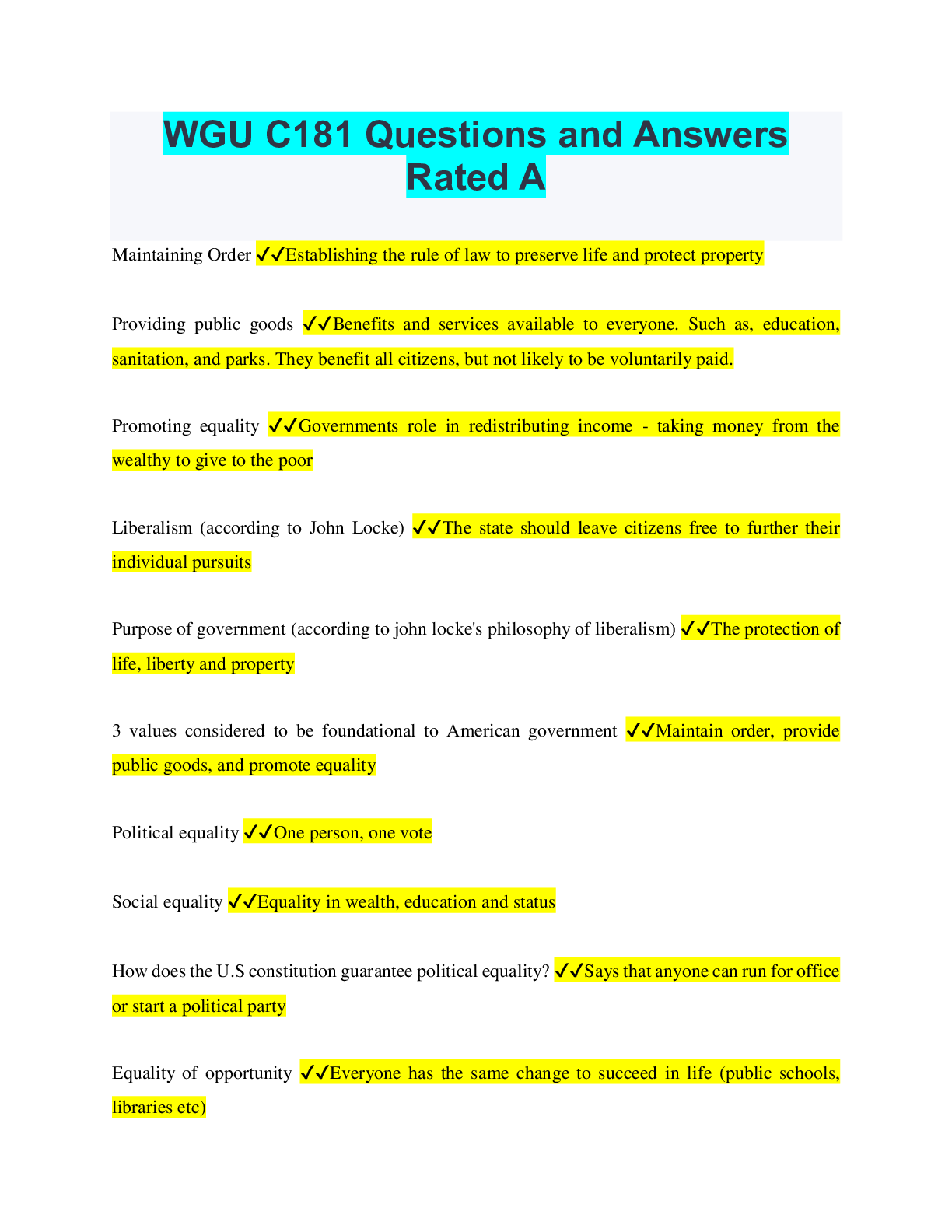
WGU C181 Questions and Answers
Rated A
Maintaining Order ✔✔Establishing the rule of law to preserve life and protect property
Providing public goods ✔✔Benefits and services available to everyone. Such as, education,
...
WGU C181 Questions and Answers
Rated A
Maintaining Order ✔✔Establishing the rule of law to preserve life and protect property
Providing public goods ✔✔Benefits and services available to everyone. Such as, education,
sanitation, and parks. They benefit all citizens, but not likely to be voluntarily paid.
Promoting equality ✔✔Governments role in redistributing income - taking money from the
wealthy to give to the poor
Liberalism (according to John Locke) ✔✔The state should leave citizens free to further their
individual pursuits
Purpose of government (according to john locke's philosophy of liberalism) ✔✔The protection of
life, liberty and property
3 values considered to be foundational to American government ✔✔Maintain order, provide
public goods, and promote equality
Political equality ✔✔One person, one vote
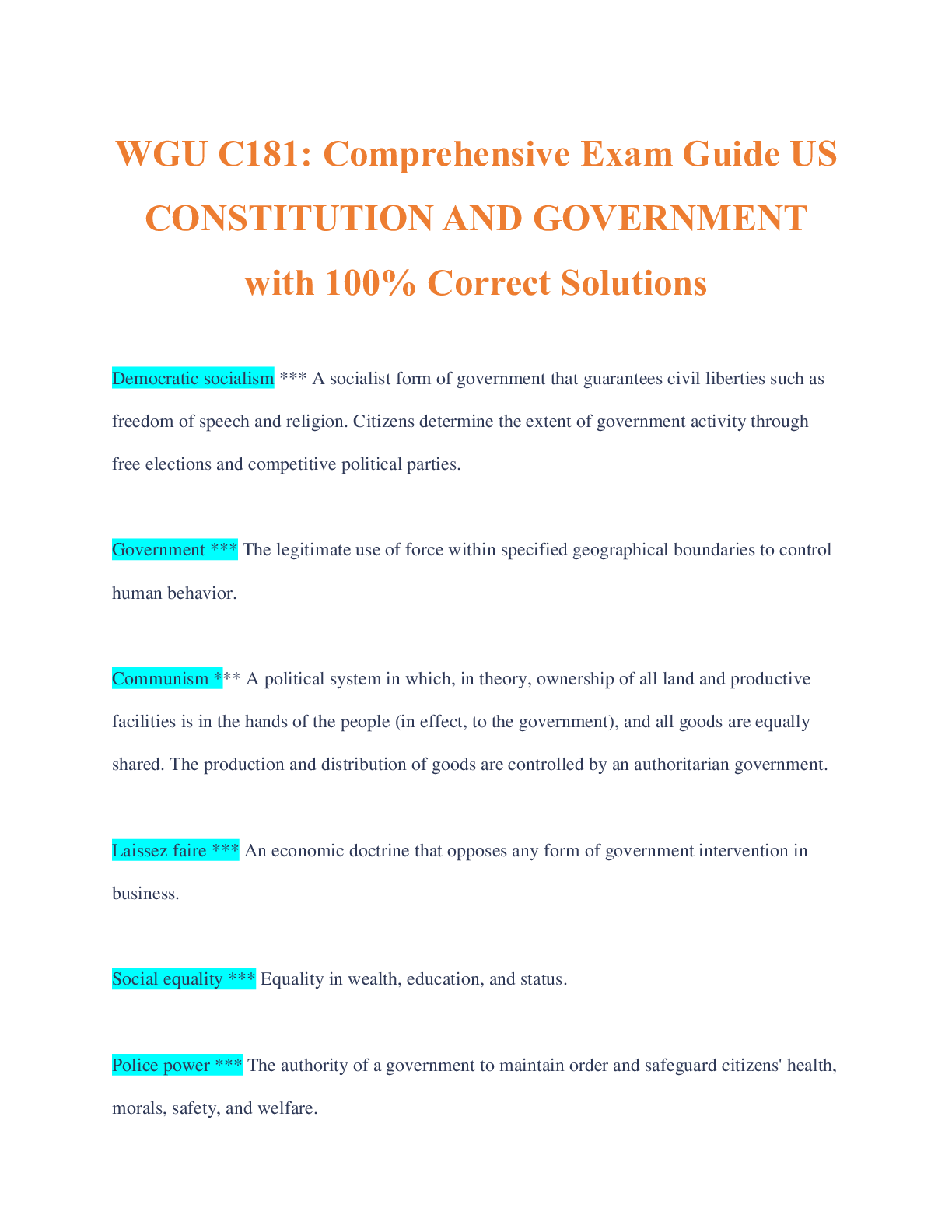
Social equality ✔✔Equality in wealth, education and status
How does the U.S constitution guarantee political equality? ✔✔Says that anyone can run for office
or start a political party
Equality of opportunity ✔✔Everyone has the same change to succeed in life (public schools,
libraries etc)Equality of outcome ✔✔Must ensure equal rights in economic and social outcomes, equal pay for
equal work, money redistribution
-equal pay for men and women
The ORIGINAL dilemma is freedom vs: ✔✔Order
Ex: mandatory testing for HIV/AIDS
The MODERN dilemma is freedom vs: ✔✔Equality
Ex: Mandating that buses and trains are accessible to people with disabilities
Political ideology ✔✔A consistent set of values and beliefs about the proper purpose and scope of
government
Totalitarianism ✔✔Government should control and do everything
Anarchism ✔✔Government shouldn't exist
Capitalism ✔✔Favors free enterprise, private business, and government provides safety and public
goods (conservatives)
Socialism ✔✔Government places strong role in regulating existing private industry and directing
the economy. Does allow some private ownership (liberals / welfare programs)
What kind of economic system would libertarians support? ✔✔Capitalism becuase its the least
amount of government controlLibertarian ✔✔Freedom vs Freedom
Wants all liberty and freedom, government is only for police and national defense
Conservative ✔✔Order vs Freedom
Use goverment for freedom and order, not equality
Support free enterprise and argue against goverment job programs, regulation of business and
legislation for working conditions and wage rates
Communitarian ✔✔Order vs Equality
Goverment for order and equality (academic theory)
Inclined to trade freedom for both order and equality
Liberal ✔✔Freedom vs Equality
Goverment to promote equality, but not laws and social order (social security, welfare programs,
wiling to tax)
See a positive role for government in helping the disadvantaged
Autocracy ✔✔One individual has the power
Oligarchy ✔✔Rule by an elite (few people)
Democracy ✔✔Rule by the peopleSupport harsher punishment for drug crimes ✔✔Conservatives
Support increased spending on public housing ✔✔Liberals
Oppose government except for protection of life/property ✔✔Libertarianism
Support higher income taxes (progressive tax) ✔✔Liberals
Support more regulation of big business ✔✔Liberals
Support lower taxes ✔✔Conservatives
Support legalization of drugs ✔✔Libertarianism
Indirect (representative) Democracy ✔✔Citizens elect public officials to make decisions on heir
behalf - Americans vote
Direct (participatory) Democracy ✔✔Universal participation. All members govern on their behalf.
Works in small cities
Majoritarian model of democracy ✔✔Assumes people...are interested in politics, are
knowledgeable about politics and have consisten opinions about politics.
Emphasizes the importance of public opinion
Believes elections are important
Believes government should be responsive to the general publicPluralist Model of democracy ✔✔Believes decentralized, group participation is important
Believes government should be responsive to interest groups
Pluralist ✔✔Government by the people operating through competing interest groups. Democracy
exists when many (plural) organizations operate separately from the government, press their
interest on the government, and even challenge the government
Majoritarian ✔✔Government by the "majority of the people" relies on what's fair.
Election on a policy issue = referendum.
Petition to put a policy question on ballot = ballot initiative
Elite theory ✔✔The view that a small group (a minority) makes most of the important government
decisions.
The group would mainly be people connected through wealth and business
A system of government where voters elect representatives to make decisions on their behalf, and
where those representatives respond to public opinion, would best be characterized by the terms:
✔✔An indirect democracy and majoritarianism
Social contract theory ✔✔Says that people agree to establish rulers for certain purposes, but that
they have the right to resist or remove rulers who violate those purposes
What is a republic? ✔✔Government without a monarch (king/queen). Rooted in consent of the
governed, whose power is exercised by elected representatives responsible to governHow is the term, republic, related to the idea of popular sovereignty hat is reflected in the social
contract theory and the Declaration of Independence? ✔✔The individual elected will do what they
can to help us, well aware of what can happen if the rights of the people aren't granted
Who has more power under a confederation, the state of the national government? ✔✔The states
What powers did the states have under the articles of confederation? ✔✔All the power - there was
no central government. There was 13 colonies that established the first government
What were some of the major weaknesses of the articles of confederation? ✔✔Didn't have the
power to tax (unable to pay for war)
Didn't have an independent leader - government could not regulate interstate and national
commerce
How does shays rebellion serve as an example of the weakness of the articles of confederation?
✔✔The national government couldn't tax so it was up to the states. Massachusetts enforced high
interest rates and high state taxes forcing farmers into debt. The march of Shays rebellion was the
result
central ideas associated with the VA plan ✔✔1 house - all have equal representation
central ideas associated with the NJ plan ✔✔2 houses - proportionate reps to state population
how were the differences between NJ and VA plan resolved in the great compromise ✔✔2
chambers of houses - bicameralism, based on population size
senate with every state rep equally represented
legislative branch based on both houseswhat feature of the VA plan did NOT become part of the constitution ✔✔the executive brand
would be selected by the legislature
what feature of the VA plan DID become part of the constitution ✔✔separation of powers
bicameralism
what 4 elements form the foundation of the american political tradition in the preamble of the US
constitution ✔✔more perfect union
creates we the people
fashions a government
reasons and goals of the constitution
4 basic principles of the US constitution ✔✔separation of powers
checks and balances
republicanism
federalism
what basic principle most closely aligns with the social contract theory's idea that people should
have the power to set up their government ✔✔federalism - according to the constitution, the
powers vested in the national government and state governments are derived from the people who
remain the ultimate sovereigns
how does checks and balances work ✔✔power to audit other branches
legislative - make laws
executive - enforce laws
judicial - interpret laws
supremacy clause ✔✔article VI asserts that national laws take precedence over state and local lawsenumerated powers ✔✔means that congress can exercise only the powers that the constitution
assigns to it
necessary and proper clause ✔✔aka "elastic clause" - gives congress the means to execute
enumerated powers
how do implied powers come from the necessary and proper clause ✔✔need to be executed by
congress
Article I: the legislative branch ✔✔necessary and proper clause
limits governments enumerated powers
2 sections of congress-senate and house of rep
article II: the executive branch ✔✔expressed and appointed powers
president and the executive officers, commander in chief - power to grand pardons
article III: the judicial branch ✔✔judicial powers /supreme court
interpret laws for supreme and lower courts made by congress
article IV: the states ✔✔full faith and credit clause
judicial acts and criminal warrants of each state are to be honored in all states
article V ✔✔amendment processonly way the constitution can be changed is to add an amendment by 2/3 congress and 3/4 states
article VI: ✔✔supremacy clause
supreme law of the land. must uphold the constitution
article VII: ✔✔ratification
9/13 states to ratify the constitution
who were the federalists and what did they want ✔✔wanted a strong national government / were
for the new constitution. wanted federal government to add a bill of rights
who ere the anti-federalists and what did they want ✔✔against the new constitution / federal
government is too big and takes away peoples rights / bill of rights to protect against stronger
government / new president would be king
central ideas of federalist paper #10 ✔✔how to balance freedom and maintain law and order.
majority factions cannot take away minority rights / failed because of factions (interest groups)
factions ✔✔interest groups
central ideas of federalist paper # 51 ✔✔separate branches of power / add checks and balances /
stop extreme factions that wanted to take over
how was the US constitution ratified ✔✔constitutional convention JULY 1788
took 2 years and 12 amendments
what was the chief obstacle to the adoption of the Constitution by the states ✔✔omission of the
bill of rightshow long did it take for the bill of rights to be ratified after the US constitution was passed ✔✔took
6 months
bill of rights ✔✔first 10 amendments - it restrains the national government from tempering with
fundamental rights and civil liberties
formal amendment process ✔✔used to change the constitution
two stages - proposal and ratification
proposal stage of amendment process ✔✔needs a 2/3 vote from both the houses (senate and house
of rep) or a national convention by congress by 2/3 of state legislatures
ratification stage ✔✔3/4 of state legislatures (26th amendment) or a constitutional convention and
3/4 states. after an amendment has been ratified it cannon be undone
federalism ✔✔2 or more governments exercise power and authority over the same people and the
same territory (a central and regional government)
dual federalism ✔✔there are clear differences between sate and national powers, functions and
responsibilities
primary importance under dual federalism ✔✔sates rights
(the idea that all rights other than those specifically specified under the national government are
reserved for the states)
10th amendment ✔✔the powers not delegated to the US nor prohibited to the states are "reserved
to the states respectively, or to the people"(which amendment protects other powers for the states?)
dual federalism ✔✔layered cake
state and national rights are sperate
cooperative federalism ✔✔marbled cake
(overlapping of state and national powers and rejects the idea of separate spheres, no concentrated
power)
how is the elastic clause interpreted under cooperative federalism ✔✔broadly, thus expanding the
powers of the national government
elastic clause ✔✔gives congress the power to make ALL laws which shall be necessary and proper
for carrying execution for power
what time represents when the greatest changes to national power usually happen ✔✔during times
of crisis and change
EX: civil war , great depression , 9/11
McCulloch v MD, what was the court asked to decide in regards to a national bank? how did the
court interpret the necessary and proper clause in deciding the outcome? ✔✔whether or not
congress has the power to establish a national bank and if so where the states have the power to
tax the bank. congress has the power to charter a bank, sate could not tax because it represents the
best interest of the nation as a whole
commerce clause ✔✔3rd clause of article I section 8
[Show More]



.png)