WGU C224 - STUDY GUIDE Latest 2022
Graded A
Characteristics of Quantitative Research ✔✔numerical data (quantity); hypothesis & research
procedure are stated BEFORE data collection; large sample size; rely on statistic
...
WGU C224 - STUDY GUIDE Latest 2022
Graded A
Characteristics of Quantitative Research ✔✔numerical data (quantity); hypothesis & research
procedure are stated BEFORE data collection; large sample size; rely on statistical procedure; low
interaction with subjects; rely on controlling, measuring, and generalizing; objective by nature
Quantitative Methods/Designs ✔✔survey research; correlational research; causal comparative;
experimental; single subject experimental
Sampling techniques for quantitative research ✔✔simple random; stratified; cluster; systematic;
Simple random ✔✔(quant) selection using table of random numbers
Stratified ✔✔(quant) selection based on dividing up into subgroups which have roughly equal
representation
Cluster ✔✔(quant) intact groups are selected as by classroom, efficient but less representative
Systematic ✔✔(quant) take a population and select every Kth invidual i.e. sample population =
100 and you select every 5th person on list.
Qualitative Research ✔✔*emphasis on words and feelings; *research problems/methods evolve
as understanding of topic increases; *smaller sample sizes; *relies on categorizing & organizing
data into themes or patterns to describe & synthesize the data; *high level interaction with subjects;
*many possible contexts & meanings for different people; *subjective by nature
Qualitative Research Methods ✔✔observation/field notes; interviews: face-to-face, phone, focus
group; questionnaires; archival documents; journals; audio/videoQualitative Sampling Techniques ✔✔intensity; homogenous; criterion; snowball; random
purposive
Characteristics of Action Research (comes out of qualitative research) ✔✔*persuasive &
authoritative b/c it's done by teachers for teachers; *relevant b/c solves real world problems;
*accessible b/c teachers already have built-in audience as test subjects; *encourages school reform
by providing an action plan; *practical by nature (see ch20).
Selecting topics - Characteristics of good research topics ✔✔*researchable (can be solved by
collecting and analyzing data); *interesting enough to hold your attention (love it); *significant
(contributes to field of knowledge); *ethical (no harm done); *manageable (keep it in scope)
How to write a good research question ✔✔*solvable by collecting data; *cannot be answered with
simple yes/no; *what is the effect of x on y (x is indep. Variable, y is dependent variable); *i.e.
What is the effect of an after school reading program (x) on students' reading comprehension scores
(y)?
Purpose & function of literature review ✔✔*see what's already been done; *reveals what needs to
be done; *addresses the research questions; *provides rationale for your hypothesis; *avoids
mistakes of others; *may suggest ideas not previously considered; *provide new direction to your
research
Resource Identification Evaluation & Selection ✔✔*primary & secondary sources; WGU library:
books, articles, e-reserves, ERIC; *What was problem statement?; *Who was studied?; *Where
was source published?; When was source published?; *How was study conducted?; *see ch 3 for
more detail
5 types Hypotheses ✔✔1. Deductive, 2. Inductive, 3. Directional, 4. Non-directional, 5. NullHypothesis ✔✔based on sound reasoning consistent with theory or observation; provides
reasonable explanation for a predicted outcome; states the expected relationship between variables;
is testable within a reasonable time frame
Evaluating a research report ✔✔*does it include all appropriate heading according to the research
design? (i.e. intro, prob. Stmt., lit review, hypothesis, etc.); *enough detail to allow the reader to
completely understand the what, why, when, and how.; *look out for researcher bias; *review
comprehensive list in ch. 22
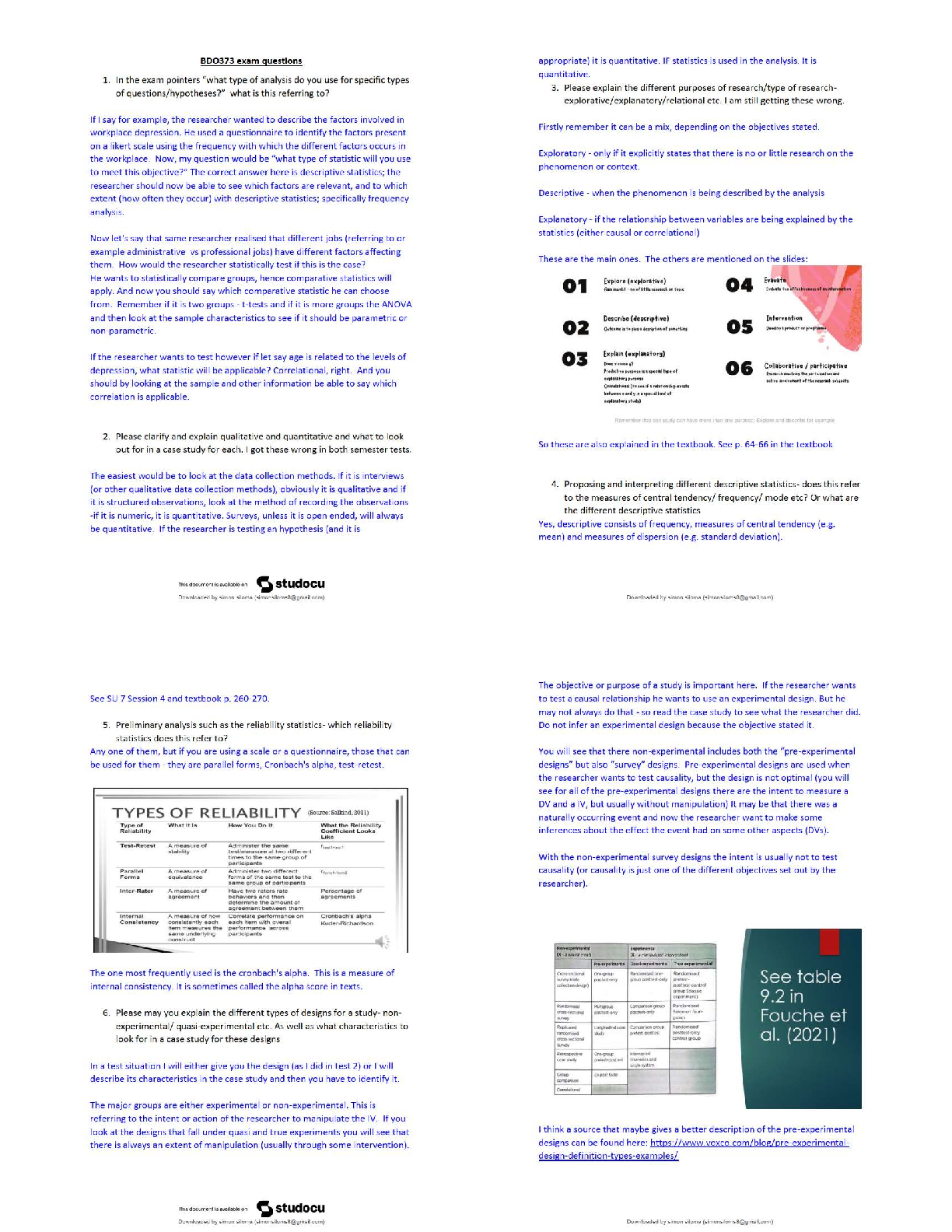
Measurement instruments ✔✔*reliability - degree to which a test consistently measures whatever
it is measuring; *validity - degree to which a test measures what it is intended to measure; *validity
assumes reliability
Factors that threaten validity of measurement instruments ✔✔*unclear test directions; *ambiguous
test items; *complex vocabulary & sentence structure; *subjective scoring; *items on test not
covered in instruction; *inconsistent testing procedures; *cheating (see pg 158)
How to determine reliability? ✔✔*stability (test - re-test); *equivalence (2 similar tests); *Internal
Consistency (requires only 1 test administration) split half, Kuder Richardson, Chronibachs Alpha)
; see chapter 6
Types of Measurement Instruments (see Ch. 6) ✔✔Achievement tests; aptitude tests; Affective
tests; Projective tests
Dependent variable ✔✔the effect or outcome
Independent variable ✔✔the cause or treatment
Measurement Scales ✔✔variables - a placeholder that can assume any one of a range of valuesVariables ✔✔nominal - named categories i.e. male/female; ordinal - ranks form high to low, i.e.
class rank; interval - scores on achievement tests i.e. 90% and 100%; ratio - has true zero point i.e.
height, weight, time, distance, *(pp145-146)
Attitude scales commonly used in education ✔✔*likert - strongly agree to strongly disagree;
*semantic differential - select a position on a continuum i.e. Better to worse; *Rating scales -
various forms i.e. select the statement that best describes you
Data analysis (ch. 18) ✔✔categorical analysis for qualitative data; statistical methods for
quantitative data
Analyzing Qualitative Data ✔✔-reading/memoing; -classifying; -identifying themes & patterns; -
coding
Analyzing Quantitative data (commonly used statistical procedures) ✔✔-descriptive statistics =
describes a set of data; -inferential = tests of significance between two or more means, allows
generalization, significance level p. <.05 or .01
Types of descriptive statistics (measures of) ✔✔frequencies; central tendency; variability; relative
position; relationship
Types of inferential statistics ✔✔t-tests; ChiSquare; Anova
t-tests ✔✔statistical measure: test means of 2 independent samples, significantly different?
ChiSquare ✔✔statistical measure: used for nominal scales (male/female), compares proportions
actually observed to the proportions expected to see if they are significantly different, ie flipping
a coin 50x
Anova ✔✔statistical measure: 2 or more means statistically different?Errors ✔✔Null; Type I; Type II
Null Hypothesis ✔✔no difference between variables, any difference will be due to chance
Type I error ✔✔you determine the null hypothesis is false & it is actually true (0 difference); false
positive (think you're pregnant but you're not)
Type II error ✔✔You determine the null hypothesis is true and it is false (there IS a difference),
false negative (you think you are NOT pregnant, but you are), LESS COMMON (see pg 331)
Survey research(quant) ✔✔determines & reports the way things are, collect numerical data to test
hypothesis or answer questions about current status of subject of study. I.e. political polls survey
preferences, attitudes, practices, concerns or interests of voters.
Correlational research ✔✔(quant) collect data to determine whether and to what degree a relation
exists between 2 or more quantifiable variables. Requires info about at least 2 variables obtained
from single group of participants.
Causal comparative research ✔✔(quant) attempts to determine the cause or reason for existing
differences in the behavior or status of groups of individuals. Cause = behavior or characteristic
believed to influence some other behavior or characteristic
Experimental research ✔✔(quant) at least 1 independent variable is manipulated other relevant
variables are controlled, and the effect on one or more dependent variables is observed. True
experimental Research provides strongest results of any quantitative research
Single subject experimental research ✔✔(quant) used to study the behavior change that an
individual or group exhibits as a result of some intervention or treatmentInductive reasoning ✔✔developing generalizations based on observation of a limited number of
related events or experiences
Deductive reasoning ✔✔arriving at specific conclusions based on general principles, observations,
or experiences
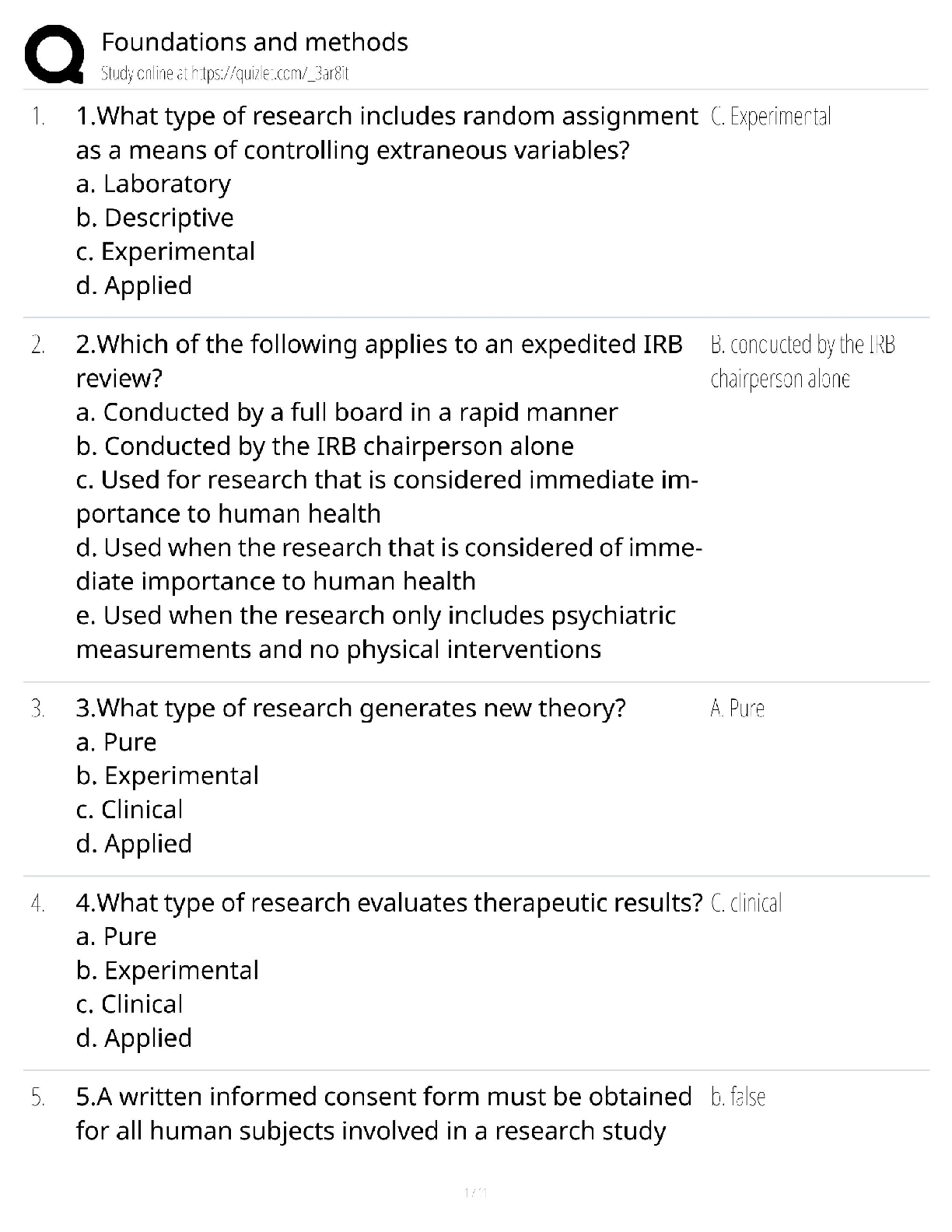
Basic Research ✔✔pure research that aims to confirm an existing theory or to learn more about a
concept or phenomenon
Applied research ✔✔research undertaken to solve a specific proble
[Show More]






.png)