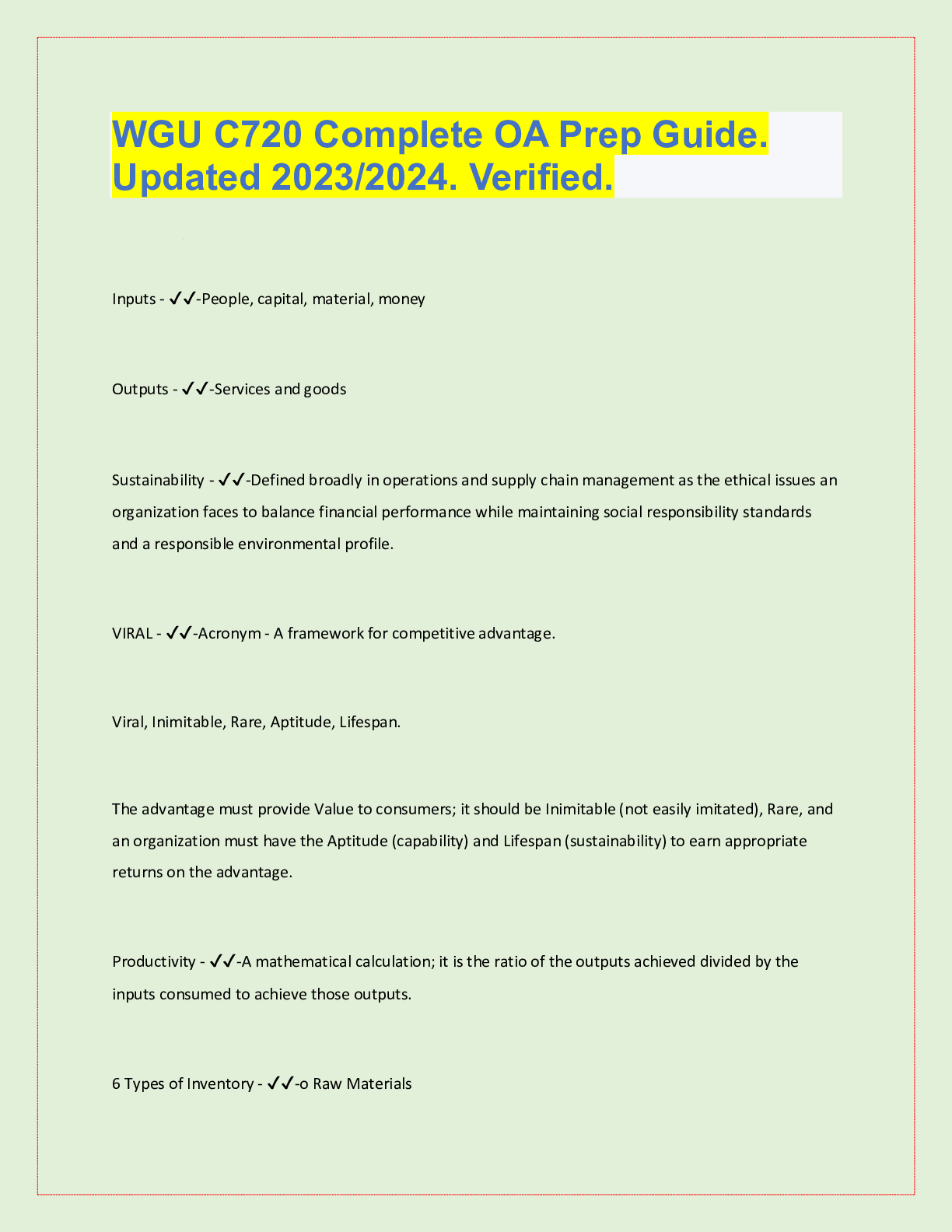
WGU - C720 Operations and Supply
Chain Management Already Passed
Ethics ✔✔Are a sense of what is right and wrong that guide behavior. This set of standards is
often more stringent than legal standards. Test questions
...
WGU - C720 Operations and Supply
Chain Management Already Passed
Ethics ✔✔Are a sense of what is right and wrong that guide behavior. This set of standards is
often more stringent than legal standards. Test questions on the OA will require you to understand
right and wrong regarding common business practices. Anything related to fraud, wrong doing,
dishonesty, etc., even if it is to protect the company, is considered unethical
business practices.
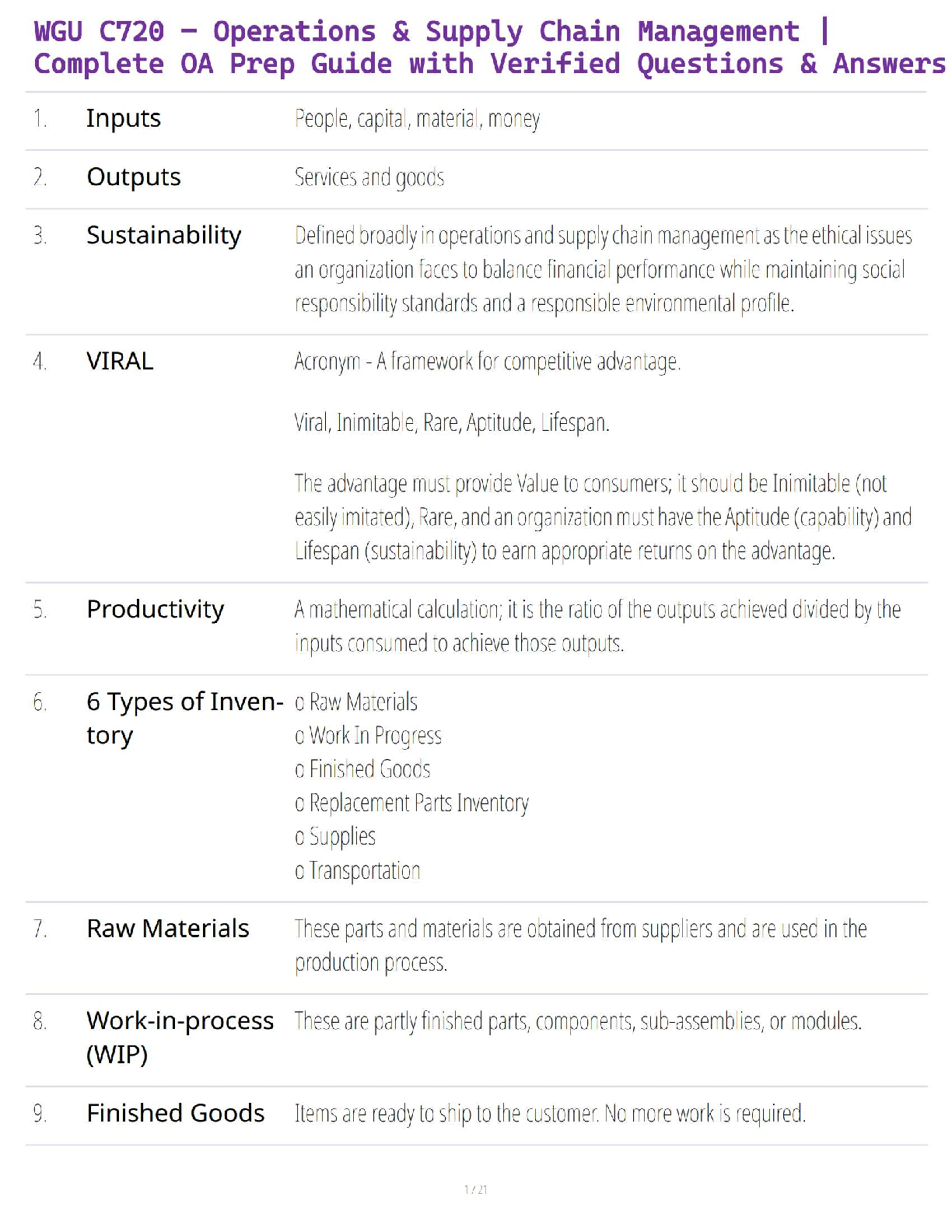
Sustainability ✔✔Is defined broadly in operations and supply chain management as the ethical
issues an organization faces to balance financial performance while maintaining social
responsibility standards and a responsible environmental profile.
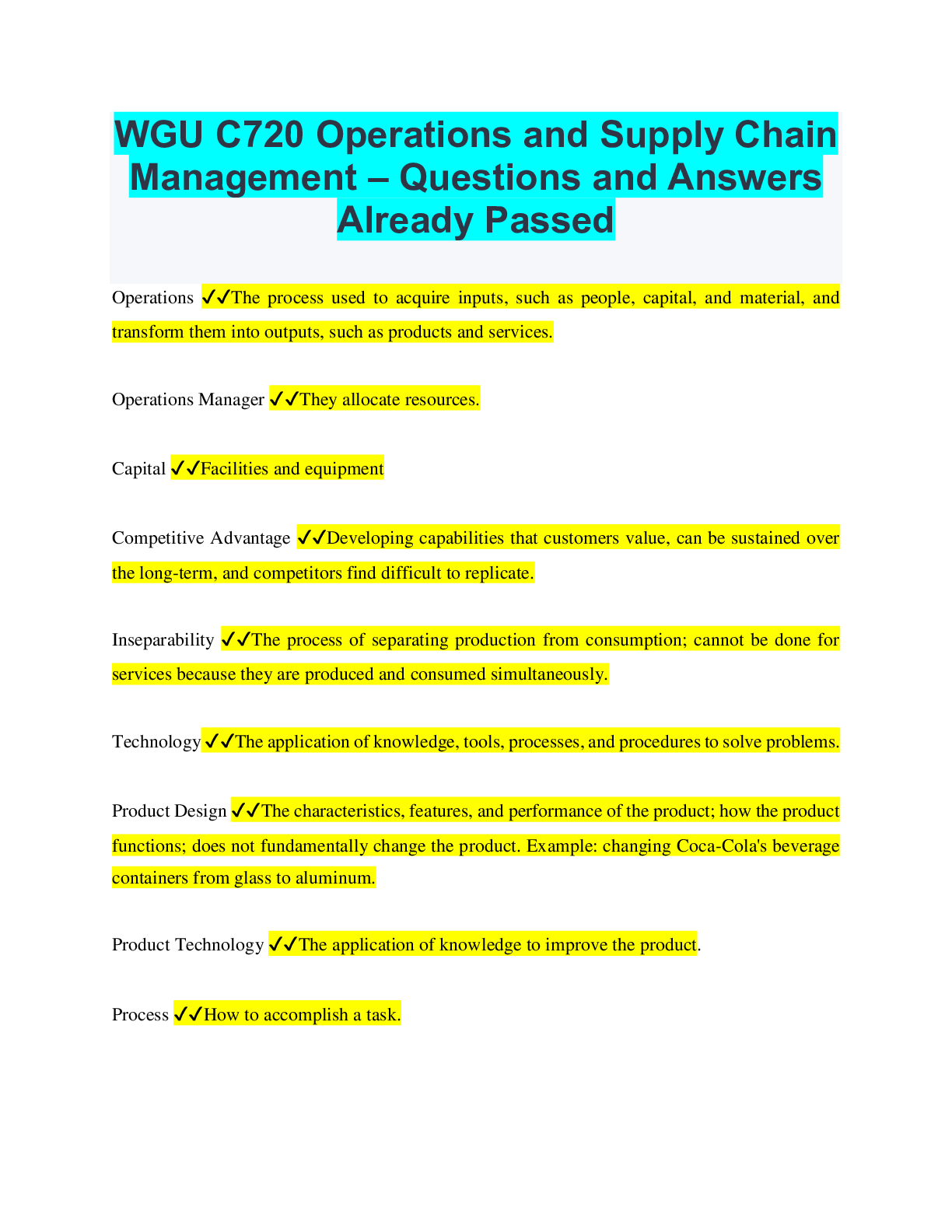
Competitive Advantage ✔✔Is a capability that customers value, such as short delivery leadtime or high product quality that gives an organization an edge against its competition.
o Some scholars use the acronym VIRAL as a framework for competitive advantage. The
advantage must provide Value to consumers; it should be Inimitable (not easily imitated), Rare,
and an organization must have the Aptitude (capability) and Lifespan
(sustainability) to earn appropriate returns on the advantage.
SWOT Analysis ✔✔Is a simple but useful technique for analyzing an organization's strengths and
weaknesses and the opportunities and threats that it faces. It helps a company focus on its strengths,
minimize threats, and take the greatest possible advantage of opportunities
available.
SWOT Analysis ✔✔Is a useful framework for understanding the strengths and weaknesses
internal to
an organization, and for identifying both the opportunities and the threats related to externalfactors. Identification of strengths, weaknesses, opportunities, and threats is important because
SWOT
Analysis can assist in future planning to achieve objectives.
The four elements of SWOT Analysis: ✔✔Strengths
Weaknesses
Opportunities
The first of the four elements of SWOT Analysis: ✔✔Strengths:These are the characteristics of a
business or project that lend an advantage
within the scope of the study.
The second of the four elements of SWOT Analysis: ✔✔Weaknesses: These characteristics of a
business or project result in a disadvantage, relative to others,
The third of the four elements of SWOT Analysis ✔✔Opportunities: These are elements that the
project could exploit to its advantage.
The forth the four elements of SWOT Analysis ✔✔Threats: These elements in the competitive
environment could create trouble for the business or project.
Productivity ✔✔Is a mathematical calculation; it is the ratio of the outputs achieved divided
by the inputs consumed to achieve those outputs.
o As productivity increases, organizations can do the same work with less effort, or can do more
work with the same effort. Increases in productivity reduce costs, lower prices, and provide a basis
for competing in world markets.
6 Types of Inventory ✔✔Raw MaterialsWork-in-process (WIP)
Finished Goods
Replacement parts inventory
Supplies
Transportation (pipeline)
Raw Materials ✔✔These parts and materials are obtained from suppliers and are used in the
production process.
Work-in-process (WIP) ✔✔These are partly finished parts, components, subassemblies,
or modules.
Finished Goods ✔✔Items are ready to ship to the customer. No more work is required.
Replacement parts inventory ✔✔These are maintained to replace other parts in machinery or
equipment as those parts wear out.
Supplies ✔✔Parts or materials are used to support the production process but not usually a
component of the product. These items, such as lubricant and cutting tools, are
consumed in the production process.
Transportation (pipeline) ✔✔The portion of inventory that is in the process of being shipped
through the distribution system.
4 types of demand ✔✔Peak demandSeasonal demand
Unexpected demand
Chase demand
Peak demand ✔✔Which occurs in response to planned events such as advertising, publicity or
promotion. The release of a popular game franchise's latest version often causes peak demand for
a few days or weeks.
Seasonal demand ✔✔As shoppers adjust their purchase velocity in line with holidays,
especially Christmas. But Halloween, Thanksgiving and even St. Patrick's Day also create seasonal
demand for certain kinds of merchandise.
Unexpected demand ✔✔Which occurs due to a usually-unexpected event. For
example, an underdog school may upset a favorite during the NCAA's basketball tournament,
causing a run on their merchandise.
Chase demand ✔✔Occurs when a company has to adjust production by rates to match
demand by varying the workforce and using overtime. Companies vary the workforce by adding
or reducing the number of employees on duty at any given time. And they may choose to provide
overtime by asking workers to stay on thejob beyond their normally scheduled time.
Stock-Out ✔✔Occurs when inventory is depleted. This may occur for a variety of reasons. For
example, an organization may underestimate demand, experience disruptions
in its supply chain or delays in production that lead to late delivery of the product.
Perpetual and Periodic Inventory Systems ✔✔Are systems that companies use to
track inventory. Although mostly used separately, they can also be used together.Perpetual Inventory System ✔✔Continuously monitors inventory levels and is also called
continuous review system. Requires human input (i.e. cashier) and the ordering of more inventory
is triggered by reorder point.
Periodic Inventory System ✔✔Randomly monitors inventory levels and is also called the fixed
order interval system. Not expensive to implement or maintain.
Perpetual Inventory System ✔✔-Used for inventory that requires an exact inventory balance at all
times.
-Most suitable for big businesses, large retail stores and/or Banks
-Most appropriate for high value and high volume items
-Best for accurate financial statements
-Expensive to implement and maintain
Periodic Inventory System ✔✔-Requires a physical count to know exact inventory balances
-Used when a supplier will only deliver at specific time intervals (during open window)
-Most appropriate for low value and low volume items
-Most appropriate for small businesses
-Inexpensive to implement and maintain
ABC analysis ✔✔-Has been developed to determine which inventory items should receive the
highest level of control.
-By multiplying the dollar value of each item by its annual usage, a dollar usage value can be
obtained.
Two models used to help companies control the cost of ordering ✔✔The EOQ (Economic Order
Quantity) and EPQ (Economic Production Quantity) are two models used to help companies
control the cost of ordering, receiving, and holding inventory.
EOQ (Economic Order Quantity) ✔✔Is used:For inventory that doesn't require production
when demand is constant and known
when cost per unit does not depend on order quantity
Most appropriate for retail stores or companies that order finished goods
EPQ (Economic Production Quantity) ✔✔Is used:
For inventory that will be used in production
When incremental ordering and depletion of inventory is allowed
Also called production order quantity
Most appropriate for manufacturing and production companies
Ordering cost and Holding cost ✔✔Can be described with the analogy of two children sitting on
a seesaw. When one goes up, the other goes down, and vice versa. Although it costs money to
replenish inventory, it also costs money to hold that inventory.
Holding costs, also called carrying costs ✔✔May include costs paid for storage space, interest paid
on borrowed money to finance the inventory, and any losses incurred due to damage or
obsolescence.
Quantity discount model ✔✔A discount offered in price for ordering above a specified amount
Transportation discounts ✔✔A discount offered on shipping cost for ordering above a specified
amount
Revenue Sharing ✔✔When 2 or more companies partner and divides the profits received based on
an agreement between all parties involved.
Reserve Capacity ✔✔When a company stores, or pays another company to store, excess inventory
to be used for unexpected demand.Quality ✔✔the degree to which a specific product conforms to its design characteristics or
specifications
the amount of a specific, desired attribute
the capacity to satisfy customers' needs
consistently meeting or exceeding the customer's needs and expectations
Is everyone's responsibility in the organization
Internal orientation of quality ✔✔Directly measure characteristics of the product or service, such
as the number of packages delivered on time or the thickness of an engine part based on
manufactures specification.
External orientation of quality ✔✔Fitness for use for the customer or the capacity to satisfy
customer's needs.
Quality function deployment (QFD) ✔✔Taking customer expectations and transforming them into
specific actions designed to meet those expectations
Service Quality ✔✔The following five dimensions of quality are often used by customers to judge
service quality. Understanding these dimensions helps firms to define quality and determine what
steps are needed to improve quality.
Reliability ✔✔Ability to perform the promised service dependably and accurately.
Responsiveness ✔✔Willingness to help customers and provide prompt service.Assurance ✔✔Knowledge and courtesy of employees and their ability to convey trust and
confidence.
Empathy ✔✔Provision of caring, individualized attention to customers.
Tangibles ✔✔Appearance of physical facilities, equipment, personnel, and communication
materials, including access and effectiveness of Internet-based information.
Quality of Goods ✔✔In examining the dimensions of quality for goods, it is important to recall
that a good is tangible, and therefore, direct contact between the customer and the employees who
make the good does not often occur. As a result, the factors that comprise the quality of goods are
quite different from the factors that comprise quality service.
Performance ✔✔Primary operating characteristics of a product.
Features ✔✔Secondary characteristics that supplement the product's basic functioning.
Reliability ✔✔Length of time a product will function before it fails, or the probability it will
function for a stated period of time.
Conformance ✔✔Degree to which a product's design and operating characteristics match preestablished standards.
Durability ✔✔Ability of a product to function when subjected to hard and frequent use.
Serviceability ✔✔Speed, courtesy, and competence of rep
[Show More]


.png)