Final Exam Study Set-SHRM-CP*
Questions and Answers Rated A+
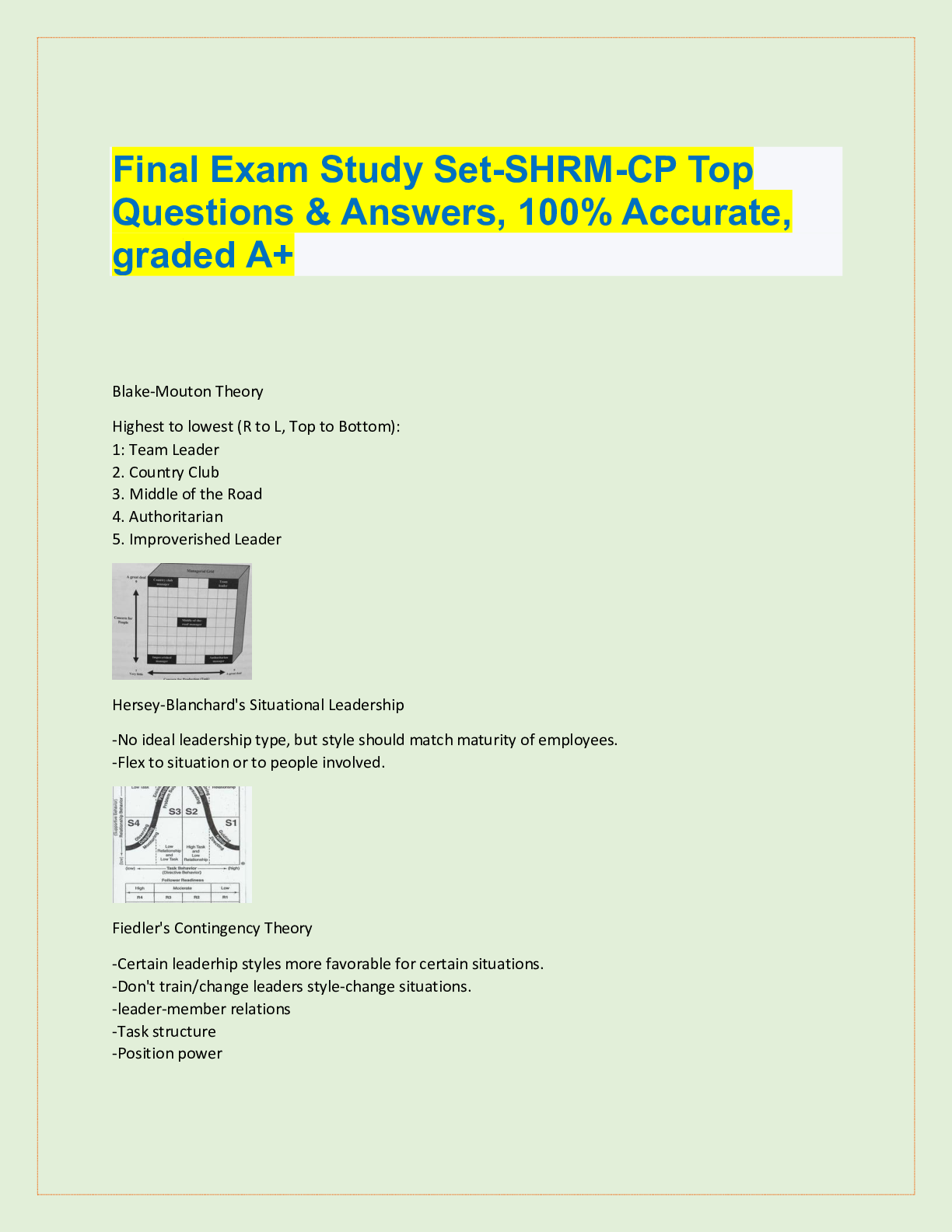
Blake-Mouton Theory ✔✔Highest to lowest (R to L, Top to Bottom):
1: Team Leader
2. Country Club
3. Middle of the Road
4. Authoritarian
5. Improverished
...
Final Exam Study Set-SHRM-CP*
Questions and Answers Rated A+
Blake-Mouton Theory ✔✔Highest to lowest (R to L, Top to Bottom):
1: Team Leader
2. Country Club
3. Middle of the Road
4. Authoritarian
5. Improverished Leader
Hersey-Blanchard's Situational Leadership ✔✔-No ideal leadership type, but style should match
maturity of employees.
-Flex to situation or to people involved.
Fiedler's Contingency Theory ✔✔-Certain leaderhip styles more favorable for certain situations.
-Don't train/change leaders style-change situations.
-leader-member relations
-Task structure
-Position power
John Adair-Action Centered Leadership ✔✔Effective leader accomplishes tasks through the
efforts of the team.
Dispersed Leadership ✔✔AKA "Emergent leadership"
Given a certain task a leader will emerge.
Budget Types ✔✔1. Zero Based Budget
2. Incremental Budget
3. Formula Budgeting4. Activity Based Budget
Zero Based Budgeting ✔✔-Justify entire budget and show how funding meets Org's goals.
-Budget starts at 0 and all expenditures justified each new period.
-Goals/units ranked by priority, then $ given.
Incremental Budgeting ✔✔Line Item Budgeting. Prior year budget basis for the next. Increased
incrementally by a set %. Additional funds must be requested based on need.
Formula Based Budgetting ✔✔-Different units or operations receive varying %'s.
-General funding is changed by specific amount units, budgets adjusted accordingly.
Activity Based Budgetting ✔✔-Not how much to divide $, but how much it costs to perform
enterprise activities.
-Funding may be allocated in strategic significance.
Balanced Scorecard ✔✔Measurement approach that provides an overall picture of an
organization's performance in the following ways:
Metrics from 4 organizational perspectives
1) Financial
2) Customer
3) Internal Business processes
4) Learning + Growth
HR Strategic Process ✔✔1) Get the big picture
2) Conduct HR SWOT analysis
3) Develop HR Mission & Vision Statements
4) Conduct detailed HR analysis
5) Determine critical people issues.6) Develop HR goals, metrics, consequences, & solutions.
7) Develop an implementation & evaluation plan.
ADDIE Model ✔✔A-Assess
D-Design
D-Develop
I-Implement
E-Evaluate
(A)DDIE ✔✔Assess-Difference between present and desired and what is contributing to the gap?
A(D)DIE ✔✔Design-Intervention-targets, audiences, objectives, and how will be measured.
AD(D)IE ✔✔Develop-The solution, who should be involved and how it will be delivered.
ADD(I)E ✔✔ImplementADDI(E) ✔✔EvaluateTQM ✔✔Top Quality Management
W. Edwards Deming ✔✔-Poor products essentially the fault of top managers and no one else.
-Popular in Japan.
-Deming award
-Scored on 14 point system
Joseph M. Juran ✔✔-"Fitness to use" Reliability of product or service.
-Trilogy-quality planning, quality control, quality ipmrovement
Phillip B. Crosby ✔✔-14 point program (Similar to Deming)-4 Absolutes:
-Definition of quality
-Prevention system
-Peformance Standard (Zero Defects)
-Measurement of quality (Cost of non-conformance)
Systems Theory ✔✔Inputs-Process-Outputs
TOC ✔✔Theory of Constraints-Elijah Goldratts book-The Goal
Six Sigma ✔✔Eliminates defects
-not more than 3.4 defects per million opportunities
DMAIC ✔✔For EXISTING processes.
Define, Measure, Analyze, Improve, Control
DMADV ✔✔For NEW processes.
Define, Measure, Analyze, Design, Verify
Workforce Analysis ✔✔1) Supply Analysis
2) Demand Analysis
3) Gap Analysis
4) Solution Analysis
Supply Analysis ✔✔The skill mix in an organization
Future needs based on attrition and org. growth.
Where are we now? What do we have?
Demand Analysis ✔✔Where do we want to be? What do we need?Gap Analysis ✔✔What's lacking? What will we need in the future? (KSA's)
Solution Analysis ✔✔What can we afford? How will we get what we need?
Delphi Technique ✔✔Progressively collects info from a group on a preselected issue. Idea-survey,
refine-repeat.
Don't have to actually meet.
Nominal Group Technique ✔✔Accesses a variety of individuals to forecast ideas + assumptions,
then prioritize issues
-Face to face
-Led by moderator.
-Write down, round robin ideas.
Replacement planning ✔✔Short Term, Snapshot
Succession planning ✔✔Longer team, keeping talent in the pipeline
Radicalism ✔✔Believe that management-labor conflict is inherent in capitalism and resolved only
change in the economic system.
Pluralist ✔✔Multiple forces at work in labor relationships, each with their own agenda.
Unitarist ✔✔Employers and employees can work together for common good.
ILO ✔✔8 core standards
UN Global Impact ✔✔10 StandardsOECD ✔✔Org for Economic Cooperation and Development.
Addresses globalization.
WTO ✔✔World Trade Organization
4 Core standards
Diaspora ✔✔Global remittance
Money sent "home" from migrants working in other countries.
$414 billion in 2013.
Demographic Dichotomy ✔✔Workforce in emerging countries becoming disproportionately
young, but in developing countries, aging rapidly.
"Push" factors ✔✔1) Need for new markets
2) Increased cost pressures and competition.
3) Short falls in natural resources and talent supply.
4) Government policies
5) Trade agreements
6) Globalized supply chain.
"Pull" Factors ✔✔1) Greater strategic control
2) Government policies that promote outward foreign investments.
3) Trade agreements.
Greenfield Operation ✔✔New operation from the ground
[Show More]