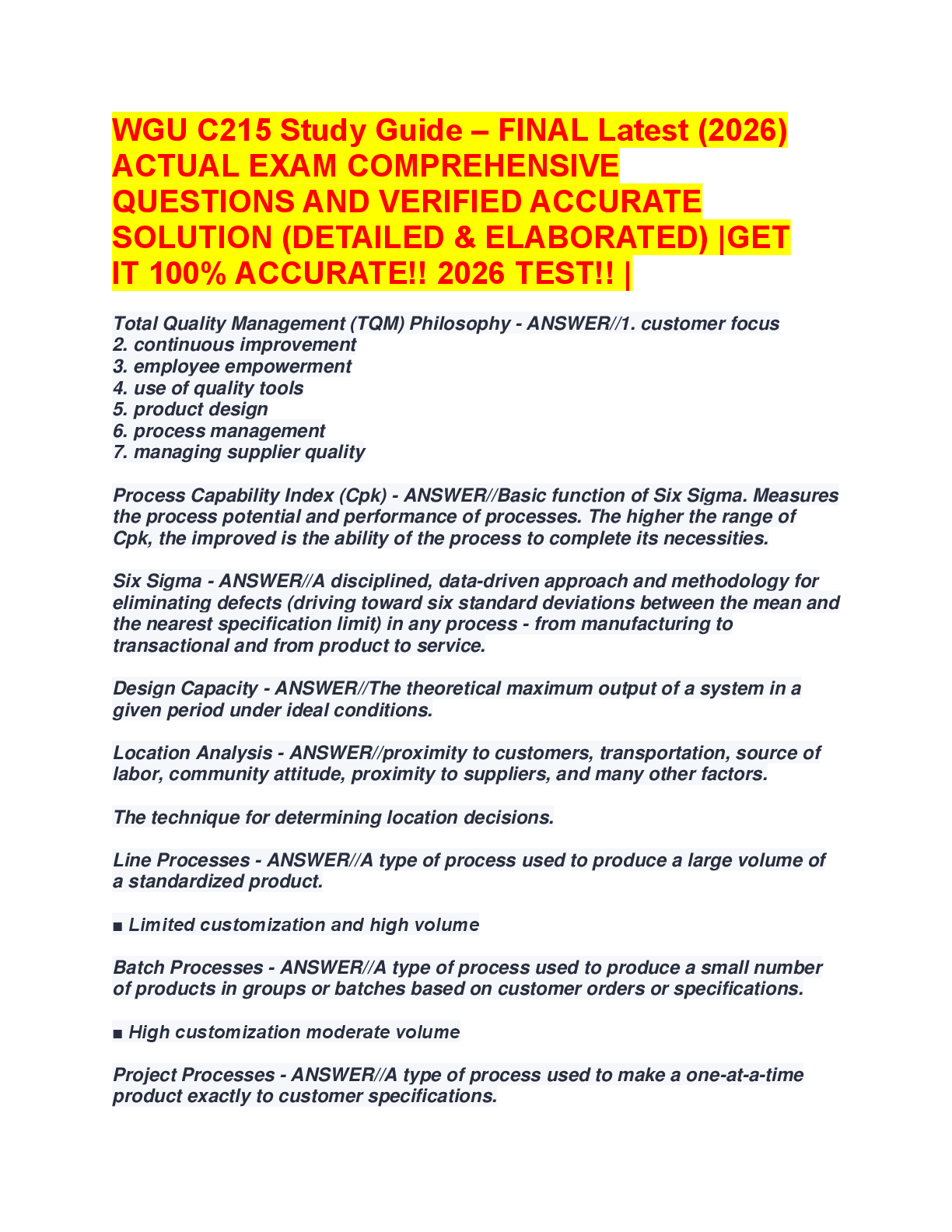
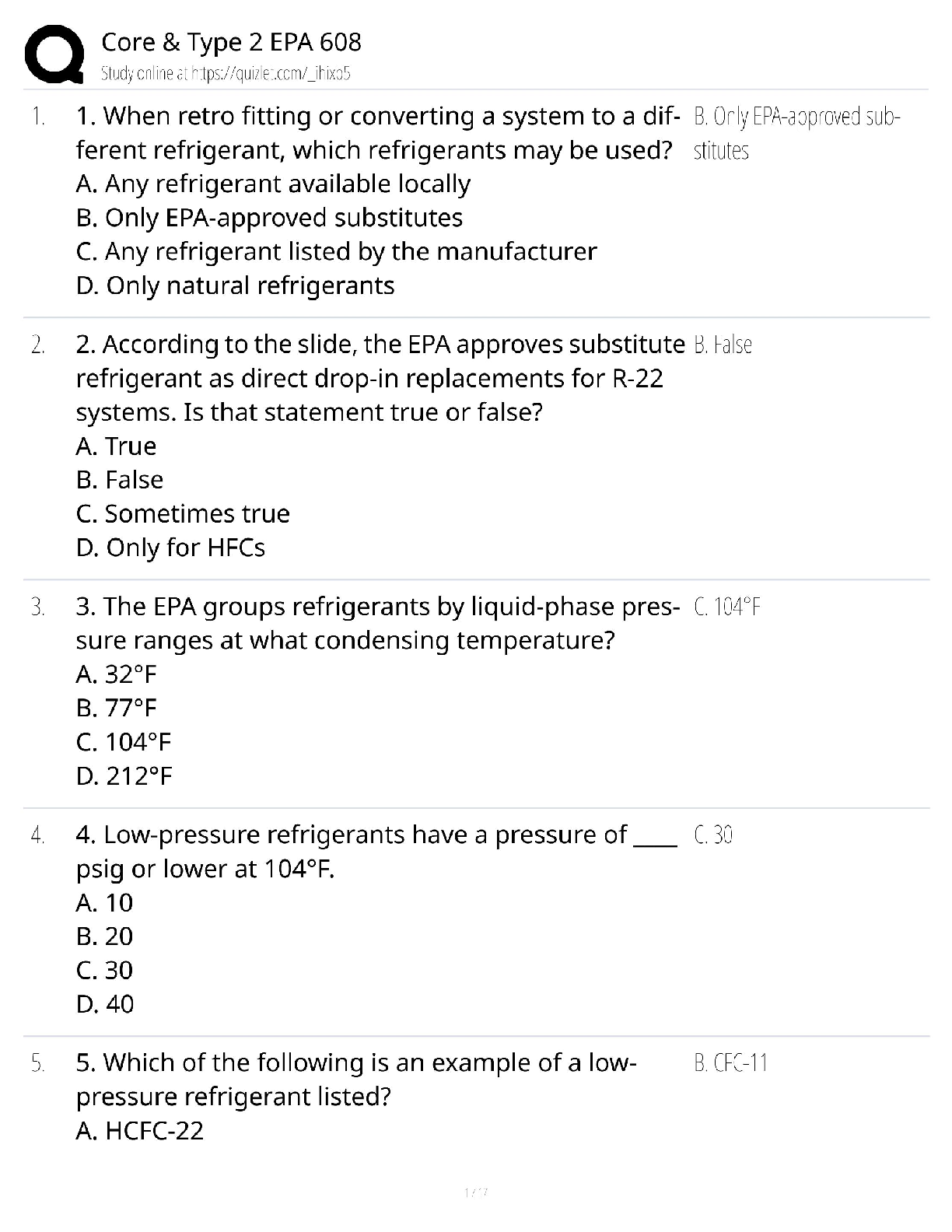
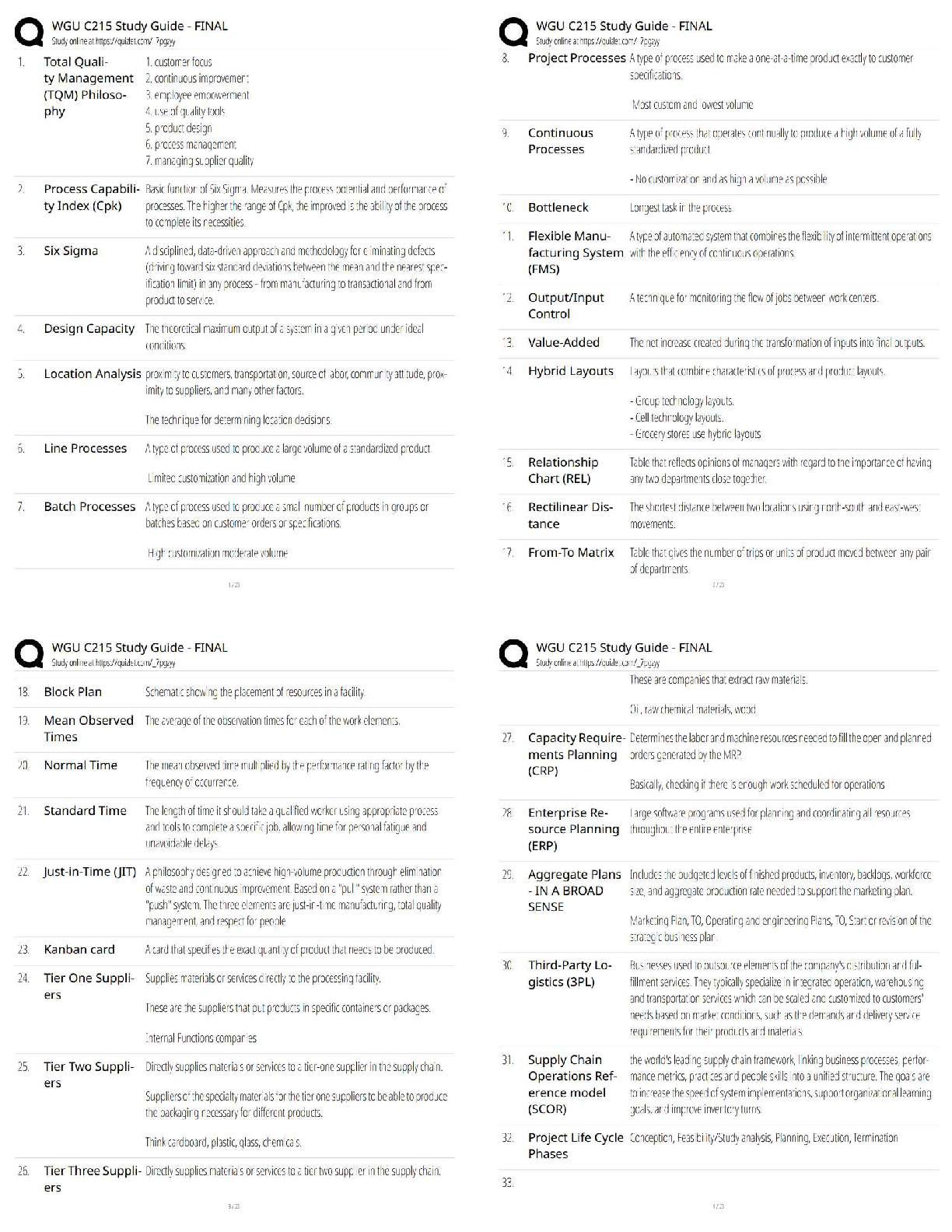
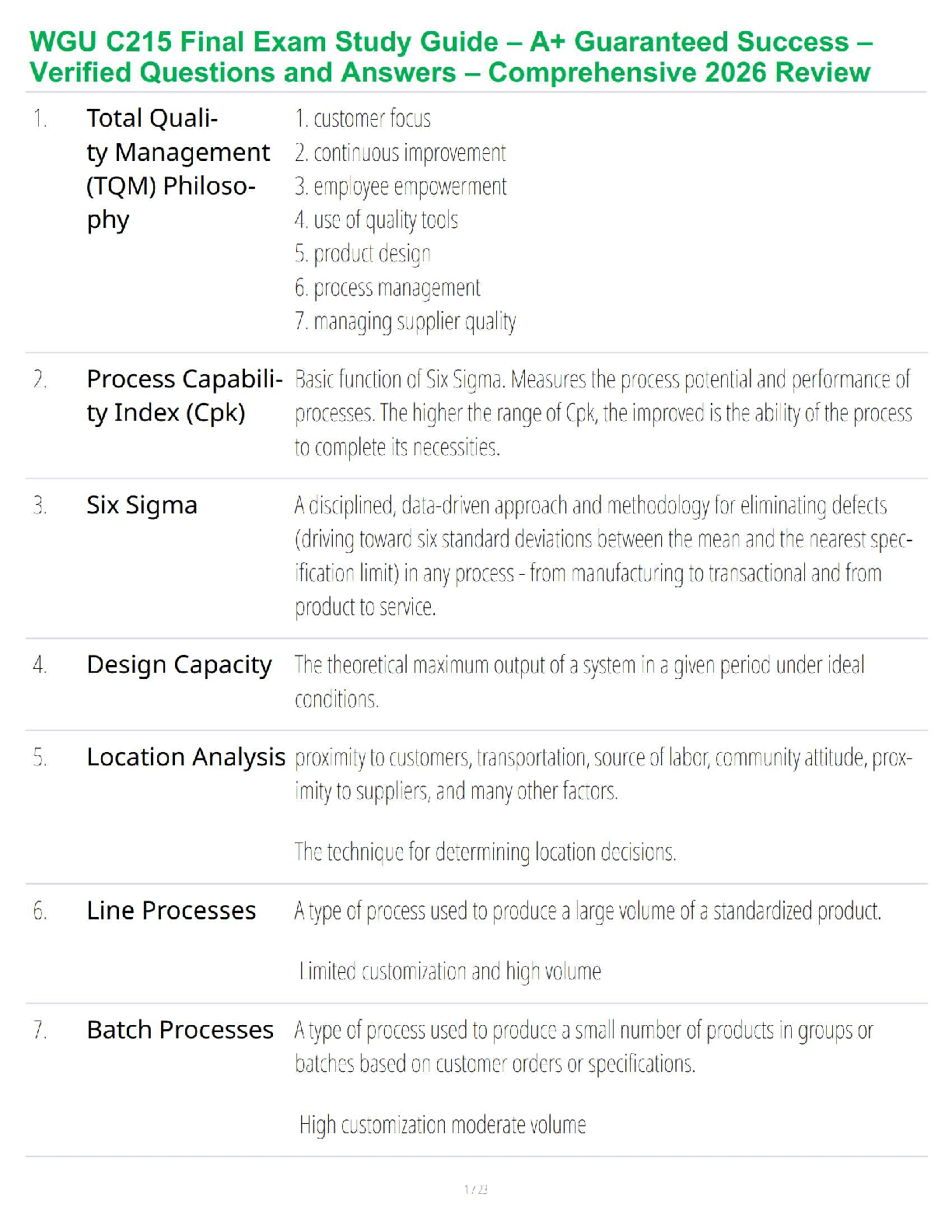
WGU C215 QUESTIONS AND ANSWERS
WITH COMPLETE SOLUTIONS
ABC Classification ✔✔a method for determining level of control and frequency of review of
inventory items
Acceptable Quality Level (AQL) ✔✔The small percentage o
...
WGU C215 QUESTIONS AND ANSWERS
WITH COMPLETE SOLUTIONS
ABC Classification ✔✔a method for determining level of control and frequency of review of
inventory items
Acceptable Quality Level (AQL) ✔✔The small percentage of defects that consumers are willing
to accept.
Acceptable Sampling ✔✔The process of randomly inspecting a sample of goods and deciding
whether to accept the entire lot based on the results
Action Bucket ✔✔The current time period
Action Notices ✔✔Output from an MRP system that identifies the need for an action to be taken.
Activity-on-node ✔✔network diagramming notation that places activities in the nodes and arrows
to signify precedence relationships
Advertising Revenue Model ✔✔Provides users with information on services and products and
provides an opportunity for suppliers to advertise.
Affiliate Revenue Model ✔✔companies receive a referral fee for directing business to an affiliate
Aggregate Plan ✔✔Includes the budgeted levels of finished products, inventory, backlogs,
workforce size, and aggregate production rate needed to support the marketing plan.
ALDEP ✔✔Computer software packages for design process layoutsAllowance Factor ✔✔the amount of time the analyst allows for personal time, fatigue, and
unavoidable delays
Alternative Workplace ✔✔brings work to the worker rather than the worker to the workplace
Anticipation Inventory ✔✔inventory built in anticipation of future demand
Application Service Provider (ASP) ✔✔sets up and runs ERP systems
Appraisal Costs ✔✔Costs incurred in the process of uncovering defects
Assemble-to-order Strategy ✔✔produces standard components that can be combined to customer
specifications
Assignable causes of variation ✔✔Causes that can be identified and eliminated.
Attributes ✔✔A product characteristic that has discrete value and can be counted
Automated order entry system ✔✔A method using telephone models to send digital orders to
suppliers
Automation ✔✔Using machinery to perform work without human operators
Average number of jobs in the system ✔✔measures work-in-process inventory
Average outgoing quality (AOQ) ✔✔The expected proportion of defective items that will be
passed to the customer under the sampling plan.
Back orders ✔✔unfilled customer ordersBack-order ✔✔Delaying delivery to the customer until the item becomes available.
Backward integration ✔✔Owning or controlling sources of raw materials and components.
backward scheduling ✔✔scheduling method that determines when the job must be started to be
done on the due date
Balance Delay ✔✔The amount by which the line efficiency falls short of 100 percent.
Batch processes ✔✔A type of process used to produce a small quantity of products in groups or
batches based on customer orders or specifications.
Behavioral Feasibility ✔✔degree to which the job is intrinsically satisfying to the employee
Beliefs that help define JIT Philosophy ✔✔Broad view operations, simplicity, continuous
improvements, visibility, and flexibility
Benchmarking ✔✔The process of studying the practices of companies considered 'best-in-class'
and comparing your company's performance against theirs.
Best operating level ✔✔The volume of output that results in the lowest average unit cost.
beta probability distribution ✔✔typically represents project activities
Bill of Material (BOM) ✔✔lists all the subassemblies, component parts, and raw materials that go
into an end item and shows the usage quantity of each required
Block Plan ✔✔schematic showing the placement of resources in a facilityBottleneck ✔✔Longest Task in the process
Bottom-round management ✔✔Consensus management by committees or teams
break-even analysis ✔✔technique used to compute the amount of goods that must be sold just to
cover costs
Broad view of JIT ✔✔a philosophy that encompasses the entire organization
Broad view of the organization ✔✔Tasks and procedures are important only if they meet the
company's overall goals.
bullwhip effect ✔✔inaccurate or distorted demand information created in the supply chain
Business-to-business e-commerce ✔✔businesses selling to and buying from other businesses
Business-to-consumer e-commerce ✔✔on-line businesses sell to individual consumers
C-charts ✔✔A control chart used to monitor the number of defects per unit
Capacity ✔✔The maximum output rate that can be achieved by a facility
capacity cushion ✔✔Additional capacity added to regular capacity requirements to provide greater
flexibility.
Capacity Planning ✔✔the process of establishing the output rate that can be achieved by a facilityCapacity Requirements Planning (CRP) ✔✔determines the labor and machine resources needed
to fill the open and planned orders generated by the MRP
Capacity Utilization ✔✔Percentage measure of how well available capacity is being used.
Capacity-based Options ✔✔A group of options that allow the firm to change its current operating
capacity.
Capacity-constrained Resources ✔✔Bottleneck caused by ineffective usage
Capital Costs ✔✔the higher of the cost of capital or the opportunity cost for the company
Cause-and-effect diagram ✔✔A chart that identifies potential causes of particular quality
problems.
Cell Manufacturing ✔✔placement of dissimilar machines and equipment together to produce a
family of products with similar processing requirements
Chase Aggregate Plan ✔✔a planning approach that varies production to meet demand each period
Checklist ✔✔A list of common defects and the number of observed occurrences of these defects.
Closed-loop MRP ✔✔An MRP system that includes production planning, master production
scheduling, and capacity requirements planning
Common ✔✔Random causes that cannot be identified
Components ✔✔Raw materials, purchased items, or sub assemblies that are part of a larger
assemblycomputer-aided design (CAD) ✔✔A system that uses computer graphics to design new products.
computer-integrated manufacturing (CIM) ✔✔A term used to describe the integration of product
design, process planning, and manufacturing using an integrated computer system.
Concurrent Engineering ✔✔An approach that brings together multifunction teams in the early
phase of product design in order to simultaneously design the product and the process.
Conformance to specifications ✔✔How well a product or service meets the targets and tolerances
determined by its designers.
Consumer's Risk ✔✔The chance of accepting a lot that contains a greater number of defects than
the LTPD limit
Continuous Improvement ✔✔A philosophy of never-ending improvement
Continuous Processes ✔✔A type of process that operates continually to produce a high volume of
a fully standardized product.
Continuous Review System ✔✔updates inventory balances after each inventory transaction
Control Chart ✔✔A graph that shows whether a sample of data falls within the common or normal
range of variation.
Control Charts ✔✔Charts used to evaluate whether a process is operating within set expectations
CRAFT ✔✔Computer software packages for design process layoutsCrashing ✔✔reducing the completion time of the project
Critical Chain Approach ✔✔focus on the final due date that is based on the theory of constraints
Critical Path ✔✔the longest sequential path through the network diagram
Critical Path Method (CPM) ✔✔Network planning technique, with deterministic times, used to
determine a project's planned completion date and identify the project's critical path.
Crossdocking ✔✔Eliminates the storage and order-picking functions of a distribution warehouse.
Customer Service ✔✔the ability to satisfy customer requirements
Customer-defined quality ✔✔an integrated effort designed to improve quality performance at
every level of the organization
Cycle counting ✔✔prespecified items are counted daily
Cycle time ✔✔the maximum amount of time a product is allowed to spend at each workstation
Decision Tree ✔✔Modeling tool used to evaluate independent decisions that must be made in
sequence.
Demand-based options ✔✔A group of options that respond to demand fluctuations through the
use of inventory or back orders, or by shifting the demand pattern.
Deeming Prize ✔✔A japanese award given to companies to recognize efforts in quality
improvementDependent Demand ✔✔demand for component parts is based on the number of end items being
produced
descriptive statistics ✔✔Statistics used to describe quality characteristics and relationships
Design capacity ✔✔The maximum output rate that can be achieved by a facility under ideal
conditions.
Design for manufacture (DFM) ✔✔A series of guidelines to follow in order to produce a product
easily and profitably.
Deterministic ✔✔Assumption that the activity duration is known with certainty
diseconomies of scale ✔✔A condition in which the cost of each additional unit made increases.
Distribution Inventory ✔✔finished goods in the distribution system
Distribution Management ✔✔responsible for movement of material from the manufacturer to the
customer
Distribution Warehouse ✔✔Used for short term storage, consolidation, and product mixing.
Distribution Crossdocking ✔✔The receiving and consolidating of inbound products from different
vendors into a multi-SKU pallet
Due Date ✔✔time when the job is supposed to be finished
Duration of the change ✔✔the expected length of time the different capacity level is neededE-commerce ✔✔Using the internet to carry out business transactions
E-distributors ✔✔Independently owned net marketplaces having catalogs representing thousands
of suppliers and designed for spot purchases.
E-purchasing ✔✔Companies that connect on-line MRO suppliers to businesses that pay fees to
join the market, usually for long-term contractual purchasing.
Early Supplier Involvement (ESI) ✔✔Involvement of critical suppliers in new product design.
Economic Feasibility ✔✔The cost of the job should be less than the value it adds
Economic order quantity model (EOQ) ✔✔An optimizing method used for determining order
quantity and reorder points.
Economic Production Quantity (EPQ) ✔✔A model that allows for incremental product delivery
economies of scale ✔✔A condition in which the average cost of a unit produced is reduced as the
amount of output is increased
Effective Capacity ✔✔the maximum output rate that can be sustained under normal conditions. Is
a permanent measure used to achieve design capacity. Is lower than design capacity.
Efficiency ✔✔Ratio of actual output to standard output
Electronic Data Interchange (EDI) ✔✔a form of computer-to-computer communications that
enables sharing business documents
electronic request for quote (eRFQs) ✔✔An electronic request for a quote on goods and services.Electronic storefronts ✔✔on-line catalogs of products made available to the general public by a
single supplier
Elemental Time Database ✔✔Establish standards based on previously completed time studies,
stored in an organization's database
End Item ✔✔A product sold as a completed item or repair part.
Engineering Plan ✔✔Identifies new products or modifications to existing products that are needed
to support the marketing plan.
Enterprise Resource Planning (ERP) ✔✔An information system designed to integrate internal and
external members of the supply chain
Exchanges ✔✔A marketplace that focuses on spot requirements of large firms in a single industry.
Expected Value ✔✔A weighted average of chance events, where each chance event is given a
probability of occurrence.
Expedite ✔✔To rush orders that are needed in less than the normal lead time.
Explosion Process ✔✔Calculates the demand for the children of a parent by multiplying the parent
requirements by the children's usage as specified in the BOM.
external failure costs ✔✔costs associated with quality p
[Show More]