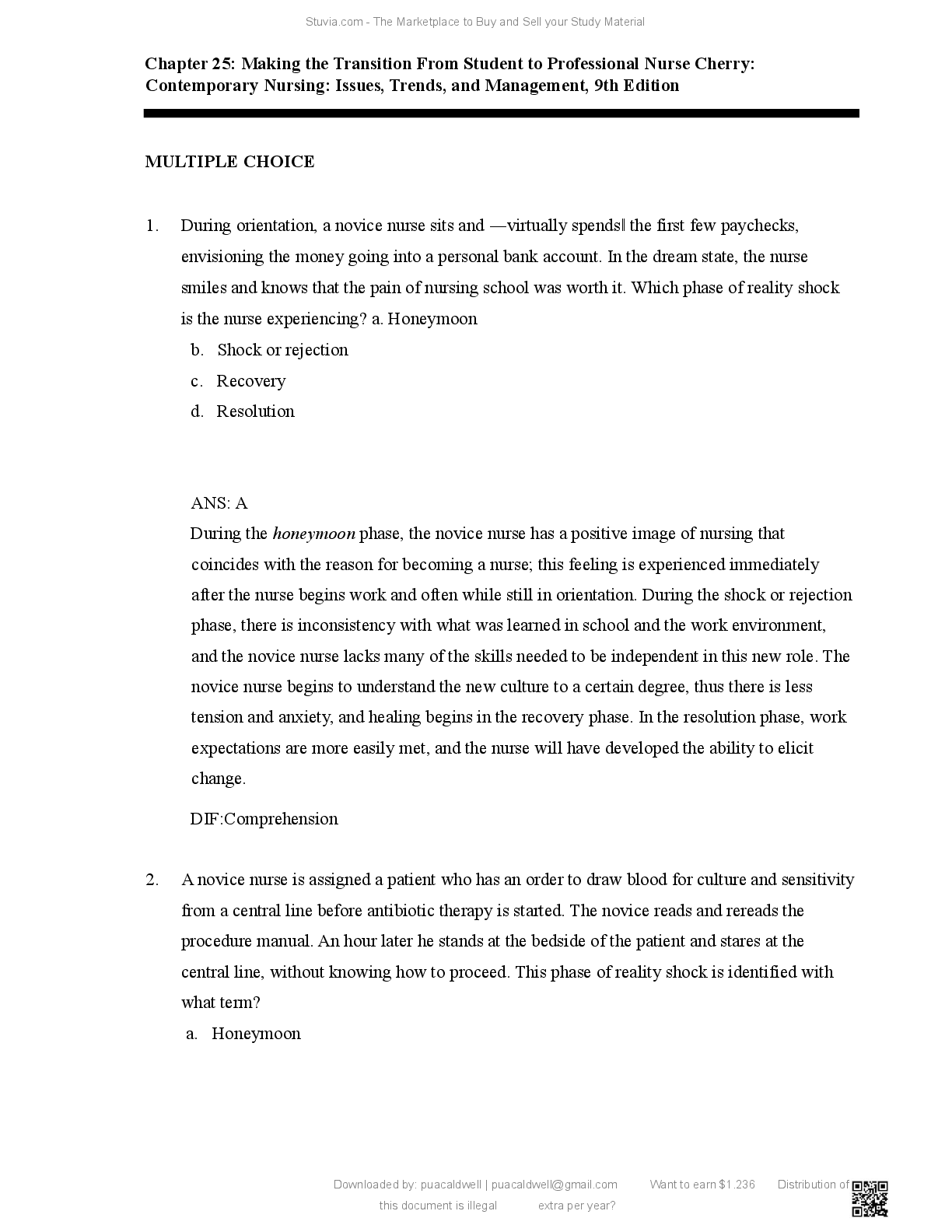
Chapter 25--Heart Failure and Inflammatory Dysfunction: Nursing Management
MULTIPLE CHOICE
1. The nurse suspects a client’s heart is failing when which of the following heart sounds is assessed?
1. S1
2. S2
3.
...
Chapter 25--Heart Failure and Inflammatory Dysfunction: Nursing Management
MULTIPLE CHOICE
1. The nurse suspects a client’s heart is failing when which of the following heart sounds is assessed?
1. S1
2. S2
3. S3
4. S4
PTS: 1 DIF: Analyze REF: Assessment with Clinical Manifestations
2. A client is diagnosed with heart failure. Which of the following diagnostic tests is useful to determine the degree of the failure?
1. Brain natriuretic peptide level
2. Blood cultures
3. Sedimentation rate
4. Arterial blood gas
PTS: 1 DIF: Analyze REF: Heart Failure: Diagnostic Tests
3. A nurse is instructing a client regarding medications and substances contraindicated for the client with heart failure. Which of the following would not be contraindicated?
1. Alcohol
2. Furosemide
3. Metformin
4. Pioglitazone
PTS: 1 DIF: Apply
REF: Table 25-1 Recommended and Contraindicated Medications in Heart Failure
4. The nurse is determining nursing diagnoses appropriate for a client demonstrating productive cough with pink frothy sputum, shortness of breath, and crackles. Which of the following nursing diagnoses is of the most importance?
1. Activity intolerance
2. Anxiety
3. Impaired gas exchange
4. Risk for ineffective respiratory function
PTS: 1 DIF: Apply REF: Heart Failure: Nursing Diagnoses
5. In planning the care for a client diagnosed with heart failure, which of the following would be an appropriate goal?
1. Reduce myocardial contractility.
2. Increase cardiac workload.
3. Decrease ejection fraction.
4. Increase activity levels.
PTS: 1 DIF: Analyze REF: Heart Failure: Collaborative Management
6. The nurse is instructing a client diagnosed with mild heart failure on dietary modifications. Which of the following client statements indicates that the instruction has been effective?
1. “I will avoid green beans.”
2. “I will avoid orange juice.”
3. “I will avoid soy sauce.”
4. “I will avoid apple sauce.”
PTS: 1 DIF: Analyze REF: Heart Failure: Planning and Implementation
7. A client is undergoing diagnostic testing for infective endocarditis. Which of the following laboratory tests would be most useful in diagnosis?
1. Basic metabolic panel
2. Blood cultures
3. Reticulocyte count
4. Prothrombin time
PTS: 1 DIF: Analyze REF: Infective Endocarditis: Diagnostic Tests
8. Which of the following would the nurse most likely assess in a client diagnosed with right-sided heart failure?
1. Distended neck veins
2. Oliguria
3. Cough with frothy blood-tinged sputum
4. Syncope
PTS: 1 DIF: Apply REF: Box 25-2 Heart Failure Clinical Manifestations
9. Which of the following diagnostic tests is useful to diagnose mitral valve prolapse?
1. Electrocardiogram
2. Echocardiogram
3. Cardiac angiography
4. Transesophageal echocardiography
PTS: 1 DIF: Analyze
REF: Mitral Valve Prolapse: Assessment with Clinical Manifestations
10. A client diagnosed with mitral valve prolapse is experiencing palpitations. Which of the following should the nurse instruct this client?
1. Avoid tobacco
2. Ingest alcohol in moderation
3. Avoid weight loss
4. Limit caffeine intake
PTS: 1 DIF: Apply
REF: Mitral Valve Prolapse: Planning and Implementation
11. A client tells the nurse that she had rheumatic heart disease as a child. For which of the following valvular disorders should this client be assessed?
1. Mitral valve prolapse
2. Mitral stenosis
3. Aortic regurgitation
4. Aortic stenosis
PTS: 1 DIF: Analyze REF: Mitral Stenosis
12. A client, recovering from surgery to replace a calcified aortic valve with a mechanical valve, should be instructed that which of the following medications will be needed long term?
1. ACE inhibitor
2. Beta-blocker
3. Antibiotic
4. Anticoagulant
PTS: 1 DIF: Apply REF: Valvular Surgery
13. A client is scheduled for annuloplasty surgery to the aortic valve. Which of the following will most likely occur during this client’s procedure?
1. A catheter will be inserted through the femoral vein.
2. A heart bypass machine will be used.
3. Local anesthesia will be provided.
4. A balloon will inflate and stretch the valve open.
PTS: 1 DIF: Apply REF: Valvular Surgery
MULTIPLE RESPONSE
1. The nurse suspects a client is experiencing left-sided heart failure when which of the following is assessed? (Select all that apply.)
1. Decreased basilar lung sounds
2. Distended neck veins
3. Extra heart sounds
4. Lung crackles
5. Tachycardia
6. Weight gain
PTS: 1 DIF: Analyze REF: Box 25-2 Heart Failure Clinical Manifestations
2. A client diagnosed with heart failure is prescribed furosemide (Lasix). Which of the following should this client be monitored for because of this medication? (Select all that apply.)
1. Dehydration
2. Rebound fluid volume overload
3. Hyponatremia
4. Hypokalemia
5. Hypernatremia
6. Hyperkalemia
PTS: 1 DIF: Apply REF: Heart Failure: Pharmacology
3. The nurse is reviewing the medications prescribed for a client diagnosed with dilated cardiomyopathy. Which of the following medications are commonly prescribed for this disease process? (Select all that apply.)
1. ACE Inhibitor
2. Beta-blocker
3. Diuretic
4. Anticoagulant
5. Antiarrhythmic
6. Antibiotic
PTS: 1 DIF: Analyze REF: Dilated Cardiomyopathy: Pharmacology
4. Which of the following should the nurse instruct a client diagnosed with hypertrophic cardiomyopathy? (Select all that apply.)
1. Follow recommended activity level
2. Avoid all alcohol
3. Take hot tub baths routinely
4. Avoid overexertion
5. Avoid dehydration
6. Unexplained breathlessness is a common symptom
PTS: 1 DIF: Apply
REF: Hypertrophic Cardiomyopathy: Planning and Implementation
5. The nurse determines that a client diagnosed with pericarditis is demonstrating the classic signs of the Beck triad. What are the signs of the Beck triad? (Select all that apply.)
1. Fever
2. Dyspnea
3. Muffled heart sounds
4. Elevated jugular vein pressure
5. Hypotension
6. Abdominal pain
PTS: 1 DIF: Analyze
REF: Pericarditis: Assessment with Clinical Manifestations
[Show More]