1. The nurse is assessing the eyes of a client who has a lesion of the sympathetic nervous system. What assessment finding should the nurse anticipate?
A) Bilateral dilated pupils
B) Nystagmus (involuntary eye movement
...
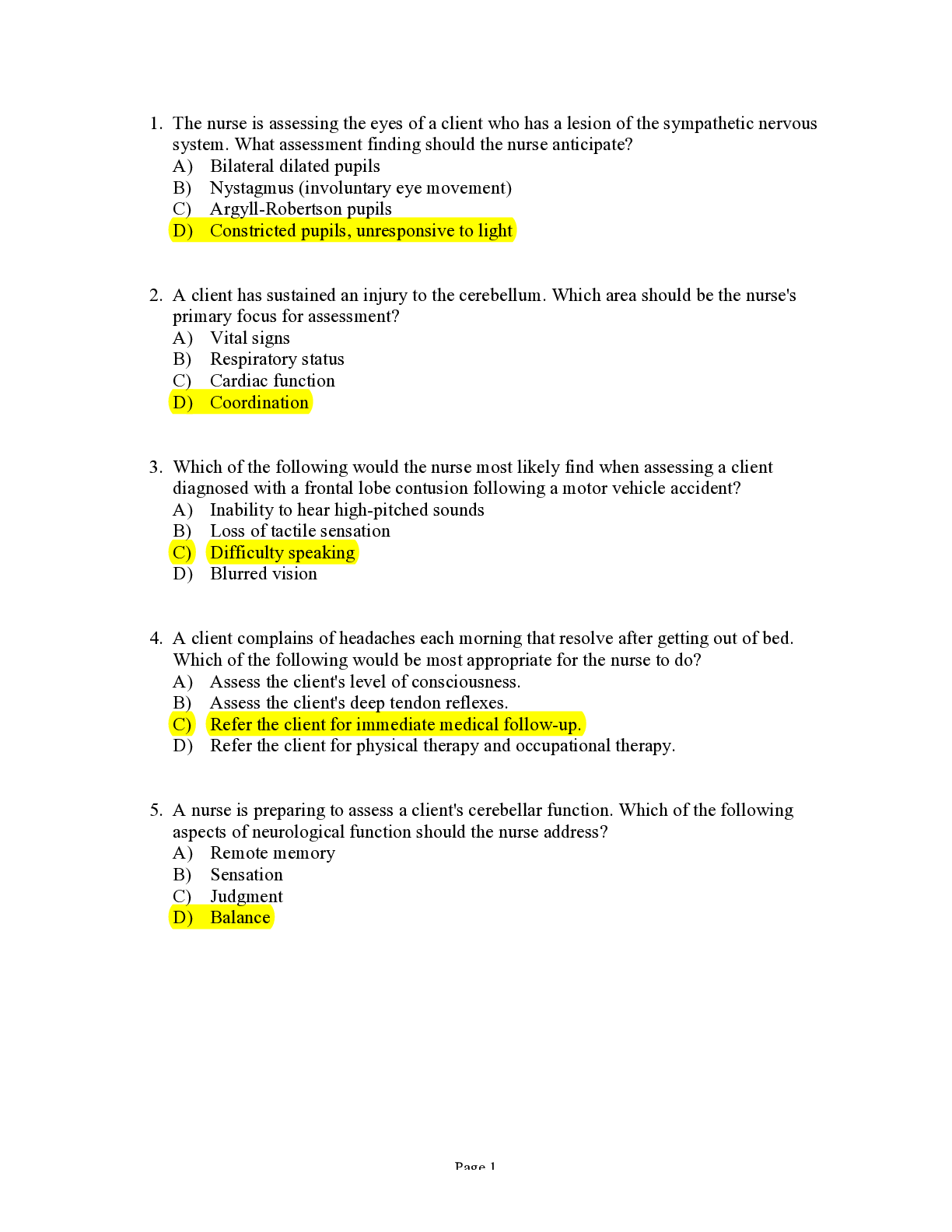
1. The nurse is assessing the eyes of a client who has a lesion of the sympathetic nervous system. What assessment finding should the nurse anticipate?
A) Bilateral dilated pupils
B) Nystagmus (involuntary eye movement)
C) Argyll-Robertson pupils
D) Constricted pupils, unresponsive to light
2. A client has sustained an injury to the cerebellum. Which area should be the nurse's primary focus for assessment?
A) Vital signs
B) Respiratory status
C) Cardiac function
D) Coordination
3. Which of the following would the nurse most likely find when assessing a client diagnosed with a frontal lobe contusion following a motor vehicle accident?
A) Inability to hear high-pitched sounds
B) Loss of tactile sensation
C) Difficulty speaking
D) Blurred vision
4. A client complains of headaches each morning that resolve after getting out of bed. Which of the following would be most appropriate for the nurse to do?
A) Assess the client's level of consciousness.
B) Assess the client's deep tendon reflexes.
C) Refer the client for immediate medical follow-up.
D) Refer the client for physical therapy and occupational therapy.
5. A nurse is preparing to assess a client's cerebellar function. Which of the following aspects of neurological function should the nurse address?
A) Remote memory
B) Sensation
C) Judgment
D) Balance
6. The nurse assesses brisk reflexes in a client during a neurological assessment. The nurse should document this finding as which of the following?
A) 1+
B) 2+
C) 3+
D) 4+
7. A nurse is having difficulty eliciting a patellar reflex during a client's neurological assessment. Which of the following would be most appropriate for the nurse to have the client do?
A) Lock the fingers together and pull against each other.
B) Clench the jaw tightly.
C) Squeeze a thigh with the opposite hand.
D) Stretch the arms over head.
8. Which of the following tests would be most appropriate for the nurse to use when assessing motor function of a client's trigeminal nerve?
A) Ask client to differentiate sharp and dull sensations on the face.
B) Have the client smile, frown, and wrinkle the forehead.
C) Palpate temporal and masseter muscles while client clenches the teeth.
D) Assess dilatation of the client's pupils with direct light.
9. A client has presented with signs and symptoms that are suggestive of Bell's palsy. What assessment finding is most consistent with this diagnosis?
A) Inability to detect sharp and dull stimuli
B) Inability to wrinkle the forehead
C) Closure of the affected eye from swelling
D) Muscle spasm of the lower face on the affected side
10. When assessing cranial nerves IX and X, which of the following would the nurse consider as a normal finding?
A) Stationary soft palate on phonation
B) Deviation of uvula when client says ìahî
C) Asymmetrical soft palate
D) Uvula and soft palate rising bilaterally
11. The nurse is planning to assess a client for graphesthesia. How will the nurse perform this phase of assessment?
A) The client will close the eyes and identify what number the nurse writes in the
palm of the client's hand with a blunt-ended object.
B) The client is asked to identify the number of points felt when the nurse touches the client with the ends of two applicators at the same time.
C) The nurse will simultaneously touch the client in the same area on both sides of the body, and the client will identify where the touch occurred.
D) The nurse will briefly touch the client, and the client will identify where the touch occurred.
12. During the Romberg test, a client is unable to stand with the feet together and demonstrates a wide-based, staggering, unsteady gait. The nurse would interpret this finding as suggestive of which of the following?
A) Spastic hemiparesis
B) Parkinsonian gait
C) Scissors gait
D) Cerebellar ataxia
13. When assessing a client's deep tendon reflexes, which technique would be most appropriate for the nurse to use?
A) Use the blunt end of the reflex hammer to strike a smaller area.
B) Strike the area slowly and methodically.
C) Hold the reflex hammer between the thumb and index finger.
D) Percuss the area of the tendon to be struck for the reflex.
14. When preparing to test a client for meningeal irritation, which of the following would be most important for the nurse to do first?
A) Check for evidence of fever and chills.
B) Ensure there is no injury to the cervical spine.
C) Position the client prone.
D) Check for a Babinski reflex.
15. During the health history, a client reports a decrease in his ability to smell. During the physical assessment, the nurse would make sure to assess which cranial nerve?
A) CN I
B) CN II
C) CN VII
D) CN IX
16. When evaluating a client's risk for cerebrovascular accident, which client should the nurse identify as being at highest risk?
A) A 42-year-old Caucasian female who smokes
B) A 68-year-old African-American male with hypertension
C) A 70-year-old Caucasian male who has one to two beers a day
D) A 35-year-old African-American male who has sleep apnea
17. After teaching a group of students about the brain and spinal cord, the instructor determines that the students demonstrate the need for additional teaching when they identify which of the following as being controlled by the brain stem?
A) Respiratory function
B) Heart rate
C) Equilibrium
D) Reflex actions
18. A nurse is preparing to assess the cranial nerves of a client. The nurse is about to test CN I. Which of the following should the nurse do?
A) Use a Snellen chart to test visual acuity.
B) Ask a client to identify scents.
C) Test extraocular eye movements.
D) Perform the Weber test.
19. When reviewing the neural pathways, a group of students is identifying sensations that travel via the spinothalamic tract. Select all the sensations that are carried by this tract.
A) Pain
B) Temperature
C) Position
D) Vibration
E) Light touch
20. A nurse is testing a client's deep tendon reflex. The nurse taps the tendon above the olecranon process. The nurse is assessing which reflex?
A) Brachioradialis
B) Triceps
C) Biceps
D) Achilles
21. The nurse is assessing a 39-year-old woman who has a 20 pack-year history of cigarette smoking. When reviewing the client's current medication administration record, what drug would the nurse identify as increasing the woman's risk of stroke?
A) Acetaminophen
B) A beta-adrenergic blocker
C) ASA
D) An oral contraceptive
22. An adult client has asked the nurse about actions that she can take to reduce her future risk of stroke. What health promotion activity should the nurse prioritize?
A) Smoking cessation
B) Annual MRI screening
C) Nutritional supplementation
D) Improved coping skills
23. The nurse is obtaining the health history of a young adult client. During the interview, the client tells the nurse, ìI banged my head pretty good when I was snowboarding last weekend.î The client states that he did not subsequently seek care. What is the nurse's most appropriate action?
A) Promptly assess the client's balance and coordination.
B) Teach the client about the warning signs of increased intracranial pressure.
C) Refer the client for medical assessment and possible treatment.
D) Teach the client about the importance of wearing head protection during sports.
24. The nurse is conducting a focused neurological assessment of an 81-year-old client. When analyzing the assessment data, the nurse should be aware of what age-related neurological change?
A) Impaired judgment
B) Tremors accompanying intentional movements
C) Loss of remote memory
D) Loss of sensation in distal extremities
25. The nurse has positioned a client supine and asked her to perform the heel-to-shin test. An inability to run each heel smoothly down each shin should prompt the nurse to perform further assessment in what domain?
A) Balance and coordination
B) Light touch sensation
C) Deep tendon reflexes
D) Leg strength
26. The nurse has placed her hands behind the client's head and flexed the client's neck forward as far as the client can tolerate. During the test, the client experiences leg pain and bends his knees. This assessment finding is suggestive of what health problem?
A) Ischemic stroke
B) Meningitis
C) Bell's palsy
D) Brain stem lesion
27. The nurse is performing the Romberg test as part of a client's focused neurological assessment. What finding would constitute a positive Romberg test?
A) The client moves her feet apart to prevent herself from falling.
B) The client is unable to consistently touch her finger to her nose while her eyes are close.
C) The client experiences pain during neck flexion and extension.
D) The client experiences pain when clenching her teeth.
28. The emergency department nurse's rapid assessment of a young adult client admitted unresponsive reveals fixed, constricted pupils bilaterally. The nurse should consider what possible cause for this assessment finding?
A) Recent narcotic use
B) Hemorrhagic stroke
C) Recent seizure activity
D) Cerebellar lesion
29. The nurse is assessing CN V (trigeminal nerve) in a newly admitted client. What instruction should the nurse provide to the client during this phase of assessment?
A) ìClench your teeth together tightly.î
B) ìClose your left eye and look at me with your right.î
C) ìLook straight at me while I shine this light in your eye.î
D) ìOpen your mouth wide and say 'ah.'î
30. Examination of a client's gait reveals that the client is stooped over when walking and that he slowly shuffles. As well, the client maintains a stiff posture when walking. The nurse should document what type of gait?
A) Scissors gait
B) Parkinsonian gait
C) Spastic hemiparesis
D) Footdrop
[Show More]





.png)
.png)
.png)