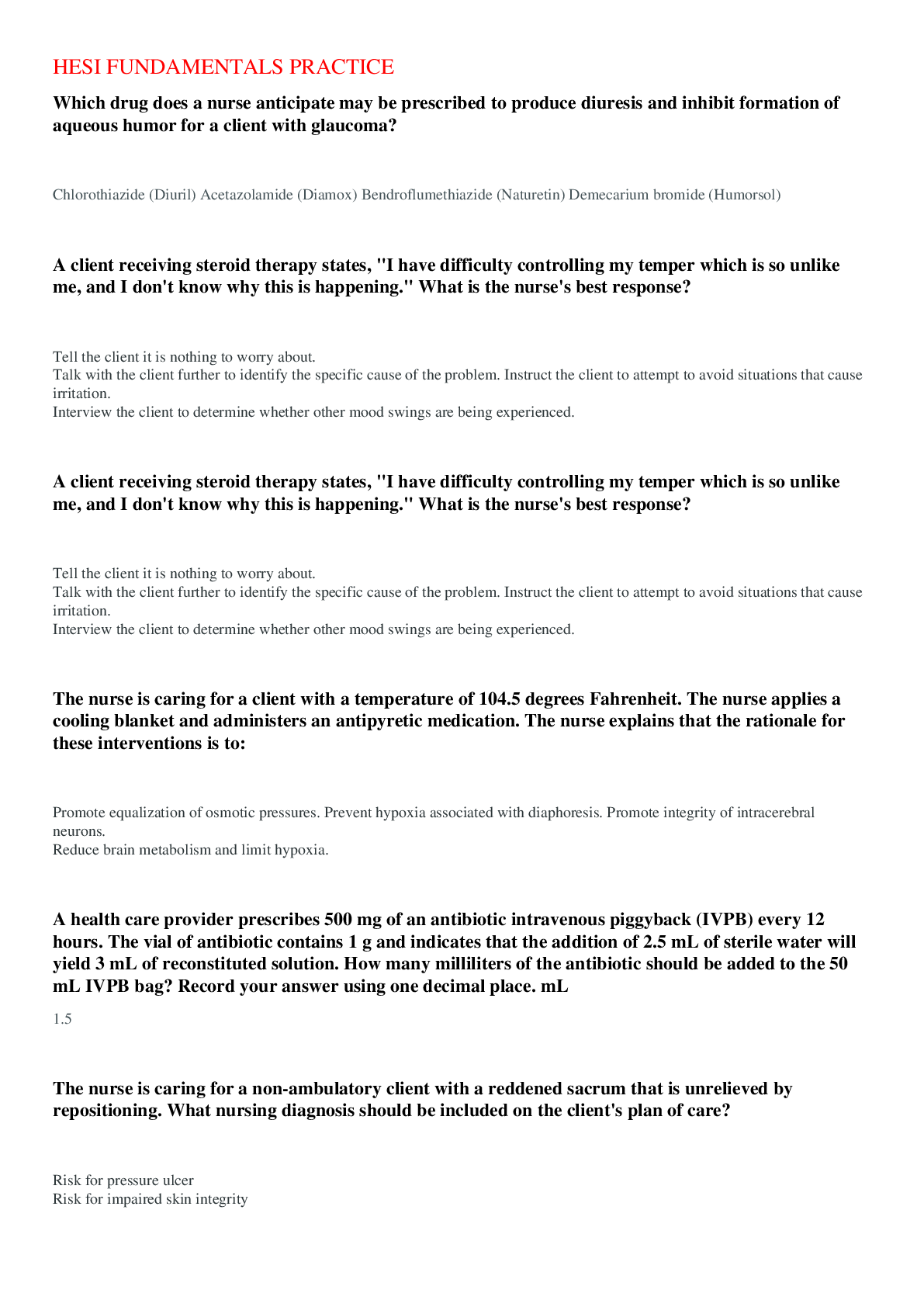
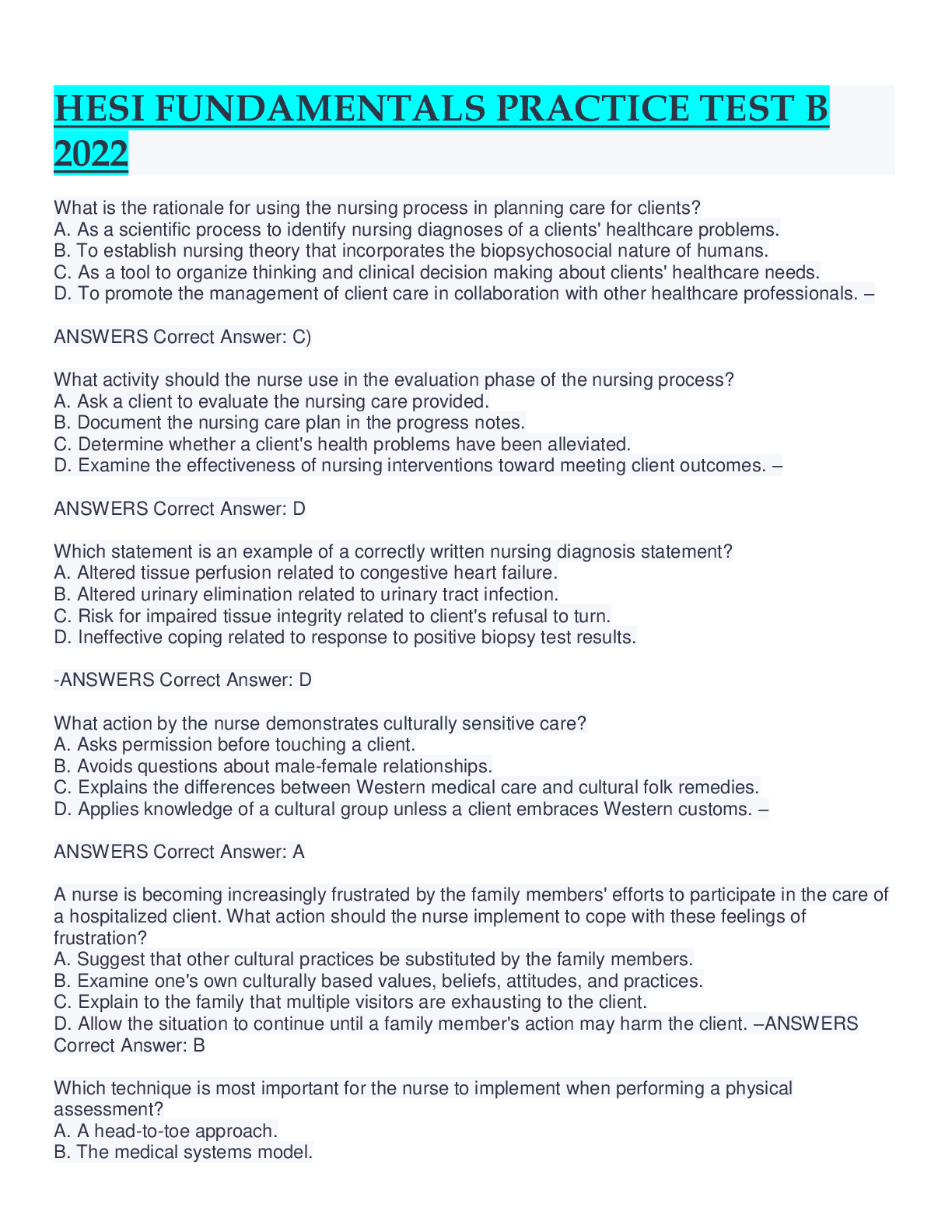
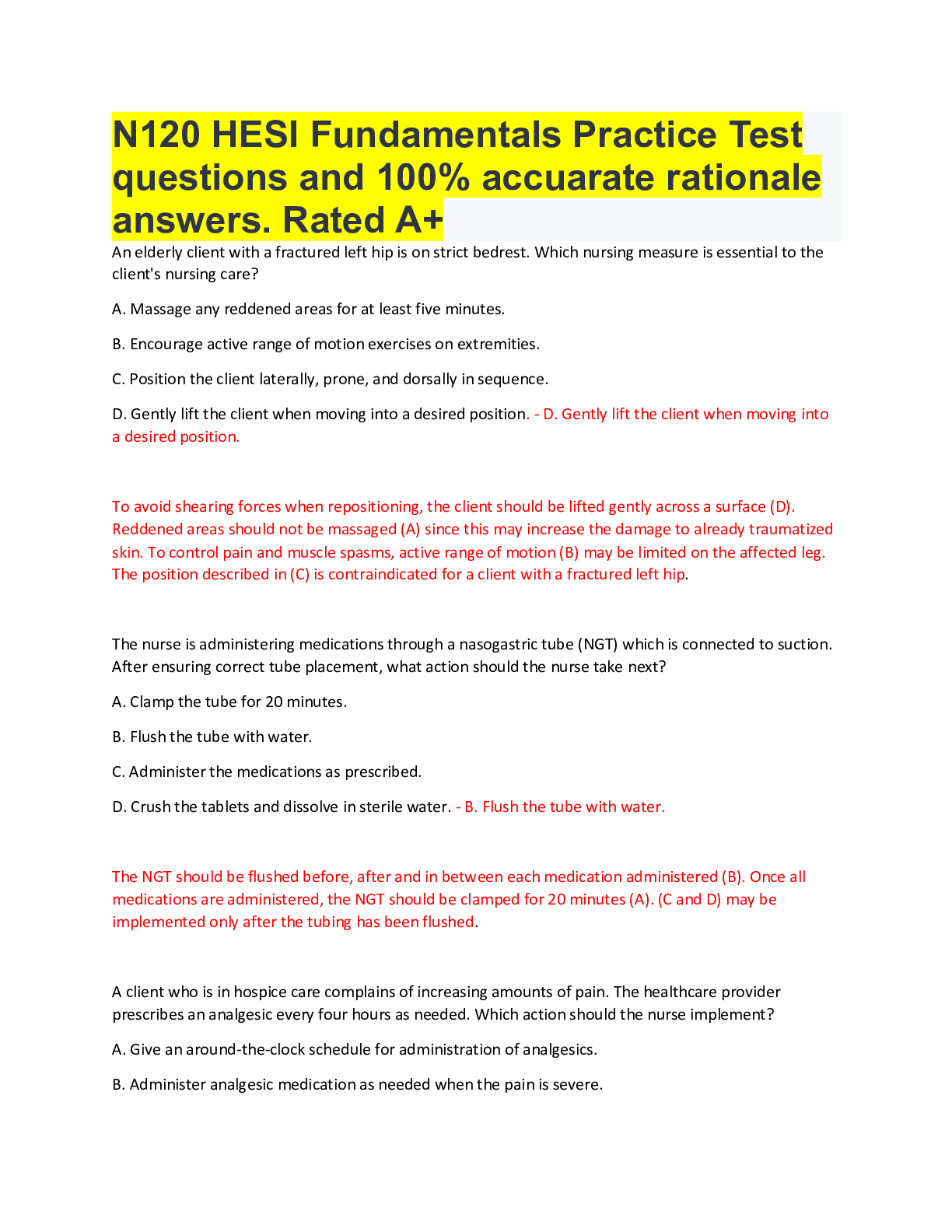
HESI - Fundamentals practice
questions with accurate
answers, rated A
1. When turning an immobile bedridden client without assistance,
whichaction by the nurse best ensures client safety?
A. Securely grasp the clien
...
HESI - Fundamentals practice
questions with accurate
answers, rated A
1. When turning an immobile bedridden client without assistance,
whichaction by the nurse best ensures client safety?
A. Securely grasp the client's arm and leg.
B. Put bed rails up on the side of bed opposite from
the nurse.
C. Correctly position and use a turn sheet.
D. Lower the head of the client's bed slowly.
Rationale:
Because the nurse can only stand on one side of the bed, bed rails should be up on
the opposite side to ensure that the client does not fall out of bed. Option A can
cause client injury to the skin or joint. Options C and D are useful techniques
while turning a client but have less priority in terms of safety than use of the bed
rails.
2. The nurse identifies a potential for infection in a client with partialthickness (second-degree) and full-thickness (third-degree) burns. What
intervention has the highest priority in decreasing the client's risk of
infection?
A. Administration of plasma expanders
B. Use of careful handwashing technique
C. Application of a topical antibacterial cream
D. Limiting visitors to the client with burns
Rationale:
Careful handwashing technique is the single most effective intervention for the
prevention of contamination to all clients. Option A reverses the hypovolemia that
initially accompanies burn trauma but is not related to decreasing the proliferation
of infective organisms. Options C and D are recommended by various burn
centers as possible ways to reduce the chance of infection. Option B is a proven
technique to prevent infection.
3. The nurse is aware that malnutrition is a common problem among clients
lOMoARcPSD|499 043 4
served by a community health clinic for the homeless. Which laboratory
value is the most reliable indicator of chronic protein malnutrition?
lOMoARcPSD|499 043 4
A. Low serum albumin level
B. Low serum transferrin level
C. High hemoglobin level
D. High cholesterol level
Rationale:
Long-term protein deficiency is required to cause significantly lowered serum
albumin levels. Albumin is made by the liver only when adequate amounts of
amino acids (from protein breakdown) are available. Albumin has a long half-life,
so acute protein loss does not significantly alter serum levels. Option B is a serum
protein with a half-life of only 8 to 10 days, so it will drop with an acute protein
deficiency. Options C and D are not clinical measures of protein malnutrition.
4. In completing a client's preoperative routine, the nurse finds that the
operative permit is not signed. The client begins to ask more questions
about the surgical procedure. Which action should the nurse take next?
A. Witness the client's signature to the permit.
B. Answer the client's questions about the surgery.
C. Inform the surgeon that the operative permit is
not signed and the client has questions about the
surgery.
D. Reassure the client that the surgeon will answer
any questions before the anesthesia is
administered.
Rationale:
The surgeon should be informed immediately that the permit is not signed. It is the
surgeon's responsibility to explain the procedure to the client and obtain the
client's signature on the permit. Although the nurse can witness an operative
permit, the procedure must first be explained by the health care provider or
surgeon, including answering the client's questions. The client's questions should
be addressed before the permit is signed.
5. The nurse is assessing several clients prior to surgery. Which factor in a
client's history poses the greatest threat for complications to occur during
surgery?
A. Taking birth control pills for the past 2 years
B. Taking anticoagulants for the past year
C. Recently completing antibiotic therapy
D. Having taken laxatives PRN for the last 6 months
lOMoARcPSD|499 043 4
Rationale:
Anticoagulants increase the risk for bleeding during surgery, which can pose a
threat for the development of surgical complications. The health care provider
should be informed that the client is taking these drugs. Although clients who take
birth control pills may be more susceptible to the development of thrombi, such
problems usually occur postoperatively. A client with option C or D is at less of a
surgical risk than with option B.
6. When assisting a client from the bed to a chair, which procedure is best for
the nurse to follow?
A. Place the chair parallel to the bed, with its back
toward the head of the bed and assist the client in
moving to the chair.
B. With the nurse's feet spread apart and knees
aligned with the client's knees, stand and pivot the
client into the chair.
C. Assist the client to a standing position by gently
lifting upward, underneath the axillae.
D. Stand beside the client, place the client's arms
around the nurse's neck, and gently move the
client to the chair.
Rationale:
Option B describes the correct positioning of the nurse and affords the nurse a
wide base of support while stabilizing the client's knees when assisting to a
standing position. The chair should be placed at a 45-degree angle to the bed, with
the back of the chair toward the head of the bed. Clients should never be lifted
under the axillae; this could damage nerves and strain the nurse's back. The client
should be instructed to use the arms of the chair and should never place his or her
arms around the nurse's neck; this places undue stress on the nurse's neck and back
and increases the risk for a fall.
7.Which step(s) should the nurse take when administering ear drops to an adult
client? (Select all that apply.)
A. Place the client in a side-lying position.
B. Pull the auricle upward and outward.
C. Hold the dropper 6 cm above the ear canal.
D. Place a cotton ball into the inner canal.
E. Pull the auricle down and back.
Rationale:
lOMoARcPSD|499 043 4
The correct answers (A and B) are the appropriate administration of ear drops.
The dropper should be held 1 cm (½ inch) above the ear canal (C). A cotton ball
should be placed in the outermost canal (D). The auricle is pulled down and back
for a child younger than 3 years of age, but not an adult (E).
8.The nurse is instructing a client in the proper use of a metered-dose inhaler.
Which instruction should the nurse provide the client to ensure the optimal
benefits from the drug?
A. "Fill your lungs with air through your mouth and
then compress the inhaler."
B. "Compress the inhaler while slowly breathing in
through your mouth."
C. "Compress the inhaler while inhaling quickly
through your nose."
D. "Exhale completely after compressing the inhaler
and then inhale."
Rationale:
The medication should be inhaled through the mouth simultaneously with
compression of the inhaler. This will facilitate the desired destination of the
aerosol medication deep in the lungs for an optimal bronchodilation effect.
Options A, C, and D do not allow for deep lung penetration
9. A 20-year-old female client with a noticeable body odor has refused to shower
for the last 3 days. She states, "I have been told that it is harmful to bathe during
my period." Which action should the nurse take first?
A. Accept and document the client's wish to refrain
from bathing.
B. Offer to give the client a bed bath, avoiding the
perineal area.
C. Obtain written brochures about menstruation to
give to the client.
D. Teach the importance of personal hygiene during
menstruation with the client.
Rationale:
Because a shower is most beneficial for the client in terms of hygiene, the client
should receive teaching first, respecting any personal beliefs such as cultural or
spiritual values. After client teaching, the client may still choose option A or B.
Brochures reinforce the teaching.
lOMoARcPSD|499 043 4
10. While reviewing the side effects of a newly prescribed medication, a 72-yearold client notes that one of the side effects is a reduction in sexual drive. Which is
the best response by the nurse?
A. "How will this affect your present sexual
activity?"
B. "How active is your current sex life?"
C. "How has your sex life changed as you have
become older?"
D. "Tell me about your sexual needs as an older
adult."
Rationale:
Option A offers an open-ended question most relevant to the client's statement.
Option B does not offer the client the opportunity to express concerns. Options C
and D are even less relevant to the client's statement.
11.The nurse is using the Glasgow Coma Scale to perform a neurologic
assessment. A comatose client winces and pulls away from a painful stimulus.
Which action should the nurse take next?
A. Document that the client responds to painful
stimulus.
B. Observe the client's response to verbal
stimulation.
C. Place the client on seizure precautions for 24
hours.
D. Report decorticate posturing to the health care
provider.
Rationale:
The client has demonstrated a purposeful response to pain, which should be
documented as such. Response to painful stimulus is assessed after response to
verbal stimulus, not before. There is no indication for placing the client on seizure
precautions. Reporting decorticate posturing to the health care provider is
nonpurposeful movement.
12. The nurse plans to administer diazepam, 4 mg IV push, to a client with severe
anxiety. How many milliliters should the nurse administer? (Round to the nearest
tenth.)
lOMoARcPSD|499 043 4
A. 0.2 mL
B. 0.8 mL
C. 1.25 mL
D. 2.0 mL
Rationale:
(1 mL × 4 mg)/5 mg = 0.8 mL
13. The nurse prepares to insert a nasogastric tube in a client with hyperemesis
who is awake and alert. Which intervention(s) is(are) correct? (Select all that
apply.)
A. Place the client in a high Fowler position.
B. Help the client assume a left side-lying position.
C. Measure the tube from the tip of the nose to the
umbilicus.
D. Instruct the client to swallow after the tube has
passed the pharynx.
E. Assist the client in extending the neck back so the
tube may enter the larynx.
Rationale:
(A and D) are the correct steps to follow during nasogastric intubation. Only the
unconscious or obtunded client should be placed in a left side-lying position (B).
The tube should be measured from the tip of the nose to behind the ear and then
from behind the ear to the xiphoid process (C). The neck should only be extended
back prior to the tube passing the pharynx and then the client should be instructed
to position the neck forward (E).
14. The nurse teaches the use of a gait belt to a male caregiver whose wife has
right-sided weakness and needs assistance with ambulation. The caregiver
performs a return demonstration of the skill. Which observation indicates that the
caregiver has learned how to perform this procedure correctly?
A. Standing on his wife's strong side, the caregiver is
ready to hold the gait belt if any evidence of
weakness is observed.
B. Standing on his wife's weak side, the caregiver
lOMoARcPSD|499 043 4
provides security by holding the gait belt from the
back.
C. Standing behind his wife, the caregiver provides
balance by holding both sides of the gait belt.
D. Standing slightly in front and to the right of his
wife, the caregiver guides her forward by gently
pulling on the gait belt.
Rationale:
His wife is most likely to lean toward the weak side and needs extra support on
that side and from the back to prevent falling. Options A, C, and D provide less
security for her.
15. Which nursing diagnosis has the highest priority when planning care for a
client with an indwelling urinary catheter?.
A. Self-care deficit
B. Functional incontinence
C. Fluid volume deficit
D. High risk for infection
Rationale:
Indwelling urinary catheters are a major source of infection. Options A and B are
both problems that may require an indwelling catheter. Option C is not affected by
an indwelling catheter
16. A client has a nursing diagnosis of Altered sleep patterns related to nocturia.
Which client instruction is important for the nurse to provide?
A. Decrease intake of fluids after the evening meal.
B. Drink a glass of cranberry juice every day.
C. Drink a glass of warm decaffeinated beverage at
bedtime.
D. Consult the health care provider about a sleeping
pill.
Rationale:
Nocturia is urination during the night. Option A is helpful to decrease the
production of urine, thus decreasing the need to void at night. Option B helps
prevent bladder infections. Option C may promote sleep, but the fluid will
contribute to nocturia. Option D may result in urinary incontinence if the client is
sedated and does not awaken to void.
17. When performing sterile wound care in the acute care setting, the nurse
obtains a bottle of normal saline from the bedside table that is labeled "opened"
and dated 48 hours prior to the current date. Which is the best action for the nurse
lOMoARcPSD|499 043 4
to take?
A. Use the normal saline solution once more and
then discard.
B. Obtain a new sterile syringe to draw up the
labeled saline solution.
C. Use the saline solution and then relabel the bottle
with the current date.
D. Discard the saline solution and obtain a new
unopened bottle.
Rationale:
Solutions labeled as opened within 24 hours may be used for clean procedures, but
only newly opened solutions are considered sterile. This solution is not newly
opened and is out of date, so it should be discarded. Options A, B, and C describe
incorrect procedures.
18. Based on the nursing diagnosis of risk for infection, which intervention is best
for the nurse to implement when providing care for an older incontinent client?
A. Maintain standard precautions.
B. Initiate contact isolation measures.
C. Insert an indwelling urinary catheter.
D. Instruct client in the use of adult diapers.
Rationale:
The best action to decrease the risk of infection in vulnerable clients is
handwashing. Option B is not necessary unless the client has an infection. Option
C increases the risk of infection. Option D does not reduce the risk of infection.
19. When taking a client's blood pressure, the nurse is unable to distinguish the
point at which the first sound was heard. Which is the best action for the nurse to
take?
A. Deflate the cuff completely and immediately
reattempt the reading.
B. Reinflate the cuff completely and leave it inflated
for 90 to 110 seconds before taking the second
reading.
C. Deflate the cuff to zero and wait 30 to 60 seconds
before reattempting the reading.
D. Document the exact level visualized on the
sphygmomanometer where the first fluctuation
was seen.
lOMoARcPSD|499 043 4
Rationale:
Deflating the cuff for 30 to 60 seconds allows blood flow to return to the
extremity so that an accurate reading can be obtained on that extremity a second
time. Option A could result in a falsely high reading. Option B reduces
circulation, causes pain, and could alter the reading. Option D is not an accurate
method of assessing blood pressure.
20.A client's blood pressure reading is 156/94 mm Hg. Which action should the
nurse take first?
A. Tell the client that the blood pressure is high and
that the reading needs to be verified by another
nurse.
B. Contact the health care provider to report the
reading and obtain a prescription for an
antihypertensive medication.
C. Replace the cuff with a larger one to ensure an
ample fit for the client to increase arm comfort.
D. Compare the current reading with the client's
previously documented blood pressure readings.
Rationale:
Comparing this reading with previous readings will provide information about
what is normal for this client; this action should be taken first. Option A might
unnecessarily alarm the client. Option B is premature. Further assessment is
needed to determine if the reading is abnormal for this client. Option C could
falsely decrease the reading and is not the correct procedure for obtaining a blood
pressure reading.
21.A nurse stops at a motor vehicle collision site to render aid until the emergency
personnel arrive and applies pressure to a groin wound that is bleeding profusely.
Later the client has to have the leg amputated and sues the nurse for malpractice.
Which is the most likely outcome of this lawsuit?
A. The Patient's Bill of Rights protects clients from
malicious intents, so the nurse could lose the
case.
B. The lawsuit may be settled out of court, but the
nurse's license is likely to be revoked.
C. There will be no judgment against the nurse,
whose actions were protected under the Good
Samaritan Act.
lOMoARcPSD|499 043 4
D. The client will win because the four elements of
negligence (duty, breach, causation, and
damages) can be proved.
Rationale:
The Good Samaritan Act protects health care professionals who practice in good
faith and provide reasonable care from malpractice claims, regardless of the client
outcome. Although the Patient's Bill of Rights protects clients, this nurse is
protected by the Good Samaritan Act. The state Board of Nursing has no reason to
revoke a registered nurse's license unless there was evidence that actions taken in
the emergency were not done in good faith or that reasonable care was not
provided. All four elements of malpractice were not shown.
22. When the health care provider diagnoses metastatic cancer and recommends a
gastrostomy for an older female client in stable condition, the son tells the nurse
that his mother must not be told the reason for the surgery because she "can't
handle" the cancer diagnosis. Which legal principle is the court most likely to
uphold regarding this client's right to informed consent?
A. The family can provide the consent required in
this situation because the older adult is in no
condition to make such decisions.
B. Because the client is mentally incompetent, the
son has the right to waive informed consent for
her.
C. The court will allow the health care provider to
make the decision to withhold informed consent
under therapeutic privilege.
D. If informed consent is withheld from a client,
health care providers could be found guilty of
negligence.
Rationale:
Health care providers may be found guilty of negligence, specifically assault and
battery, if they carry out a treatment without the client's consent. The client's
condition is stable, so option A is not a valid rationale. Advanced age does not
automatically authorize the son to make all decisions for his mother, and there is
no evidence that the client is mentally incompetent. Although option C may have
been upheld in the past, when paternalistic medical practice was common, today's
courts are unlikely to accept it
23.The nurse is obtaining a lie-sit-stand blood pressure reading on a client. Which
action is most important for the nurse to implement?
A. Stay with the client while the client is standing.
B. Record the findings on the graphic sheet in the
lOMoARcPSD|499 043 4
chart.
C. Keep the blood pressure cuff on the same arm.
D. Record changes in the client's pulse rate.
Rationale:
Although all these measures are important, option A is most important because it
helps ensure client safety. Option B is necessary but does not have the priority of
option A. Options C and D are important measures to ensure accuracy of the
recording but are of less importance than providing client safety.
24. A client becomes angry while waiting for a supervised break to smoke a
cigarette outside and states, "I want to go outside now and smoke. It takes forever
to get anything done here!" Which intervention is best for the nurse to implement?
A. Encourage the client to use a nicotine patch.
B. Reassure the client that it is almost time for
another break.
C. Have the client leave the unit with another staff
member.
D. Review the schedule of outdoor breaks with the
client.
Rationale:
The best nursing action is to review the schedule of outdoor breaks and provide
concrete information about the schedule. Option A is contraindicated if the client
wants to continue smoking. Option B is insufficient to encourage a trusting
relationship with the client. Option C is preferential for this client only and is
inconsistent with unit rules.
25. Which serum laboratory value should the nurse monitor carefully for a client
who has a nasogastric (NG) tube to suction for the past week?
A. White blood cell count
B. Albumin
C. Calcium
D. Sodium
Rationale:
Monitoring serum sodium levels for hyponatremia is indicated during prolonged
NG suctioning because of loss of fluids. Changes in levels of option A, B, or C are
not typically associated with prolonged NG suctioning.
26. A female client with frequent urinary tract infections (UTIs) asks the nurse to
explain her friend's advice about drinking a glass of juice daily to prevent future
UTIs. Which response is best for the nurse to provide?
lOMoARcPSD|499 043 4
A. Orange juice has vitamin C that deters bacterial
growth.
B. Apple juice is the most useful in acidifying the
[Show More]
.png)
.png)



 (1).png)

 Questions, Answers & Rationale, A+ Guide.png)