Chapter 44--Assessment of Integumentary Function
MULTIPLE CHOICE
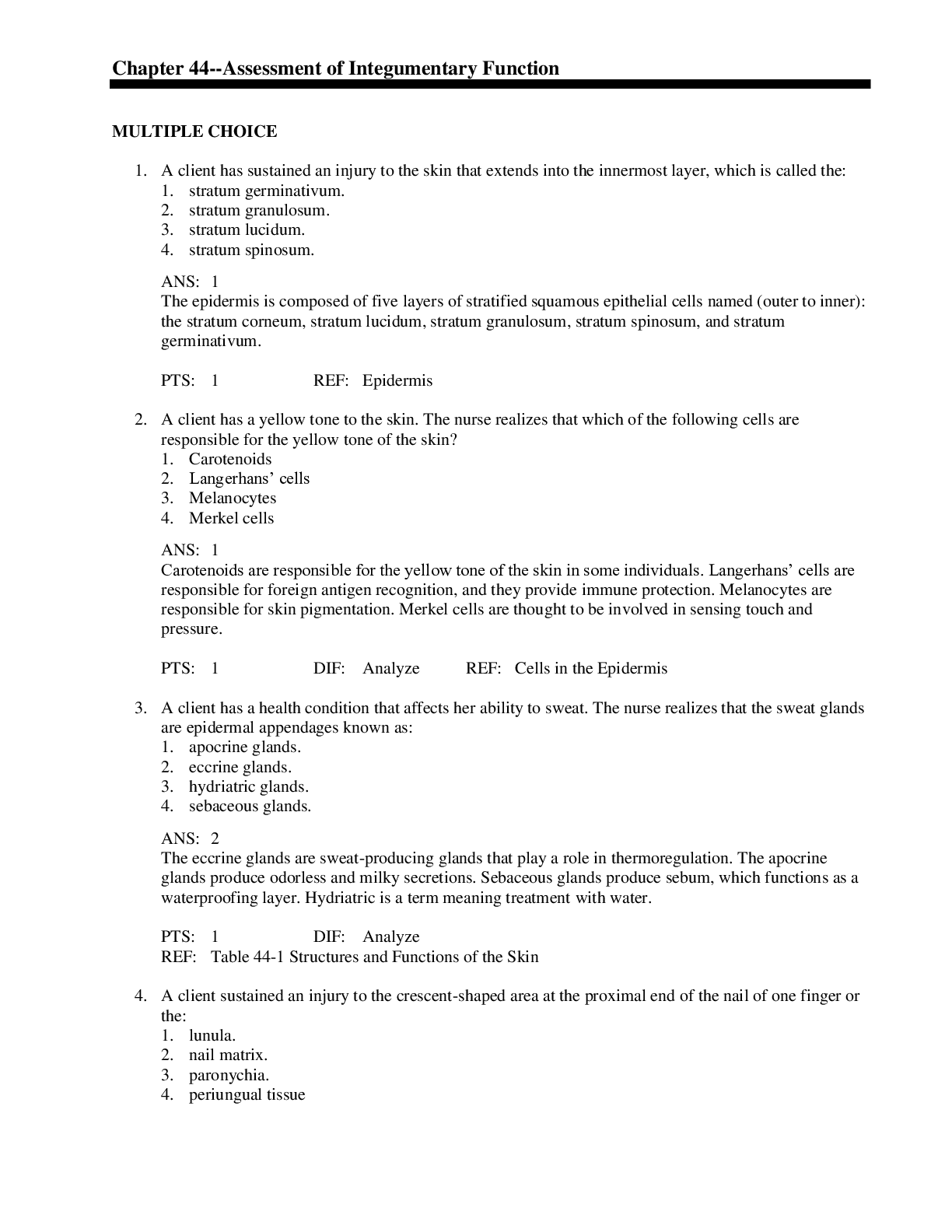
1. A client has sustained an injury to the skin that extends into the innermost layer, which is called the:
1. stratum germinativum.
2. stratum g
...
Chapter 44--Assessment of Integumentary Function
MULTIPLE CHOICE
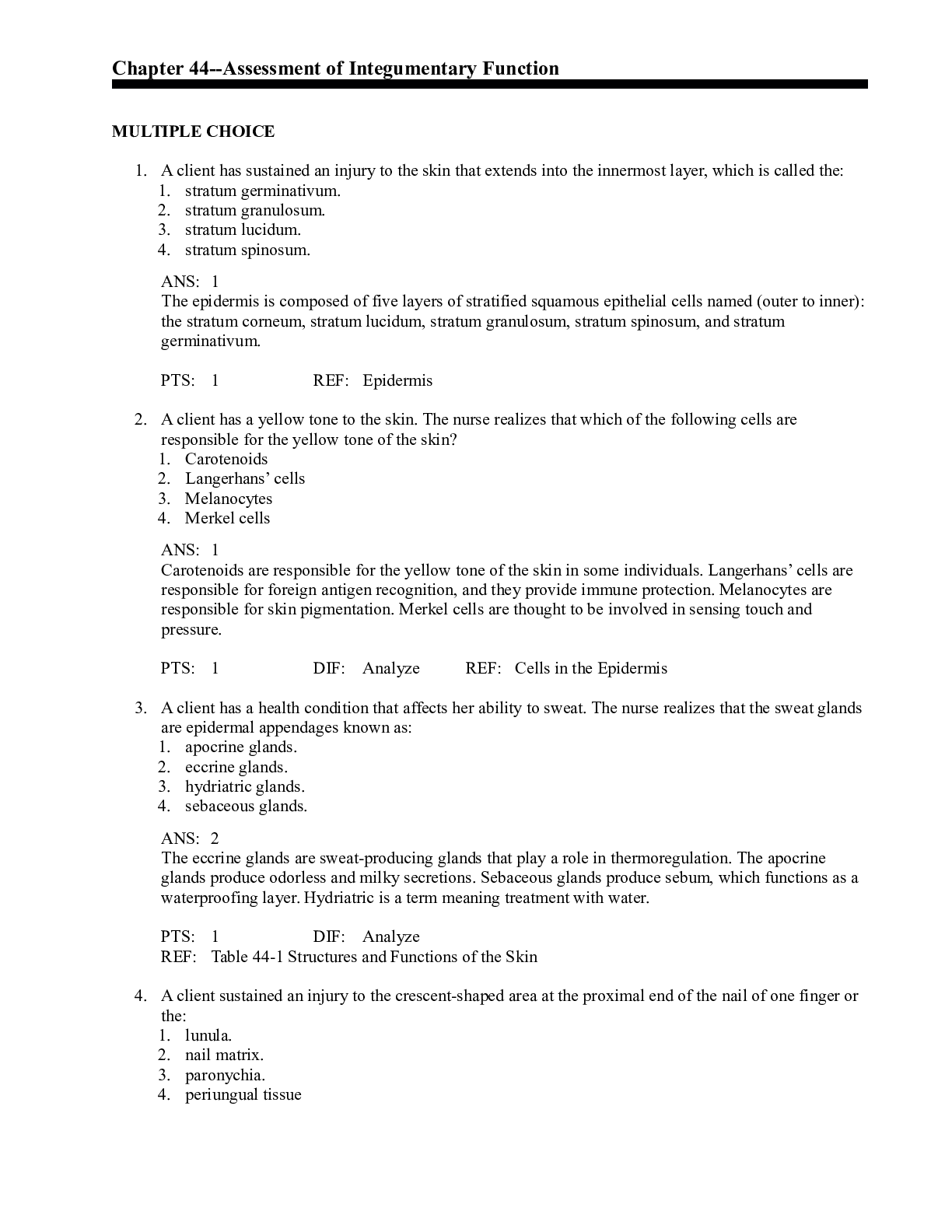
1. A client has sustained an injury to the skin that extends into the innermost layer, which is called the:
1. stratum germinativum.
2. stratum granulosum.
3. stratum lucidum.
4. stratum spinosum.
PTS: 1 REF: Epidermis
2. A client has a yellow tone to the skin. The nurse realizes that which of the following cells are responsible for the yellow tone of the skin?
1. Carotenoids
2. Langerhans’ cells
3. Melanocytes
4. Merkel cells
PTS: 1 DIF: Analyze REF: Cells in the Epidermis
3. A client has a health condition that affects her ability to sweat. The nurse realizes that the sweat glands are epidermal appendages known as:
1. apocrine glands.
2. eccrine glands.
3. hydriatric glands.
4. sebaceous glands.
PTS: 1 DIF: Analyze
REF: Table 44-1 Structures and Functions of the Skin
4. A client sustained an injury to the crescent-shaped area at the proximal end of the nail of one finger or the:
1. lunula.
2. nail matrix.
3. paronychia.
4. periungual tissue
PTS: 1 DIF: Analyze REF: Epidermal Appendages
5. The nurse is assessing the skin of an elderly client. Which of the following would not be assessed in this client?
1. Decreased elasticity
2. Increased skin hydration
3. Slow wound healing
4. Thinning skin
PTS: 1 DIF: Analyze REF: Cellular Effects of Aging on the Skin
6. A client is experiencing elevated fluid-filled lesions on the skin. The nurse would document these lesions as being:
1. macules.
2. nodules.
3. vesicles.
4. wheals.
PTS: 1 DIF: Analyze REF: Box 44-1 Primary Lesions
7. A client is experiencing a change in skin status. During the assessment, the nurse asks about any changes in laundry products as part of which of the following systems review?
1. Environmental changes
2. Nutritional patterns
3. Activities and exercise patterns
4. Cultural influences
PTS: 1 DIF: Apply
REF: Table 44-2 Review of Systems Related to Skin Disorders
8. A client is recovering from burns located on both arms, anterior chest, and both legs. The nurse realizes that this client may need which of the following dietary supplements?
1. Vitamin B
2. Vitamin C
3. Vitamin D
4. Vitamin E
PTS: 1 DIF: Analyze REF: Synthesis
9. The nurse, assessing a client’s skin as being overly dry and scaly, would document this finding as being:
1. poor turgor.
2. ichthyosis.
3. edematous.
4. anasarca.
PTS: 1 DIF: Apply REF: Assessment of the Skin
10. A client has a nonpalpable skin lesion that is causing a change in skin color greater than 1 cm in diameter. The nurse would document this finding as being a(n):
1. patch.
2. macule.
3. wheal.
4. vesicle.
PTS: 1 DIF: Apply REF: Figure 44-6 Morphology of Primary Lesions
11. A client has an enlarged scar as a result of abdominal surgery. The nurse realizes this scar would be considered a(n):
1. erosion.
2. fissure.
3. excoriation.
4. keloid.
PTS: 1 DIF: Analyze REF: Figure 44-7 Morphology of Secondary Lesions
12. A client has several patches of horny, thickened skin on the palmar surface of the hands and feet. The nurse would document this finding as being:
1. keratosis.
2. linear.
3. serpiginous.
4. dermatomal.
PTS: 1 DIF: Apply
REF: Box 44-2 Description and Configuration of Selected Group of Lesions
13. A school age child is diagnosed with many individual and separate skin lesions. The nurse realizes this client is experiencing the result of:
1. measles.
2. poison ivy.
3. herpes zoster.
4. insect bites.
PTS: 1 DIF: Analyze REF: Figure 44-5 Arrangement of Lesions
MULTIPLE RESPONSE
1. The nurse is assessing the skin status of a client. Which of the following will be included in this assessment? (Select all that apply.)
1. Personal perception of the skin problem
2. Nutritional pattern
3. Elimination pattern
4. Self-concept
5. Self-image
6. Employment status
PTS: 1 DIF: Apply
REF: Table 44-2 Review of Systems Related to Skin Disorders
2. The nurse determines that a client has skin changes consistent with sun exposure. Which of the following did the nurse assess in this client? (Select all that apply.)
1. Age spots
2. Actinic keratoses
3. Telangiectasias
4. Lentigines
5. Freckles
6. Burrows
PTS: 1 DIF: Analyze REF: Skin Changes Throughout the Life Span
3. The nurse is assessing a client for primary skin lesions. Which of the following would be considered primary lesions of the skin? (Select all that apply.)
1. Crust
2. Scales
3. Tumors
4. Nodules
5. Macules
6. Plaques
PTS: 1 DIF: Analyze
REF: Box 44-1 Primary Lesions; Figure 44-7 Morphology of secondary lesions
4. The nurse is describing the distribution and configuration of lesions. Which of the following can be used for this description? (Select all that apply.)
1. Iris
2. Annular
3. Linear
4. Keratosis
5. Wheal
6. Bullae
ANS: 1, 2, 3, 4
PTS: 1 DIF: Apply
REF: Box 44-2 Description and Configuration of Selected Group of Lesions
5. The nurse assesses a linear lesion along the length of a client’s leg. Which diagnosis does the nurse realize is associated with linear lesions? (Select all that apply.)
1. Drug reaction
2. Herpes zoster
3. Herpes simplex
4. Hookworm
5. Dermatitis
6. Poison ivy
PTS: 1 DIF: Analyze REF: Figure 44-5 Arrangement of Lesions
[Show More]