WEEK 4 MIDTERM EXAM DOC QUESTIONS AND ANSWERS 2021
Question 1 (Worth 1 points)
The term that is used to indicate decreasing levels of spatial interactions with increasing distances is:
A. distance delay
B. stat
...
WEEK 4 MIDTERM EXAM DOC QUESTIONS AND ANSWERS 2021
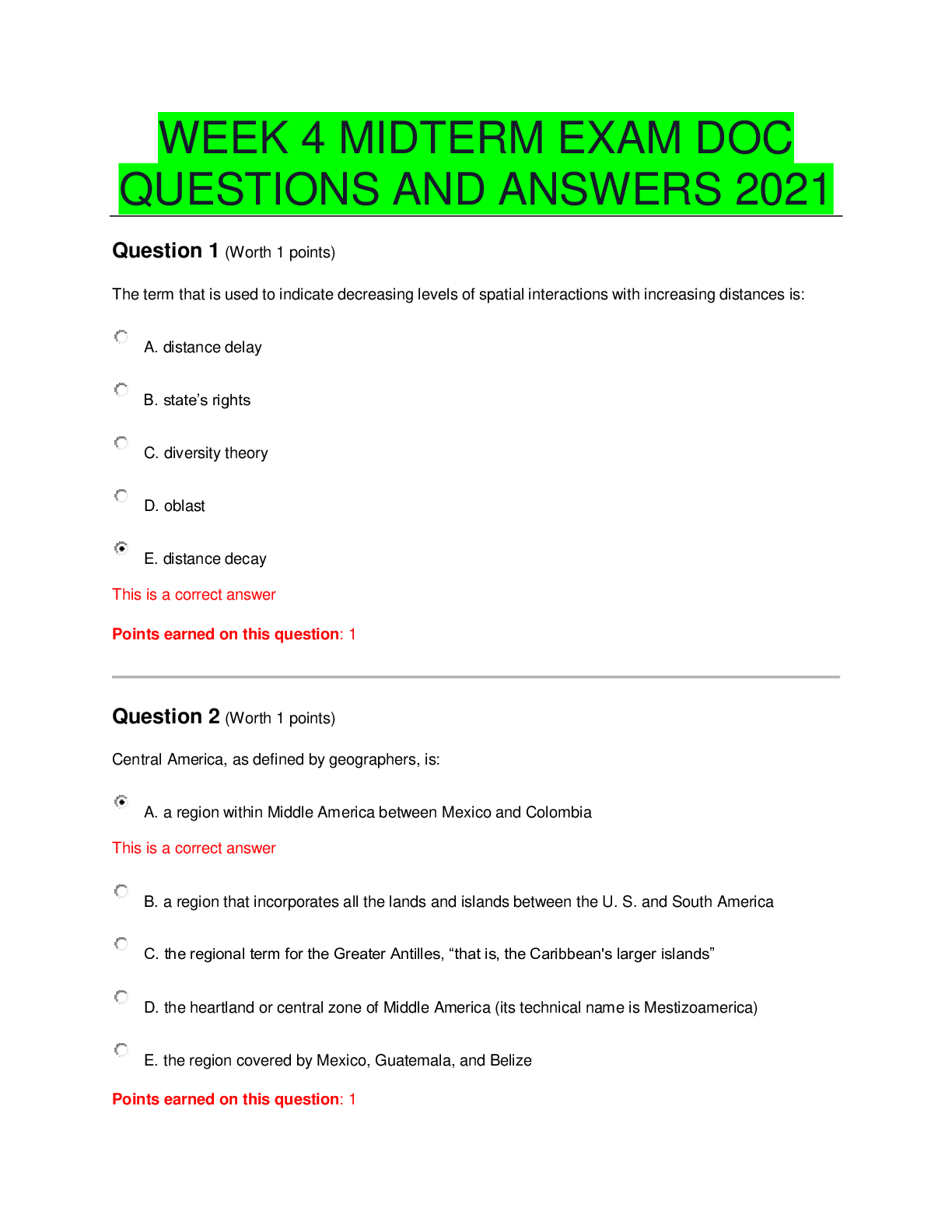
Question 1 (Worth 1 points)
The term that is used to indicate decreasing levels of spatial interactions with increasing distances is:
A. distance delay
B. state’s rights
C. diversity theory
D. oblast
E. distance decay
________________________________________
Question 2 (Worth 1 points)
Central America, as defined by geographers, is:
A. a region within Middle America between Mexico and Colombia
B. a region that incorporates all the lands and islands between the U. S. and South America
C. the regional term for the Greater Antilles, “that is, the Caribbean's larger islands”
D. the heartland or central zone of Middle America (its technical name is Mestizoamerica)
E. the region covered by Mexico, Guatemala, and Belize
________________________________________
Question 3 (Worth 1 points)
The rebellion in Chiapas was designed to occur at the same time as:
A. the launching of NAFTA
B. Christmas
C. the presidential election in Mexico
D. other Mexican states were seceding from the country
E. none of the above
________________________________________
Question 4 (Worth 1 points)
The Western European state that is not a member of the European Union is:
A. Austria
B. England
C. Spain
D. Switzerland
E. Belgium
________________________________________
Question 5 (Worth 1 points)
The leading manufacturing/industrial complex in Poland is located in:
A. Gdansk
B. Warsaw
C. Slovenia
D. Silesia
E. The Ukraine
________________________________________
Question 6 (Worth 1 points)
The major difference between an endemic and a pandemic disease is that:
A. an endemic disease moves swiftly through the population of a local area, whereas a pandemic disease is simply present, affecting the lives of millions of people in a negative way
B. a pandemic disease moves swiftly through the population of a local area, whereas a endemic disease is simply present, affecting the lives of millions of people in a negative way
C. a pandemic disease moves through the population of a large area of the world, whereas an endemic disease is simply present, affecting the lives of millions of people in a negative way
D. there is no difference between an endemic and a pandemic disease
E. none of the above
________________________________________
Question 7 (Worth 1 points)
A market that is set up only on certain days of the week is known as a ____ market.
A. Bantustan
B. condominium
C. trader
D. periodic
E. sequent occupant
________________________________________
Question 8 (Worth 1 points)
Which of the following is landlocked?
A. Paraguay
B. Ecuador
C. Guiana
D. Peru
E. Chile
________________________________________
Question 9 (Worth 1 points)
Which of the following is not a state created by the devolution of former Yugoslavia?
A. Bosnia
B. Macedonia
C. Croatia
D. Slovakia
E. Serbia-Montenegro
________________________________________
Question 10 (Worth 1 points)
Italy’s economic core, no longer focused on Rome, is located today in:
A. Romania
B. Po River Valley
C. the Indus River Valley
D. Greece
E. the Alpine chain
________________________________________
Question 11 (Worth 1 points)
Before independence, the modern state of The Congo was a colony of:
A. France
B. Germany
C. Britain
D. Belgium
E. South Africa
________________________________________
Question 12 (Worth 1 points)
Which of the following statements is false?
A. Germany is larger territorially than France.
B. Germany has a better river system than France.
C. Germany is more industrialized than France.
D. Germany is more urbanized than France.
E. France has better harbors than does Germany.
________________________________________
Question 13 (Worth 1 points)
The Polonoroeste Plan has called for settlement near the border with:
A. Venezuela
B. Chile
C. Bolivia
D. Mexico
E. Sao Paulo
________________________________________
Question 14 (Worth 1 points)
These two cities act as Russian ports facing the Barents Sea in the north.
A. Kiev and Odessa
B. Murmansk and Vladivostok
C. Tyva Republic and Yakutia
D. Arkhangelsk and Odessa
E. Murmansk and Arkhangelsk
________________________________________
Question 15 (Worth 1 points)
The Kuzbas region:
A. lead city is Novosibirsk
B. is also called the Kuznetsk Basin
C. has developed in part because of the central planning activities of the former Soviet Union
D. contains both iron and coal deposits
E. all of the above
________________________________________
Question 16 (Worth 1 points)
Which of the following cities is an oil center in the Azerbaijan?
A. Moscow
B. White Russia
C. Baki (Baku)
D. Leningrad
E. Bucharest
________________________________________
Question 17 (Worth 1 points)
In South America, the richest 20% of the population control _____ of the wealth.
A. 2%
B. 70%
C. 90%
D. 1%
E. 95%
________________________________________
Question 18 (Worth 1 points)
The country in Equatorial Africa with significant oil supplies and an upper middle income economy is:
A. Congo
B. Cameroon
C. Central African Republic
D. Gabon
E. Equatorial Guinea
________________________________________
Question 19 (Worth 1 points)
The Brazilian subregion with the most diversity in its European population is the:
A. South
B. Northeast
C. state of Sao Paulo
D. Interior
E. Amazonian North
________________________________________
Question 20 (Worth 1 points)
The __________ form(s) the eastern limit of the Russian Core:
A. Volga-Dan Canal
B. large petroleum reserves
C. Volga River
D. Ural Mountains
E. distance from European conflicts
________________________________________
Question 21 (Worth 1 points)
In which of the following countries did the Communist Chinese build the Tan-Zam Railway?
A. Sudan
B. Tanzania
C. Malawi
D. The Congo
E. Ethiopia
________________________________________
Question 22 (Worth 1 points)
The North American region which is the largest and the least densely settled is the:
A. Northern Frontier
B. Continental Interior
C. Maritime Northeast
D. Southwest
E. Pacific Hinge
________________________________________
Question 23 (Worth 1 points)
Which of the following is one of the world’s most productive post-industrial complexes?
A. Phoenix and Tucson
B. Dallas-Fort Worth, Houston and San Antonio
C. El Paso
D. Miami, Fort Lauderdale, and West Palm Beach
E. Charlotte, Atlanta, and Charleston
________________________________________
Question 24 (Worth 1 points)
From the end of World War II until the 1990s, Eastern Europe was dominated by the:
A. Ottomans
B. Hapsburgs
C. Lithuanians
D. Soviet Union
E. Poles
________________________________________
Question 25 (Worth 1 points)
The island contested between Greece and Turkey is:
A. Cyprus
B. Crete
C. Malta
D. Sicily
E. Macedonia
________________________________________
Question 26 (Worth 1 points)
Which of the following is the smallest Central American country in terms of population?
A. Honduras
B. Jamaica
C. Belize
D. Nicaragua
E. Guyana
________________________________________
Question 27 (Worth 1 points)
Which of the following is a natural gas producing state?
A. Maine
B. New York
C. Ohio
D. Texas
E. none of the above
________________________________________
Question 28 (Worth 1 points)
Civil war in which of the following led to the change in the government of The Congo?
A. The Congo
B. Cameroon
C. Central African Republic
D. Rwanda
E. Equatorial Guinea
________________________________________
Question 29 (Worth 1 points)
The vegetation of coniferous forest at the southern end of the treeless plains is known as:
A. taiga
B. Ural
C. permafrost
D. tundra
E. Kola
________________________________________
Question 30 (Worth 1 points)
Which of the following countries is not in The African Transition Zone?
A. Mauritania
B. Mali
C. Niger
D. Nigeria
E. Egypt
________________________________________
Question 31 (Worth 1 points)
The North American region which has undergone the most change in recent years is:
A. the South
B. the Continental Core
C. Agricultural Heartland
D. New England/Atlantic Provinces
E. French Canada
________________________________________
Question 32 (Worth 1 points)
A growth pole is:
A. an established manufacturing center that dominates a substantial region
B. any large city in a national core area
c. a location where a set of industries, given a start, will grow, setting off ripples of development in a surrounding area
d. a location, now in decline, that served as a focal point for a developing region in the
past
E. an agricultural region where annual yields increase annually
________________________________________
Question 33 (Worth 1 points)
The territory in dispute between Azerbaijan and Armenia is:
A. Georgia
B. Abkhazian
C. Nakhichevan
D. Nagorno-Karabakh
E. South Ossetia
________________________________________
Question 34 (Worth 1 points)
Slovakia has a large _______ minority.
A. Czech
B. Hungarian
C. Serbian
D. Moldovan
E. Jewish
________________________________________
Question 35 (Worth 1 points)
The Caribbean Coast of Middle America is:
A. part of the Rimland
B. part of the Heartland
C. an area settled by the Dutch
D. an area settled by the Portuguese
E. none of the above
________________________________________
Question 36 (Worth 1 points)
The ethnic group exerting the most control in Kenya is the:
a. Kikuyu
b. Swahili
c. Tutsi
d. Bantu
e. Hutu
________________________________________
Question 37 (Worth 1 points)
Quebec has:
A. a declining birth rate.
B. offered incentives for French speakers from elsewhere to move to Quebec.
C. significant hydroelectric power.
D. a population that has rapidly urbanized.
E. all of the above are true.
________________________________________
Question 38 (Worth 1 points)
In which country did a major slave rebellion take place?
A. Mexico
B. Jamaica
C. Haiti
D. Ocho Rios
E. Cuba
________________________________________
Question 39 (Worth 1 points)
Which of the following is not one of the four Motors of Europe?
A. Tirane (Albania)
B. Milan
C. Stuttgart
D. Barcelona
E. Lyon
________________________________________
Question 40 (Worth 1 points)
A narrow strip of land connecting two larger land bodies is known as a(n):
A. spine
B. isthmus
C. Oriente
D. rimland
E. peninsula
________________________________________
Question 41 (Worth 1 points)
As a result of U.S. interest in a Panama Canal during the early 20th century:
A. Panama became a territorially coherent state
B. a treaty was drawn granting the U. S. permanent sovereignty over the Canal Zone
C. Panama became independent from Colombia
D. a Panamanian revolt was subdued by U. S. intervention
E. a French company finally completed the canal in 1918
________________________________________
Question 42 (Worth 1 points)
The capital of the Chechen Republic is:
A. Chechenia
B. Moscow
C. Tbilisi
D. Groznyy
E. Yerevan
________________________________________
Question 43 (Worth 1 points)
The geopolitical theory that indicates that the rimland is the key to control of the world was forwarded by:
A. Marx
B. Mackinder
C. Spykman
D. Lenin
E. Gorbachev
________________________________________
Question 44 (Worth 1 points)
Identify the incorrect association.
A. Jamaica: British dependency
B. Aruba, Bonaire, Curaçao: Netherlands dependencies
C. Martinique: French département
D. Cayman Islands: United States possessions
E. Cuba: Spanish
________________________________________
Question 45 (Worth 1 points)
_________ is the city with the most Asians in North America.
A. Denver
B. Vancouver
This is a correct answer
C. Seattle
D. San Diego
E. Chicago
________________________________________
Question 46 (Worth 1 points)
The Peru (Humboldt) Current is:
A. a cool offshore ocean current conducive to commercial fishing that flows parallel to the
Peruvian coastline
B. a drying wind that blows off the Andes and creates desert-like conditions along the Peruvian coastal plain
C. a rising air movement that brings the hot and humid conditions of the tierra fría to the uppermost Andean basins
D. a new high voltage electrical network that transmits Amazon-oil-generated power by pipeline to the cities across the Andes
E. the name of Bolivár’s revolutionary movement of the 1960s ________________________________________
Question 47 (Worth 1 points)
Which former Soviet Republic, with its capital at Mensk, is also called White Russia, and is still strongly linked to Moscow?
A. Belarus
B. Lithuania
C. Georgia
D. Estonia
E. Ukraine
________________________________________
Question 48 (Worth 1 points)
The Transcaucasian area includes all of the following except:
A. Georgia
B. Armenia
C. Azerbaijan
D. Nagorno-Karabakh
E. Kirghizstan
________________________________________
Question 49 (Worth 1 points)
The term _________ refers to a huge state farm and literally means “a grain and meat factory” in which agricultural efficiency through mechanization and minimum labor requirements should be at its peak.
A. kuzbas
B. sovkhoz
C. gorod
D. Ural
E. kolkhoz
________________________________________
Question 50 (Worth 1 points)
Which of the following cities is located in Italy’s core area?
A. Milan-Turin-Genoa
B. Rome
C. Barcelona
D. Naples
E. Catalonia
________________________________________
Question 51 (Worth 1 points)
The Central American country where English is spoken, but where Spanish will eventually become the predominant language is:
A. Cuba
B. Guatemala
C. Costa Rica
D. Mexico
E. Belize
________________________________________
Question 52 (Worth 1 points)
Rubber production has had the greatest impact on which Brazilian subregion?
A. South
B. Northeast
C. state of Sao Paulo
D. Interior
E. North
________________________________________
Question 53 (Worth 1 points)
Which of the following jobs belongs to the tertiary sector of the American economy?
A. computer systems specialist
B. chief executive of a multinational corporation
C. auto assembly line welder
D. office receptionist
E. farmer
________________________________________
Question 54 (Worth 1 points)
The rings of slums surrounding South America’s large cities are known as:
A. mestizos
B. favelas
C. tierra templada
D. altiplanos
E. the spines of the city
________________________________________
Question 55 (Worth 1 points)
This former Soviet Republic contains the oil city of Baki (Baku) and its people have ethnic affinities with Iran. Recently, the Armenian population of this area became refugees.
A. Azerbaijan
B. Moldavia
C. Georgia
D. Estonia
E. Turkmenistan
________________________________________
Question 56 (Worth 1 points)
Which of the following statements is incorrect?
A. Haiti's population is predominantly black with a small mulatto minority.
B. In the second half of the nineteenth century approximately 100,000 Chinese emigrated to Cuba as indentured servants.
C. Trinidad has a large East Indian minority and Hindi remains a commonly spoken language.
D. Cuba’s population has a black majority.
E. Haiti is on the island of Hispanola.
________________________________________
Question 57 (Worth 1 points)
An interesting aspect of Madagascar is that:
A. the Great Rift Valley predominates in the central part of the country
B. the population is of Malay-Polynesian origin
C. it produces exceptional quantities of corn
D. the island is controlled by the South Africans who have extended apartheid to the
island
E. most of the population is descendant of Ethiopians
________________________________________
Question 58 (Worth 1 points)
The now-independent political entity that was called South West Africa is today renamed:
A. Namibia
B. Botswana
C. Western Rhodesia
D. Bophuthatswana
E. Lesotho
________________________________________
Question 59 (Worth 1 points)
Japanese investment in Russia’s Far East has been held up by a dispute over:
A. the Amur River
B. Kurile Islands
C. Manchuria
D. Sakhalin Island
E. Vladivostok
________________________________________
Question 60 (Worth 1 points)
The two major language groups in Canada are:
A. English and Spanish
B. English and French
C. English and Canadian
D. Canadian and French
E. only English is spoken widely in Canada
________________________________________
Question 61 (Worth 1 points)
The North Slope of Alaska contains large fields of:
a. cold weather crops
b. tar sands
c. diamonds
d. hydroelectric power
e. coal
________________________________________
Question 62 (Worth 1 points)
Which of the following countries was not a British colony prior to its independence?
A. Botswana
B. Zambia
C. Kenya
D. Ethiopia
E. Malawi
________________________________________
Question 63 (Worth 1 points)
This small country gains much of its importance because of its location on the Bab el Mandeb Strait leading into the Red Sea
A. Mauritania
B. Mali
C. Niger
D. Nigeria
E. Djibouti
________________________________________
Question 64 (Worth 1 points)
The country in Equatorial Africa that had a border dispute with Nigeria over an oil-rich area is:
A. Congo
B. Cameroon
C. Central African Republic
D. Gabon
E. Equatorial Guinea
________________________________________
Question 65 (Worth 1 points)
Which of the following states has most of its territory located in the Intermontane Basin and Plateau physiographic province?
A. Wisconsin
B. Texas
C. Pennsylvania
D. Nevada
E. New York
________________________________________
Question 66 (Worth 1 points)
Which of the following is not an important manufacturing region of the Soviet Union?
A. Volga Region
B. Urals Region
C. Donbas Region
D. Central Industrial Region
E. the Muslim region of central Asia
________________________________________
Question 67 (Worth 1 points)
Your textbook identifies Eastern Europe as a zone of politico-geographical splintering and fracturing, called a:
A. Irredentist region
B. hinterland
C. shatter belt
D. Balkan
E. heartland region
________________________________________
Question 68 (Worth 1 points)
When a state seeks to acquire the ethnically similar people and territory on the other side of its boundary by appealing to a concentrated group, this action is termed:
A. irradiation
B. irrational
C. interference
D. irredentism
E. irresponsible
________________________________________
Question 69 (Worth 1 points)
Which of the following associations is incorrect?
A. Niger River, Bulge of Africa
B. Congo River, The Congo
C. Zambezi River, Angola
D. Nile River, Sudan
E. Orange River, Kenya
________________________________________
Question 70 (Worth 1 points)
_______ dominates Western Europe demographically and economically.
A. France
B. Belgium
C. Austria
D. Germany
E. Switzerland
Question 71 (Worth 1 points)
Central America’s poorest country is:
A. Cuba
B. Guatemala
C. Mexico
D. Honduras
E. Nicaragua
________________________________________
Question 72 (Worth 1 points)
The three-pronged foundation of the Southwest is:
A. sail-wagon, horsecar-walking, steel-rail
B. coal, natural gas, oil
C. urban, rural, and suburban settlement
D. electricity, water, and the automobile
E. none of the above
________________________________________
Question 73 (Worth 1 points)
The Autonomous Community in eastern Spain just south of the Pyrenees Mountains centered on industrialized Barcelona is known as:
A. Silesia
B. Galicia
C. Catalonia
D. Lombardy
E. Portugal
________________________________________
Question 74 (Worth 1 points)
The Soviet Union consisted of _____________ Soviet Socialist Republics.
A. 120
B. 1
C. 15
D. 3
E. 2
________________________________________
Question 75 (Worth 1 points)
An industry identified in your textbook as one with mixed blessing for Middle America is:
A. agriculture
B. industry
C. banking
D. tourism
E. diamond cutting
________________________________________
Question 76 (Worth 1 points)
Which republic has Serb, Croat and Muslim populations that were finally brought together in 1995 at a US-run peace conference?
A. Bosnia
B. Serbia
C. Croatia
D. Kosovo
E. Slovenia
________________________________________
Question 77 (Worth 1 points)
The Panama Canal was opened in ________.
A. 1872
B. 1903
C. 1914
D. 1934
E. 1959
________________________________________
Question 78 (Worth 1 points)
In 1982, Argentina fought a war with Britain over the:
A. Tierra del Fuego
B. Falkland Islands
C. South Georgia Islands
D. British withdrawal of trade concessions
E. Antarctica
________________________________________
Question 79 (Worth 1 points)
Canada’s large cluster of Francophones in New Brunswick are known as:
A. Acadians
B. Ontarioans
C. French
D. Brunswickers
E. none of the above
________________________________________
Question 80 (Worth 1 points)
Which country has no dominant ethnic groups?
A. Nigeria
B. Ethiopia
C. Zimbabwe
D. The Congo
E. Kenya
________________________________________
Question 81 (Worth 1 points)
Which city contains the United States’ largest cluster of Asian ethnics?
A. Los Angeles
B. Miami
C. New York
D. Montreal
E. Pittsburgh
________________________________________
Question 82 (Worth 1 points)
The largest ethnic minority in Ukraine is:
A. Bulgarians
B. Moldovans
C. Crimeans
D. Russians
E. None of the above
________________________________________
Question 83 (Worth 1 points)
The archipelago to the north of Cuba that is a leading tourist destination is:
A. Bermuda
B. Bahamas
C. Turks
D. Jamaica
E. Grenidines
________________________________________
Question 84 (Worth 1 points)
Which of the following countries is the home of the Shona and Ndebele tribes where many whites have remained even after the white minority government was replaced?
A. Botswana
B. Cameroon
C. Zimbabwe
D. Zambia
E. Mozambique
________________________________________
Question 85 (Worth 1 points)
Which South American “culture sphere” resembles the Middle American “Rimland?”
A. The European-Commercial region
B. The Tropical-Plantation sphere
C. The Indo-Subsistence region
D. The Mestizo-Transitional region
E. The “Undifferentiated” area
________________________________________
Question 86 (Worth 1 points)
Which of the following Soviet programs was most successful?
A. Virgin and Idle Lands Project
B. Sovkhoz farms
C. Kolkhoz farms
D. Ethnic acculturation
E. Industrialization
________________________________________
Question 87 (Worth 1 points)
The country of Guyana:
A. was formerly a British colony before independence in 1966
B. is also called Suriname
C. contains a population that is three-quarters European
D. is the smallest of the four Guianas in population size
E. still belongs to France
________________________________________
Question 88 (Worth 1 points)
This Russian republic contains 30 distinct nationalities, is located near the Chechen Republic, and is dominated by agriculture and oil:
A. Chechen Republic
B. Mari Republic
C. North Ossetian Republic
D. Dagestan Republic
E. Mordovian Republic
________________________________________
Question 89 (Worth 1 points)
Brazil’s Northeast:
A. was Brazil’s source area: its early plantation economy developed here first
B. today still produces the country’s coffee crop
C. is the site of Brazil’s most spectacular recent surge of economic development
D. contains the largest number of German settlers in the country
F. remains mainly Indian country: most of the Amazonian Indians have resettled here
________________________________________
Question 90 (Worth 1 points)
An industrial area east of the Kuzbas is centered around:
A. Kiev
B. Uzbekistan
C. Lake Baykal
D. Odessa
E. Siberia
________________________________________
Question 91 (Worth 1 points)
Which two colonial powers were principally involved in West Africa?
A. Britain and France
B. Portugal and France
C. Italy and Britain
D. U.S. and France
E. Algeria and ________________________________________
Question 92 (Worth 1 points)
Bulgarians have felt close to the Russian population because:
A. the Russians are a fellow Serbian population
B. the capital Sofia is close to the Russian city of Kiev
C. the Russians were responsible for driving the Turks from the area
D. the Russians were responsible for freeing Bulgaria from the control of the Hungarians
E. none of the above
________________________________________
Question 93 (Worth 1 points)
In the Russian revolution of 1917:
A. the czars defeated the communists
B. the Bolsheviks defeated the Leninists
C. the Bolsheviks defeated the Mensheviks
D. the whites defeated the reds
E. the capitalists defeated the communists
________________________________________
Question 94 (Worth 1 points)
Spain and the United Kingdom are in dispute over which piece of territory:
A. Basque
B. Portugal
C. Ceuta
D. Malta
E. Gibraltar
________________________________________
Question 95 (Worth 1 points)
The name Peron is associated with which country?
A. Venezuela
B. Argentina
C. Chile
D. Tierra del Fuego
E. Entre Rios
________________________________________
Question 96 (Worth 1 points)
The final stage in the evolution of an insurgent state, according to McColl, is the stage of:
A. equilibrium
B. contention
C. counteroffensive
D. subsequence
E. disintegration ________________________________________
Question 97 (Worth 1 points)
According to Japanese economist Ohmae, a regional state is:
a. a province about to secede from a country
b. a natural economic zone
c. one of the Four Canadas
d. a grouping of provinces or states
e. soley a Japanese phenomena ________________________________________
Question 98 (Worth 1 points)
Northern New England is tied culturally and economically to:
A. Quebec
B. Atlantic Canada
C. British Columbia
D. Prince Edward Island
E. Newfoundland and Labrador
________________________________________
Question 99 (Worth 1 points)
The majority of Russia falls within the humid cold climate region. In the Köppen-Geiger classification scheme, this is signified by the letter:
A. A
B. B
C. C
D. D
E. E
________________________________________
Question 100 (Worth 1 points)
Which city is not located within the American Manufacturing Belt (the Continental Core)?
A. Atlanta
B. New York
C. Detroit
D. Pittsburgh
E. Philadelphia
[Show More]






 answers.png)


