HESI 4 REVIEW - CRITICAL CARE - MCA 3 ANSWERED CORRECTLY WITH RATIONALES.Which color-tagged clients usually make up the greatest number in most large-scale multi-casualty situations, based on the disaster triage tag syst
...
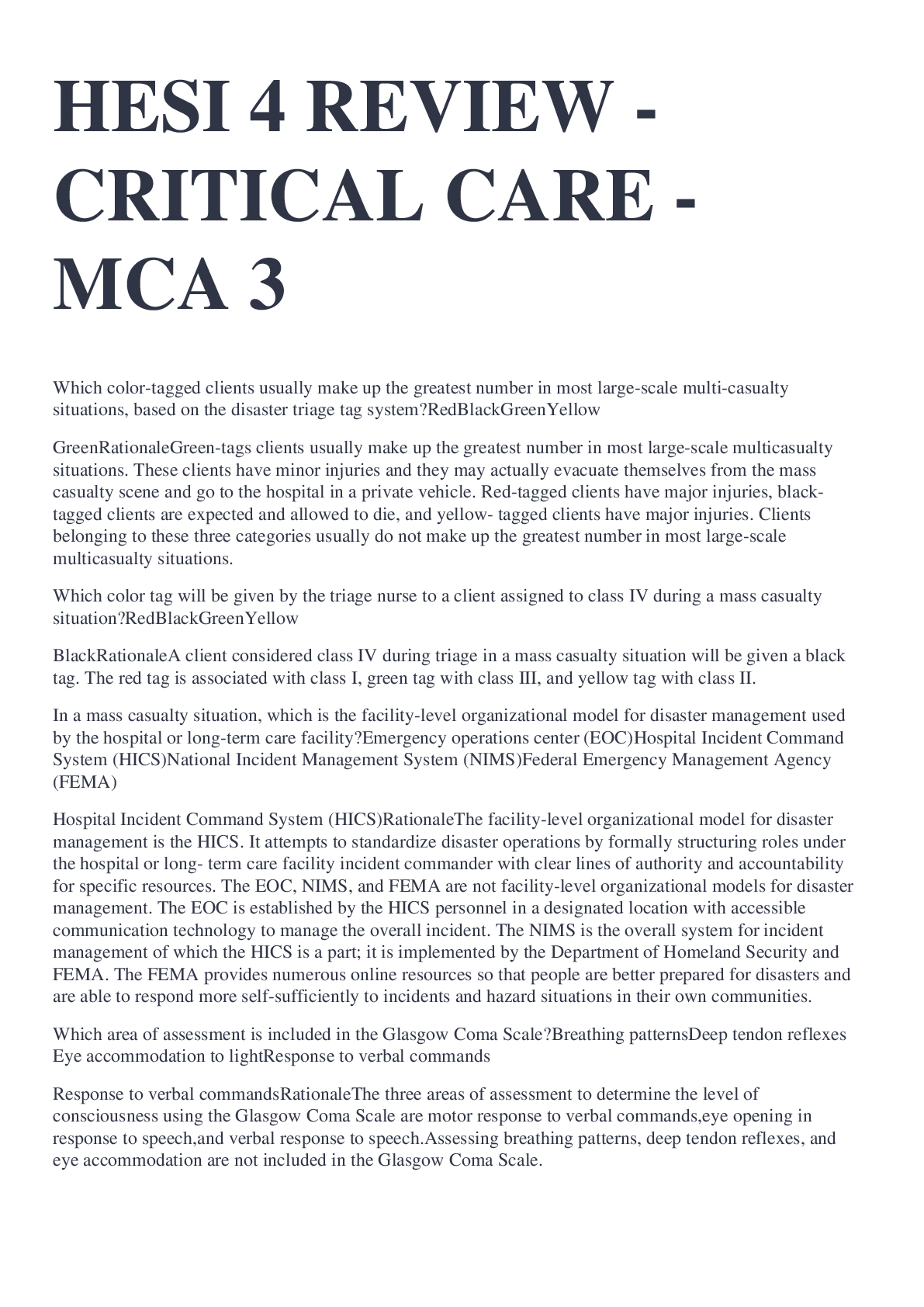
HESI 4 REVIEW - CRITICAL CARE - MCA 3 ANSWERED CORRECTLY WITH RATIONALES.Which color-tagged clients usually make up the greatest number in most large-scale multi-casualty situations, based on the disaster triage tag system?
Red
Black
Green
Yellow
Green
Rationale
Green-tags clients usually make up the greatest number in most large-scale multicasualty
situations. These clients have minor injuries and they may actually evacuate themselves from the mass casualty scene and go to the hospital in a private vehicle. Red-tagged clients have major injuries, black-tagged clients are expected and allowed to die, and yellow- tagged clients have major injuries. Clients belonging to these three categories usually do not make up the greatest number in most large-scale multicasualty situations.
Which color tag will be given by the triage nurse to a client assigned to class IV during a mass casualty situation?
Red
Black
Green
Yellow
Black
Rationale
A client considered class IV during triage in a mass casualty situation will be given a black tag. The red tag is associated with class I, green tag with class III, and yellow tag with class II.
In a mass casualty situation, which is the facility-level organizational model for disaster management used by the hospital or long-term care facility?
Emergency operations center (EOC)
Hospital Incident Command System (HICS)
National Incident Management System (NIMS)
Federal Emergency Management Agency (FEMA)
Hospital Incident Command System (HICS)
Rationale
The facility-level organizational model for disaster management is the HICS. It attempts to standardize disaster operations by formally structuring roles under the hospital or long- term care facility incident commander with clear lines of authority and accountability for specific resources. The EOC, NIMS, and FEMA are not facility-level organizational models for disaster management. The EOC is established by the HICS personnel in a designated location with accessible communication technology to manage the overall incident. The NIMS is the overall system for incident management of which the HICS is a part; it is implemented by the Department of Homeland Security and FEMA. The FEMA provides numerous online resources so that people are better prepared for disasters and are able to respond more self-sufficiently to incidents and hazard situations in their own communities.
Which area of assessment is included in the Glasgow Coma Scale?
Breathing patterns
Deep tendon reflexes
Eye accommodation to light
Response to verbal commands
Response to verbal commands
Rationale
The three areas of assessment to determine the level of consciousness using the Glasgow Coma Scale are motor response to verbal commands,
eye opening in response to speech,
and verbal response to speech.
Assessing breathing patterns, deep tendon reflexes, and eye accommodation are not included in the Glasgow Coma Scale.
A group of bomb blast victims needs to be transported to the hospital immediately. Which staff members of an emergency unit are most appropriate to handle this situation?
Triage officer
Medical command physician
Prehospital care providers
Emergency medicine physician
Prehospital care providers
Rationale
Prehospital care providers are the first caregivers who provide transport to the emergency department by ambulance or helicopter for clients in an emergency situation. Triage officers are responsible for evaluating each client to determine priorities for treatment. The medical command physician decides the number, acuity, and resource needs of clients. Emergency medicine health care providers have specialized education and training in emergency client management.
Which parameters would the nurse consider for proper rapid baseline assessment using a disability mnemonic (AVPU) in a client with drug abuse? Select all that apply. One, some, or all responses may be correct.
Level of anxiety
Reaction to pain
Response to voice
Body temperature
Evidence of assault
Reaction to pain
Response to voice
Rationale
The disability examination provides a rapid baseline assessment of neurological status. It helps evaluate level of consciousness by the AVPU mnemonic, which also helps assess the responsiveness to pain and voice. Level of anxiety is not assessed by a disability mnemonic. Body temperature and evidence of assault are assessed in a primary survey of exposure.
The postanesthesia care unit nurse providing care for a client who had a craniotomy for a meningioma would monitor for which specific clinical manifestation in this client?
Dehydration
Blurred vision
Wound infection
Narrowing pulse pressure
Blurred vision
Rationale
Blurred vision is a sign of increasing intracranial pressure, which may follow a craniotomy. Dehydration, wound infection, and narrowing pulse pressure require time to develop; these clinical manifestations will not be observable immediately after surgery. The pulse pressure widens with increased intracranial pressure.
[Show More]




.png)