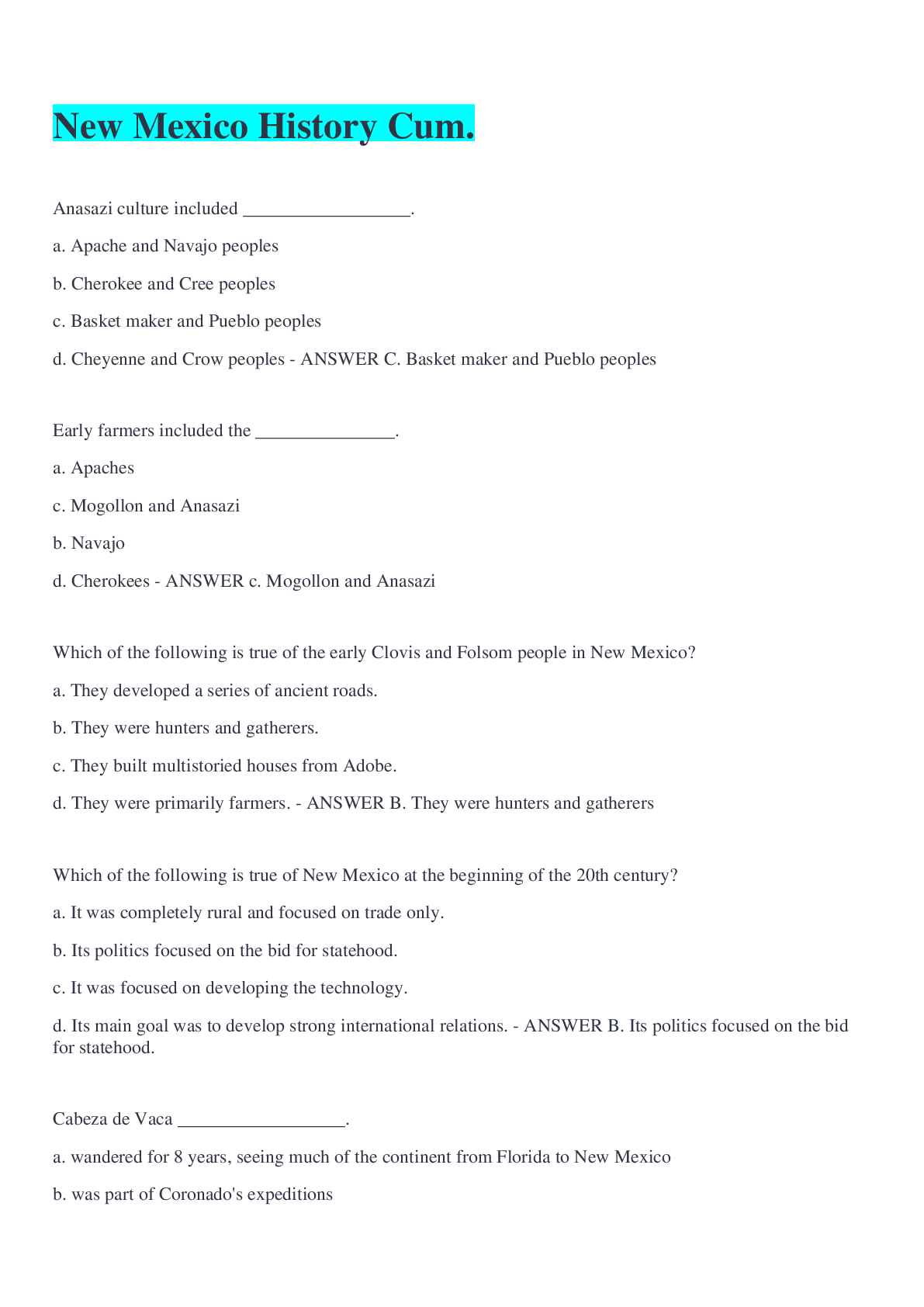
Identify the two recurring themes in New Mexico history. - ANSWER The living conditions of New Mexico are often inhospitable, and the people typically live in isolation.
The largest of New Mexico's land form provinces
...
Identify the two recurring themes in New Mexico history. - ANSWER The living conditions of New Mexico are often inhospitable, and the people typically live in isolation.
The largest of New Mexico's land form provinces is the - ANSWER Basin and Range.
The N.M. region has _______ important river systems. - ANSWER 5
Three-quarters of the moisture received in N.M. during an average years occurs during the the months of - ANSWER June-September.
In regards to elevation, N.M. is generally considered to be a land of - ANSWER high elevation.
Humans likely first arrived in N.M. some time between - ANSWER 12,000-8,000 years ago.
The ancestors of earliest native American peoples - ANSWER migrated by land across the Alaskan-Siberian land bridge.
The first humans to arrive in N.M. were primarily - ANSWER big game hunters.
Among the animals that early New Mexico inhabitants hunted were - ANSWER giant Bison.
Mastadons.
Mammoths.
All Of the above
The two prominent archaeological sites in N.M. for early humans can be found in what part of the state? - ANSWER eastern
As the early group of hunter's game became extinct, a new age of native inhabitants in N.M. after 8000 B.C. known as the - ANSWER Archaic period.
During the new emerging Desert Culture, the desert dwellers likely became early farmers sometime between - ANSWER 4,000-2,500 B.C.
The Mogollon Culture existed in - ANSWER Southwestern New Mexico.
The pre-pueblo people (Anasazi) began making above ground adobe structures during the - ANSWER Developmental Pueblo Culture.
By the time of the Developmental Pueblo Culture, the Anasazi were skilled at - ANSWER pottery making.
farming.
hunting with a bow and arrow.
The major cause for the decline of the pre-pueblo people (Anasazi) after 1100 A.D. was - ANSWER extended and persistent drought.
What were the three primary crops traditionally grown by Pueblo People? - ANSWER corn, beans, and squash
What were the purposes of the Pueblo Peoples' Kachina religious practices? - ANSWER to bring rain for crops and good health for people, just as many people pray for such things
The first of the Athabascan peoples in New Mexico to abandon complete nomadic life and become more settled were the - ANSWER Navajo.
The Manchus were originally forest dwellers in the northeastern region of China, known to westerners as - ANSWER Manchuria.
Who led the first Spanish expedition into the lands that are now New Mexico? - ANSWER Francisco Vasquez de Coronado
What originally led the first Spanish expedition to New Mexico? - ANSWER The legend of Seven Golden Cities of Cibola proclaimed by Fray Marcos de Niza.
Which of the following Spanish led expeditions to New Mexico in the 1580s and 1590s? - ANSWER Fray Agustin
Fray Bernadino stipends and congregated in castle towns of the daimyo or in Edo
Canstano de Sosa
The first but short lived Spanish "colony" or settlement in New Mexico in 1590 was located at - ANSWER Santa Domingo.
Why did Governor Don Pedro de Peralta—the second governor of New Mexico—move the capital of New Mexico from San Gabriel to Santa Fe? - ANSWER Peralta relocated to an area with a regular water source, ample land for cultivation, a more defensible location, and no Pueblo Indians in vicinity.
After the 1599 massacre of most of the citizens of Acoma Pueblo by Spanish soldiers and war dogs, the few surviving citizens were force marched to Santo Domingo - what happened to the survivors? - ANSWER sixty girls were permanently separated from their parents and family members to be sold 2000 miles south into slavery, twelve more children were given to Spanish priests, adults became slaves for twenty years, and the men among them had part of one foot cut off.
During the first decades of Spanish colonization and settlement, the Native Americans primary contact with Spanish culture came through the - ANSWER Spanish Catholic Missions.
The Spanish system of labor and tribute that subjected natives to Spanish law and created hardship and near slavery was the - ANSWER Encomienda.
The Native Pueblo Peoples in New Mexico suffered terribly in New Mexico during the mid-1600s from - ANSWER all the above.
As a result of a native revolt and a decisive Spanish defeat at the hands of the Pueblo forces led by Pope in 1680, - ANSWER the Spanish were driven from New Mexico for 12 years, while initially Native leadership under Pope sought to wipe out Spanish influence and culture.
During Don Diego de Vargas' first expedition to reconquer New Mexico in 1692, - ANSWER de Vargas was able to conduct a reasonably peaceful expedition that retook Santa Fe and received native pledges of loyalty with only two casualties.
What was one of the consequences of Spanish reconquest and colonization of the Pueblo Nations of the Rio Grande Valley after 1691? - ANSWER The Spanish continued to spread smallpox and other diseases, while increasing pressure was put upon the Pueblos by nomadic Navajo, Apache and other raiders.
The Pueblo Peoples lost several thousand residents who left to live with the Hopi rather than submit to Spanish rule.
The Spanish became more tolerant of native religion and no longer raided Kivas or destroyed objects of Pueblo faith.
After the Pueblo Revolt, with the Spanish gone, the new availability of this animal changed the nature of life for both Pueblo Nations, and especially the Nomadic Tribes. - ANSWER Horses
During the 1700s, the Spanish population in New Mexico - ANSWER grew steadily and by 1800 had doubled several times over to a number of 10,000 residents.
After 1700, which of the following Nomadic Native tribes created havoc and destruction in both Pueblo and Spanish settlements in New Mexico? - ANSWER Apache
Navajo
Comanche
Spanish hegemony seemed secure in New Mexico until what new threat emerged in 1803? - ANSWER The United Sates gained the Louisiana Purchase.
[Show More]










![Preview of THE TEFL ACADEMY LEVEL 5 - ASSIGNMENT C - AUTHENTIC MATERIAL [2026]](https://browseimages.nyc3.digitaloceanspaces.com/paper-images/2026/04/10/HpVkRcWV2026-04-10-11-5769d96426bd64f.png)