HOME WORK QUESTIONS
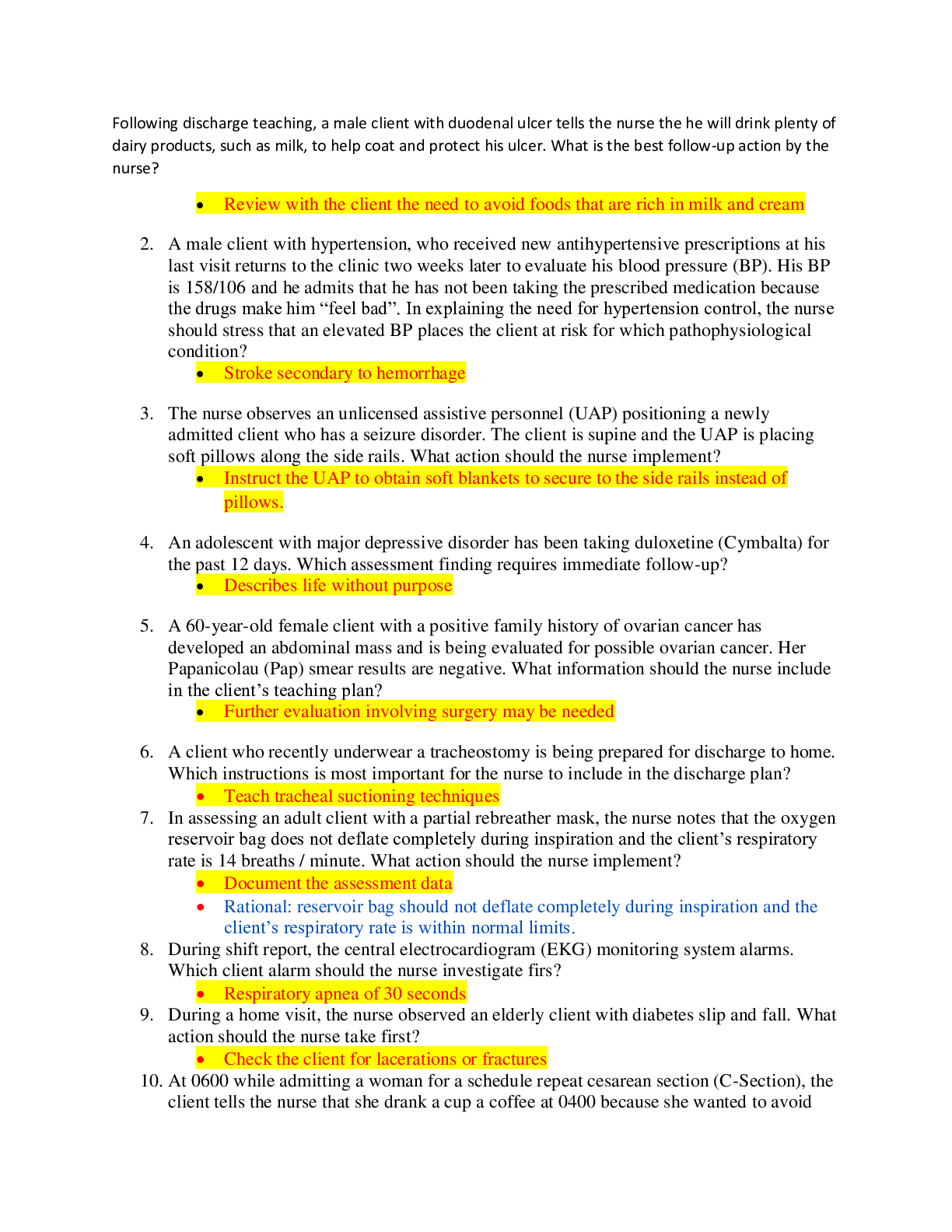
1. The student nurse studying the gastrointestinal system understands that chyme refers to what?
a. Hormones that reduce gastric acidity
b. Liquefied food ready for digestion
c. Nutrients after
...
HOME WORK QUESTIONS
1. The student nurse studying the gastrointestinal system understands that chyme refers to what?
a. Hormones that reduce gastric acidity
b. Liquefied food ready for digestion
c. Nutrients after being absorbed
d. Secretions that help digest food
2. A client scheduled for a percutaneous transhepatic cholangiography (PTC) denies allergies to medication. What action by the nurse is best?
a. Ask the client about shellfish allergies.
b. Document this information on the chart.
c. Ensure that the client has a ride home.
d. Instruct the client on bowel preparation.
3. A client is having an esophagogastroduodenoscopy (EGD) and has been given midazolam hydrochloride (Versed). The client’s respiratory rate is 8 breaths/min. What action by the nurse is best?
a. Administer naloxone (Narcan).
b. Call the Rapid Response Team.
c. Provide physical stimulation.
d. Ventilate with a bag-valve-mask.
4. A client is scheduled for a colonoscopy and the nurse has provided instructions on the bowel cleansing regimen. What statement by the client indicates a need for further teaching?
a. “It’s a good thing I love orange and cherry gelatin.”
b. “My spouse will be here to drive me home.”
c. “I should refrigerate the GoLYTELY before use.”
d. “I will buy a case of Gatorade before the prep.”
5. A client had a colonoscopy and biopsy yesterday and calls the gastrointestinal clinic to report a spot of bright red blood on the toilet paper today. What response by the nurse is best?
a. Ask the client to call back if this happens again today.
b. Instruct the client to go to the emergency department.
c. Remind the client that a small amount of bleeding is possible.
d. Tell the client to come in to the clinic this afternoon.
6. An older client has had an instance of drug toxicity and asks why this happens, since the client has been on this medication for years at the same dose. What response by the nurse is best?
a. “Changes in your liver cause drugs to be metabolized differently.”
b. “Perhaps you don’t need as high a dose of the drug as before.”
c. “Stomach muscles atrophy with age and you digest more slowly.”
d. “Your body probably can’t tolerate as much medication anymore.”
7. To promote comfort after a colonoscopy, in what position does the nurse place the client?
a. Left lateral
b. Prone
c. Right lateral
d. Supine
8. A nurse is examining a client reporting right upper quadrant (RUQ) abdominal pain. What technique should the nurse use to assess this client’s abdomen?
a. Auscultate after palpating.
b. Avoid any palpation.
c. Palpate the RUQ first.
d. Palpate the RUQ last.
9. A client presents to the emergency department reporting severe abdominal pain. On assessment, the nurse finds a bulging, pulsating mass in the abdomen. What action by the nurse is the priority?
a. Auscultate for bowel sounds.
b. Notify the provider immediately.
c. Order an abdominal flat-plate x-ray.
d. Palpate the mass and measure its size.
10. A client presents to the family practice clinic reporting a week of watery, somewhat bloody diarrhea. The nurse assists the client to obtain a stool sample. What action by the nurse is most important?
a. Ask the client about recent exposure to illness.
b. Assess the client’s stool for obvious food particles.
c. Include the date and time on the specimen container.
d. Put on gloves prior to collecting the sample.
11. A client who has been taking antibiotics reports severe, watery diarrhea. About which test does the nurse teach the client?
a. Colonoscopy
b. Enzyme-linked immunosorbent assay (ELISA) toxin A+B
c. Ova and parasites
d. Stool culture
12. The nurse knows that a client with prolonged prothrombin time (PT) values (not related to medication) probably has dysfunction in which organ?
a. Kidneys
b. Liver
c. Spleen
d. Stomach
13. A client is recovering from an esophagogastroduodenoscopy (EGD) and requests something to drink. What action by the nurse is best?
a. Allow the client cool liquids only.
b. Assess the client’s gag reflex.
c. Remind the client to remain NPO.
d. Tell the client to wait 4 hours.
1. The nurse is aware of the 2014 American Cancer Society Screening Guidelines for colon cancer, which include which testing modalities for people over the age of 50? (Select all that apply.)
a. Colonoscopy every 10 years
b. Colonoscopy every 5 years
c. Computed tomography (CT) colonography every 5 years
d. Double-contrast barium enema every 10 years
e. Flexible sigmoidoscopy every 10 years
2. A client had an endoscopic retrograde cholangiopancreatography (ERCP). The nurse instructs the client and family about the signs of potential complications, which include what problems? (Select all that apply.)
a. Cholangitis
b. Pancreatitis
c. Perforation
d. Renal lithiasis
e. Sepsis
3. The nurse working with older clients understands age-related changes in the gastrointestinal system. Which changes does this include? (Select all that apply.)
a. Decreased hydrochloric acid production
b. Diminished sensation that can lead to constipation
c. Fat not digested as well in older adults
d. Increased peristalsis in the large intestine
e. Pancreatic vessels become calcified
4. The nurse working in the gastrointestinal clinic sees clients who are anemic. What are common causes for which the nurse assesses in these clients? (Select all that apply.)
a. Colon cancer
b. Diverticulitis
c. Inflammatory bowel disease
d. Peptic ulcer disease
e. Pernicious anemia
5. The nurse working with clients who have gastrointestinal problems knows that which laboratory values are related to what organ dysfunctions? (Select all that apply.)
a. Alanine aminotransferase: biliary system
b. Ammonia: liver
c. Amylase: liver
d. Lipase: pancreas
e. Urine urobilinogen: stomach
53
1. A student nurse is providing care to an older client with stomatitis and dysphagia. What action by the student nurse requires the registered nurse to intervene?
a. Assisting the client to perform oral care every 2 hours
b. Preparing to administer a viscous lidocaine gargle
c. Reminding the client not to swallow nystatin (Mycostatin)
d. Teaching the client to use a soft-bristled toothbrush
2. A client has a large oral tumor. What assessment by the nurse takes priority?
a. Airway
b. Breathing
c. Circulation
d. Nutrition
3. A female client hospitalized for an unrelated problem has a large pearly-white lesion on her lip, to which she continues to apply lipstick that she will not remove for inspection. The client refuses to discuss the lesion with the nurse or health care provider. What action by the nurse is best?
a. Ask the client why her appearance is so important.
b. Ignore the lesion since the client will not discuss it.
c. Inform the client that early-stage cancer is curable.
d. Work with the client to establish a trusting relationship.
4. A nurse has conducted a community screening event for oral cancer. What client is the highest priority for referral to a dentist?
a. Client who has poor oral hygiene practices
b. Client who smokes and drinks daily
c. Client who tans for an upcoming vacation
d. Client who occasionally uses illicit drugs
5. The nurse reads a client’s chart and sees that the health care provider assessed mucosal erythroplasia. What should the nurse understand that this means for the client?
a. Early sign of oral cancer
b. Fungal mouth infection
c. Inflammation of the gums
d. Obvious oral tumor
6. A client is having a temporary tracheostomy placed during surgery for oral cancer. What action by the nurse is best to relieve anxiety?
a. Agree on a postoperative communication method.
b. Explain that staff will answer the call light promptly.
c. Give the client a Magic Slate to write on postoperatively.
d. Reassure the client that you will take care of all of his or her needs.
7. A nurse is caring for four clients. After receiving the hand-off report, which client should the nurse see first?
a. Client having a radial neck dissection tomorrow who is asking questions
b. Client who had a tracheostomy 4 hours ago and needs frequent suctioning
c. Client who is 1 day postoperative for an oral tumor resection who is reporting pain
d. Client waiting for discharge instructions after a small tumor resection
8. A client is prescribed cetuximab (Erbitux) for oral cancer and asks the nurse how it works. What response by the nurse is best?
a. “It blocks epidermal growth factor.”
b. “It cuts off the tumor’s blood supply.”
c. “It prevents tumor extension.”
d. “It targets rapidly dividing cells.”
9. A client had an oral tumor removed this morning and now has a tracheostomy. What action by the nurse is the priority?
a. Delegate oral care every 4 hours.
b. Monitor and record the client’s intake.
c. Place the client in a high-Fowler’s position.
d. Remove the inner cannula for cleaning.
10. A nurse assesses a client’s oral cavity and observes the condition depicted in the photo below:
What action by the nurse is best?
a. Ask about the client’s human immunodeficiency virus (HIV) status.
b. Assess the client for dysphagia.
c. Listen to the client’s lung sounds.
d. Refer the client to an oncologist.
MULTIPLE RESPONSE
1. The nurse is caring for a client with sialadenitis. What comfort measures may the nurse delegate to the unlicensed assistive personnel (UAP)? (Select all that apply.)
a. Applying warm compresses
b. Massaging salivary glands
c. Offering fluids every hour
d. Providing lemon-glycerin swabs
e. Reminding the client to avoid speaking
2. A nurse studying cancer knows that job-related risks for developing oral cancer include which occupations? (Select all that apply.)
a. Coal miner
b. Electrician
c. Metal worker
d. Plumber
e. Textile worker
Ch 57
1. A nurse assesses a client who has appendicitis. Which clinical manifestation should the nurse expect to find?
a. Severe, steady right lower quadrant pain
b. Abdominal pain associated with nausea and vomiting
c. Marked peristalsis and hyperactive bowel sounds
d. Abdominal pain that increases with knee flexion
2. A nurse cares for an older adult client who has Salmonella food poisoning. The client’s vital signs are heart rate: 102 beats/min, blood pressure: 98/55 mm Hg, respiratory rate: 22 breaths/min, and oxygen saturation: 92%. Which action should the nurse complete first?
a. Apply oxygen via nasal cannula.
b. Administer intravenous fluids.
c. Provide perineal care with a premedicated wipe.
d. Teach proper food preparation to prevent contamination.
3. A nurse teaches a client who has viral gastroenteritis. Which dietary instruction should the nurse include in this client’s teaching?
a. “Drink plenty of fluids to prevent dehydration.”
b. “You should only drink 1 liter of fluids daily.”
c. “Increase your protein intake by drinking more milk.”
d. “Sips of cola or tea may help to relieve your nausea.”
4. After teaching a client who was hospitalized for Salmonella food poisoning, a nurse assesses the client’s understanding. Which statement made by the client indicates a need for additional teaching?
a. “I will let my husband do all of the cooking for my family.”
b. “I’ll take the ciprofloxacin until the diarrhea has resolved.”
c. “I should wash my hands with antibacterial soap before each meal.”
d. “I must place my dishes into the dishwasher after each meal.”
5. A nurse assesses a client who is hospitalized with an exacerbation of Crohn’s disease. Which clinical manifestation should the nurse expect to find?
a. Positive Murphy’s sign with rebound tenderness to palpitation
b. Dull, hypoactive bowel sounds in the lower abdominal quadrants
c. High-pitched, rushing bowel sounds in the right lower quadrant
d. Reports of abdominal cramping that is worse at night
6. After teaching a client with diverticular disease, a nurse assesses the client’s understanding. Which menu selection made by the client indicates the client correctly understood the teaching?
a. Roasted chicken with rice pilaf and a cup of coffee with cream
b. Spaghetti with meat sauce, a fresh fruit cup, and hot tea
c. Garden salad with a cup of bean soup and a glass of low-fat milk
d. Baked fish with steamed carrots and a glass of apple juice
7. A nurse cares for a teenage girl with a new ileostomy. The client states, “I cannot go to prom with an ostomy.” How should the nurse respond?
a. “Sure you can. Purchase a prom dress one size larger to hide the ostomy appliance.”
b. “The pouch won’t be as noticeable if you avoid broccoli and carbonated drinks prior to the prom.”
c. “Let’s talk to the enterostomal therapist about options for ostomy supplies and dress styles.”
d. “You can remove the pouch from your ostomy appliance when you are at the prom so that it is less noticeable.”
8. After teaching a client with perineal excoriation caused by diarrhea from acute gastroenteritis, a nurse assesses the client’s understanding. Which statement by the client indicates a need for additional teaching?
a. “I’ll rinse my rectal area with warm water after each stool and apply zinc oxide ointment.”
b. “I will clean my rectal area thoroughly with toilet paper after each stool and then apply aloe vera gel.”
c. “I must take a sitz bath three times a day and then pat my rectal area gently but thoroughly to make sure I am dry.”
d. “I shall clean my rectal area with a soft cotton washcloth and then apply vitamin A and D ointment.”
9. After teaching a client who is prescribed adalimumab (Humira) for severe ulcerative colitis, the nurse assesses the client’s understanding. Which statement made by the client indicates a need for additional teaching?
a. “I will avoid large crowds and people who are sick.”
b. “I will take this medication with my breakfast each morning.”
c. “Nausea and vomiting are common side effects of this drug.”
d. “I must wash my hands after I play with my dog.”
10. A nurse cares for a client who is prescribed mesalamine (Asacol) for ulcerative colitis. The client states, “I am having trouble swallowing this pill.” Which action should the nurse take?
a. Contact the clinical pharmacist and request the medication in suspension form.
b. Empty the contents of the capsule into applesauce or pudding for administration.
c. Ask the health care provider to prescribe the medication as an enema instead.
d. Crush the pill carefully and administer it in applesauce or pudding.
11. A nurse assesses a client who has ulcerative colitis and severe diarrhea. Which assessment should the nurse complete first?
a. Inspection of oral mucosa
b. Recent dietary intake
c. Heart rate and rhythm
d. Percussion of abdomen
12. A nurse assesses a client with Crohn’s disease and colonic strictures. Which clinical manifestation should alert the nurse to urgently contact the health care provider?
a. Distended abdomen
b. Temperature of 100.0° F (37.8° C)
c. Loose and bloody stool
d. Lower abdominal cramps
13. A nurse reviews the chart of a client who has Crohn’s disease and a draining fistula. Which documentation should alert the nurse to urgently contact the provider for additional prescriptions?
a. Serum potassium of 2.6 mEq/L
b. Client ate 20% of breakfast meal
c. White blood cell count of 8200/mm3
d. Client’s weight decreased by 3 pounds
14. After teaching a client who has a new colostomy, the nurse provides feedback based on the client’s ability to complete self-care activities. Which statement should the nurse include in this feedback?
a. “I realize that you had a tough time today, but it will get easier with practice.”
b. “You cleaned the stoma well. Now you need to practice putting on the appliance.”
c. “You seem to understand what I taught you today. What else can I help you with?”
d. “You seem uncomfortable. Do you want your daughter to care for your ostomy?”
15. A nurse assesses a client who is hospitalized for botulism. The client’s vital signs are temperature: 99.8° F (37.6° C), heart rate: 100 beats/min, respiratory rate: 10 breaths/min, and blood pressure: 100/62 mm Hg. Which action should the nurse take?
a. Decrease stimulation and allow the client to rest.
b. Stay with the client while another nurse calls the provider.
c. Increase the client’s intravenous fluid replacement rate.
d. Check the client’s blood glucose and administer orange juice.
16. After teaching a client who has diverticulitis, a nurse assesses the client’s understanding. Which statement made by the client indicates a need for additional teaching?
a. “I’ll ride my bike or take a long walk at least three times a week.”
b. “I must try to include at least 25 grams of fiber in my diet every day.”
c. “I will take a laxative nightly at bedtime to avoid becoming constipated.”
d. “I should use my legs rather than my back muscles when I lift heavy objects.”
17. A nurse cares for a client who has a Giardia infection. Which medication should the nurse anticipate being prescribed for this client?
a. Metronidazole (Flagyl)
b. Ciprofloxacin (Cipro)
c. Sulfasalazine (Azulfidine)
d. Ceftriaxone (Rocephin)
18. A nurse cares for a client who has food poisoning resulting from a Clostridium botulinum infection. Which assessment should the nurse complete first?
a. Heart rate and rhythm
b. Bowel sounds
c. Urinary output
d. Respiratory rate
19. A nurse plans care for a client with Crohn’s disease who has a heavily draining fistula. Which intervention should the nurse indicate as the priority action in this client’s plan of care?
a. Low-fiber diet
b. Skin protection
c. Antibiotic administration
d. Intravenous glucocorticoids
20. A nurse assesses a client who is recovering from an ileostomy placement. Which clinical manifestation should alert the nurse to urgently contact the health care provider?
a. Pale and bluish stoma
b. Liquid stool
c. Ostomy pouch intact
d. Blood-smeared output
21. A nurse cares for a client with a new ileostomy. The client states, “I don’t think my friends will accept me with this ostomy.” How should the nurse respond?
a. “Your friends will be happy that you are alive.”
b. “Tell me more about your concerns.”
c. “A therapist can help you resolve your concerns.”
d. “With time you will accept your new body.”
22. A nurse cares for a client with ulcerative colitis. The client states, “I feel like I am tied to the toilet. This disease is controlling my life.” How should the nurse respond?
a. “Let’s discuss potential factors that increase your symptoms.”
b. “If you take the prescribed medications, you will no longer have diarrhea.”
c. “To decrease distress, do not eat anything before you go out.”
d. “You must retake control of your life. I will consult a therapist to help.”
MULTIPLE RESPONSE
1. After teaching a client with a parasitic gastrointestinal infection, a nurse assesses the client’s understanding. Which statements made by the client indicate that the client correctly understands the teaching? (Select all that apply.)
a. “I’ll have my housekeeper keep my toilet clean.”
b. “I must take a shower or bathe every day.”
c. “I should have my well water tested.”
d. “I will ask my sexual partner to have a stool test.”
e. “I must only eat raw vegetables from my own garden.”
2. A nurse teaches a client how to avoid becoming ill with Salmonella infection again. Which statements should the nurse include in this client’s teaching? (Select all that apply.)
a. “Wash leafy vegetables carefully before eating or cooking them.”
b. “Do not ingest water from the garden hose or the pool.”
c. “Wash your hands before and after using the bathroom.”
d. “Be sure meat is cooked to the proper temperature.”
e. “Avoid eating eggs that are sunny side up or undercooked.”
3. A nurse teaches a community group ways to prevent Escherichia coli infection. Which statements should the nurse include in this group’s teaching? (Select all that apply.)
a. “Wash your hands after any contact with animals.”
b. “It is not necessary to buy a meat thermometer.”
c. “Stay away from people who are ill with diarrhea.”
d. “Use separate cutting boards for meat and vegetables.”
e. “Avoid swimming in backyard pools and using hot tubs.”
4. A nurse teaches a community group about food poisoning and gastroenteritis. Which statements should the nurse include in this group’s teaching? (Select all that apply.)
a. “Rotavirus is more common among infants and younger children.”
b. “Escherichia coli diarrhea is transmitted by contact with infected animals.”
c. “To prevent E. coli infection, don’t drink water when swimming.”
d. “Clients who have botulism should be quarantined within their home.”
e. “Parasitic diseases may not show up for 1 to 2 weeks after infection.”
5. After teaching a client with an anal fissure, a nurse assesses the client’s understanding. Which client actions indicate that the client correctly understands the teaching? (Select all that apply.)
a. Taking a warm sitz bath several times each day
b. Utilizing a daily enema to prevent constipation
c. Using bulk-producing agents to aid elimination
d. Self-administering anti-inflammatory suppositories
e. Taking a laxative each morning
6. A nurse assesses a client with peritonitis. Which clinical manifestations should the nurse expect to find? (Select all that apply.)
a. Distended abdomen
b. Inability to pass flatus
c. Bradycardia
d. Hyperactive bowel sounds
e. Decreased urine output
7. A nurse assesses a client with ulcerative colitis. Which complications are paired correctly with their physiologic processes? (Select all that apply.)
a. Lower gastrointestinal bleeding – Erosion of the bowel wall
b. Abscess formation – Localized pockets of infection develop in the ulcerated bowel lining
c. Toxic megacolon – Transmural inflammation resulting in pyuria and fecaluria
d. Nonmechanical bowel obstruction – Paralysis of colon resulting from colorectal cancer
e. Fistula – Dilation and colonic ileus caused by paralysis of the colon
1. A nurse cares for a client who is prescribed 5 mg/kg of infliximab (Remicade) intravenously. The client weighs 110 lbs and the pharmacy supplies infliximab 100 mg/10 mL solution. How many milliliters should the nurse administer to this client? (Record your answer using a whole number.) ____ mL
MULTIPLE CHOICE
1. The nurse is caring for a client with peptic ulcer disease who reports sudden onset of sharp abdominal pain. On palpation, the client’s abdomen is tense and rigid. What action takes priority?
a. Administer the prescribed pain medication.
b. Notify the health care provider immediately.
c. Percuss all four abdominal quadrants.
d. Take and document a set of vital signs.
2. A client has a pyloric obstruction and reports sudden muscle weakness. What action by the nurse takes priority?
a. Document the findings in the chart.
b. Request an electrocardiogram (ECG).
c. Facilitate a serum potassium test.
d. Place the client on bedrest.
3. A client with peptic ulcer disease is in the emergency department and reports the pain has gotten much worse over the last several days. The client’s blood pressure when lying down was 122/80 mm Hg and when standing was 98/52 mm Hg. What action by the nurse is most appropriate?
a. Administer ibuprofen (Motrin).
b. Call the Rapid Response Team.
c. Start a large-bore IV with normal saline.
d. Tell the client to remain lying down.
4. A client with a bleeding gastric ulcer is having a nuclear medicine scan. What action by the nurse is most appropriate?
a. Assess the client for iodine or shellfish allergies.
b. Educate the client on the side effects of sedation.
c. Inform the client a second scan may be needed.
d. Teach the client about bowel preparation for the scan.
5. A client is being taught about drug therapy for Helicobacter pylori infection. What assessment by the nurse is most important?
a. Alcohol intake of 1 to 2 drinks per week
b. Family history of H. pylori infection
c. Former smoker still using nicotine patches
d. Willingness to adhere to drug therapy
6. An older female client has been prescribed esomeprazole (Nexium) for treatment of chronic gastric ulcers. What teaching is particularly important for this client?
a. Check with the pharmacist before taking other medications.
b. Increase intake of calcium and vitamin D.
c. Report any worsening of symptoms to the provider.
d. Take the medication as prescribed by the provider.
7. The nurse caring for clients with gastrointestinal disorders should understand that which category best describes the mechanism of action of sucralfate (Carafate)?
a. Gastric acid inhibitor
b. Histamine receptor blocker
c. Mucosal barrier fortifier
d. Proton pump inhibitor
8. A nurse answers a client’s call light and finds the client in the bathroom, vomiting large amounts of bright red blood. Which action should the nurse take first?
a. Assist the client back to bed.
b. Notify the provider immediately.
c. Put on a pair of gloves.
d. Take a set of vital signs.
9. A client had an upper gastrointestinal hemorrhage and now has a nasogastric (NG) tube. What comfort measure may the nurse delegate to the unlicensed assistive personnel (UAP)?
a. Lavaging the tube with ice water
b. Performing frequent oral care
c. Re-positioning the tube every 4 hours
d. Taking and recording vital signs
10. A client is scheduled for a total gastrectomy for gastric cancer. What preoperative laboratory result should the nurse report to the surgeon immediately?
a. Albumin: 2.1 g/dL
b. Hematocrit: 28%
c. Hemoglobin: 8.1 mg/dL
d. International normalized ratio (INR): 4.2
11. A client has a recurrence of gastric cancer and is in the gastrointestinal clinic crying. What response by the nurse is most appropriate?
a. “Do you have family or friends for support?”
b. “I’d like to know what you are feeling now.”
c. “Well, we knew this would probably happen.”
d. “Would you like me to refer you to hospice?”
12. A client with peptic ulcer disease asks the nurse about taking slippery elm supplements. What response by the nurse is best?
a. “Slippery elm has no benefit for this problem.”
b. “Slippery elm is often used for this disorder.”
c. “There is no evidence that this will work.”
d. “You should not take any herbal remedies.”
13. A nurse is teaching a client about magnesium hydroxide with aluminum hydroxide (Maalox). What instruction is most appropriate?
a. “Aspirin must be avoided.”
b. “Do not worry about black stools.”
c. “Report diarrhea to your provider.”
d. “Take 1 hour before meals.”
14. For which client would the nurse suggest the provider not prescribe misoprostol (Cytotec)?
a. Client taking antacids
b. Client taking antibiotics
c. Client who is pregnant
d. Client over 65 years of age
15. A client has dumping syndrome after a partial gastrectomy. Which action by the nurse would be most helpful?
a. Arrange a dietary consult.
b. Increase fluid intake.
c. Limit the client’s foods.
d. Make the client NPO.
16. An older client has gastric cancer and is scheduled to have a partial gastrectomy. The family does not want the client told about her diagnosis. What action by the nurse is best?
a. Ask the family why they feel this way.
b. Assess family concerns and fears.
c. Refuse to go along with the family’s wishes.
d. Tell the family that such secrets cannot be kept.
MULTIPLE RESPONSE
1. The student nurse studying stomach disorders learns that the risk factors for acute gastritis include which of the following? (Select all that apply.)
a. Alcohol
b. Caffeine
c. Corticosteroids
d. Fruit juice
e. Nonsteroidal anti-inflammatory drugs (NSAIDs)
2. A client has a gastrointestinal hemorrhage and is prescribed two units of packed red blood cells. What actions should the nurse perform prior to hanging the blood? (Select all that apply.)
a. Ask a second nurse to double-check the blood.
b. Prime the IV tubing with normal saline.
c. Prime the IV tubing with dextrose in water.
d. Take and record a set of vital signs.
e. Teach the client about reaction manifestations.
3. The student nurse learns about risk factors for gastric cancer. Which factors does this include? (Select all that apply.)
a. Achlorhydria
b. Chronic atrophic gastritis
c. Helicobacter pylori infection
d. Iron deficiency anemia
e. Pernicious anemia
4. A client has dumping syndrome. What menu selections indicate the client understands the correct diet to manage this condition? (Select all that apply.)
a. Canned unsweetened apricots
b. Coffee cake
c. Milk shake
d. Potato soup
e. Steamed broccoli
5. A nurse working with a client who has possible gastritis assesses the client’s gastrointestinal system. Which findings indicate a chronic condition as opposed to acute gastritis? (Select all that apply.)
a. Anorexia
b. Dyspepsia
c. Intolerance of fatty foods
d. Pernicious anemia
e. Nausea and vomiting
6. A client who had a partial gastrectomy has several expected nutritional problems. What actions by the nurse are best to promote better nutrition? (Select all that apply.)
a. Administer vitamin B12 injections.
b. Ask the provider about folic acid replacement.
c. Educate the client on enteral feedings.
d. Obtain consent for total parenteral nutrition.
e. Provide iron supplements for the client.
7. A nurse is preparing to administer pantoprazole (Protonix) intravenously. What actions by the nurse are most appropriate? (Select all that apply.)
a. Administer the drug through a separate IV line.
b. Infuse pantoprazole using an IV pump.
c. Keep the drug in its original brown bag.
d. Take vital signs frequently during infusion.
e. Use an in-line IV filter when infusing.
and frequent vital signs are not needed.
CH 56
1. After teaching a client with irritable bowel syndrome (IBS), a nurse assesses the client’s understanding. Which menu selection indicates that the client correctly understands the dietary teaching?
a. Ham sandwich on white bread, cup of applesauce, glass of diet cola
b. Broiled chicken with brown rice, steamed broccoli, glass of apple juice
c. Grilled cheese sandwich, small banana, cup of hot tea with lemon
d. Baked tilapia, fresh green beans, cup of coffee with low-fat milk
2. A nurse assesses a client who is prescribed alosetron (Lotronex). Which assessment question should the nurse ask this client?
a. “Have you been experiencing any constipation?”
b. “Are you eating a diet high in fiber and fluids?”
c. “Do you have a history of high blood pressure?”
d. “What vitamins and supplements are you taking?”
3. After teaching a client who has a femoral hernia, the nurse assesses the client’s understanding. Which statement indicates the client needs additional teaching related to the proper use of a truss?
a. “I will put on the truss before I go to bed each night.”
b. “I’ll put some powder under the truss to avoid skin irritation.”
c. “The truss will help my hernia because I can’t have surgery.”
d. “If I have abdominal pain, I’ll let my health care provider know right away.”
4. A nurse assesses a client who is recovering from a hemorrhoidectomy that was done the day before. The nurse notes that the client has lower abdominal distention accompanied by dullness to percussion over the distended area. Which action should the nurse take?
a. Assess the client’s heart rate and blood pressure.
b. Determine when the client last voided.
c. Ask if the client is experiencing flatus.
d. Auscultate all quadrants of the client’s abdomen.
5. A nurse assesses clients at a community health center. Which client is at highest risk for the development of colorectal cancer?
a. A 37-year-old who drinks eight cups of coffee daily
b. A 44-year-old with irritable bowel syndrome (IBS)
c. A 60-year-old lawyer who works 65 hours per week
6. A nurse assessing a client with colorectal cancer auscultates high-pitched bowel sounds and notes the presence of visible peristaltic waves. Which action should the nurse take?
a. Ask if the client is experiencing pain in the right shoulder.
b. Perform a rectal examination and assess for polyps.
c. Contact the provider and recommend computed tomography.
d. Administer a laxative to increase bowel movement activity.
7. A nurse prepares a client for a colonoscopy scheduled for tomorrow. The client states, “My doctor told me that the fecal occult blood test was negative for colon cancer. I don’t think I need the colonoscopy and would like to cancel it.” How should the nurse respond?
a. “Your doctor should not have given you that information prior to the colonoscopy.”
b. “The colonoscopy is required due to the high percentage of false negatives with the blood test.”
c. “A negative fecal occult blood test does not rule out the possibility of colon cancer.”
d. “I will contact your doctor so that you can discuss your concerns about the procedure.”
8. A nurse cares for a client newly diagnosed with colon cancer who has become withdrawn from family members. Which action should the nurse take?
a. Contact the provider and recommend a psychiatric consult for the client.
b. Encourage the client to verbalize feelings about the diagnosis.
c. Provide education about new treatment options with successful outcomes.
d. Ask family and friends to visit the client and provide emotional support.
9. A nurse cares for a client with colon cancer who has a new colostomy. The client states, “I think it would be helpful to talk with someone who has had a similar experience.” How should the nurse respond?
a. “I have a good friend with a colostomy who would be willing to talk with you.”
b. “The enterostomal therapist will be able to answer all of your questions.”
c. “I will make a referral to the United Ostomy Associations of America.”
d. “You’ll find that most people with colostomies don’t want to talk about them.”
10. An emergency room nurse assesses a client after a motor vehicle crash and notes ecchymotic areas across the client’s lower abdomen. Which action should the nurse take first?
a. Measure the client’s abdominal girth.
b. Assess for abdominal guarding or rigidity.
c. Check the client’s hemoglobin and hematocrit.
d. Obtain the client’s complete health history.
11. A nurse cares for a client who states, “My husband is repulsed by my colostomy and refuses to be intimate with me.” How should the nurse respond?
a. “Let’s talk to the ostomy nurse to help you and your husband work through this.”
b. “You could try to wear longer lingerie that will better hide the ostomy appliance.”
c. “You should empty the pouch first so it will be less noticeable for your husband.”
d. “If you are not careful, you can hurt the stoma if you engage in sexual activity.”
12. A nurse cares for a client who is recovering from a hemorrhoidectomy. The client states, “I need to have a bowel movement.” Which action should the nurse take?
a. Obtain a bedside commode for the client to use.
b. Stay with the client while providing privacy.
c. Make sure the call light is in reach to signal completion.
d. Gather supplies to collect a stool sample for the laboratory.ANS: B
13. An emergency room nurse cares for a client who has been shot in the abdomen and is hemorrhaging heavily. Which action should the nurse take first?
a. Send a blood sample for a type and crossmatch.
b. Insert a large intravenous line for fluid resuscitation.
c. Obtain the heart rate and blood pressure.
d. Assess and maintain a patent airway.
14. A nurse assesses a client with a mechanical bowel obstruction who reports intermittent abdominal pain. An hour later the client reports constant abdominal pain. Which action should the nurse take next?
a. Administer intravenous opioid medications.
b. Position the client with knees to chest.
c. Insert a nasogastric tube for decompression.
d. Assess the client’s bowel sounds.
15. A nurse assesses a client who is prescribed 5-fluorouracil (5-FU) chemotherapy intravenously for the treatment of colon cancer. Which assessment finding should alert the nurse to contact the health care provider?
a. White blood cell (WBC) count of 1500/mm3
b. Fatigue
c. Nausea and diarrhea
d. Mucositis and oral ulcers
16. A nurse cares for a client who had a colostomy placed in the ascending colon 2 weeks ago. The client states, “The stool in my pouch is still liquid.” How should the nurse respond?
a. “The stool will always be liquid with this type of colostomy.”
b. “Eating additional fiber will bulk up your stool and decrease diarrhea.”
c. “Your stool will become firmer over the next couple of weeks.”
d. “This is abnormal. I will contact your health care provider.”
17. A nurse cares for a middle-aged male client who has irritable bowel syndrome (IBS). The client states, “I have changed my diet and take bulk-forming laxatives, but my symptoms have not gotten better. I heard about a drug called Amitiza. Do you think it might help?” How should the nurse respond?
a. “This drug is still in the research phase and is not available for public use yet.”
b. “Unfortunately, lubiprostone is approved only for use in women.”
c. “Lubiprostone works well. I will recommend this prescription to your provider.”
d. “This drug should not be used with bulk-forming laxatives.”
18. A nurse teaches a client who is recovering from a colon resection. Which statement should the nurse include in this client’s plan of care?
a. “You may experience nausea and vomiting for the first few weeks.”
b. “Carbonated beverages can help decrease acid reflux from anastomosis sites.”
c. “Take a stool softener to promote softer stools for ease of defecation.”
d. “You may return to your normal workout schedule, including weight lifting.”
19. A nurse teaches a client who is at risk for colon cancer. Which dietary recommendation should the nurse teach this client?
a. “Eat low-fiber and low-residual foods.”
b. “White rice and bread are easier to digest.”
c. “Add vegetables such as broccoli and cauliflower to your new diet.”
d. “Foods high in animal fat help to protect the intestinal mucosa.”
20. A nurse cares for a client who has a new colostomy. Which action should the nurse take?
a. Empty the pouch frequently to remove excess gas collection.
b. Change the ostomy pouch and wafer every morning.
c. Allow the pouch to completely fill with stool prior to emptying it.
d. Use surgical tape to secure the pouch and prevent leakage.
21. A nurse cares for a client who has a family history of colon cancer. The client states, “My father and my brother had colon cancer. What is the chance that I will get cancer?” How should the nurse respond?
a. “If you eat a low-fat and low-fiber diet, your chances decrease significantly.”
b. “You are safe. This is an autosomal dominant disorder that skips generations.”
c. “Preemptive surgery and chemotherapy will remove cancer cells and prevent cancer.”
d. “You should have a colonoscopy more frequently to identify abnormal polyps early.”
MULTIPLE RESPONSE
1. A nurse inserts a nasogastric (NG) tube for an adult client who has a bowel obstruction. Which actions does the nurse perform correctly? (Select all that apply.)
a. Performs hand hygiene and positions the client in high-Fowler’s position, with pillows behind the head and shoulders
b. Instructs the client to extend the neck against the pillow once the NG tube has reached the oropharynx
c. Checks for correct placement by checking the pH of the fluid aspirated from the tube
d. Secures the NG tube by taping it to the client’s nose and pinning the end to the pillowcase
e. Connects the NG tube to intermittent medium suction with an anti-reflux valve on the air vent
2. After teaching a client who is recovering from a colon resection, the nurse assesses the client’s understanding. Which statements by the client indicate a correct understanding of the teaching? (Select all that apply.)
a. “I must change the ostomy appliance daily and as needed.”
b. “I will use warm water and a soft washcloth to clean around the stoma.”
c. “I might start bicycling and swimming again once my incision has healed.”
d. “Cutting the flange will help it fit snugly around the stoma to avoid skin breakdown.”
e. “I will check the stoma regularly to make sure that it stays a deep red color.”
f. “I must avoid dairy products to reduce gas and odor in the pouch.”
3. A nurse assesses a client with irritable bowel syndrome (IBS). Which questions should the nurse include in this client’s assessment? (Select all that apply.)
a. “Which food types cause an exacerbation of symptoms?”
b. “Where is your pain and what does it feel like?”
c. “Have you lost a significant amount of weight lately?”
d. “Are your stools soft, watery, and black in color?”
e. “Do you experience nausea associated with defecation?”
4. A nurse plans care for a client who is recovering from an inguinal hernia repair. Which interventions should the nurse include in this client’s plan of care? (Select all that apply.)
a. Encouraging ambulation three times a day
b. Encouraging normal urination
c. Encouraging deep breathing and coughing
d. Providing ice bags and scrotal support
e. Forcibly reducing the hernia
5. A nurse cares for a client who has been diagnosed with a small bowel obstruction. Which assessment findings should the nurse correlate with this diagnosis? (Select all that apply.)
a. Serum potassium of 2.8 mEq/L
b. Loss of 15 pounds without dieting
c. Abdominal pain in upper quadrants
d. Low-pitched bowel sounds
e. Serum sodium of 121 mEq/L
6. A nurse assesses a male client with an abdominal hernia. Which abdominal hernias are correctly paired with their physiologic processes? (Select all that apply.)
a. Indirect inguinal hernia – An enlarged plug of fat eventually pulls the peritoneum and often the bladder into a sac
b. Femoral hernia – A peritoneum sac pushes downward and may descend into the scrotum
c. Direct inguinal hernia – A peritoneum sac passes through a weak point in the abdominal wall
d. Ventral hernia – Results from inadequate healing of an incision
e. Incarcerated hernia – Contents of the hernia sac cannot be reduced back into the abdominal cavity
7. A nurse plans care for a client who has chronic diarrhea. Which actions should the nurse include in this client’s plan of care? (Select all that apply.)
a. Using premoistened disposable wipes for perineal care
b. Turning the client from right to left every 2 hours
c. Using an antibacterial soap to clean after each stool
d. Applying a barrier cream to the skin after cleaning
e. Keeping broken skin areas open to air to promote healing
8. A nurse cares for a client who has a nasogastric (NG) tube. Which actions should the nurse take? (Select all that apply.)
a. Assess for proper placement of the tube every 4 hours.
b. Flush the tube with water every hour to ensure patency.
c. Secure the NG tube to the client’s upper lip.
d. Disconnect suction when auscultating bowel peristalsis.
e. Monitor the client’s skin around the tube site for irritation.
SHORT ANSWER
1. A nurse prepares to administer 12 mg/kg of 5-fluorouracil chemotherapy intravenously to a client who has colon cancer. The client weights 132 lb. How many milligrams should the nurse administer? (Record your answer using a whole number.) _____ mg
Ch 54
MULTIPLE CHOICE
1.A client has been taught about alginic acid and sodium bicarbonate (Gaviscon). What statement by the client indicates that teaching has been effective?
a. “I can only take this medicine at night.”
b. “I should take this on a full stomach.”
c. “This drug decreases stomach acid.”
d. “This should be taken 1 hour before meals.”
2.A client has returned to the nursing unit after an open Nissen fundoplication. The client has an indwelling urinary catheter, a nasogastric (NG) tube to low continuous suction, and two IVs. The nurse notes bright red blood in the NG tube. What action should the nurse take first?
a. Document the findings in the chart.
b. Notify the surgeon immediately.
c. Reassess the drainage in 1 hour.
d. Take a full set of vital signs.
3.A client is scheduled to have a fundoplication. What statement by the client indicates a need to review preoperative teaching?
a. “After the operation I can eat anything I want.”
b. “I will have to eat smaller, more frequent meals.”
c. “I will take stool softeners for several weeks.”
d. “This surgery may not totally control my symptoms.”
4.A client with an esophageal tumor has difficulty swallowing and has been working with a speech-language pathologist. What assessment finding by the nurse indicates that the priority goal for this problem is being met?
a. Choosing foods that are easy to swallow
b. Lungs clear after meals and snacks
c. Properly performing swallowing exercises
d. Weight unchanged after 2 weeks
5.A client with an esophageal tumor is having extreme difficulty swallowing. For what procedure does the nurse prepare this client?
a. Enteral tube feeding
b. Esophageal dilation
c. Nissen fundoplication
d. Photodynamic therapy
6.A client is scheduled for a traditional esophagogastrostomy. All preoperative teaching has been completed and the client and family show good understanding. What action by the nurse is best?
a. Arrange an intensive care unit tour.
b. Assess the client’s psychosocial status.
c. Document the teaching and response.
d. Have the client begin nutritional supplements.
7.A client is 1 day postoperative after having Zenker’s diverticula removed. The client has a nasogastric (NG) tube to suction, and for the last 4 hours there has been no drainage. There are no specific care orders for the NG tube in place. What action by the nurse is most appropriate?
a. Document the findings as normal.
b. Irrigate the NG tube with sterile saline.
c. Notify the surgeon about this finding.
d. Remove and reinsert the NG tube.
8.A client is in the emergency department with an esophageal trauma. The nurse palpates subcutaneous emphysema in the mediastinal area and up into the lower part of the client’s neck. What action by the nurse takes priority?
a. Assess the client’s oxygenation.
b. Facilitate a STAT chest x-ray.
c. Prepare for immediate surgery.
d. Start two large-bore IVs.
9.A client has a nasogastric (NG) tube. What action by the nursing student requires the registered nurse to intervene?
a. Checking tube placement every 4 to 8 hours
b. Monitoring and documenting drainage from the NG tube
c. Pinning the tube to the gown so the client cannot turn the head
d. Providing oral care every 4 to 8 hours
10.A client has a nasogastric (NG) tube after a Nissen fundoplication. The nurse answers the call light and finds the client vomiting bright red blood with the NG tube lying on the floor. What action should the nurse take first?
a. Notify the surgeon.
b. Put on a pair of gloves.
c. Reinsert the NG tube.
d. Take a set of vital signs.
11.A client has gastroesophageal reflux disease (GERD). The provider prescribes a proton pump inhibitor. About what medication should the nurse anticipate teaching the client?
a. Famotidine (Pepcid)
b. Magnesium hydroxide (Maalox)
c. Omeprazole (Prilosec)
d. Ranitidine (Zantac)
12.After hiatal hernia repair surgery, a client is on IV pantoprazole (Protonix). The client asks the nurse why this medication is given since there is no history of ulcers. What response by the nurse is best?
a. “Bacteria can often cause ulcers.”
b. “This operation often causes ulcers.”
c. “The medication keeps your blood pH low.”
d. “It prevents stress-related ulcers.”
13.A nurse works on the surgical unit. After receiving the hand-off report, which client should the nurse see first?
a. Client who underwent diverticula removal with a pulse of 106/min
b. Client who had esophageal dilation and is attempting first postprocedure oral intake
c. Client who had an esophagectomy with a respiratory rate of 32/min
d. Client who underwent hernia repair, reporting incisional pain of 7/10
14.The following data relate to an older client who is 2 hours postoperative after an esophagogastrostomy:
Physical Assessment Vital Signs Physician Orders
Skin dry
Urine output 20 mL/hr
NG tube patent with 100 mL brown drainage/hr
Restless Pulse: 128 beats/min
Blood pressure: 88/50 mm Hg
Respiratory rate: 20 on ventilator
Cardiac output: 2.1 L/min
Oxygen saturation: 99% Normal saline at 75 mL/hr
Morphine sulfate 2 mg IV push every 1 hr PRN pain
Intake and output every hour
Vital signs every hour
Vancomycin (Vancocin) 1 g IV every 8 hr
What action by the nurse is best?
a. Administer the prescribed pain medication.
b. Consult the surgeon about a different antibiotic.
c. Consult the surgeon about increased IV fluids.
d. Have respiratory therapy reduce the respiratory rate.
MULTIPLE RESPONSE
1.The nurse is aware that which factors are related to the development of gastroesophageal reflux disease (GERD)? (Select all that apply.)
a. Delayed gastric emptying
b. Eating large meals
c. Hiatal hernia
d. Obesity
e. Viral infections
2.The nurse is caring for a client who had an esophagectomy 3 days ago and was extubated yesterday. What actions may the nurse delegate to the unlicensed assistive personnel (UAP)? (Select all that apply.)
a. Assisting with position changes and getting out of bed
b. Keeping the head of the bed elevated to at least 30 degrees
c. Reminding the client to use the spirometer every 4 hours
d. Taking and recording vital signs per hospital protocol
e. Titrating oxygen based on the client’s oxygen saturations
3.A client has been discharged to an inpatient rehabilitation center after an esophagogastrectomy. What menu selections by the client at the rehabilitation center indicate a good understanding of dietary instructions? (Select all that apply.)
a. Boost™ supplement
b. Greek yogurt
c. Scrambled eggs
d. Whole milk shake
e. Whole wheat toast
4.The nurse has taught a client about lifestyle modifications for gastroesophageal reflux disease (GERD). What statements by the client indicate good understanding of the teaching? (Select all that apply.)
a. “I just joined a gym, so I hope that helps me lose weight.”
b. “I sure hate to give up my coffee, but I guess I have to.”
c. “I will eat three small meals and three small snacks a day.”
d. “Sitting upright and not lying down after meals will help.”
e. “Smoking a pipe is not a problem and I don’t have to stop.”
5.The nurse is working with clients who have esophageal disorders. The nurse should assess the clients for which manifestations? (Select all that apply.)
a. Aphasia
b. Dysphagia
c. Eructation
d. Halitosis
e. Weight gain
6.A nurse is teaching clients with gastroesophageal reflux disease (GERD) about foods to avoid. Which foods should the nurse include in the teaching? (Select all that apply.)
a. Chocolate
b. Decaffeinated coffee
c. Citrus fruits
d. Peppermint
e. Tomato sauce
Chocolate, citrus fruits such as oranges and grapefruit, peppermint and spearmint, and tomato-based products all contribute to the reflux associated with GERD. Caffeinated teas, coffee, and sodas should be avoided.
[Show More]

 (1).png)



 (1).png)



.png)


.png)