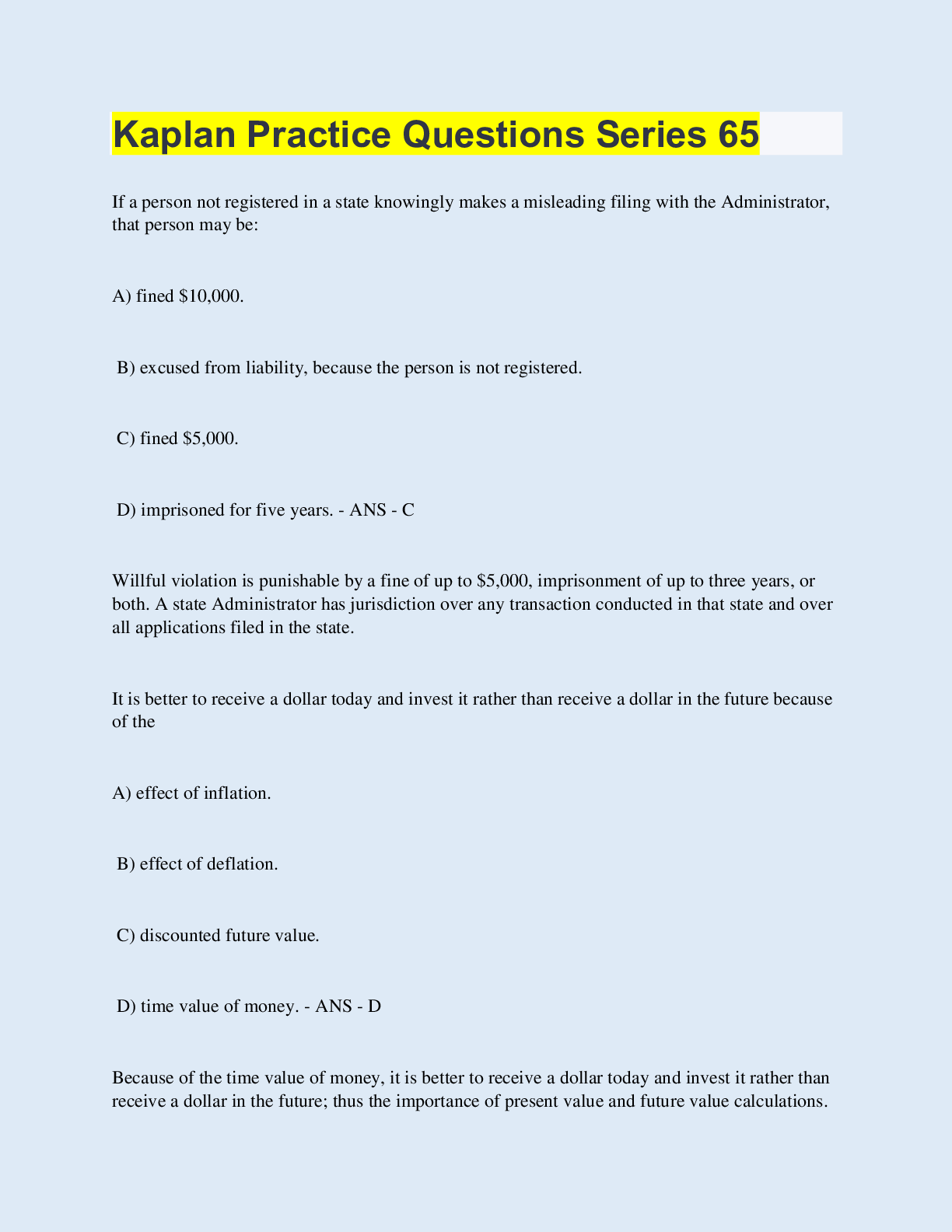
Kaplan Practice Questions Series 65
If a person not registered in a state knowingly makes a misleading filing with the Administrator,
that person may be:
A) fined $10,000.
B) excused from liability, because the perso
...
Kaplan Practice Questions Series 65
If a person not registered in a state knowingly makes a misleading filing with the Administrator,
that person may be:
A) fined $10,000.
B) excused from liability, because the person is not registered.
C) fined $5,000.
D) imprisoned for five years. - ANS - C
Willful violation is punishable by a fine of up to $5,000, imprisonment of up to three years, or
both. A state Administrator has jurisdiction over any transaction conducted in that state and over
all applications filed in the state.
It is better to receive a dollar today and invest it rather than receive a dollar in the future because
of the
A) effect of inflation.
B) effect of deflation.
C) discounted future value.
D) time value of money. - ANS - D
Because of the time value of money, it is better to receive a dollar today and invest it rather than
receive a dollar in the future; thus the importance of present value and future value calculations.
An investor interested in acquiring a convertible bond as part of his investment portfolio would:
A)
want the assurance of a guaranteed dividend on the underlying common stock.
B)
seek to minimize changes in the bond price during periods of steady interest rates.
C)
want the safety of a fixed-income investment along with potential capital appreciation.
D)
be interested in tax advantages available to convertible debt securities. - ANS - C
An investor who wants the safety of a fixed-income investment with the potential for capital
gains would be most interested in purchasing a convertible bond. However, because convertible
bonds can be exchanged for common stock, their market price tends to be more volatile during
times of steady interest rates than other fixed-income securities.
Ms. Libby Ralph sees a tombstone advertisement for a new issue of Southwest Barge
subordinated convertible debentures. The bonds will carry an 11-¼% coupon, are convertible
into common stock at $10.50, and are being issued to the public at 100. The proceeds of the issue
will be used specifically for purchasing new Southwest barges. Ms. Ralph's concerns about the
issue could include:
A)
the company might demand that she accept common stock for her bond.
B)
the issue may be junior-in-lien to another security issue.
C)
the new barges might sink, and the collateral would be gone.
D)
nothing, because the bonds will be first in liquidation. - ANS - B
The word "subordinated" is the key to the question. A subordinated bond has other debt holders
ahead of it in the event of liquidation. The barges do not serve as collateral because the bonds are
identified as debentures, and having to convert to common stock is not a threat because she is the
one that will exercise the conversion privilege if she desires.
A corporation has issued a 4% $60 par convertible stock with a conversion price of $20. With the
preferred stock selling at $66 per share, an investor holding 100 shares of this stock would
benefit by converting if the price of the common stock was
A)
above $18.20 per share
B)
above $20 per share
C)
below $22 per share
D)
above $22 per share - ANS - D
With a conversion price of $20 and a par value of $60, this preferred stock is convertible into 3
shares of the company's common stock. We divide the current price of the preferred ($66) by the
3 shares to arrive at the parity price of $22. If the common stock is selling for more than the
parity price, the investor can benefit by converting and selling the stock in the marketplace.
A bond, preferred stock, or debenture exchangeable at the option of the holder (for common
stock of the issuing corporation) is a:
A)
collateral-backed equity security.
B)
synthetic security.
C)
nondilutive stock.
D)
convertible security. - ANS - D
Discounted cash flow is commonly thought of as applying solely to fixed-income securities.
However, forms of DCF used for the valuation of common stock also include
I. the price-to-earnings ratio
II.the dividend discount model
[Show More]




![Preview of [WILEY FINRA SERIES]VAN BLARCOM, JEFF -Wiley Series 65 Exam Review 2016 + TEST BANK The Un](https://scholarfriends.com/storage/[WILEY FINRA SERIES]VAN BLARCOM, JEFF -Wiley Series 65 Exam Review 2016 + TEST BANK The Uniform Investment Advisor Law Exam.png)
 Van Blarcom, Jeff - Wiley Series 65 Exam Review 2016 + Test Bank_ the Uniform Investment Advisor Law Examination-Wiley (2015).png)

.png)