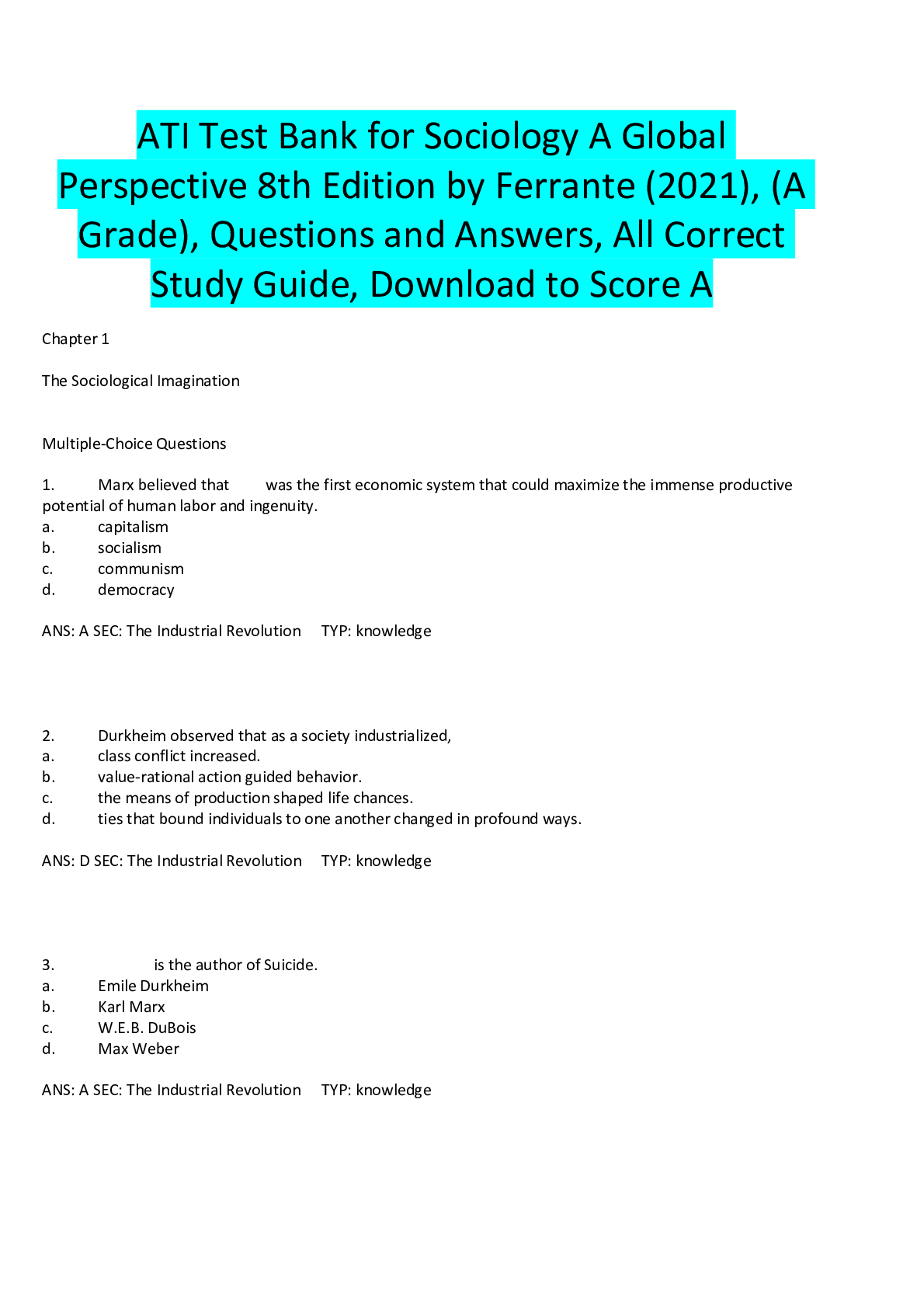
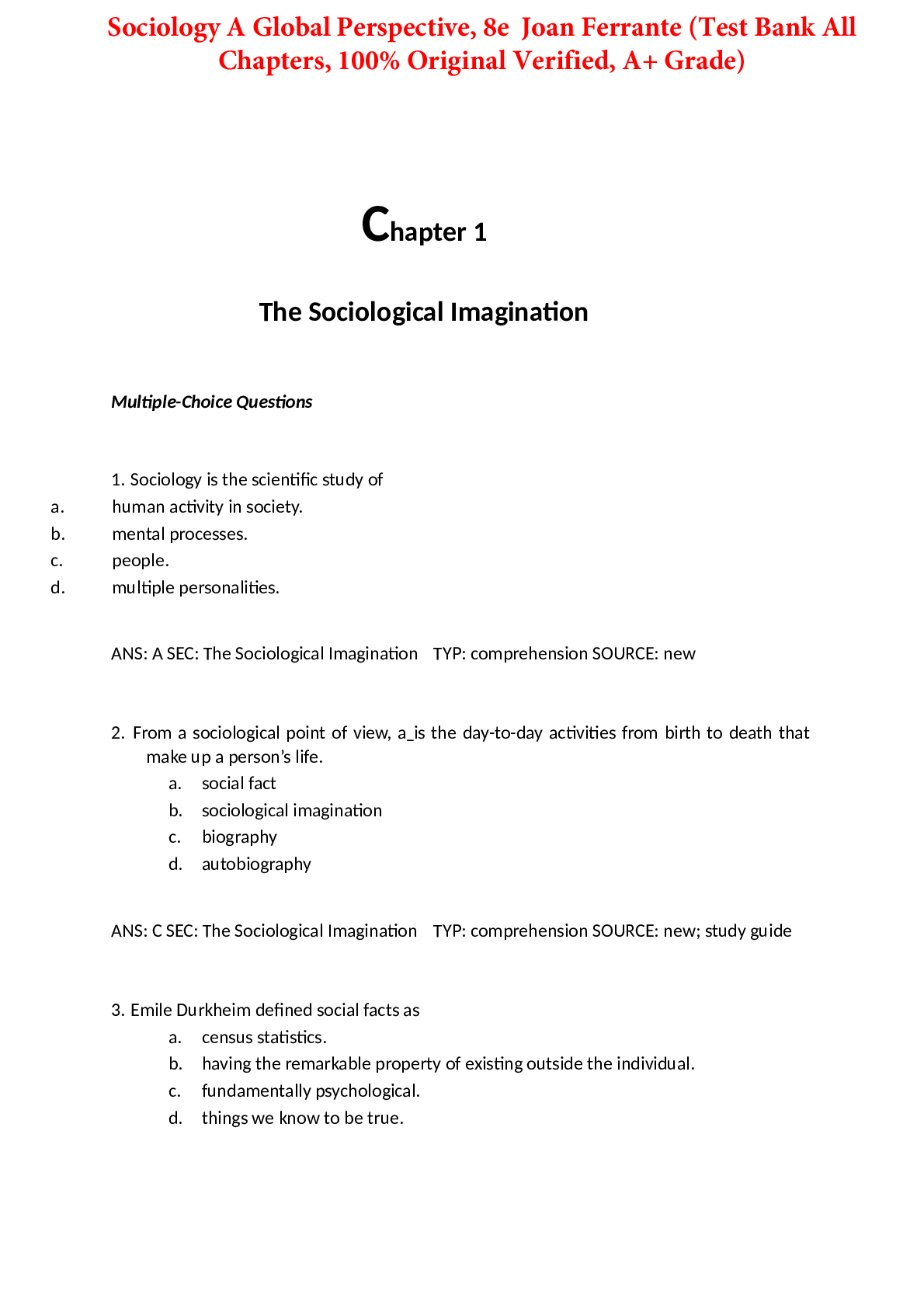
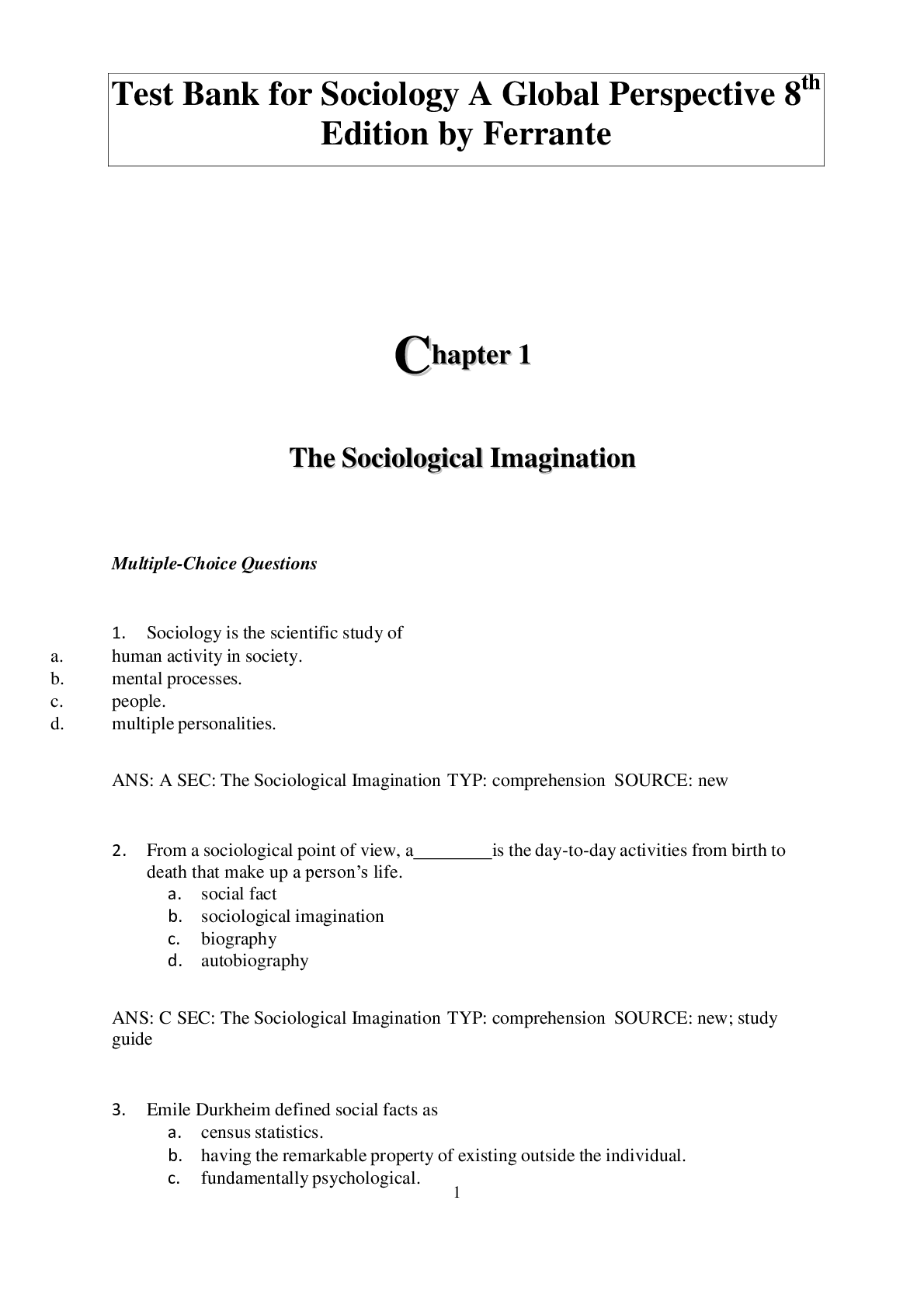
ATI Test Bank for Sociology A Global
Perspective 8th Edition by Ferrante (2021), (A Grade), Questions and Answers, All Correct Study Guide, Download to Score A
Chapter 1
The Sociological Imagination
Multiple-C
...
ATI Test Bank for Sociology A Global
Perspective 8th Edition by Ferrante (2021), (A Grade), Questions and Answers, All Correct Study Guide, Download to Score A
Chapter 1
The Sociological Imagination
Multiple-Choice Questions
1. Marx believed that was the first economic system that could maximize the immense productive potential of human labor and ingenuity.
a. capitalism
b. socialism
c. communism
d. democracy
ANS: A SEC: The Industrial Revolution TYP: knowledge
2. Durkheim observed that as a society industrialized,
a. class conflict increased.
b. value-rational action guided behavior.
c. the means of production shaped life chances.
d. ties that bound individuals to one another changed in profound ways.
ANS: D SEC: The Industrial Revolution TYP: knowledge
3. is the author of Suicide.
a. Emile Durkheim
b. Karl Marx
c. W.E.B. DuBois
d. Max Weber
ANS: A SEC: The Industrial Revolution TYP: knowledge
4. From a sociological perspective, suicide is
a. an act of intentionally killing oneself.
b. the result of personal disappointment and sorrow.
c. self-hatred actualized.
d. the severing of relationships.
ANS: D SEC: The Industrial Revolution TYP: knowledge SOURCE: study guide
5. The term describes a state in which ties attaching individuals to others in the society are weak.
a. egoistic
b. altruistic
c. anomic
d. fatalistic
ANS: A SEC: The Industrial Revolution TYP: application
6. suicide occurs when people kill themselves because they have been cast into a lower status.
a. Egoistic
b. Altruistic
c. Anomic
d. Fatalistic
ANS: C SEC: The Industrial Revolution TYP: application
7. suicide occurs when individuals kill themselves because they see their futures as hopelessly blocked.
a. Egoistic
b. Altruistic
c. Anomic
d. Fatalistic
ANS: D SEC: The Industrial Revolution TYP: application
8. When people commit suicide, it is on behalf of the group they love more than themselves.
a. egoistic
b. altruistic
c. anomic
d. fatalistic
ANS: B SEC: The Industrial Revolution TYP: applicationSOURCE: study guide
9. When people are cast into a lower status, they must reduce their requirements, restrain their needs, and practice self-control. This situation describes a(n) situation.
a. egoistic
b. altruistic
c. anomic
d. fatalistic
ANS: C SEC: The Industrial Revolution TYP: application
10. During World War II, Japanese pilots committed suicide by flying small planes into targets. This suicide would qualify as
a. egoistic.
b. altruistic.
c. anomic.
d. fatalistic.
ANS: B SEC: The Industrial Revolution TYP: application
11. A quilt maker may work years creating a one-of-a-kind object from fabrics saved or purchased and then give it to a special person. Weber would classify the quilt maker’s actions as driven by
a. rationalization.
b. specialization.
c. an emotion, such as love, loyalty, or revenge.
d. value-rational motives.
ANS: C SEC: The Industrial Revolution TYP: application
12. Max Weber focused on the Industrial Revolution and its effect on
a. the means of production.
b. social actions.
c. ties that bind individuals to one another.
d. the color line.
ANS: B SEC: The Industrial Revolution TYP: knowledge
13. Weber maintained that with industrialization, behavior was less likely to be guided by and more likely to be instrumental-rational.
a. efficiency or expediency
b. subjective meaning
c. tradition or emotion
d. rational thought
ANS: C SEC: The Industrial Revolution TYP: comprehension
14. Max Weber maintained that the sociologist’s task was to focus on
a. social facts.
b. social action.
c. the broad reasons people pursue goals.
d. debunking “reality.”
ANS: B SEC: The Industrial Revolution TYP: knowledge
15. If an individual pursues a college degree because everyone in his or her family going back five generations is college-educated, the action can be classified as
a. traditional.
b. affectional.
c. value-rational.
d. instrumental rational
ANS: A SEC: The Industrial Revolution TYP: applicationSOURCE: study guide
66. If an individual pursues college for the love and pleasure of learning, the action is
a. traditional.
b. affectional.
c. value-rational.
d. instrumental.
ANS: B SEC: The Industrial Revolution TYP: application
67. If an individual pursues a college degree taking the easiest classes and paying people to write essays and papers, the action is classified as
a. traditional.
b. affectional.
c. value-rational.
d. instrumental rational.
ANS: D SEC: The Industrial Revolution TYP: application
68. W.E.B. DuBois coined the phrase
a. the “ties that bind people to one another.”
b. the “strange meaning of being black.”
c. the “means of production.”
d. the “course and consequences of social action.”
ANS: B SEC: The Industrial Revolution TYP: knowledge SOURCE: study guide
69. is the sense of always looking at one’s self through the eyes of others and of measuring one’s soul by the tape of a world that looks on in amused contempt and pity.
a. The sociological imagination
b. A trouble
c. An issue
d. Double consciousness
ANS: D SEC: The Industrial Revolution TYP: comprehension
70. W.E.B. DuBois described the American Negro as “two souls, two thoughts, two unreconciled strivings; two warring ideals in one dark body, whose dogged strength alone keep its from being torn asunder.” DuBois was describing
a. the sociological imagination.
b. a trouble.
c. an issue.
d. double consciousness.
ANS: D SEC: The Industrial Revolution TYP: application
71. W.E.B. Dubois traced the to the scramble for Africa’s resources, beginning with the slave trade.
a. color line
b. double consciousness
c. troubles
d. disenchantment
ANS: A SEC: The Industrial Revolution TYP: knowledge
72. DuBois wrote that the world was able “to endure this horrible tragedy by deliberately stopping its ears and changing the subject in conversation.” The tragedy was
a. the scramble for Africa’s resources, including the slave trade.
b. double consciousness.
c. mechanization, which left people without jobs.
d. the carnage of World War I and World War II.
ANS: A SEC: The Industrial Revolution TYP: comprehension
73. Which one of the following classical sociologists is credited with founding Hull House?
a. Karl Marx
b. Jane Addams
c. Emile Durkheim
d. W.E.B. DuBois
ANS: B SEC: The Industrial Revolution TYP: comprehension SOURCE: new
74. is first-hand knowledge gained by living and working among those being studied.
a. Solidarity
b. Social research
c. Sympathetic knowledge
d. Double consciousness
ANS: C SEC: The Industrial Revolution TYP: comprehension SOURCE: new; study guide
[Show More]