Dry Eye
Is a common syndrome affecting mostly those > 40 yo
More prevalent in Hispanics and Asians
Affects both eyes - usually
How do patients describe Dry Eye?
Feels like sand in the eye
Eyes feel hot
Irrit
...
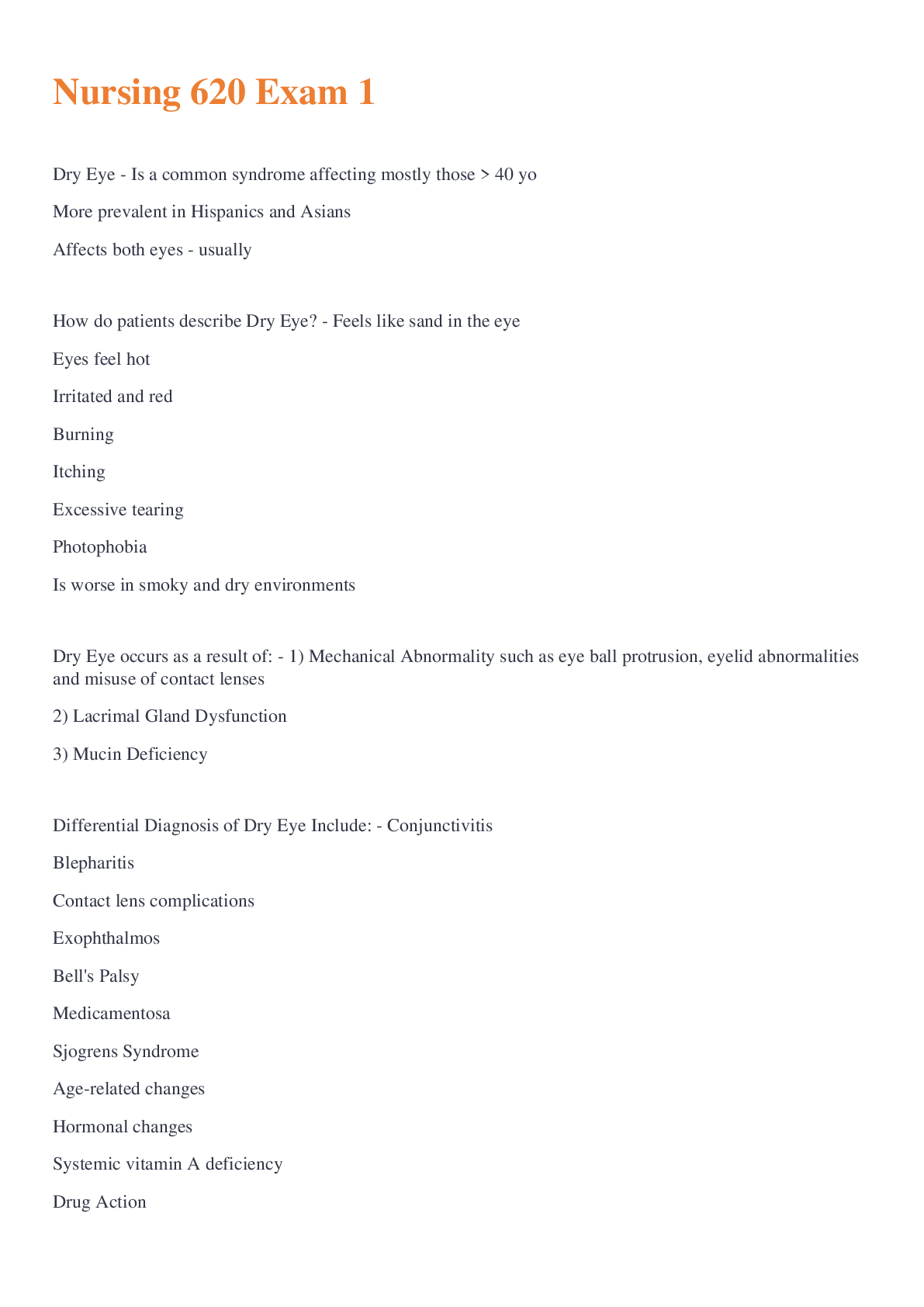
Dry Eye
Is a common syndrome affecting mostly those > 40 yo
More prevalent in Hispanics and Asians
Affects both eyes - usually
How do patients describe Dry Eye?
Feels like sand in the eye
Eyes feel hot
Irritated and red
Burning
Itching
Excessive tearing
Photophobia
Is worse in smoky and dry environments
Dry Eye occurs as a result of:
1) Mechanical Abnormality such as eye ball protrusion, eyelid abnormalities and misuse of contact lenses
2) Lacrimal Gland Dysfunction
3) Mucin Deficiency
Differential Diagnosis of Dry Eye Include:
Conjunctivitis
Blepharitis
Contact lens complications
Exophthalmos
Bell's Palsy
Medicamentosa
Sjogrens Syndrome
Age-related changes
Hormonal changes
Systemic vitamin A deficiency
Drug Action
What is Epiphora?
Excessive tearing
Differential Diagnosis for Epiphora include:
Allergens
Dry eye syndrome
Viral or Bacterial Conjunctivitis
Blocked Lacrimal Duct
Ectropion
Trauma (foreign body or corneal abrasion)
Environmental pollutants
Glaucoma
What is the most important thing for the clinician to know when dealing with eye pain?
When to refer to an ophthalmologist
Conditions requiring immediate referral include:
Sudden vision loss
Sudden non-traumatic eye pain
When the physical exam reveals:
corneal abrasion
suspected herpes zoster ophthalmicus
hazy cornea
irregular pupils
elevation of fundus on exam
papilledema
limbal flush
muscle paresis
Management Issues:
steroid therapy
no improvement in pt condition after treatment
Recommendation #1 to begin empiric therapy is guided by the following three typical presentations.
These are made to help distinguish between Acute Bacterial Rhinosinusitis and uncomplicated Viral URI. Once the diagnosis has been made treatment should not be delayed.
The three typical presentations are:
1. Onset with persistent symptoms that last > 10 days and not improving
2. Onset with severe symptoms, characterized by high fever of at least 39 C or 102 F and purulent nasal discharge for at least 3-4 consecutive days at the beginning of the illness.
3. Onset with worsening symptoms characterized by typical viral URI symptoms that appear to improve followed by the sudden onset of worsening symptoms after 5-6 days (double-sickening)
What is the typical triad of symptoms for Acute Bacterial Rhinosinusitis in Adults?
1. Headache
2. Facial Pain
3. Fever
----Onset with persistent symptoms is far more frequent
In children with Acute Bacterial Rhinosinusitis, what is the usual presenting condition?
1. The most common is a cough (80%)
2. Nasal discharge (76%)
3. Fever (63%)
Parents of preschoolers often report malodorous breath
Differential Diagnosis for Mouth Sores:
• Food or drug allergies
• Chemical irritation
• Dry mouth
• Mechanical or Thermal injury
• Infections (fungal, viral or bacterial)
• Host Immunosupression
• Nutritional deficiency
Differential Diagnosis for Hoarseness:
• Infection
• Inflammation
• Overuse
• Vocal cord pathology
• Vocal cord paralysis
• Muscle atrophy (aging)
• Gastroesophageal reflux
• Chronic Allergies
Differential Diagnosis for Sore Throat:
• Streptococcal pharyngitis
• Tonsillitis
• HSV
• Gonococcus
• Candidiasis
• Aphthous ulceration
• Rhinovirus, adenovirus, Epstein-Barr virus, Coxsackievirus
• Mycoplasma
What are Common Eye Complaints?
• Redness
• Dry eye
• Watery or purulent eye discharge
• Eye pain
• Impaired vision
• Ocular itching
• Swelling of the eyelid
What conditions require immediate referral?
• Severe or sudden vision loss
• Eye pain
• Corneal ulceration
• Trauma
• Foreign body
• Herpetic Infection of the eye
What is Blepharitis?
• Is an inflammation of the eyelids and eyelid margins
What forms of Blepharitis are there?
• Nonulcerative form associated with seborrhea
• Ulcerative
Describe Non-ulcerative Blepharitis:
• Tends to affect people with psoriasis, seborrhea, eczema, allergies, and lice infestations
• Contributing factors: exposure to chemical or environmental irritants, use of eye makeup and contact lenses
• Non-Ulcerative Blephritis may present with scales along the lid margins that are easily removed
What are contributing factors to Non-Ulcerative Blepharitis?
• Exposure to chemical or environmental irritants
• Use of eye makeup
• Contact lenses
Describe Ulcerative Blepharitis:
• Involves the lash follicle and the meibomian glands of the eyelid
• Lashes become thin and break easily
• Ulcerative Blephritis may have pustules at the base of the hair follicles that may crust and bleed.
What is the clinical presentation of Blephritis (both forms)?
Subjective:
• Itching and burning
• Foreign body sensation
• Sensitivity to bright lights
• Excessive tearing
• May be unilateral or bilateral
Objective:
• Lid margins are edematous and erythematous in both cases
• Palpate for preauricular lymphadenopathy
[Show More]