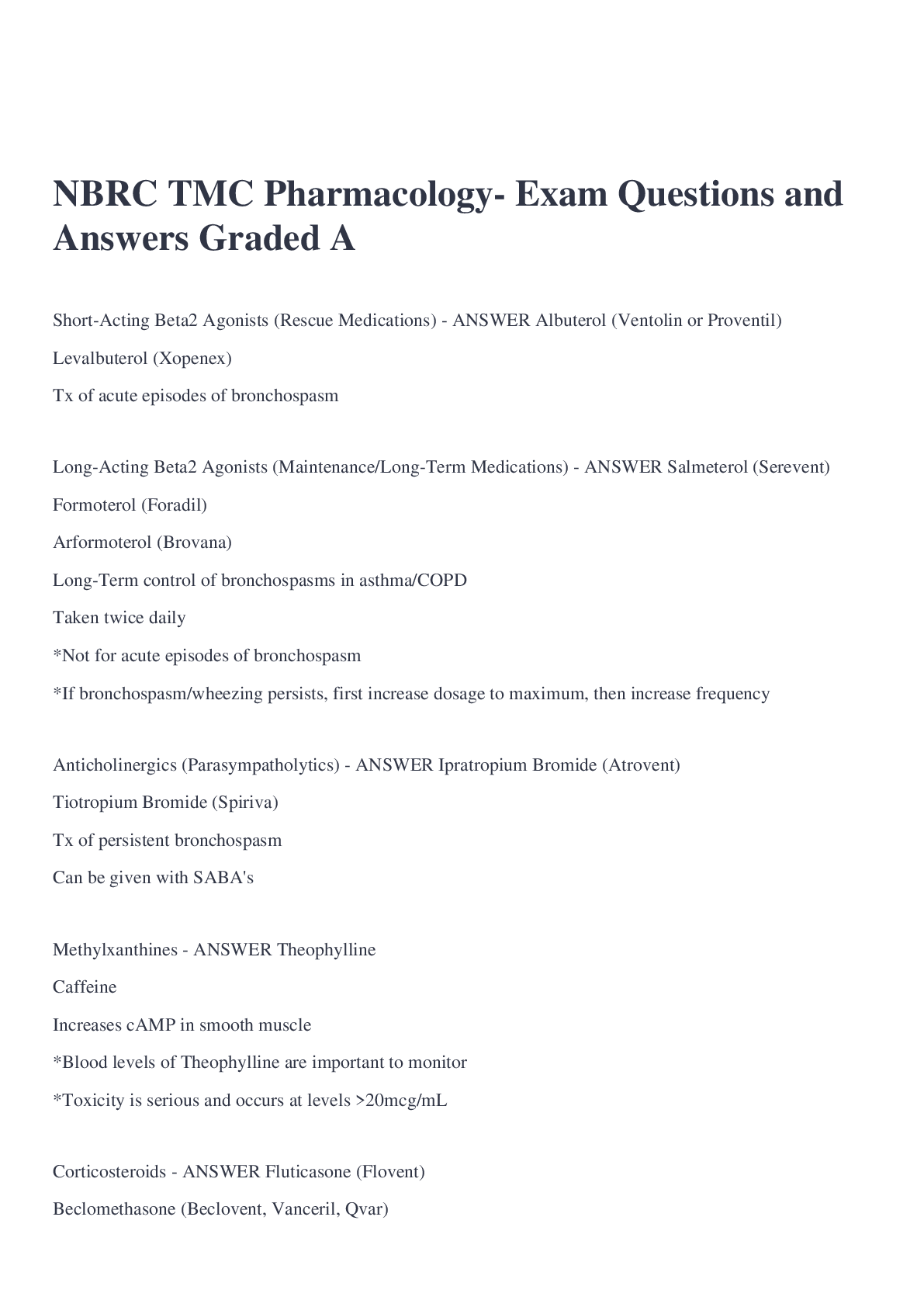
Short-Acting Beta2 Agonists (Rescue Medications) - ANSWER Albuterol (Ventolin or Proventil)
Levalbuterol (Xopenex)
Tx of acute episodes of bronchospasm
Long-Acting Beta2 Agonists (Maintenance/Long-Term Medications)
...
Short-Acting Beta2 Agonists (Rescue Medications) - ANSWER Albuterol (Ventolin or Proventil)
Levalbuterol (Xopenex)
Tx of acute episodes of bronchospasm
Long-Acting Beta2 Agonists (Maintenance/Long-Term Medications) - ANSWER Salmeterol (Serevent)
Formoterol (Foradil)
Arformoterol (Brovana)
Long-Term control of bronchospasms in asthma/COPD
Taken twice daily
*Not for acute episodes of bronchospasm
*If bronchospasm/wheezing persists, first increase dosage to maximum, then increase frequency
Anticholinergics (Parasympatholytics) - ANSWER Ipratropium Bromide (Atrovent)
Tiotropium Bromide (Spiriva)
Tx of persistent bronchospasm
Can be given with SABA's
Methylxanthines - ANSWER Theophylline
Caffeine
Increases cAMP in smooth muscle
*Blood levels of Theophylline are important to monitor
*Toxicity is serious and occurs at levels >20mcg/mL
Corticosteroids - ANSWER Fluticasone (Flovent)
Beclomethasone (Beclovent, Vanceril, Qvar)
Budesonide (Pulmicort)
Prednisone
Tx in patients with asthma and COPD
*Rinse mouth after therapy to prevent thrush
Multiple Tx Sequence - ANSWER 1-Bronchodilator and/or anticholinergic
2-Corticosteroid
3-Antibiotics
Mucolytics - ANSWER Acetylcysteine (Mucomyst)
-Liquifies tenacious secretions
-Tx of acetaminophen overdose
Recombinant human DNAse (Pulmozyme)
-Specifically indicated for patients with Cystic Fibrosis
*Side effects- Voice alteration, pharyngitis, laryngitis, rash, chest pain, conjunctivitis
Pulmonary Vasodilators - ANSWER Prostacyclins: epoprostenol (Flolan)
Sildenafil (Viagra)
Tx of pulmonary hypertension, ARDS, right ventricular failure/cor pulmonale
Wetting Agents - ANSWER Water given orally or intravenously
Best mucolytic
Sterile distilled water aerosol is very irritating to airways and may cause bronchospasm
0.45% Saline - ANSWER Hypotonic
For liquefying secretions and humidifying the airway
May be irritating and cause swelling of dried secretions
May cause bronchospasm
0.9% Saline - ANSWER Isotonic/Normal
Commonly used to liquefy secretions, humidify the airway, and to dilute medications
1.8-15% Saline - ANSWER Hypertonic
Commonly used to induce sputum specimens
Can irritate the airway and cause bronchospasm or secretion obstruction
Leukotriene Modifiers - ANSWER Montelukast (Singulair)
Non-steroidal
Tx of patients with mild to moderate persistent asthma
*Not for acute exacerbations
Mast Cell Stabilizers - ANSWER Cromolyn sodium (Intal, Aarane)
Tx of patients with exercised induced asthma (EIA)
*Not effective once exacerbation has begun
Mucosal Vasoconstrictors/Decongestants - ANSWER Aerosolized Racemic Epinephrine (Vaponefrin)
Tx of upper airway conditions such as croup and post extubation swelling with stridor
Inotropic Agents - ANSWER Digitalis (Crystodigin)
Digoxin (Lanoxin)
Tx of CHF and atrial tachycardia and fibirillation
Amiodarone - ANSWER Tx of pulseless V-Tach and V-Fib that hasn't responded to defibrillation
Lidocaine - ANSWER Tx of PVC and stable V-Tach
Atropine and Epinephrine - ANSWER Tx of Bradycardia
Tx of Angina (Chest Pain) - ANSWER Nitroglycerin
Lowers blood pressure - ANSWER Nitroprusside (Nipride)
*Light sensitive
Raises blood pressure - ANSWER Epinephrine
Norepinephrine (Levophed)
Dopamine
Dobutamine (Dobutrex)
Furosemide (Lasix) - ANSWER Tx of pulmonary edema, liver and kidney disease, CHF
*Monitor serum electrolytes for hypokalemia, hypochloremia, metabolic alkalosis
Succinylcholine (Anectine) - ANSWER Depolarizing neuromuscular blocking agent
Causes total muscle contraction followed by paralysis
Rapid onset: 1-1.5mins
Short duration: 7-12mins
Primarily used for intubation
Pancuronium (Pavulon)
Vecuronium (Norcuron)
Rocuronium (Zemuron) - ANSWER Non-depolarizing neuromuscular blocking agent
Prevents stimulation of muscles
results in complete paralysis
Rapid onset: 3-5mins
Longer duration: 35-120mins
Used when paralysis is needed for longer periods of time
Neuromuscular Blocking Drugs Indications - ANSWER Reduce spontaneous breathing
Prevent movement that can dislodge airways, catheters
Reduce oxygen consumption
Improve ventilator/patient synchrony
*Do not affect pain or consciousness, so 0atient should receive sedation and analgesia (pain control)
Sedatives - ANSWER Alprazolam (Xanax)
Diazepam (Valium)
Midazolam (Versed)
Lorazepam (Ativan)
Used to manage fear and anxiety
Increase comfort during mechanical ventilation
Induce sleep
Anesthetics - ANSWER Propofol (Diprivan)
Ketamine (Ketalar)
Short acting, used for anesthesia and sedation of ventilated patients
Administered via IV
Analgesics - ANSWER Morphine
Codeine
Meperidine (Demerol)
Hydromorphone (Dilaudid)
Fentanyl (Sublimaze)
Oxycodone (Oxycontin)
Hydrocodone
Reduces sensation of pain
Can cause respiratory distress at high doses
Can be reversed with Naloxone (Narcan)
Tx of acute bronchospasm - ANSWER Albuterol
Levalbuterol
Long-term treatment of bronchospasm in COPD and Asthma - ANSWER Salmeterol (Serevent)
Formoterol (Foradil)
Arformoterol (Brovana)
Tx of persistent bronchospasm - ANSWER Ipratropium Bromide (Atrovent)
Tiotropium Bromide (Spiriva)
Safe blood theophylline levels in adults - ANSWER 10-20mcg/mL
Safe blood theophylline levels in neonates and children - ANSWER 5-10mcg/mL
Drug specifically used for Cystic Fibrosis - ANSWER Recombinant human DNAse (Pulmozyme)
[Show More]