RNSG 2331 - Exam-4-Capstone-1
Question:
The client has been working on weight loss for 8 months and has been successful in losing 35 lbs (15.9 kg). The client is now entering the maintenance phase of the health promo
...
RNSG 2331 - Exam-4-Capstone-1
Question:
The client has been working on weight loss for 8 months and has been successful in losing 35 lbs (15.9 kg). The client is now entering the maintenance phase of the health promotion plan. Which strategies are important for the nurse to emphasize as the client enters this phase?
You answered this question Correctly
3. Discontinue programmatic exercise plan.
1., 2., 4. & 5. Correct: The person must have ongoing support to prevent a relapse. The
weigh-ins increase accountability for prolonged behavioral change. Anytime that a new behavior is instituted, there is a chance that the person will return to old habits.
Having a plan in place may help the person to stay on track. Ongoing peer support can be very helpful as the client continues in the maintenance phase.
3. Incorrect: Programmatic exercise, although reduced in frequency perhaps, should still be available. If this is taken away or reduced too much, the client may return to old habits.
Question:
Which client in the Labor, Delivery, Recovery, and Postpartum Unit (LDRP) should the nurse see first?
You answered this question Correctly
2. Multigravida at term who is dilated to six centimers and at minus one station with moderate contractions every five to ten minutes.
3. Primipara at 38 weeks gestation who is dilated to five centimeters and at zero station with strong contractions every four minutes.
4. Multigravida at 36 weeks gestation with pregestational diabetes in for a biophysical profile for fetal well being.
1. Correct: Minus two station is high with the presenting part not engaged. This client
is at high risk for prolapsed cord, which would require relieving pressure on the cord and emergency cesarean delivery.
2. Incorrect: Contractions are not close enough for this client to be an emergent situation. Also, since this is a multigravida client and not fully dilated yet, she is not a high risk client.
3. Incorrect: This client is in the active phase of labor, but there is much work to be done before she is fully dilated and engaged for delivery.
4. Incorrect: This client is not in labor and is a non-emergent client, particularly compared to client #1.
Question:
The nurse is preparing to discharge a client who has been placed on tranylcypromine. The nurse teaches the client about food to avoid while taking this medication. What food choice by the client confirms appropriate understanding of the teaching?
You answered this question Correctly
1. Cottage cheese
3. Baked chicken
4. Potatoes
2. Correct: The client taking a monoamine oxidase inhibitor (MAOI) such as
tranylcypromine should avoid foods rich in tyramine or tryptophan. These include: cured foods, those that have been aged, pickled, fermented, or smoked. These can precipitate a hypertensive crisis.
1. Incorrect: Clients taking MAOIs can eat cottage cheese in reasonable amounts.
3. Incorrect: Clients taking MAOIs can eat baked chicken.
4. Incorrect: Clients taking MAOIs can eat potatoes.
Question:
What task by the RN should be performed first? You answered this question Correctly
1. Changing a burn dressing that is scheduled every four hours.
2. Administering scheduled IV antibiotic.
3. Teaching a new diagnosed diabetic about diet and exercise.
4. Correct: The admit assessment should be done first. It is important to initiate the
assessment and physical exam within one hour of being admitted to the unit or floor. The assessment and plan of care should be completed within 8 hours of admission.
1. Incorrect: The other clients' needs are important, but are scheduled and established in a routine. These routines can be continued once the new client’s assessment has been completed.
2. Incorrect: This is not a priority based on the information in the question. The scheduled IV antibiotic administration can be administered within the appropriate time frame.
3. Incorrect: A newly diagnosed diabetic is not always ready for teaching, so this is not priority. The nurse should identify when the client is ready to learn. This teaching session can occur prior to or after assessing the new client.
Question:
A client is admitted to the intensive care unit after overdosing on meperidine. What is the nurse's first priority?
You answered this question Incorrectly
1. Maintain continuous cardiac monitoring.
3. Provide alprazolam 0.25 mg PO PRN.
4. Initiate intravenous fluid resuscitation with lactated ringers at 125 mL/hr.
2. Correct: The respiratory status of the client takes priority. The administration of
naloxone will block the opioid, initiating a reversal of the central nervous system (CNS) and respiratory depression.
1. Incorrect: Continuous cardiac monitoring is appropriate, however, airway takes priority.
3. Incorrect: Alprazolam will worsen respiratory depression. Alprazolam is a benzodiazepine. The action of this drug may depress the CNS.
4. Incorrect: IV fluids will be initiated, but airway takes priority.
Question:
A client is admitted to the medical unit with an acute onset of fever, chills and RUQ pain. Vital signs are: T 99.8°F (37.7°C), P 132, RR 34, B/P 142/82. ABG results are: pH- 7.53, PaCO2 30, HCO3 22. The nurse determines that this client is in what acid/base imbalance?
You answered this question Correctly
1. Respiratory acidosis
3. Metabolic acidosis
4. Metabolic alkalosis
2. Correct: This client has a severe infection. Hyperventilation due to anxiety, pain,
shock, severe infection, fever, and liver failure can lead to respiratory alkalosis. pH > 7.45, PCO2 < 35, HCO3 normal.
1. Incorrect: Not acidosis with hyperventilation and pH of 7.53.
3. Incorrect: Not a metabolic related acid/base imbalance since the HCO3 is in normal range and is not acidosis.
4. Incorrect: Not a metabolic related acid/base imbalance since the HCO3 is in normal range.
Question:
A new mother calls the clinic and tells the nurse, “I don’t have any help taking care of my 3 week old baby. I don’t know what to do. I just feel like I can’t take care of him anymore. I wish I never had him sometimes. Maybe then my husband would spend more time at home.” What would be the nurse's best response?
You answered this question Correctly
1. "You are experiencing maternity blues, which will go away on its own."
2. "You are just tired. Tell your husband that you need his help."
4. "Have you thought about getting a family member to help with the baby?"
3. Correct: This client is exhibiting signs of postpartum psychosis. Post partum
psychosis is characterized by depressed mood, agitation, indecision, lack of concentration, guilt, and an abnormal attitude toward bodily functions. There is a lack of
interest in or rejection of the baby, or a morbid fear that the baby may be harmed. Risks of suicide and infanticide should not be overlooked.
1. Incorrect: Maternity blues includes tearfulness, despondency, anxiety and subjectivity with impaired concentration.
2. Incorrect: This ignores a potentially life-threatening problem. The client is not just tired.
4. Incorrect: This ignores a potentially life-threatening problem. Assume the worse. Think about the safety of mom and baby.
Question:
A client has a prescription for digoxin 0.125 mg IV push every morning. Prior to administering digoxin, the nurse notes that the digoxin level drawn this morning was 0.9 ng/mL. Which action would be most important for the nurse to take?
You answered this question Incorrectly
2. Hold the digoxin.
3. Notify the primary healthcare provider.
4. Repeat the digoxin level.
1. Correct: This is a normal digoxin level. The nurse would administer the prescribed
digoxin. The therapeutic serum levels of digoxin range from 0.5 to 2 ng/mL.
2. Incorrect: This is a normal digoxin level. The nurse would administer the prescribed digoxin.
3. Incorrect: There is no need to notify the primary healthcare provider of a normal digoxin level.
4. Incorrect: There is no need to repeat a normal laboratory value.
Question:
Which member of the multi-disciplinary team oversees and coordinates the healthcare delivery process and organizes the delivery of healthcare services to the client?
You answered this question Correctly
1. Clinical nutritionist
2. Primary nurse each shift
3. Primary healthcare provider
4. Correct: An important role of the case manager in the multi-disciplinary team care
approach is coordination of client care. The case manager oversees the process of healthcare delivery and organizes and coordinates the delivery of healthcare services to the client.
1. Incorrect: The clinical nutritionist is a member of the multi-disciplinary team, but does not coordinate and organize the delivery of care outside of the client's nutritional needs.
2. Incorrect: The primary nurse each shift develops and executes the plan of care for the client, but is not the organizer and coordinator of all the services to the client.
3. Incorrect: The primary healthcare provider is a member of the multi-disciplinary team, but is responsible for prescribing healthcare for the client, not organizing the services.
Question:
The unlicensed assistive personnel (UAP) reports to the nurse that a client
with Alzheimer's has been walking into rooms on the unit and stating, "This is my room, so get out!" What is the best instruction the nurse can give to the UAP?
You answered this question Correctly
1. Calmly sit with the client and have the client repeat the room number at frequent intervals.
2. Have the client remain in the room so the client can become familiar with it.
3. Place a sign on the client's door that clearly has the client's name so the client can identify it.
4. Correct: A client with Alzheimer's is likely to recognize a familiar object
before reading the name on the door.
1. Incorrect: You can make the client repeat the room number over and over, but he or she will not remember it particularly since it is short-term current memory. This is the part of memory that goes first with the Alzheimer's client.
2. Incorrect: Stay in your room until you get used to it? No, this is non- therapeutic for a client with Alzheimer's and could increase their confusion and moody behavior.
3. Incorrect: This seems like an appropriate answer, but clients with Alzheimer's may not recognize their own name or take the time to read.
Question:
The nurse sees that the new medication noted in a recent prescription is on the client’s list of allergies. In the role of client advocate, what actions should the nurse take to ensure client safety?
You answered this question Incorrectly
1. Document the medication with times and doses to be given, then administer the medication as ordered.
5. Call the pharmacy to see if the medication needs to be changed.
2. , 3. & 4. Correct: Administration of a medication that the client is allergic to could
result in harm to the client. The primary healthcare provider should be notified immediately of a medication prescription that conflicts with the client’s list of medication allergies. The medication should be discontinued on the medication administration record, and the client’s allergy band checked against the list of allergies documented in the medication record for accuracy. All of these actions place the nurse in the role of client advocate and ensure the client's safety.
1. Incorrect: No, this medication could cause harm to the client. The client is allergic to this medication.
5. Incorrect: No, the primary healthcare provider, not the pharmacy, should be notified for medication changes. The primary healthcare provider is responsible for prescribing the medication.
Question:
Which suggestion should the nurse provide to a client reporting frequent episodes of constipation?
You answered this question Incorrectly
1. Take a stool softener.
3. Monitor elimination habits for the next week.
4. Rest after each meal.
2. Correct: Increased fiber intake may help to establish regular elimination habits.
1. Incorrect: Not the best initial suggestion. It's better to promote health maintenance routines than to just go with a medication, which could be a temporary fix.
3. Incorrect: The nurse should make a suggestion that will assist the client with normal elimination. This option does not suggest a way to fix the problem.
4. Incorrect: Increased activity is likely to result in more normal elimination. Resting after meals would not increase elimination frequency.
Question:
The nurse is assigned to triage a client presenting to the emergency department who is suspected to have exposure to inhaled anthrax. What assessment findings are expected?
You answered this question Correctly
2. Small papule on skin resembling an insect bite.
3. Pustular vesicles on skin.
4. Fatigue.
1. Correct: Inhalation of anthrax spores is very serious, and clients will experience
abrupt dyspnea and fever. Treatment must begin immediately.
2. Incorrect: Cutaneous anthrax manifests itself as papules resembling an insect bite that progresses to depressed black ulcers.
3. Incorrect: Pustular vesicles are consistent with smallpox.
4. Incorrect: Fatigue is a vague symptom that is usually not associated with inhaled anthrax.
Question:
What should the nurse include when teaching a client in renal failure about peritoneal dialysis?
You answered this question Incorrectly
1. Instill 250 ml of fluid into the peritoneal cavity over 30 minutes.
2. Use cool effluent when instilling into the peritoneal cavity.
5. If all the fluid does not drain out, place the bed in the Trendelenburg position.
3, 4, & 6 Correct: Once the prescribed dwell time has ended, the bag is lowered and
the fluids, along with the toxins, are drained out into a bag over a period of 15 – 30 minutes. The fluid should be clear in appearance (should be able to read a paper through it). Cloudy return could indicate infection. Since the dialysate has a lot of glucose in it, the client frequently reports a constant sweet taste.
1. Incorrect: The amount of fluid used in peritoneal dialysis is about 2000 to 2500 ml at a time. This filling of the peritoneal cavity is often completed in 10 minutes.
2. Incorrect: Cool fluids would cause vasoconstriction. The effluent should be warmed to body temperature to promote blood flow to enhance the exchange (the more blood flow, the more toxin removal).
5. Incorrect: If all of the fluid does not come out, the client should turn side to side to promote drainage. The Trendelenburg position would cause the fluids to pool in the upper peritoneal area and not drain adequately.
Question:
A client has just delivered a newborn. Based on the primary healthcare provider’s notation, what prescriptions does the nurse anticipate administering to the mother?
You answered this question Correctly
2. Hepatitis A vaccine
3. Hepatitis B immune globulin
5. Tetanus toxoid
1. , & 4. Correct: A client who has a titer of less than 1:8 is administered a
subcutaneous injection of rubella vaccine, or measles, mumps and rubella vaccine (MMR) during the postpartum period to protect a subsequent fetus from malformations. Clients should not get pregnant for 4 weeks following the vaccination. All Rh negative moms who have Rh positive newborns must be given RH0(D) immune globulin IM within 72 hours of newborn being born to suppress antibody formation in the mother.
2. Incorrect: The mother is negative for hepatitis but current guidelines recommend that the newborn be given the hepatitis B vaccine. Hepatitis A vaccine is not given.
3. Incorrect: The mother is negative for hepatitis. If the newborn had been born to a mom who has hepatitis B, the newborn would receive the hepatitis B vaccine and the Hepatitis B immune globulin within 12 hours of birth.
5. Incorrect: Mom is up to date on tetanus toxoid vaccine.
Question:
When performing an admission assessment, what should the nurse recognize as signs/symptoms of hyperthyroidism?
You answered this question Correctly
2. Weight gain
4. Loss of appetite
5. Constipation
1. , 3., & 6. Correct: With hyperthyroidism, the client has too much energy. They report
being nervous and feeling hot. Exophthalmos is an irreversible eye condition where the eyes bulge. This condition is associated with hyperthyroidism that has not been treated early enough to prevent this from occurring. Due to the hypermetabolic state, the client will often report feeling hot and will be sweating.
2. Incorrect: The client with hyperthyroidism has an increased appetite but experiences weight loss due to the excessive energy consumption.
4. Incorrect: Loss of appetite is seen in the client with hypothyroidism. The client with hyperthyroidism has an increased appetite but experiences weight loss due to the excessive energy consumption.
5. Incorrect: Constipation is a sign of hypothyroidism due to slowed GI motility. In hyperthyroidism, the nurse would expect increased GI motility.
Question:
The nurse is administering medication to an elderly client who has no visitors. The client takes the pills, and, as the client hands the medication cup back to the nurse, grabs onto the nurse's hand tightly. What is the most logical rationale for the client's action?
You answered this question Incorrectly
1. Confusion and disorientation.
3. Would like to talk with the nurse.
4. Would like to reminisce with the nurse.
2. Correct: This elderly client with no visitors is most likely scared and lonely. The touch
of the nurse's hand is comforting for the client.
1. Incorrect: There is no indication of confusion or disorientation.
3. Incorrect: Grabbing the nurse's hand indicates more than just a desire to talk. This is indicative of needing comfort and personal touch.
4. Incorrect: There is no indication of a desire to reminisce from the information in the question.
Question:
The client is admitted to the hospital following a motor vehicle accident and has sustained a closed chest wound. The nurse notes paradoxical chest wall movement. Which problem does the nurse suspect?
You answered this question Correctly
1. Mediastinal shift
2. Tension pneumothorax
4. Pulmonary contusion
3. Correct: Hallmark of flail chest is paradoxical chest wall movement. This is often
described as a see-saw effect when observing the rise and fall of the chest.
1. Incorrect: A closed or open tension pneumothorax results from the lung collapsing and air entering into the pleural cavity. This results in pressure shifting toward the unaffected pleural cavity.
2. Incorrect: Tension pneumothorax occurs when there is an accumulation of air in the pleural cavity. The client may exhibit dyspnea, tachycardia, or hypotension.
4. Incorrect: A pulmonary contusion usually results from blunt trauma. Bruising of lung would be demonstrated by pain but not paradoxical chest wall movement.
Question:
Which intervention should the nurse initiate for a client post liver biopsy? You answered this question Incorrectly
3. Position client on left side.
4. Keep client NPO for 24 hours.
1., 2., & 5. Correct: Anyone who has a liver problem is at risk for bleeding. The clotting
factor produced in the liver is prothrombin. Anytime a needle is inserted into the body and removed, bleeding can occur. Whenever there is risk for bleeding, the preventive measure is to apply pressure. The puncture site should be monitored frequently. The client may experience some discomfort once the anesthetic wears off.
3. Incorrect: Lying on the left side does not put pressure on the puncture site. The liver is on the right side, as is the puncture site.
4. Incorrect: The client will be prescribed NPO for 2 hours. The client's usual diet as tolerated will be resumed after the 2 hours
Question:
One week ago a client was involved in a motor vehicle crash and was brought to the Emergency Department. The client received two sutures to the forehead and was sent home. Today, the client’s spouse notes the client “acts drunk” and cannot control the right foot and arm. Based on this data, what should the nurse suspect?
You answered this question Correctly
1. Meningitis
2. Transient ischemic attack
4. Meniere's disease
3. Correct: Yes, subacute subdural hematoma is a head injury with slow venous bleed. The body does not have symptoms until compensation is exhausted.
1. Incorrect: No, fever and nuchal rigidity are symptoms of meningitis.
2. Incorrect: No, because of the motor vehicle crash, the nurse should think subdural hematoma first due to the risk of increasing intracranial pressure (ICP).
4. Incorrect: No, whirling vertigo and vomiting would be expected with Meniere's disease.
Question:
The nurse is caring for a client prescribed vancomycin for Methicillin-
Resistant Staphylococcus Aureus (MRSA) infection. What nursing intervention is appropriate?
You answered this question Correctly
1. Provide the client food or a snack to take with the medication
3. Administer an antiemetic prior to vancomycin administration
4. Request the placement of a PICC line for IV administration
2. Correct: Vancomycin is nephrotoxic, caution should be exercised in clients with
impaired renal function. BUN and creatinine are specific diagnostic tests that indicate appropriate renal function.
1. Incorrect: Vancomycin is not effective via the oral route for systemic infections. It is taken orally only for the treatment of Clostridium difficile colitis. It does not need to be administered with food when taken orally.
3. Incorrect: Nausea and vomiting are not common side effects of vancomycin administration.
4. Incorrect: Vancomycin may be administered via a peripheral IV line; however, the IV
access should be monitored closely due to the risk of necrosis and tissue sloughing with extravasation.
Question:
A client of Jewish faith has requested a Kosher diet. Which food tray would the nurse provide to the client?
You answered this question Correctly
1. Medium rare steak, potato salad, peas and coffee
2. Ham sandwich, chips, fruit salad and juice
4. Baked chicken, vegetable medley, rice and milk
3. Correct: Fish is allowed if it has fins and scales. Shellfish is not kosher. Pasta,
potatoes, salads and tea are allowed.
1. Incorrect: Although steak is allowed, all traces of blood must be gone.
2. Incorrect: No pork products are allowed, so no bacon, ham, or sausage.
4. Incorrect: Milk is not allowed at the same time as meat. There should be at least three hours separating the two.
Question:
The drug nadolol is prescribed for a client with stable angina. Which findings would indicate to the nurse that the drug is effective?
You answered this question Correctly
3. Bounding pulses
5. Bradycardia
1., 2., & 4. Correct: Nadolol is a beta-blocking agent. Beta-blockers block the beta 1
adrenergic receptor cells in the heart, thereby decreasing heart rate, contractility, and blood pressure. These effects decrease the workload on the heart. With decreased oxygen demand (workload on the heart), chest pain is relieved. Beta-blockers decrease
cardiac contractility, thereby decreasing cardiac output. Beta blockers also relieve anxiety.
3. Incorrect: Bounding pulses would indicate fluid volume excess, thus making the problem worse.
5. Incorrect: Nadolol is a beta-blocking agent, which blocks the beta 1 adrenergic receptor cells in the heart, thereby decreasing heart rate; however, decreasing the heart rate to the point of bradycardia would be an adverse effect.
Question:
The new nurse is caring for a client receiving oxygen by nasal cannula. Which action would require the charge nurse to intervene?
You answered this question Correctly
1. Apply gauze padding beneath the tubing.
3. Provide mouth and nose care every 4 hours as needed.
4. Place the oxygen tubing above the ears.
2. Correct: Petroleum jelly is a combustible substance. It should not be used with
oxygen therapy.
1. Incorrect: The charge nurse would not need to intervene if the new nurse applied gauze padding beneath the tubing to protect the client’s skin. This is acceptable.
3. Incorrect: The charge nurse would not need to intervene if the new nurse provided mouth and nose care every four hours as needed to protect the client’s skin and mucous membranes. This is acceptable.
4. Incorrect: The charge nurse would not need to intervene if the new nurse placed the oxygen mask straps well above the client’s ears to protect the client’s skin. This is acceptable.
Question:
The client with bleeding esophageal varices has a Blakemore tube in place. What piece of equipment should be present at the bedside?
You answered this question Incorrectly
1. Tracheostomy set
2. Clamps
4. Tourniquet
3. Correct: Yes, if the tube gets dislodged and occludes the airway, the balloon must be
cut and the tube removed to allow the client to breathe.
1. Incorrect: No, that goes with thyroidectomy and parathyroidectomy, either accidental or intentional. When the parathyroids are removed, hypocalcemia can occur and leads to tight rigid muscles. This also affects the smooth muscle of the airway and leads to stridor, respiratory distress, and possible trach.
2. Incorrect: No, that’s for chest tubes and would be necessary if there was a leak in the chest tube system or in preparation for removal of chest tubes if prescribed.
4. Incorrect: That goes with amputations because there is a risk for massive hemorrhage after an amputation. A tourniquet would be necessary for a limb amputation. There is a risk for excessive hemorrhage after an amputation.
Question:
Which statement by a client scheduled to be discharged home following treatment for alcoholism would indicate to the nurse that further instruction is necessary?
You answered this question Correctly
1. “I will read labels to be sure there is no hidden alcohol in food.”
3. “I can call the clinic or my sponsor whenever I feel tempted to drink alcohol.”
4. “Even one glass of alcohol can cause me to start drinking regularly again.”
2. Correct: This statement indicates the need for further instruction for this client. When
discharged home following rehabilitation for alcohol, clients are told to attend at least one AA meeting every single day, whether feeling the need to drink or not. Constant reinforcement is found to increase the rate of success following inpatient rehabilitation. 1.Incorrect: This statement by the client is correct. Many daily products contain small amounts of alcohol, such as salad dressings, cold medications, and even after shave. 3.Incorrect: This is also a correct statement, as clients who are recovering from alcoholism are designated a “sponsor”, or support person, whom they can contact at any time for assistance. Also, there is a 24/7 hotline for most clinics to provide emotional support to clients
4. Incorrect: This statement by the client is also correct. No amount of alcohol is considered “safe” for an alcoholic and even one glass of alcohol or wine can defeat months of rehab since most alcoholics cannot stop at one drink.
Question:
A client is taking a nonsteroidal anti-inflammatory drug (NSAID) for the relief of joint pain. A gastrointestinal bleed is suspected. Which laboratory value alerts the nurse to the possibility that the client is chronically losing small amounts of blood?
You answered this question Incorrectly
1. Prolonged bleeding time
3. Decreased platelet count
4. Elevated bands
2. Correct: Elevated reticulocyte count indicates increased production of RBCs. If a
client is chronically losing blood, the body's response is to increase RBC production, so the retic count would increase.
1. Incorrect: Prolonged bleeding times occur with liver problems.
3. Incorrect: A decreased platelet count will cause bleeding but will not tell the nurse if there is chronic bleeding.
4. Incorrect: Elevated bands are a part of the WBC differential and are increased with acute infection.
Question:
The nurse is preparing to collect a capillary blood specimen for measuring blood glucose. Which action is most likely to result in an adequate stick for the client?
You answered this question Correctly
1. Place the finger at heart level when making the stick.
3. Keep the injector loose against the skin.
4. Place the finger above heart level when making the stick.
2. Correct: Warming the finger will increase circulation to the site, thereby increasing
blood flow.
1. Incorrect: The finger should be dependent to enhance blood flow to the site, so it needs to be below the level of the heart to be effective.
3. Incorrect: The injector should be placed firmly against the skin; otherwise the client may get an insufficient stick and require another stick.
4. Incorrect: The finger should be in a dependent position to increase blood flow to the site so as to prevent the need for another stick.
Question:
Which tasks could the nurse working on a cardiac unit delegate to an unlicensed assistive personnel (UAP)?
You answered this question Incorrectly
4. Feed a client who is dysphagic.
1., 2., 3., & 5. Correct: Remember the RN cannot delegate assessment, teaching,
evaluation, medications, or an unstable client to the UAP. The UAP could bathe the client who is on telemetry. This is an appropriate assignment. The UAP can apply cardiac leads and connect the client to a cardiac monitor. The UAP can assist with helping the client sit up for a portable chest x-ray as long as the UAP is not pregnant and wears a shield. The UAP can collect specimens, such as a stool specimen.
4. Incorrect: This client has difficulty swallowing and is at risk for choking making the client unstable. Therefore, the nurse should not allow the UAP to feed this client
Question:
A client is admitted with a diagnosis of myasthenia gravis. What interventions should the nurse include to manage this client's swallowing and chewing impairment?
You answered this question Correctly
4. Position upright with head tilted slightly backwards.
5. Dissolve the cholinesterase inhibitor medication in water.
1., 2., & 3. Correct: Myasthenia gravis is a disorder wherein the postsynaptic
neuromuscular junction receptor sites are decreased. This decrease in receptor sites causes decreased muscular depolarization. The clinical manifestations of this disease are progressive muscle weakness and fatigue. Eventually clients may experience difficulty breathing due to weakness and fatigue of the respiratory muscles. Muscle fatigue impairs chewing and swallowing. These actions decrease the risk of aspiration, decrease the work of muscles, and allow for improved swallowing.
4. Incorrect: Tilt head slightly forward (chin tuck, head turn).
5. Incorrect: The cholinesterase inhibitor should not be dissolved in water due to the client's difficulty swallowing. Liquids should be thickened.
Question:
The nurse is caring for a client with a perineal burn. The skin is not intact. What signs are suggestive of infection?
You answered this question Correctly
5. Bleeding
1., 2., 3., 4. & 6. Correct: Infections may cause color changes, drainage, odor, fever, &
increased pain. Bleeding is a sign of hemorrhage, trauma, anemia or other blood disorders but not infection.
5. Incorrect: Bleeding is not a sign of infection. It may occur along with an infection but will not be caused by it.
Question:
A client diagnosed with schizophrenia tells the nurse, "God is going to heal me. I do not need medication." Which response by the nurse would best promote compliance with the prescribed medication regimen?
You answered this question Correctly
1. Yes, I believe that God will heal you.
3. We are talking about taking your medications right now.
4. What if God does not heal you and you should have taken the medication?
2. Correct: This allows the client to keep the belief that God will heal but will do it
through the medication. This promotes compliance with the prescribed medication regimen.
1. Incorrect: The nurse does not know if God will heal the client and does not promote compliance with the prescribed medication regimen.
3. Incorrect: This approach may make the client angry, which will close the communication between the client and the nurse. It also does not promote compliance with the prescribed medication regimen.
4. Incorrect: This approach is argumentative and puts the client on the defense, which will close the communication between the client and the nurse.
Question:
A client is being treated in the emergency department for dehydration. Which central venous pressure (CVP) reading would the nurse identify as the desired response to treatment?
You answered this question Correctly
1. -1 mm Hg
3. 10 mm Hg
4. 15 mm Hg
2. Correct: This CVP reading is indicative of a normal fluid volume state. This would
be the desired response of treatment for dehydration.
1. Incorrect: This CVP reading is indicative of fluid volume deficit. The normal CVP reading is 2-6 mm Hg.
3. Incorrect: The normal CVP reading is 2-6 mm Hg. This CVP reading is high and indicative of fluid volume excess. This is not the desired outcome of treatment for dehydration.
4. Incorrect: The normal CVP reading is 2-6 mm Hg. This CVP reading is high and
indicative of fluid volume excess. This is not the desired outcome of treatment for dehydration.
Question:
A nurse is caring for a 65 year-old client diagnosed with dehydration. The client has been receiving intravenous normal saline at 150 mL/hour for the past 4 hours. Which finding would the nurse need to notify the primary healthcare provider?
You answered this question Correctly
1. Blood pressure 136/84
2. Report of nausea
4. Urinary output at 50 mL/hour
3. Correct: Anxiety, restlessness, or a sense of apprehension is often the first sign/symptoms of acute pulmonary edema.
1. Incorrect: Blood pressure is normal. The number one concern right now is the anxiety: an early sign of pulmonary edema.
2. Incorrect: Although we would want to help the client having nausea, the anxiety is of upmost importance, as it might indicate acute pulmonary edema.
4. Incorrect: The client is dehydrated. A urinary output of 50 mL/hr, although low, is not at a critical level. Signs of pulmonary edema will take priority.
Question:
Which finding would indicate to the nurse that a client is at nutritional risk and should receive a dietary consult?
You answered this question Correctly
2. Twelve year old admitted 5 days ago receiving total parenteral nutrition (TPN).
3. Two year old taking only clear liquids since admission 24 hours ago.
4. Nine month old admitted 2 days ago for diarrhea and now on ½ strength formula.
1. Correct: This child has been receiving only clear liquids for more than 3 days and
would be a nutritional risk. Proper nutrients are required for healing after surgery, and only liquids would not be adequate.
2. Incorrect: The child receiving total parenteral nutrition (TPN) has already had a nutritional evaluation receiving supplementation for nutritional needs. After reviewing the nutritional evaluation, the TPN will be formulated accordingly.
3. Incorrect: The two year old taking only clear liquids is acceptable until the child is on liquids for more than 3 days, then would be at nutritional risk. After 3 days the nutritional status of the child should be evaluated due to the food restrictions of a clear liquid diet.
4. Incorrect: The nine month old is being put back on formula at ½ strength. Once this is tolerated, then the strength will be advanced; therefore, this client is not at risk
Question:
The primary healthcare provider (PHP)has prescribed a saline IM injection for a client who requests pain medication every 2-3 hours. What would be the nurse’s best
first action?
You answered this question Correctly
1. Administer the injection.
2. Take vital signs.
4. Notify the nursing supervisor.
3. Correct: A placebo is any medication or procedure that produces an effect in clients
resulting from its implicit or explicit intent and not from its physical or chemical properties. An example would be a sugar pill or injection of saline. Some professionals try to justify the use of placebos to elicit the desirable placebo effect or in a misguided attempt to determine if the client’s pain is real. These reasons cannot be justified on either a clinical or ethical basis, except in an approved research study. It is deceptive and represents fraudulent and unethical treatment.
1. Incorrect: Giving a placebo is fraudulent and unethical treatment.
2. Incorrect: Taking the vital signs does not take care of the problem of giving a placebo.
4. Incorrect: First, the nurse should discuss the prescription with the primary healthcare provider.
Question:
What laboratory results would the nurse anticipate finding in a client receiving chemotherapy who is experiencing pancytopenia?
You answered this question Correctly
2. White blood cell count of 15,000 (15.0 x 10⁹/L)
4. Platelet count of 450,000/µL (450 x 109/L)
6. Red blood cell count of 7.3 million/mcL (7.3 x 10¹²/L)
1. , 3., 5. Correct: Pancytopenia is a condition in which there is a concurrent leukopenia
(a reduction in white blood cells), thrombocytopenia (a reduction in platelets), and anemia (reduction in red blood cells). The normal white blood cell count is 5,000- 10,000 (5.0 to 10.0 x 10⁹/L), so a level of 3,800 (3.8 x 10⁹/L) represents leukopenia. The normal platelet count is 150,000-400,000/µL (150 - 450 x 109/L), so a level of 90,000/µL represents thrombocytopenia. The normal red blood cell count for a Female is 4.2 – 5.4 million/mcL ( 4.2 – 5.4 x 10¹²/L), and the normal red blood count for a Male is 4.7 – 6.1 million/mcL (4.7 – 6.1 X 10¹²/L). Therefore, a red blood cell count of 3.0 million/mcL (3.0 x 10¹²/L) is indicative of anemia, regardless of the sex of the client.
2. Incorrect. The normal white blood cell count is 5,000-10,000 (5.0 to 10.0 x 10⁹/L). A WBC count of 15,000 (15.0 x 10⁹/L) is considered leukocytosis (elevated WBC level).
4. Incorrect: The normal platelet count is 150,000-400,000/µL (150 - 450 x 109/L). Therefore, a platelet count of 450,000/µL (450 x 109/L) would be an elevated platelet level (thrombocytosis).
6. Incorrect: The normal red blood cell count for a Female is 4.2 – 5.4 million/mcL (4.2
– 5.4 x 10¹²/L), and the normal red blood count for a Male is 4.7 – 6.1 million/mcL (4.7
– 6.1 X 10¹²/L). Therefore, a level of 7.3 million/mcL (7.3 x 10¹²/L) is elevated (polycythemia).
Question:
A nurse is teaching a client about post-procedure thoracentesis nursing care. Which statements should the nurse include?
You answered this question Incorrectly
4. Positioning you with your affected lung down.
1., 2., 3., & 5. Correct: Anytime fluid is being removed from a client, there is a risk they
could develop a fluid volume deficit, or worse, shock. Checking vital signs frequently is important. Examining the dressing for bleeding is appropriate. Listening to lung sounds is appropriate. The nurse percusses the lungs as part of the respiratory assessment. (Hyperresonance indicates air in the pleural space. Dull percussions indicate fluid in the pleural space) Subcutaneous emphysema could indicate a pneumothorax. There is air leaking into the tissue.
4. Incorrect: Turn the client on the unaffected side for at least one hour to allow the pleural puncture site to heal and promote lung expansion of the affected lung.
Question:
Which information obtained during a well-baby checkup of a 3 month old infant would the nurse need to report to the primary healthcare provider?
You answered this question Correctly
4. Able to hold head upright without head wobbling.
1., 2., 3., & 5. Correct: These are signs/symptoms of cystic fibrosis (CF) and should be
reported to the primary health care provider. One of the first signs of CF that parents may notice is that their baby's skin tastes salty when kissed. People who have CF have thick, sticky mucus that builds up in their airways. This buildup of mucus makes it easier for bacteria to grow and cause infections. Infections can block the airways and cause frequent coughing that brings up thick mucus or mucus that's sometimes bloody. Mucus can block tubes, or ducts, in the pancreas, preventing enzymes from reaching the intestines. As a result, the intestines can't fully absorb fats and proteins. This can cause ongoing diarrhea or bulky, foul-smelling, greasy stools. A hallmark of CF in children is poor weight gain and growth. These children are unable to get enough nutrients from their food because of the lack of enzymes to help absorb fats and proteins.
4. Incorrect: This is expected at this age. Very little or no head wobbling should be seen in a three-month-old baby when the head is upright.
Question:
The nurse is teaching a group of clients who have reduced peripheral circulation how to care for their feet. What points should the nurse include?
You answered this question Incorrectly
3. Cover feet and between toes with creams to moisten the skin.
5. Use pumice stones to treat calluses.
1., 2., & 4. Correct: Rubbing from rough spots in the shoe can lead to corns or calluses.
File the toenails rather than cutting to avoid skin injury. File nails straight across the ends of the toes. If the nails are too thick or misshapen to file, consult podiatrist. Break in new shoes gradually by increasing the wearing time 30-60 minutes each day.
3. Incorrect: Cover the feet, except between the toes, with creams or lotions to moisten the skin. Lotion will also soften calluses. A lotion that reduces dryness effectively is a mixture of lanolin and mineral oil.
5. Incorrect: Avoid self-treatment of corns or calluses. Pumice stones and some callus and corn applications are injurious to the skin. Do not cut calluses or corns. Consult a podiatrist or primary healthcare provider first.
Question:
The nurse is planning to discuss pain management with a client who experiences chronic pain. How should the nurse best begin this discussion?
You answered this question Incorrectly
2. “It is my job to teach you how to deal with your pain.”
3. “I will be teaching you how to use guided imagery to decrease your pain.”
4. “Your primary healthcare provider has prescribed pain medication for your pain. I will teach you about this medication.”
1. Correct: This statement sends a couple of messages that are an important part of
treatment planning and evaluation of care. First, it places the ownership and
responsibility for controlling pain on the client. Second, it acknowledges that the client may be the best judge of what is needed, respecting the cultural meaning of pain, and acceptable ways of expressing/controlling pain. Third, it establishes the nurse’s role in helping the client be more comfortable and in control of their condition.
2. Incorrect: This statement does not include or even consider the client. This statement reflects the role of the nurse. The focus should be on the client's needs.
3. Incorrect: This statement begins with what the nurse is planning to accomplish. This statement does not include or even consider the client.
4. Incorrect: What does the client think might help relieve the pain? What other options are there? The nurse begins the teaching session by what the primary healthcare provider has ordered. The nurse should assess the client's knowledge about pain management.
Question:
What instruction is most important to include when teaching a child how to self administer a combined dose of isophane suspension and
regular insulin subcutaneously?
You answered this question Correctly
1. Alternate the injection sites from one body area to another with each dose.
2. Draw up the isophane suspension insulin first and then regular insulin into the same insulin syringe.
3. Massage the injection site after the medication is injected.
4. Correct: Insulin syringes and needles should be stored at room temperature. The
potential benefits or risks of refrigerating the syringe are unknown.
1. Incorrect: Insulin injection sites are rotated, but within a chosen site e.g., the abdomen. Once all the sites in that area are used, then another area of the body is selected e.g., the arm.
2. Incorrect: As a rule, remember clear before cloudy; that is, draw up the regular (clear) insulin first, and then draw up the long acting insulin, isophane
suspension (cloudy).
3. Incorrect: Gently blot any blood with a gauze pad. Do not massage the site. Massaging or rubbing the site will alter the rate of absorption of the medication.
Question:
The nurse is caring for a client on the medical unit. The client has an IV of 1000 mL D5W with 50,000 units heparin. The infusion is to run at 60 mL per hour. How many units/hour is the client receiving? Round answer to the nearest whole number.
You answered this question CorrectlyEnter the answer for the question below.
Question:
A newly admitted client with schizophrenia tells the nurse, "The doctor is trying to steal my organs for science." Which response by the nurse would be most therapeutic?
You answered this question Correctly
2. I am here with you.
3. Let's discuss something else.
4. You know that is not true.
1. Correct: The nurse should speak to the underlying feeling of the client’s statement
which is fear.
2. Incorrect: The nurse is offering self. This does not respond to the underlying message in the client’s statement that indicates fear and false information.
3. Incorrect: The nurse is changing the subject. This is a non-therapeutic response by the nurse that will decrease communication between the nurse and the client.
4. Incorrect: The nurse is arguing with the client. This is a non-therapeutic response by the nurse that will decrease communication between the nurse and the client.
Question:
In order to prevent injury or discomfort and maximize overall performance, what essential elements of ergonomic principles should the nurse utilize when caring for clients?
You answered this question Correctly
4. Save effort by lifting rather than rolling, turning, or pivoting.
5. Utilize muscles of the back rather than muscles of the shoulders.
1., 2., 3., & 6. Correct: When in a standing position, the center of gravity is at the center of the pelvis. The wider the base of support and the lower the center of gravity the nurse maintains, the greater the stability for the movement. Using both the arms and the legs provides a sense of balance for the activity. It is always smart to seek more assistance when needed to avoid injury to self.
4. Incorrect: Rolling, turning, and pivoting are less likely to cause injury than attempting to lift. Lifting puts more strain on the back than these other methods.
5. Incorrect: The larger muscles of the thighs, buttocks, and shoulders should be utilized for activity because the smaller muscles such as those in the back and arms are more susceptible to injury.
Question:
A home care nurse is preparing to perform venipuncture on a client to draw blood. As the nurse gathers supplies, the client begins to experience palpitations, trembling, nausea, shortness of breath and a feeling of losing control. How should the nurse communicate with this client?
You answered this question Correctly
2. Speak loudly to the client.
3. Do not speak to the client at this time.
4. Use open-ended questions to ask what is wrong.
1. Correct: Use simple words, because the client cannot comprehend anything but the
most elemental communications during a panic attack.
2. Incorrect: A calm, low level of intensity to reduce anxiety is needed. Speaking loudly will increase the client's anxiety.
3. Incorrect: Calm, simple words are needed instead of silence which could be interpreted as ignoring the client.
4. Incorrect: Simple communication of reassurance needed. This is not the time for open ended questions and would increase the client's anxiety.
Question:
The nurse is teaching the client with asthma on proper use of an inhaler. Which statements by the client indicates that teaching has been successful?
You answered this question Incorrectly
2. "Use my steriod inhaler before the bronchodilator."
5. "Wait 5 minutes between puffs."
1. , 3. & 4. Correct: The client should exhale completely before using the inhaler; this
response indicates the teaching was effective. The client should inhale slowly and push down firmly on the inhaler when administering the medication; therefore, the teaching was effective. The client should rinse the mouth after using the inhaler to prevent thrush.
2. Incorrect. The client should use the bronchodilator before the steroid inhaler. This response indicates the need for further teaching.
5. Incorrect. For inhaled quick-relief medication (beta2-agonists), wait about one minute between puffs. There is no need to wait between puffs for other medications.
Question:
Which client should the charge nurse assign to a new RN? You answered this question Incorrectly
2. Adult client reporting abdominal pain after being beaten up in a fight.
3. Adolescent with sickle cell disease requesting more medication via the patient controlled analgesia device.
4. Child admitted with cystic fibrosis 2 hours ago.
1. Correct: This is the least complicated client that could be given to a new,
inexperienced nurse. Even though he client has a fracture, the focus is on giving pain medication prior to a major procedure.
2. Incorrect: This client could have internal bleeding and other complications not diagnosed. This is not the best client to give to the new nurse.
3. Incorrect: This is a more complex client and is least likely to be assigned to a new nurse because of the increased need for pain medications, like narcotics, and use of a technological device. Sickle cell pain episodes will vary in it's intensity and frequency.
4. Incorrect: This is a complex client and should not be given to the new nurse. This client is a new admit at risk for respiratory distress and potential infections due to the chronic long term effects of cystic fibrosis.
Question:
A Hispanic mother and her child visit the primary healthcare provider's office due to a fever that the child has been having for two or three days. Upon entering the room, the nurse immediately asks what is happening with the child and begins to check the temperature. Which response is likely from the mother?
You answered this question Incorrectly
1. Accepts the treatment of the nurse and think that it is appropriate.
3. Thinks that the nurse is busy and needs to rush.
4. Thinks that the nurse is very efficient.
2. Correct: The family is likely to be offended by the abrupt manner of the nurse. The
Hispanic culture is present time oriented and desire attention and interaction. It would not be relevant that the nurse may be busy. To overlook this cultural variation is
rude and does not treat the mother with dignity.
1. Incorrect: The nurse is not demonstrating cultural sensitivity. The family is not likely to accept this abrupt approach due to the cultural differences related to time and the desire for more genuine personal interaction. The Hispanic mother may be offended by the direct interviewing approach of the nurse.
3. Incorrect: The mother is likely to be offended with this abrupt response. Efficiency is not a priority as much as attentiveness and care, particularly with an ill child. The
cultural frame of reference is present time in which other events should not interfere with the present situation. Expectations for genuine, personal interaction are also a part of the culture.
4. Incorrect: The mother is likely to interpret the nurse’s actions as rude. The American culture is future time oriented and desires efficiency; the Hispanic culture is more interested in relationships and what is occurring at the present time.
Question:
A client at 32 weeks gestation is admitted to the obstetric unit with a BP of 142/90 and 1+ proteinurea. Since no private rooms are available, the charge nurse must assign the client to a semi-private room. Which client should the charge nurse assign this client to room with?
You answered this question Incorrectly
1. Postpartum woman who delivered at term.
2. Woman in preterm labor at 35 weeks gestation.
3. Woman with placenta previa at 37 weeks gestation.
4. Correct: Both clients are presenting with the possibility of preterm deliveries. The
room should be kept quiet to decrease stimulation of the clients. Also, the client with preeclampsia should not be stimulated which could increase her blood pressure.
1. Incorrect: The client will require frequent postpartum assessments and nursing care. The client will likely have a great deal of activity in her room and this would be potentially harmful to the newly admitted client.
2. Incorrect: This client will have a increase of activities in her room as the preterm labor progresses. There is also the potential of an emergency delivery.
3. Incorrect: The client is admitted with placenta previa. Emergency deliveries may occur if the client becomes hypovolemic or there are signs of fetal compromise.
Question:
The nurse is assessing a client who is being treated with a non-steroidal anti- inflammatory medication (NSAID) for an acute flare-up of gout. Which finding is expected in the assessment?
You answered this question Incorrectly
2. Severe abdominal pain following medication administration.
3. Decreased plasma uric acid levels.
4. Low-grade fever and rash.
1. Correct. The client usually experiences dramatic improvement within 24 hours after
beginning NSAIDs.
2. Incorrect. Most clients can tolerate NSAIDs fairly well. If severe pain in experienced, the primary healthcare provider should be notified immediately.
3. Incorrect. NSAIDs do not reduce plasma uric acid levels.
4. Incorrect. This is not an adverse effect of NSAIDs, in fact, most NSAIDs are also antipyretics and would prevent fever.
Question:
After report, the nurse is assigned to care for 4 adult clients. Which client should the nurse assess first?
You answered this question Correctly
1. Admitted 3 hours ago post appendectomy with small amount of drainage on dressing.
2. Diagnosed with early onset of Alzheimer's disease with confusion.
3. Post operative internal fixation of the femur with crust forming on the Steinman pins.
4. Correct: Being restless is an early sign of hypoxia, so oxygen may be necessary.
Remember oxygenation takes priority over the other issues with these clients. The client may also be exhibiting manifestations of fluid volume deficit (FVD)
1. Incorrect: This is a stable client, so no indication of immediate distress is indicated. A small amount of drainage on the dressing of a client who had a appendectomy 3 hours ago would not be assessed first.
2. Incorrect: This is a stable client because confusion is part of Alzheimer’s disease. Safety issues for a confused client should be evaluated. The client with dehydration is exhibiting possible manifestations of decreased oxygen level and/or fluid volume deficit (FVD) and should be assessed first.
3. Incorrect: This is a stable client with no indication of immediate distress. Crust forming on the Steinmann pins should be removed from the pin insertion site, however, this client would not be given priority over the client with dehydration.
Question:
What side effects would the nurse expect to find in a client who has received too much levothyroxine?
You answered this question Correctly
2. Bradycardia
3. Hypotension
1. , 4., & 5. Correct: These are side effects of too much levothyroxine. Levothyroxine is
the replacement hormone for clients with hypothyroidism, so if too much is given, they would exhibit symptoms just like someone with hyperthyroidism. These clients also tend to have coronary artery disease (CAD), which is why angina is a significant side effect.
2. Incorrect: Tachycardia rather than bradycardia will be seen with too much levothyroxine.
3. Incorrect: Hypertension rather than hypotension will be seen with too much levothyroxine.
Question:
The nurse is teaching a group of pregnant women about hormonal changes during pregnancy. The nurse recognizes that teaching was successful when the women identify which hormone as causing amenorrhea?
You answered this question Incorrectly
2. Estrogen
3. Follicle-stimulating hormone (FSH)
4. Human chorionic gonadotropin (hCG)
1. Correct: Progesterone causes amenorrhea.
2. Incorrect: Estrogen renders the female genital tract suitable for fertilization.
3. Incorrect: This stimulates the growth of the graafian follicle in the ovary.
4. Incorrect: This is the hormone present in urine for pregnancy test
Question:
A child is admitted to the hospital with a temp of 102.2°F ( 39.0°C), lethargic, and no urinary output in 6 hours. Which prescription would be priority for the nurse to initiate for this child?
You answered this question Incorrectly
2. Ceftriaxone 250 mg IV every 12 hours
3. Start IV & monitor site.
4. 1/2 normal saline at 40 mL/hr
1. Correct: Immediate blood cultures should be obtained on this child, as sepsis is
suspected with any temperature this high. The nurse would also need to get diagnostics before treatment is initiated so that correct interventions are prescribed.
2. Incorrect: The ceftriaxone is administered after the appropriate IV has been initiated. This would be the last intervention to be initiated.
3. Incorrect: The IV can be started at any point, but should be done after the cultures so the blood sample would not be affected in anyway.
4. Incorrect: Fluids will be started after the cultures are obtained and after the IV is started so as not to alter the results of the blood work and ensure correct treatment.
Question:
A client diagnosed with depression asks the nurse, “What is causing me to be depressed so often?” What is the best response by the nurse?
You answered this question Correctly
2. "You experience depression because of your elevated levels of thyroid hormones."
3. "The primary healthcare provider will have to explain to you what is causing your depression."
4. "Tell me what you think causes you to be depressed."
1. Correct: Decreased levels of norepinephrine, dopamine, and serotonin are
neurotransmitter implications for depression. By giving this type of information to the
client, it helps with their understanding of the depression and empowers them with knowledge.
2. Incorrect: Elevated levels of thyroid hormones are thought to contribute to panic disorder or manic-type behaviors. Decreased levels of thyroid hormones are affiliated with depression, but not increased levels, so this would be wrong.
3. Incorrect: The nurse can discuss this with the client. This would be ignoring the client's desire to have information and post-pone providing much-needed help to the client.
4. Incorrect: This statement may allow for dialogue, but does not answer the client's question.
Question:
What should the nurse include when educating a client about the use of nitroglycerin sublingual.
You answered this question Incorrectly
2. Keep the medication is a moist, warm place.
5. The most common side effect is vomiting.
1. , 3., & 4. Correct: Nitroglycerin is to be taken sublingually. Do not swallow because
this will decrease the effectiveness of the medication. The medication may or may not burn or fizz when placed under the tongue. Because hypotension occurs due to vasodilation, the client should sit or lie down when taking to prevent injuries from falls.
2. Incorrect: Keep nitroglycerin in a dark, glass bottle and a dry and cool place to maintain the effectiveness of the medication.
5. Incorrect: The most common side effect is a headache and should be taught to the client as an expected side effect that does not have to be reported to the primary healthcare provider.
Question:
A newly admitted client tells the nurse, "I am hearing voices." Which response by the nurse is most appropriate?
You answered this question Incorrectly
1. Your head is turned to the side as if you are listening to voices.
2. I don't hear anyone but you speaking.
4. Let's talk about your anxiety right now.
3. Correct: The nurse needs to know what the voices are saying to the client. This is
the first thing the nurse would ask if the newly admitted client tells the nurse about hearing voices. The nurse does not know the client or the diagnosis that might be affiliated with this statement.
1. Incorrect: The client has already told the nurse about hearing voices. This also is non-therapeutic and negates the value of what the client is saying.
2. Incorrect: Upon admission, the nurse would not start out with this comment. This would come later. First the nurse needs to know what the voices are telling the client.
4. Incorrect: Again, this would come later after the nurse finds out what the voices are telling the client.
Question:
Which client diagnosis would require the nurse to initiate droplet precaution? You answered this question Incorrectly
1. Methicillin-resistant Staphylococcus aureus (MRSA)
2. Varicella
3. Vancomycin-resistant enterococci (VRE)
4. Correct: Droplet isolation precautions are used for diseases or germs that are spread in tiny droplets caused by coughing and sneezing (examples: pneumonia, influenza, whooping cough, bacterial meningitis). Healthcare workers should wear a surgical mask while in the room. Mask must be discarded in trash after leaving the room. Clean hands (hand washing or use hand sanitizer) when they enter the room and when they leave the room.
1. Incorrect: Contact isolation precautions are used for infections, diseases, or germs that are spread by touching the client or items in the room {examples: MRSA, VRE,
diarrheal illnesses, open wounds, Respiratory syncytial virus (RSV)}. Healthcare workers should wear a gown and gloves while in the client’s room. Remove the gown and gloves before leaving the room. Clean hands (hand washing or use hand sanitizer) when entering and leaving the room. Visitors must check with the nurse before taking anything into or out of the room.
2. Incorrect: Airborne isolation precautions are used for diseases or very small germs that are spread through the air from one person to another (examples: Tuberculosis (TB), measles, varicella). Healthcare workers should ensure client is placed in an appropriate negative air pressure room (a room where the air is gently sucked outside the building) with the door shut. Wear a fit-tested NIOSH-approved N-95 or higher level respirator while in the room. Clean hands (hand washing or use hand sanitizer) when they enter the room and when they leave the room. Ensure the client wears a surgical mask when leaving the room. Instruct visitors to wear a mask while in the room.
3. Incorrect: Contact isolation precautions are used for infections, diseases, or germs that are spread by touching the client or items in the room (examples: MRSA, VRE, diarrheal illnesses, open wounds, RSV). Healthcare workers should wear a gown and gloves while in the client’s room. Remove the gown and gloves before leaving the room. Clean hands (hand washing or use hand sanitizer) when entering and leaving the room. Visitors must check with the nurse before taking anything into or out of the room.
Question:
A client presents to the emergency department (ED) reporting fever, cough, and malaise. The nurse notes that the client has a rash appearing as vesicles, most prominently on the face, palms of the hands, and soles of the feet. In addition to triaging the client as emergent, what should the nurse do?
You answered this question Correctly
1. Send the client to the waiting room.
3. Put a surgical mask on the client.
4. Initiate contact precautions.
2. Correct: The client may have smallpox, which is very contagious. Smallpox can also
be used as a weapon in biological warfare. The first thing the nurse should do is place the client into a negative pressure room. Doing this first will protect others from potential exposure.
1. Incorrect: Sending this client to the waiting room will expose others to smallpox. Even if you don't recognize these specific disease symptoms, fever and rash should cue you to thinking of this as a potential infectious disease.
3. Incorrect: Having the client wear a surgical mask is not sufficient in this case. All healthcare providers should wear a N95 respirator when in contact with the client. After the client is sequestered, the nurse should notify the ED primary healthcare provider for further treatment instructions.
4. Incorrect: Airborne precautions are necessary because that is the primary transmission mode for smallpox.
Question:
The nurse is caring for a client receiving total parenteral nutrition (TPN). Which assessment would require the nurse to intervene?
You answered this question Correctly
1. TPN has been hanging for 12 hours
2. Central venous catheter's dressing is clean and dry
3. TPN fluid is room temperature when beginning administration
4. Correct: Do not use TPN if it looks curdled, oily, or has particles in it. This is an
indication that something is wrong with the solution and could harm the client if given.
1. Incorrect: This TPN does not need to be replaced at 12 hours. It can infuse for 24 hours.
2. Incorrect: This is a description of an occlusive clean dressing at the insertion site. This description would not require intervention.
3. Incorrect: TPN should be at room temperature when beginning administration. Solutions that is too cold could cause vasoconstriction and undue harm to the client
Question:
Which client assignments are most appropriate for the charge nurse to delegate to an LPN/VN who works on the pediatric unit?
You answered this question Correctly
2. 2 year old with asthma newly admitted with dehydration.
3. 3 month old admitted with possible septicemia.
5. 10 year old transferred from ICU yesterday with a head injury.
1. & 4. Correct: These clients have conditions that the LPN/VN can care for with little
assistance from the RN. Bowel training is a health promotion, self care activity that is within the scope of practice for the LPN/VN. Buck's traction is a type of skin traction that is also within the scope of practice for the LPN/VN.
2. Incorrect: This client will probably have IV fluids prescribed that the RN will need to administer. Assessment of lung status would be important since the client is a new admit with asthma. This is a potentially unstable client and would not be appropriate for the LPN/VN.
3. Incorrect: This client, admitted with septicemia, is potentially unstable and will probably require IV antibiotics and very close monitoring due to being very young with a major infection.
5. Incorrect: This client will need close observation and the higher skill level of an RN since there is a head injury and the client spent time in the ICU only one day before.
Question:
Which task would be appropriate for the charge nurse to assign to a LPN/VN? You answered this question Incorrectly
2. Administer morphine IVP to a two day post-op client.
1. , 3., 4., & 5. Correct: All of these tasks are appropriate and within the scope of practice for the LPN/VN. The LPN/VN can collect data on a new admit, and the RN would verify and co-sign to complete the assessment. Bolus feeding by way of a gastrostomy tube and reinserting a nasogastric tube would be appropriate assignments for the LPN/VN
also. A LPN/VN can monitor the PCA pain medication but cannot initiate or administer the medication.
2. Incorrect: Administering morphine IVP is out of the scope of practice for the LPN/VN since it is a complex, high risk IV push medication and has the potential to depress the client's respiratory rate.
Question:
The nurse is planning to teach a group of assisted living residents about tuberculosis (TB) infection. What should the nurse include?
You answered this question Correctly
4. Obtain a yearly chest x-ray.
1., 2., 3. & 5. Correct: In an effort to prevent transmission of TB to others, the nurse
should carefully instruct about the importance of hygiene measures, including mouth care, covering the mouth when coughing and sneezing, proper disposal of tissues, and hand hygiene. A TB skin test is especially important when living in tight quarters such as an assisted living center.
4. Incorrect: Chest x-rays are not needed yearly, especially without signs and symptoms of TB.
Question:
A confused elderly client is brought to the emergency department by a family member who states the client fell down a flight of stairs. In addition to multiple facial contusions, x-rays reveal a spiral fracture of the left forearm. After assisting the primary healthcare provider in applying a short arm cast, the nurse identifies which action as a priority in discharge planning?
You answered this question Correctly
1. Ask the family to restrict the client to the first floor.
2. Instruct the client on home safety issues.
4. Discuss cast care with client and family.
3. Correct: The nurse is aware that a spiral fracture is caused by a twisting or jerking motion, in this case, of the forearm. While a fall could cause many injuries, contusions of the face combined with a spiral forearm, are indicative of abuse. The priority is to alert social services to follow-up with this client and family in the home setting, to determine the severity of the situation and possible interventions for the client’s well- being.
1. Incorrect: The family reported that the client fell down the steps; however, the nurse notes evidence to the contrary. Confining the client to one floor of the residence does not guarantee that the client will remain safe or uninjured in the future.
2. Incorrect: The information indicates that the client is confused, so teaching presented to the client would not be as appropriate as discussing safety issues with the family. However, in this case, home safety is not the issue that needs addressed by the nurse.
4. Incorrect: Although the family will need to know how to care for the client’s cast at home, this is not the priority issue in this situation.
Question:
The nurse is teaching the family of a newly diagnosed diabetic client about treatment of hypoglycemia at home. Which guidelines should be given to the family of the client?
You answered this question Correctly
1. It is not necessary to treat mild hypoglycemia indicated by irritability.
3. The client should consume 12 ounces of regular cola.
4. The client should consume 2 cups of orange juice without added sugar.
2. Correct. 10-15 grams of carbohydrate should raise the blood sugar 40 – 50 mg/dL.
Then the family can check the blood sugar and repeat the carbohydrate if necessary.
1. Incorrect. The blood sugar level may drop rapidly and result in changes in level of consciousness. The family should be taught to always worry about hypoglycemia.
3. Incorrect. Twelve ounces of cola would raise the blood sugar too high. Twelve ounces of cola contains about 39 grams of carbohydrates.
4. Incorrect. Two cups of orange juice would equal approximately 52 grams of carbohydrates. This would raise the blood sugar too high
Question:
When caring for young adult clients, which developmental tasks would the nurse expect to see?
You answered this question Incorrectly
1. Satisfying and supporting the next generation.
2. Reflecting on life accomplishments.
5. Developing sense of fulfillment by volunteering in the community.
3. & 4. Correct: In young adulthood, the developmental tasks involve intimacy versus
isolation. Intimacy relates more to sharing than to sex. Intimacy produces feelings of safety, closeness, and trust.
1. Incorrect: Parenting is a primary task of middle adulthood. This is the middle adulthood stage of Generativity versus Stagnation, where each adult must find some way to satisfy and support the next generation.
2. Incorrect: During late adulthood, there is refection on life accomplishments. This is the maturity stage of Ego Integrity versus Despair, where there is a reflection of one's life.
5. Incorrect: During middle age, a sense of fulfillment can be found by volunteering in the community. This is part of middle age, where the adult is finding ways to support others.
Question:
Which action, if done by a nurse, needs to be interrupted by the charge nurse? You answered this question Correctly
2. Administers diazepam before meals.
3. Raises side rails after administering hydromorphone.
4. Instructs client to call for assistance getting out of bed after administration of diazepam.
1. Correct: In this question, you are looking for the answer that is unsafe and should not
be done. Diazepam cannot be mixed with any other medication. The charge nurse should intervene.
2. Incorrect: This is an appropriate action. Food in the stomach delays absorption of diazepam so it would need to be given before meals.
3. Incorrect: This would be an appropriate action. Hydromorphone is a narcotic and can decrease level of consciousness (LOC) and increase the risk of falls, so the nurse would be taking appropriate measures to ensure the client's safety.
4. Incorrect: This would be an appropriate action. Diazepam relaxes the muscles and can decrease LOC and increase the risk of falls.
Question:
The nurse is preparing a client for surgery. Which methods are appropriate for the nurse to use in removing excessive body hair?
You answered this question Incorrectly
1. Shaving the hair with a razor.
3. Lathering the skin with soap and water prior to shaving with a razor.
5. Always use a new, sharp razor.
2. & 4. Correct: Not removing the hair at all is preferred, but if this is not an option the
use of clippers or a depilatory cream may be used to prevent trauma to the skin before surgery.
1. Incorrect: Using a razor for hair removal is not recommended because it causes micro-abrasions of the skin. Bacteria multiply in the micro-abrasions, increasing the risk of infection. This is not appropriate for a client going to surgery.
3. Incorrect: Using a razor for hair removal is not recommended because it causes micro-abrasions of the skin. Bacteria multiply in the micro-abrasions, increasing the risk of infection. This is not appropriate for a client going to surgery.
5. Incorrect: Using a razor for hair removal is not recommended because it causes micro-abrasions of the skin. Bacteria multiply in the micro-abrasions, increasing the risk of infection. This is not appropriate for a client going to surgery.
Question:
A nurse observes a fire has started in the trash can of a client’s room. What steps should the nurse take? Place steps in priority from first to last.
You answered this question Incorrectly
The Correct Order
Your Selected Order
Remember RACE: Rescue the client; activate the alarm; contain the fire in the client’s room; extinguish the fire. This standard process ensures safety for the client first and then the remaining people in the facility next.
First, remove the client from the room. Second, activate the fire alarm.
Third, close the door to the client’s room. Fourth, obtain the fire extinguisher.
Fifth, extinguish the fire.
Question:
The nurse is caring for a client with chronic renal failure who receives dialysis treatment. Which findings would indicate to the nurse that the client's AV shunt is patent?
You answered this question Correctly
3. There is a blood return on the venous side of the shunt.
4. Urine output greater than 30 mL/hr.
5. There is a strong radial pulse in the arm with the AV shunt.
1, & 2. Correct: AV shunts should have the presence of a bruit and a thrill which
indicates patency.
3. Incorrect: IV sticks should not be performed on the shunt or the extremity where the shunt is placed except for initiating dialysis.
4. Incorrect: This is not related to patency of AV shunt. This would be related to assessing the patency of an indwelling catheter.
5. Incorrect: Radial pulse does not determine patency of AV shunt. Only the confirmation of a bruit and a thrill ensure patency.
Question:
The nurse manager is teaching the principle of least restrictive intervention on a psychiatric unit with a new nurse. In order to demonstrate understanding of this principle, in what order would the new nurse correctly place interventions from least restrictive to most restrictive? Place in correct order from least restrictive to most restrictive.
You answered this question Incorrectly
The Correct Order
Your Selected Order
First, verbally tell the client to stop the unaccepting behavior and escort client to another
part of the day room. This is the least restrictive.
Second, walk the client out to the courtyard. This removes the client from the situation while still allowing some freedom.
Third, take the client to the quiet room for a time out. This removes the client from the situation but also sets restrictions on where and with whom they can interact.
Fourth, place client in the isolation room with staff observation. This is more restrictive than the quiet room, but doesn't require restraints.
Fifth, restrain client’s arms with wrist restraints. This is a two point restraint which is much more restrictive than the isolation room.
Lastly, use four point soft cloth restraints. This is the most restrictive.
Question:
The nurse is teaching a group of clients about selective serotonin reuptake inhibitors (SSRI). Which comment by a client in the group indicates adequate understanding of the effects/side effects of the medications?
You answered this question Correctly
1. My weight may decrease while taking this drug.
3. I may actually feel more depressed while taking this medication.
4. I should feel better within a couple of days after beginning the medication.
2. Correct. The drug causes temperature dysregulation, with increased sweating in
some clients.
1. Incorrect. The medications may cause weight gain in some clients.
3. Incorrect. The client should have a lessening of depressive symptoms within a few weeks. This is one of the primary indications for taking this classification of medications.
4. Incorrect. The lag time for antidepressants to reach therapeutic effect is usually two to four weeks before the therapeutic effect is reached. The client's comment indicates lack of understanding of the medication effects and side effects
Question:
The client has suicidal ideations with a vague plan for suicide. The nurse who is teaching the family to care for the client at home should emphasize which points?
You answered this question Incorrectly
1. Family members are responsible for preventing future suicidal attempts.
2. , 3., 4. & 5. Correct: A common myth is that the person who doesn’t talk about suicide
will not attempt it, but this may be a warning sign that the person has a well thought out plan. Warning signs generally exist but may not be recognized by others until after the suicide or attempted suicide. Once a person has made a suicidal attempt, the chances increase that they will attempt it again at a later time. Sudden behavioral changes can signal suicidal intentions, especially if that is the primary focus of their thoughts and feelings.
1. Incorrect: Families should be encouraged to create a safe environment and recognize warning signs, but they may not be able to stop a suicide. Families, in spite of their best efforts, should not be put into a position of guilt if the client is successful with suicide.
Question:
The nurse is planning care for a client who has a fractured hip. Which nursing interventions should the nurse plan to use for impaired physical mobility?
You answered this question Correctly
3. Sit in a chair three times per day
1., 2., 4. & 5. Correct: The client must be turned every two hours. You may not be able
to turn the client totally on the side of the fracture, but you must relieve pressure points. Place pillow between legs to keep affected leg in abducted position. Encourage fluid intake and ankle and foot exercises to prevent deep vein thrombosis (DVT).
3. Incorrect: The client has a fractured hip that has not been surgically fixed. Sitting up in a chair could do more injury and cause more pain
Question:
Three hours after delivery of a client’s newborn, the nurse assesses for bladder distention. What signs would the nurse note if the client’s bladder is distended?
You answered this question Incorrectly
3. Voids 200 mL every 2 hours
4. Fundus in abdominal midline
1., 2., & 5. Correct: Monitor client for signs of distended bladder, such as fundal height above the umbilicus or baseline level, and/or fundus displaced from midline over to the side. Bladder bulges above the symphysis pubis, excessive lochia, tenderness over the bladder area, frequent voiding of less than 150 mL (indicative of urinary retention with overflow) are also sign of distended bladder.
3. Incorrect: Voiding every 2-3 hours should be encouraged to prevent possible displacement of the uterus and the development of atony. The clients ability to do this would prevent bladder distention.
4. Incorrect: Fundus in abdominal midline is what we want and is not a sign of bladder distention. We do not want it displaced over to the side from midline.
Question:
A nurse working in a locked psychiatric unit is caring for a client diagnosed with paranoia. The client becomes very agitated and shouts, "I am not going to my session today!" What action by the nurse would be most appropriate?
You answered this question Correctly
1. Sit with the client and say a prayer.
2. Send the client to the session after explaining that shouting is not allowed.
4. Call for assistance and put the client in seclusion.
3. Correct: Yes! Get them active. Redirect their activity. This is a much more therapeutic
and effective intervention to help the paranoid client.
1. Incorrect: They are agitated, shouting. It is not reasonable to get them to sit and pray.
2. Incorrect: Setting limits is good, but here the client is disruptive and shouldn’t go to group at this time.
4. Incorrect: This would not be the best action. Try to redirect the client first, then if unsuccessful, seclusion would be considered as a last resort.
Question:
Which client can a nurse manager safely transfer from the telemetry unit to the obstetrical unit in order to receive a new admit?
You answered this question Incorrectly
1. Client admitted with possible tuberculosis (TB) awaiting skin test results.
3. Client with a new pacemaker scheduled to be discharged in the morning.
4. Client with a history of mild heart failure prescribed one unit of packed red blood cells for anemia.
2. Correct: OB nurses would have the appropriate knowledge needed to care for a client with a seizure disorders, because they care for clients who have eclampsia (seizures).
1. Incorrect: This client might have tuberculosis (TB) and is not a good choice to move to the OB floor, because of the risk for transmission of an infectious disease.
3. Incorrect: This client is not the best one to be transferred to the OB floor, because these nurses do not routinely care for clients with a new pacemaker. The client is also likely to remain on a cardiac monitor until discharge.
4. Incorrect: This client is at risk for fluid volume overload since there is a history of heart failure and would require close monitoring while receiving a blood transfusion
Question:
A new nurse is documenting in a client’s electronic record. Which documentation would the charge nurse evaluate as appropriate documentation by the new nurse?
You answered this question Correctly
2. Appears to be having abdominal discomfort.
4. Pre op Diazepam 10.0 mg given po.
1. , 3, & 5. Correct: These are written correctly with complete, concise and objective
information for each statement pertaining to the client.
2. Incorrect: "Appears" is a subjective word. Remember to use objective words. Pain should be assessed in an objective manner, such as by using a pain scale that is appropriate for the client's age and communication abilities. If the client were unable to respond to a pain scale assessment, the nurse would need to describe objectively the behavior of concern; for instance, the nurse could document "client moaning, guarding abdominal area with both hands, and knees pulled towards chest".
4. Incorrect: Do not use trailing zeros after a decimal point to prevent incorrect dosage. Likewise, always lead a decimal point with a zero (0.5).
Question:
Which client should the nurse, working the Emergency Department (ED), see first? You answered this question Correctly
1. Client diagnosed with Chronic Obstructive Pulmonary Disease (COPD) who has a non-productive cough.
2. Client who is a diabetic and has an infected sore on the foot.
4. Client with a fracture of the forearm that has been placed in a splint.
3. Correct: Adrenal insufficiency with weakness think SHOCK first. This is a client that
does not have enough of all their steroids, including glucocorticoids, mineralocorticoids or sex hormones. The most pertinent of these is aldosterone, which causes loss of sodium and water, and leads to shock (fluid volume deficit). Since the
client is feeling weak, this is a clear sign of fluid volume deficit (FVD) and potentially for shock.
1. Incorrect: Symptoms of Chronic Obstructive Pulmonary Disease (COPD), include
a non-productive cough, because of the chronic inflammation and mucous in the lungs.
2. Incorrect: The presenting problem is the infected sore on the foot, not the client's diabetes. This is not an emergency situation. Therefore, this client would not be the priority.
4. Incorrect: Since the arm is splinted, the client is stable until further assessments and treatments can be completed, such as x-rays, medications, and casting. The client would not be seen first in this situation.
Question:
The nurse is planning care for a newly admitted client who has an Arabic surname and whose spouse is wearing a traditional head covering. After verifying that the client prescriptions include a regular diet as tolerated, how would the nurse best meet the religious dietary needs for this client?
You answered this question Correctly
1. Allow the client to select whatever is acceptable from a regular meal tray.
2. Review the client’s admission data to determine any dietary restrictions.
3. Call the dietician to discuss special dietary needs with the client’s spouse.
4. Correct. Nurses must be aware of cultural, religious and spiritual beliefs as an important aspect in clients’ health and recovery. This nurse suspects possible cultural or religious implications that may require special dietary alterations for the client, even though the primary health care provider prescribed a regular diet. Asking the client
directly about dietary preferences or restrictions is the best approach, since individuals vary when adhering to religious practices.
1. Incorrect. When assessing a newly admitted client, the nurse’s responsibility is to determine any special cultural or religious restrictions, which might affect care and recovery. Although the nurse correctly believes certain dietary modifications may be needed for this client, asking the client to select only acceptable items from a regular tray would not meet basic nutritional requirements or cultural expectations.
2. Incorrect. Although there may be some diet information in the hospital admission forms, the nurse must do a thorough assessment when a client arrives on the floor, including determining any special spiritual or cultural needs. Obtaining information from the hospital chart does not ensure accurate or detailed information, and may have errors that would cause the client stress or even offend the client.
3. Incorrect. Unless the client was unconscious, there is no need for the dietician to speak to the spouse, except under certain strict cultural situations in which the spouse is expected to speak for the client. This question does not indicate either of these situations. If the nurse feels the assistance of the dietician is needed to discuss specific foods or food preparation criteria, the dietician should speak directly to the client.
Question:
An unlicensed assistive personnel (UAP) has explained how to prevent the spread of infection to the charge nurse. Which statement by the UAP indicates that further teaching is needed?
You answered this question Correctly
1. "Soap and water should be used for hand washing when our hands are visibly soiled."
2. "Gloves do not have to be worn when taking a client's vital signs or passing out meal trays."
3. "Standard precautions should be used on all clients."
4. Correct: Standard precautions are needed. If there is a risk for coming in contact
with client secretions or excretions, a standard mask may be worn. Routine nursing care does not warrant the use of an N95 mask. This type mask is needed for client's who are placed on Airborne Precautions such as for tuberculosis (TB).
1. Incorrect: This is a correct statement regarding the prevention of infection. Hand washing with soap and water is part of standard precautions.
2. Incorrect: This is a correct statement. Gloves are needed when coming into contact with body fluids.
3. Incorrect: This is a correct statement. Standard precautions is part of the first line of defense against the spread of infection.
Question:
The nurse is admitting a client with a fifteen year history of poorly controlled diabetes mellitus. During the initial assessment the client reports experiencing “numb feet.” What nursing action takes priority?
You answered this question Correctly
1. Check blood glucose level.
2. Assess for proper shoe size.
4. Test sensory perception in the client's feet.
3. Correct: Clients with decreased peripheral sensation are at risk for injury to the
extremity. They may sustain an injury and be unaware the injury has occurred. In addition to this, diabetics are at risk for poor wound healing (related to impaired circulation) and infection (related to elevated glucose levels). This is the assessment that should be performed first and takes priority.
1. Incorrect: Checking a fasting blood glucose level is important, but it is not the FIRST action to be taken. Checking the blood glucose level does not fix the problem. The problem is potential risk for injury. Assessing for injury is the priority answer.
2. Incorrect: Diabetics need well-fitting shoes, but this is not the priority answer. Check the client first.
4. Incorrect: Checking the sensation in the feet is not fixing the problem. It will be done later but risk for injury is the priority because the client has numbness of the feet.
Question:
A nurse is teaching a renal transplant client about self care after discharge. As part of the information about transplant rejection, the nurse cautions the client to notify the primary healthcare provider of which occurrence?
You answered this question Incorrectly
1. Ecchymosis of incision
3. Frequent polyuria
4. Subnormal temperature
2. Correct: Tenderness over the kidney indicates a problem with the kidney, and the
primary healthcare provider should be notified immediately. Other s/s of an acute rejection are fever, increased BUN/CR, weight gain, decreased urine output, and increased BP.
1. Incorrect: Not typical sign of kidney rejection.
3. Incorrect: Not typical sign of kidney rejection. If the kidney were being rejected, it is more likely the client would have decreased urine output, not increased.
4. Incorrect: Not typical sign of kidney rejection and would have elevated temperature instead.
Question:
What discharge instruction should a nurse provide to a client diagnosed with Hepatitis B to provide adequate nutrition?
You answered this question Correctly
2. Recommend eating meals in a semi-recumbent position.
3. Administer metoclopramide 1 hour after meals.
4. Avoid fruit juices and carbonated beverages.
1. Correct: Large meals are difficult to manage when the client is anorexic and has loss of appetite, as is usually the case with Hepatitis B. Anorexia may also worsen during the day, making intake of food difficult later in the day.
2. Incorrect: Recommend eating in upright position to reduce sensation of abdominal fullness and therefore enhance intake.
3. Incorrect: Antiemetics, such as metoclopramide, should be given ½ hour before meals, to reduce nausea, and increase food tolerance.
4. Incorrect: Encourage intake of fruit juices, carbonated beverages, and hard candy throughout the day to supply client with extra calories. These may be easier to digest/tolerate than other foods.
Question:
A client returned to the unit following a total hip replacement. What statement by the client would indicate to the nurse that teaching has been successful?
You answered this question Correctly
1. “I will try to keep my legs together as close as possible.”
3. “I know that I cannot ever swim again.”
4. “I can resume my exercises at the gym within one month.”
2. Correct: Flexion of the hip should be avoided after hip surgery. Elevating the HOB
would cause flexion, which could cause hip dislocation.
1. Incorrect: The legs should be kept in an abducted (legs apart) position following surgery to keep the head of the femur in the acetabulum (hip in the socket). An abductor pillow is often used to accomplish this and prevent the legs being close together or crossing.
3. Incorrect: Swimming is a non-weight bearing exercise that is encouraged during rehabilitation for post hip replacement clients. Walking is another good exercise for these clients.
4. Incorrect: Stressors on the hip joint should be kept to a minimum for the first 3 to 6 months. Some exercises in the gym could put too much strain on the new hip joint and cause dislocation.
Question:
As part of the screening process to identify if a client is obese, the nurse calculates the client’s body mass index (BMI).
Weight – 180 pounds Height – 5’ 5”
Calculate the BMI to the whole number.
You answered this question IncorrectlyEnter the answer for the question below.
Calculate BMI by dividing weight in pounds by height in inches squared and
multiplying by a conversion factor of 703. 5’5” = 65”
[180 pounds ÷ (65)2 ] x 703 =
[180 pounds ÷ 4225] x 703 =
0.04260355 x 703 = 29.95 or 30
Question:
A nurse assesses the 5 minute Apgar on a term, newborn infant. Based on the Apgar score, what should be the nurse’s priority intervention?
You answered this question Correctly
1. Continue Apgar scoring every five minutes until 20 minutes of life.
2. Transfer newborn to the neonatal intensive care unit ASAP.
4. Perform cardiopulmonary resuscitation.
3. Correct: An Apgar score of 4, 5, or 6 requires immediate intervention, usually in the form of oxygen and respiratory assistance or in the form of suctioning if breathing has been obstructed by mucus. A source of oxygen called “blow-by” may be placed near but not directly over the nose and mouth of the newborn during suctioning.
1. Incorrect: If the total score is below 7, or any area is scored 0 at 5 minutes, resuscitation efforts should begin immediately and scoring should continue every 5 minutes until 20 minutes of life. Resuscitation is priority.
2. Incorrect: The priority is to begin resuscitation efforts.
4. Incorrect: CPR is not needed at this point as the newborns heart rate is greater than 100 bpm.
Question:
A client comes into the clinic for a routine check-up during the second trimester of pregnancy. The client reports gastrointestinal (GI) upset and constipation. The nurse reviews the client's medications. Which client medication is most commonly associated with GI upset and constipation?
You answered this question Correctly
1. Calcium supplement
3. Folic acid
4. Cetirizine
2. Correct: Ferrous sulfate commonly causes constipation and GI upset. These side
effects can be diminished with proper teaching regarding diet and taking medication with food.
1. Incorrect: Calcium may cause constipation but generally relieves symptoms associated with gastric acid indigestion. Calcium is often used for the treatment of transient acid indigestion and heartburn.
3. Incorrect: Constipation and GI upset are not generally associated with folic acid administration.
4. Incorrect: Constipation is an adverse effect associated with cetirizine administration, since it is an antihistamine.
Question:
The nurse is caring for a newly admitted client with diabetes mellitus. The initial assessment reveals that the client is unresponsive, BP is 98/64, Resp 38, HR 100, T 97.2ºF (36.2º C). The nurse notes a fruity smell on the client’s breath. The
nurse recognizes that the client is in which acid-base imbalance? You answered this question Correctly
1. Respiratory acidosis
2. Respiratory alkalosis
4. Metabolic alkalosis
3. Correct: A diabetic client who is unresponsive with fruity ketone breath is assumed to
be in acidosis. Hyperventilation occurs due to excess ketones in the body causing metabolic acidosis. The respiratory rate indicates that the lungs are trying to fix the metabolic acidosis with Kussmaul breathing. The hyperventilation occurs to reduce the arterial pCO2 level.
1. Incorrect: The fruity smelling breath indicates a metabolic problem. This is a result of an increase in the acetone level. The client may develop diabetic ketoacidosis (DKA).
2. Incorrect: The client is in metabolic acidosis. This is not a respiratory imbalance.
4. Incorrect: The client is experiencing a metabolic situation due to the increase in the ketones in the body, the client is in metabolic acidosis.
Question:
What symptoms does the nurse expect to see in a client with bulimia nervosa? You answered this question Incorrectly
1. Amenorrhea
5. Lack of exercise
2. , 3. & 4. Correct: Diagnostic criteria for bulimia nervosa are recurrent episodes of
binge eating: recurrent inappropriate compensatory behavior to prevent weight gain such as laxative, diuretic, or enema use, induced vomiting, fasting, and excessive exercise; and feeling of self-worth unduly influenced by weight. Amenorrhea is found in anorexia nervosa.
1. Incorrect: Amenorrhea is found in anorexia nervosa.
5. Incorrect: Excessive exercise is found in bulimia nervosa as a means to compensate for the binge eating.
Question:
A client is being admitted with a diagnosis of cirrhosis of the liver. What assessment findings should the nurse anticipate in this client?
You answered this question Incorrectly
3. Increased serum albumin levels
5. Lowered ammonia levels
1., 2., 4., & 6. Correct: With cirrhosis, the liver can become very large in size and feels very firm and nodular upon palpation. Third spacing of fluids out of the vascular space (ascites) occurs due to lowered albumin levels. The client is often in a nutritional deficit which contributes to the lowered albumin level. Also, the liver is sick and unable to synthesize albumin. The liver enzymes ALT and AST will be elevated with liver problems such as cirrhosis. Increased pressure in the liver (portal hypertension) causes a backward pressure throughout the GI tract. Esophageal varices may form as a result of this pressure. If variceal rupture occurs, GI bleeding will be noted. In addition, liver diseases, such as cirrhosis, are the common causes of blood clotting problems because the liver is unable to produce the needed clotting factors.
3. Incorrect: Serum albumin levels are low in clients with cirrhosis. When the liver becomes damaged, it stops making certain proteins, including the blood protein albumin.
5. Incorrect: Ammonia levels rise in clients with cirrhosis because the liver is unable to convert the ammonia to urea to be excreted by the kidneys.
Question:
An alert client presents to the emergency department with vomiting for 3 days and has been unable to keep food or fluids down for the last 24 hours. Which imbalances does the nurse suspect this client has?
You answered this question Incorrectly
1. Hypocalcemia
2. Hypermagnesemia
5. Respiratory acidosis
3. , & 4. Correct: Clients who vomit lose acid; therefore, they will have metabolic
alkalosis. A client who is not eating and is vomiting will also lose potassium. Potassium is the electrolyte most significantly lost from the upper GI tract.
1. Incorrect: Calcium is not the electrolyte that is altered significantly with vomiting. It is primarily lost from intestinal elimination.
2. Incorrect: Actually magnesium has to be replaced daily just like potassium, so it will be low also.
5. Incorrect: The client is alert and should be breathing ok. The problem is not with the lungs.
Question:
Which assessment findings does the nurse expect to find when assessing a client admitted to the emergency department with left sided congestive heart failure?
You answered this question Correctly
1. Ascites
4. Hepatomegaly
5. Anorexia
2. & 3. Correct: Bibasilar crackles that do not clear with coughing occur with left sided
heart failure. Fluid backs up into the lungs. Orthopnea occurs in left sided heart failure when the client lies flat, because fluid backs up into the lungs.
1. Incorrect: Ascites is seen with right sided heart failure because fluid backs up into the systemic venous circulation causing stasis in the abdominal organs.
4. Incorrect: Hepatomegaly is seen with right sided heart failure because of the venous engorgement and stasis in the liver.
5. Incorrect: Anorexia is seen in right sided heart failure due to venous engorgement and venous stasis within the abdominal organs.
Question:
A client is admitted for observation following an unrestrained motor vehicle accident. A bystander stated that the client lost consciousness for 1-2 minutes. On admission, the client reports a headache and had a Glasgow coma scale (GCS) of 14. The GCS is now
12. What is the priority nursing intervention for this client?
You answered this question Correctly
1. Continue to assess every 15 minutes.
2. Stimulate the client with a sternal rub.
3. Administer acetaminophen with codeine for headache.
4. Correct: On the Glasgow coma scale, we like a number between 13 to 15. This assessment score has dropped to 12, so the client is getting worse and the headache could mean increasing intracranial pressure (ICP). This is the only intervention that can fix the problem.
1. Incorrect: Reassessing in 15 minutes is delaying treatment. When neuro changes start happening, they happen rapidly.
2. Incorrect: Stimulating the client will increase the client's ICP.
3. Incorrect: A sedative should be administered. The client's level of conscious has decreased.
Question:
The primary healthcare provider instructs the nurse to place body tissue obtained from a biopsy into a container with formalin prior to sending it to pathology. The nurse has not handled formalin before. What would be the nurse's best action?
You answered this question Incorrectly
1. Call the pathology department for directions on formalin's use and precautions.
2. Look formalin up in the drug handbook
4. Explain to the primary healthcare provider that nurses are not allowed to use formalin.
3. Correct: All hazardous materials must have a MSDS, which includes the identity of
the chemical, the physical and chemical characteristics, the physical and health hazards, primary routes of entry, exposure limits, precautions for safe handling, controls to limit exposure, emergency and first-aid procedures, and the name of the manufacturer or distributor.
1. Incorrect: The nurse should look at the MSDS, the best source of information. Calling another department does not ensure that the nurse will get as comprehensive information as the MSDS provides.
2. Incorrect: The drug handbook is for medication, not handling of hazardous material.
4. Incorrect: The nurse can place the biopsy into a container with formalin and is within the scope of practice for the nurse.
Question:
An elderly client receives instructions regarding the use of warfarin sodium. Which statement indicates to the nurse that the client understands the possible food interactions which may occur with this medication?
You answered this question Incorrectly
1. "I'm going to miss having my evening glass of wine now."
2. "I told my daughter to buy spinach for me. I'll have to eat more servings now."
4. "I am going to begin eating more fish and pork and leave beef alone now."
3. Correct: Clients taking warfarin sodium must watch their intake of vitamin K, which is
present in leafy green vegetables and tomatoes.
1. Incorrect: Wine does not affect the use of warfarin sodium.
2. Incorrect: These clients need to monitor their intake of spinach, which is a source of vitamin K.
4. Incorrect: These clients need to monitor their intake of fish, which is a source of vitamin K.
Question:
The client is worried and distracted, and explains to the nurse that because of the direct admission from the primary healthcare provider's office there was no preparation to be away from home. The client is concerned about the length of stay, pets that need care, and bills that require payment. Which response from the nurse would be most helpful to this client?
You answered this question Correctly
2. I know how you feel. I will be sure to tell your night nurse in shift report that you will probably need something to help you sleep tonight.
3. An unexpected hospital admission can be very stressful. Is there anyone who I can call for you?
4. I can call your primary healthcare provider for you and ask if you could go home today, then schedule another date for your hospital admission.
1. Correct: The case manager should be involved in coordinating the client’s care from
the date of admission in order to help the client navigate unexpected situations like a last-minute hospital admission. The ability to make telephone calls to notify family and friends will help to decrease the client’s sudden sense of isolation from normal daily life, loss of control, and anxiety.
2. Incorrect: Although sleeping medication may be warranted for this client, the nurse neglects to offer a viable solution to the client’s problem. The nursing interventions should focus on assisting the client to explore their feelings.
3. Incorrect: Although this is a helpful response, this answer does not include notifying the case manager. The nurse should forward this request to the case manager who can identify client needs.
4. Incorrect: Calling the primary healthcare provider is inappropriate, as the client requires hospitalization now. The primary healthcare provider will determine if the client should be hospitalized.
Question:
The nurse approaches a client who entered the emergency department following a fall down a flight of stairs. The client is unresponsive with snoring and wheezes with respirations. How would the nurse best open the client’s airway?
You answered this question Incorrectly
1. Endotracheal tube (ET)
2. Head tilt-chin lift maneuver
3. Oropharyngeal airway
4. Correct: This is a trauma client that could possibly have a C-spine injury. The jaw
thrust maneuver will open the client’s airway without manipulating the client’s C-spine.
1. Incorrect: The endotracheal (ET) tube is a device for maintaining an open airway, not for opening it.
2. Incorrect: This is a trauma client who may have a C-spine injury. The head tilt-chin lift maneuver would manipulate the client’s C-spine therefore is not used with this client to open the client’s airway.
3. Incorrect: The oral airway is a device for maintaining an open airway, not for opening it.
Question:
These clients have arrived at the emergency department (ED) following an explosion at a local industrial plant. The ED is operating under disaster protocol. Which client should be treated first?
You answered this question Incorrectly
1. The client whose blood pressure is 40 palpable, heart rate 30, and respirations 6.
2. The comatose client with fixed and dilated pupils.
3. The unresponsive client with an open head fracture and visible white matter.
4. Correct: This client would be tagged red and would be immediate. This is a life
threatening injury that can be helped, if done so quickly.
1. Incorrect: In a disaster this client would be tagged black- expectant: injuries that are extensive and chances of survival are unlikely even with definitive care.
2. Incorrect: In a disaster this client would be tagged black- expectant: injuries that are extensive and chances of survival are unlikely even with definitive care.
3. Incorrect: In a disaster this client would be tagged black- expectant: injuries that are extensive and chances of survival are unlikely even with definitive care.
Question:
The critical care nurse is caring for four clients who develop rhythm changes within moments of each other. Which client (with a rhythm change from a normal sinus rhythm) should the nurse assess first?
You answered this question Incorrectly
2. Correct: This client has a very slow ventricular rate at 40 beats per minute (bmp), due
to complete heart block. Cardiac output can be decreased which decreases perfusion to the vital organs and can cause shock. This client should be assessed first.
1. Incorrect: This is atrial fibrillation with a ventricular rate of 100 beats per minute (bmp). Atrial fibrillation is usually not a life threatening situation. This is not as life threatening as the complete heart block with a slow ventricular rate.
3. Incorrect: This client has had one premature ventricular contraction (PVC) which is not life-threatening. We worry about 6 or more PVCs in one minute, and multifocal PVCs.
4. Incorrect: This is atrial flutter and again is not as life threatening as the client with the slow heart rate. In atrial flutter the atria are contracting at a rate of 300 beats per minute (bmp) and at a regular rate.
Question:
A client who was hospitalized with a diagnosis of schizophrenia tells the nurse, "My veins have turned to stone and my heart is solid!" How would the nurse identify this statement?
You answered this question Correctly
2. Echopraxia
3. Neologism
4. Concrete thinking
1. Correct: Depersonalization, which is the unstable self-identity of an individual with
schizophrenia may lead to feelings of unreality (the feeling that one’s parts have changed or a sense of seeing oneself from a distance).
2. Incorrect: The client who exhibits echopraxia may purposelessly imitate movements made by others.
3. Incorrect: Neologism is the invention of new words by a psychotic client.
4. Incorrect: Concrete thinking, or literal interpretations of the environment, represents a regression to an earlier level of cognitive development.
Question:
What activities should a nurse recommend to a group of adolescents who have been diagnosed with rheumatoid arthritis?
You answered this question Correctly
1. Jogging
2. Volleyball
3. Tennis
4. , & 5. Correct: Rheumatoid arthritis is an autoimmune disease that affects the joints and other body symptoms. Low impact activities on joints are best such as swimming and bike riding.
1. Incorrect: Jogging is a high impact activity for joints. This is not appropriate for a client with rheumatoid arthritis.
2. Incorrect: Playing volleyball is a high impact activity for joints and would not be appropriate for a client with rheumatoid arthritis. The pressure on the joints may result in additional damage to the joints.
3. Incorrect: Playing tennis is a high impact activity for joints, and tennis should not be a recommended sport for a client with rheumatoid arthritis.
Question:
The nurse is caring for a client 28 weeks pregnant who reports swollen hands and feet. Which sign or symptom would cause the greatest concern?
You answered this question Correctly
1. Nasal congestion
2. Hiccups
3. Blood glucose of 150
4. Correct: This client could have preeclampsia and would be at risk for seizures.
1. Incorrect: This is a common occurrence during pregnancy and is not the greatest concern.
2. Incorrect: Hiccups would be second best answer indicating nerve/muscle irritation but not a common symptom associated with preeclampsia.
3. Incorrect: Not greatest concern with presenting signs and symptoms of swelling.
Question:
The nurse administers chemotherapeutic drugs to a client with breast cancer. Where should the nurse dispose of the medication vials?
You answered this question Incorrectly
1. In a puncture-resistant biohazard container
3. In a biohazard waste container
4. In a chemical container
2. Correct: Empty vials and sharps such as needles and syringes used in delivering
chemotherapy agents should be disposed of in a chemotherapy sharps container. These waste containers are designed to protect workers from injuries and are disposed of by incineration at regulated medical waste facilities.
1. Incorrect: Hazardous, drug-contaminated sharps should not be placed in red biohazard containers that are used for infectious wastes, since these are often autoclaved or microwaved.
3. Incorrect: Biohazard waste containers are not designed for sharps and can cause injuries.
4. Incorrect: Chemical containers are not designed for sharps and can cause injuries.
Question:
A client with Graves’ disease and exophthalmos returns to the clinic for
evaluation. Which assessment indicates to the nurse that the client is adhering to the teaching plan?
You answered this question Incorrectly
1. Moist, shiny, soft hair
2. Resting heart rate of 120
3. Adheres to the prescribed low-sodium diet
4. Correct: Graves' disease is hyperthyroidism and can lead to exophthalmos.
Exophthalmos is defined as abnormal protrusion of the eyes. These clients tend to have dry, irritated eyes. Absence of corneal irritation indicates that the client is following the plan of care, which includes eye drops or ointment to protect the exposed cornea.
1. Incorrect: The condition of the client’s hair has nothing to do with exophthalmos although hyperthyroid clients may have soft, fine hair and hair loss.
2. Incorrect: Exophthalmos has nothing to do with an elevated heart rate. This heart rate is too high and can be found in clients with hyperthyroidism. However this question is asking about exophthalmos.
3. Incorrect: Clients with Graves' disease (hyperthyroidism) are not placed on a sodium restricted diet.
Question:
A primary healthcare provider has prescribed sterile saline 1.5 mL IM every 4 hours as needed for pain for a client who reports frequent “severe” headaches. What action should the nurse take?
You answered this question Correctly
1. Administer the medication as prescribed.
2. Obtain pre-filled syringes from the pharmacy.
4. Tell the client what has been prescribed.
3. Correct: Not only does deceitful use of placebos in place of appropriate pain
treatment violate the client's right to the highest quality of care possible, it clearly poses a moral, ethical, and professional danger to healthcare providers. Perhaps the most important reason for not using placebos in the assessment and treatment of pain is that deception is involved. Deceit is harmful to both clients and healthcare professionals.
1. This is causing an ethical dilemma for the nurse. The nurse is now lying to the client by giving the placebo which is clearly wrong. The client is not aware that the solution administered is sterile saline.
2. Obtaining pre-filled syringes does not correct the ethical dilemma faced by the nurse and does nothing to fix the problem.
4. Telling the client will cause mistrust. It is best to discuss the issue with the primary healthcare provider. A discussion with the primary healthcare provider
concerning the saline order should occur prior to any discussion with the client.
Question:
The nurse has been educating a client on a new prescription for amitriptyline 25 mg PO twice a day. The nurse recognizes that teaching has been successful when the client makes which statement?
You answered this question Correctly
2. I will limit my alcohol intake to one glass of red wine with supper.
3. I need to limit my fluid intake in order to avoid fluid retention.
4. I need to maintain a high calorie diet and eat 6-8 small meals a day.
1. Correct: When taking tricyclic antidepressants such as amitriptyline, the skin may be sensitive to sunburn. Use sunscreens, wear protective clothing and sunglasses.
2. Incorrect: Alcohol should be avoided while taking antidepressant medications. These drugs potentiate the effects of each other.
3. Incorrect: An increase in fluid intake (unless contraindicated) is recommended along with foods high in fiber and exercise to avoid constipation.
4. Incorrect: Weight gain is common. Provide instructions for reduced calorie diet. Encourage increased level of activity if appropriate.
Question:
The nurse in the clinic would recognize which client statement as most indicative of gallbladder disease?
You answered this question Correctly
2. "I have been gaining a lot of weight lately."
3. "My stools are darker. Sometimes they are even black."
4. "When I start hurting, it helps if I drink milk or have a small snack."
1. Correct: The gallbladder assists in digestion of fat. When foods high in fat are
ingested, bile is released from the gallbladder to assist in digestion. If gallstones are formed in the gallbladder or are blocking the outlet to the gallbladder, the client may experience epigastric discomfort after a meal high in fat.
2. Incorrect: Weight gain is not associated with gallstones.
3. Incorrect: Black stools indicate blood in the stool and should be further investigated. Black stools are not associated with gallstones.
4. Incorrect: When the symptom of drinking milk or having a small snack relieves the abdominal pain, a duodenal ulcer may be a possible diagnosis.
Question:
A nurse manager notices that unit nurses consistently forget to ask clients to rate their pain level on a scale of 0-10. What strategies could the nurse manager initiate to improve performance?
You answered this question Incorrectly
6. Disciplines offenses through unpaid time off.
1., 2., 3., 4. & 5. Correct: If nurses have been provided the knowledge and performed
the skill before, but have not practiced the skill on a regular basis, a different type of education is required. This may take the form of "just in time" tools such as posters or guidelines outlining the critical steps in performing the skill. Brief in-services, videos, or DVDs available on the unit may also be effective in providing on the spot refreshers.
Counseling the nurses when pain level scale is not utilized may improve understanding and performance. Ensuring that performance standards exist, are clear and complete, and that they are readily available to staff is essential. The first step in correcting a performance gap is to understand what the difference is between the behavior being exhibited and what the expectations are. Always assess why staff are doing or not doing what is needed for clients. There may be a lack of knowledge or there may be a sense of non-importance.
6. Incorrect: Quality improvement looks at improving processes and does not use intimidation and punishment to improve quality care.
Question:
What impaired functions does the nurse expect to observe in the client admitted with an injury to the frontal lobe of the brain?
You answered this question Correctly
1. Decreased sensation to touch.
2. Impaired vision.
5. Decreased hearing.
3. , & 4. Correct: The frontal lobe is responsible for motor control, ability to speak words,
concentration, memory, and judgment.
1. Incorrect: This is the function of the parietal lobe.
2. Incorrect: This is the function of the occipital lobe.
5. Incorrect: This is the function of the temporal lobe.
Question:
A client has been taking enoxaparin 40 mg subcutaneous once a day for 1 week. Which action should the nurse take?
You answered this question Correctly
2. Type and cross match for 2 units PRBCs
3. Increase enoxaparin dose to increase INR
4. Give the scheduled dose of enoxaparin
1. Correct: Protamine sulfate is given for heparin overdose. It is a heparin antagonist.
Overdose is seen with a aPTT of 110 seconds. Depending on therapeutic intent, a client's aPTT levels should be between 60-80 seconds. (Normal aPTT for a client not on an anticoagulant is 25-35 seconds).
2. Incorrect: RBC, Hgb, Hct are normal. Blood transfusion is not indicated.
3. Incorrect: PT is not used to measure the therapeutic effect of enoxaparin, but rather aPTT. PT and INR are used for warfarin.
4. Incorrect: aPTT is too long at 110 seconds. Therapeutic level is 60-80 seconds.
Question:
A client is admitted to the hospital with a platelet count of 132,000 mm3 and a white cell count of 8,495 cells/mcL. What interventions should the nurse implement?
You answered this question Incorrectly
3. Place client in protective isolation.
5. Limit visitors.
1., 2., & 4. Correct: A normal platelet count ranges from 150,000-400,000 mm3. This is
a low platelet count, so interventions should focus on bleeding precautions. The white
cell count (WBC) is normal (5,000-10,000 cells/mcL). Bleeding precautions would include monitoring for bleeding, such as monitoring stools for occult blood. The client is at risk for injury, so fall prevention is needed. Since the client will bleed more easily, restrict venipunctures.
3. Incorrect: The client has a normal white blood cell count, so protective isolation is not required.
5. Incorrect: The client has a normal white blood cell count, so visitors do not have to be restricte
Question:
A soldier who returned from combat 2 months ago was admitted to a psychiatric unit with a diagnosis of Dissociative Fugue. The police found the client wandering down the street in a daze after fighting with a stranger. Which nursing interventions should the nurse implement?
You answered this question Incorrectly
1. Directly observe the client at least every 4 hours.
5. Discourage client's expression of negative feelings.
2. , 3. & 4. Correct: Anxiety rises in stimulating environments. Individuals may be
perceived as threatened by a fearful and agitated client. Removing dangerous objects will prevent the confused and agitated client from using them to harm self or others.
Anxiety is contagious and can be transmitted from staff to client.
1. Incorrect: The client should be observed closely and frequently to ensure safety for self and others. Every 4 hours is not frequent enough and doesn't ensure the client's safety.
5. Incorrect: Accepting expression of negative feelings is therapeutic and helps the client learn more effective ways of dealing with anger, anxiety or aggression.
Question:
The nurse is caring for a client on the pediatric unit. The primary healthcare
provider prescribes phenytoin 30 mg by mouth every 8 hours for a client weighting 18 kg. The recommended dosage is 5 mg/kg/day. What does the nurse determine is the safe dosage for the child in mg/day? Round your answer to the nearest whole number.
You answered this question CorrectlyEnter the answer for the question below.
5mg x 18 kg = 90 mg/day
Question:
The emergency responders enter the emergency department with a client in cardiac arrest. One of the responders is performing chest compressions. What is
the best assessment for the nurse to determine if the responder is compressing with enough force and depth?
You answered this question Correctly
1. Dilated pupils after 1 minute of CPR
3. Cardiac rhythm on the monitor
4. Rise and fall of client's chest with ventilations
2. Correct: If chest compressions are being given with enough force and depth, a pulse
will be felt with each compression.
1. Incorrect: Dilated pupils are a neurological sign. Pupils should constrict if CPR is effective and is not the priority assessment for determining effective CPR.
3. Incorrect: The cardiac rhythm reflects the electrical activity of the heart. It does not indicate effective cardiac compressions with CPR.
4. Incorrect: Responsiveness is a neurological check. It determines if the client responds to stimuli. Responsiveness is documented as alert, responds to verbal stimuli, and responds to painful stimuli, or unresponsive.
Question:
A client arrives at the emergency department with a pneumothorax. A chest tube is inserted and placed to 20 cm of suction. Two hours later, the nurse notes tidaling in the water-seal chamber. Based on this data, what intervention should the nurse initiate?
You answered this question Correctly
1. Ausculate the lung sounds.
3. Notify the primary healthcare provider.
4. Place the client on oxygen.
2. Correct: Tidaling (fluctuations in the water-seal chamber) with respiratory effort is
normal.
1. Incorrect: The lung sounds should be assessed with a pneumothorax. However, look at the hint: The question is talking about tidaling.
3. Incorrect: The primary healthcare provider does not need to be notified. Tidaling in the water-seal chamber is not an abnormal finding.
4. Incorrect: The question gives no indication of the client having active symptoms of respiratory distress. It is not an appropriate intervention.
Question:
Which nurse is providing cost effective care to a client? You answered this question Incorrectly
5. Performing a postop wound dressing change using clean gloves.
1., 2., 3., & 4. Correct. Palliative care is considered cost effective when caring for the terminally ill client. There was a 60% drop reported in the healthcare costs since palliative care was introduced. In comparison to conventional care, palliative care is considered as cost effective in reducing unnecessary utilization of resources. Palliative care has focused on the efficient and the effective care that is centered on the
clients. The nurse who begins discharge planning on admit is providing cost effective care. The client may not be able to learn all that is needed if waiting until the day of discharge. Also, supplies and equipment may be needed. If waiting until the day of discharge to determine client needs, then discharge can be delayed. This is costly.
Counseling to quit cigarette smoking, colonoscopies, giving beta-blockers to clients after heart attacks are well-established interventions that are effective and also are cost- effective. Two additional preventive interventions were found to be cost-saving: childhood immunization and counseling adults on the use of low dose aspirin.
5. Incorrect. A postop surgical wound dressing change is a sterile procedure: Sterile gloves are necessary and failure to use them could lead to infection, which would then increase the cost of care to a client.
Question:
The nurse reassesses the client's pain level after administering an oral analgesic. The client states that the pain is better but continues to report a backache. Which non- pharmacologic interventions may help the client's backache?
You answered this question Correctly
1. Educating the client regarding pain and pain control.
2. , 3., 4. & 5. Correct: Assisting the client to a side lying position, providing a back
massage, providing heat therapy, and using distraction techniques are all proven interventions that can raise the client's pain threshold. In other words, raise the level at which a client first perceives a stimulus as pain. All of these provide comfort, are non- invasive, and show the client that the nurse cares.
1. Incorrect: Education regarding pain control does not help the client's pain and would not be appropriate while the client is experiencing pain.
Question:
A client who has had a laparoscopic cholecystectomy develops pain in the left shoulder. Vital signs, laboratory studies, and an electrocardiogram are within normal limits. What does the nurse recognize as a contributing cause of the pain?
You answered this question Correctly
1. Surgical cannulation of the bile duct is causing spasm and pain.
3. Large abdominal retractors used in the procedure compressed a nerve.
4. Side lying position in the operating room generated pressure damage.
2. Correct: Phrenic nerve irritation can result in referred pain to the left shoulder. Carbon
dioxide (CO2) is used to inflate the abdominal/chest wall during the procedure for better visualization of the internal organs. If the CO2 irritates the phrenic nerve, it radiates to the shoulder.
1. Incorrect: Surgical cannulation of the bile duct is not performed during a laparoscopic cholecystectomy.
3. Incorrect: Large abdominal retractors are not used during this procedure. This is done via a small incision to accommodate a scope.
4. Incorrect: The client is turned in several directions during the procedure to prevent damage to the abdominal viscera.
Question:
During shift change the night charge nurse reports to the day charge nurse that a client, admitted with an ingestion of unknown drugs, received a prescription for physical restraint at 3:00 am because the client was incoherent, combative, and attempting to leave the facility. On last assessment at 7:00 am, the client was still combative. What is the best action by the day shift charge nurse?
You answered this question Correctly
1. Since the client is still combative, continue the restraints.
2. Remove restraints until the primary healthcare provider writes the prescription.
3. Assign an unlicensed assistive personnel (UAP) to check on the client periodically.
4. Correct: A prescription for physical restraints must be renewed every 4 hours if
restraints are still needed. Generally, restraints are not used past a 24 hour period. The prescription for the restraint should include why the client requires physical restraints and a time period for using them and no more than 24 hours.
1. Incorrect: Do not assume. The oncoming nurse needs to assess the client in order to determine if restraints are still needed for the safety of this client.
2. Incorrect: If the client is indeed still incoherent and combative, restraints are still warranted to prevent the client from harming self or others.
3. Incorrect: Periodical checks will not keep the client from harming self or others and "periodically" is not an acceptable time frame for this action.
Question:
A home health nurse visits a recently discharged client with right-sided paresis due to a stroke. The nurse discovers that the spouse has been feeding the client. What action should the nurse take?
You answered this question Correctly
1. Instruct the spouse to require the client to feed independently.
2. Suggest the spouse hire an aide to feed and bathe the client.
3. Advise the spouse to consider an extended care facility for the client.
4. Correct: Because family members are important in promoting client self-care and
preventing further illness, it is important to include family members in the teaching plan for the client. In a family support model, the goal is client self-care activities through formal and informal support systems.
1. Incorrect: Simply instructing the spouse to require the client to perform self-care activities may result in affirmative verbal response from the spouse without actual follow-through after the home health nurse leaves.
2. Incorrect: Hiring others to perform care activities that the client can do independently does not contribute to the self-care model.
3. Incorrect: There are no indications provided in the stem that the client needs an extended care facility.
Question:
After the nurse administers ear drops to an adult client, it is important for the nurse to implement which action?
You answered this question Correctly
1. Leave the client lying with the unaffected ear facing up.
2. Place a cotton ball firmly into the affected ear for 15 minutes.
3. Pull the pinna of the ear down and back.
4. Correct: This is a correct nursing measure that will facilitate the flow of medication in
the auditory canal.
1. Incorrect: The client can remain on the side for 5 to 10 minutes with the affected ear up to help distribute the medication and prevent the medication from escaping the ear canal.
2. Incorrect: The cotton ball is placed loosely at the opening of the auditory canal for 15 minutes to prevent the medication from escaping the canal when the client changes positions.
3. Incorrect: The pinna is pulled up and back on an adult client when instilling the ear drops to straighten the ear canal.
Question:
The nurse at the wellness clinic is teaching a client newly diagnosed with insulin- dependent diabetes mellitus. The client asks about beginning an exercise program. The nurse bases the response on the fact that exercise has what effect on the body?
You answered this question Correctly
3. Increases insulin need
4. Reverses complications of diabetes
5. Increases the workload of the liver
1. & 2. Correct: In the presence of adequate insulin, exercise lowers the blood glucose.
Exercise releases endorphins, providing the client with increased energy and feelings of well-being.
3. Incorrect: Exercise does not require the need; for the increased production of insulin.
4. Incorrect: Exercise does not reverse complications. Exercise helps prevent microvascular and macrovascular changes/complications.
5. Incorrect: Exercise does not increase the workload of the liver.
Question:
A nurse has educated a client on crutch walking. Which statement by the client would indicate to the nurse that the client needs further instruction?
You answered this question Incorrectly
1. “I will not alter the height of my crutches.”
2. “My body weight should be supported at the hand grips with my elbows flexed at 30 degrees.”
4. “I will not lean on my crutches while standing.”
3. Correct: The client should position crutches on affected side when sitting or rising
from a chair. This will give the client more stability with position changes.
1. Incorrect: This is a correct statement by the client. Once the crutches have been properly fitted, they should not be altered by the client.
2. Incorrect: This is a correct statement by the client. Body weight should be supported at the hand grips, not under the arms. Elbows should be flexed 30 degrees. 4. Incorrect: Leaning on crutches under the arms can damage the nerves.
[Show More]
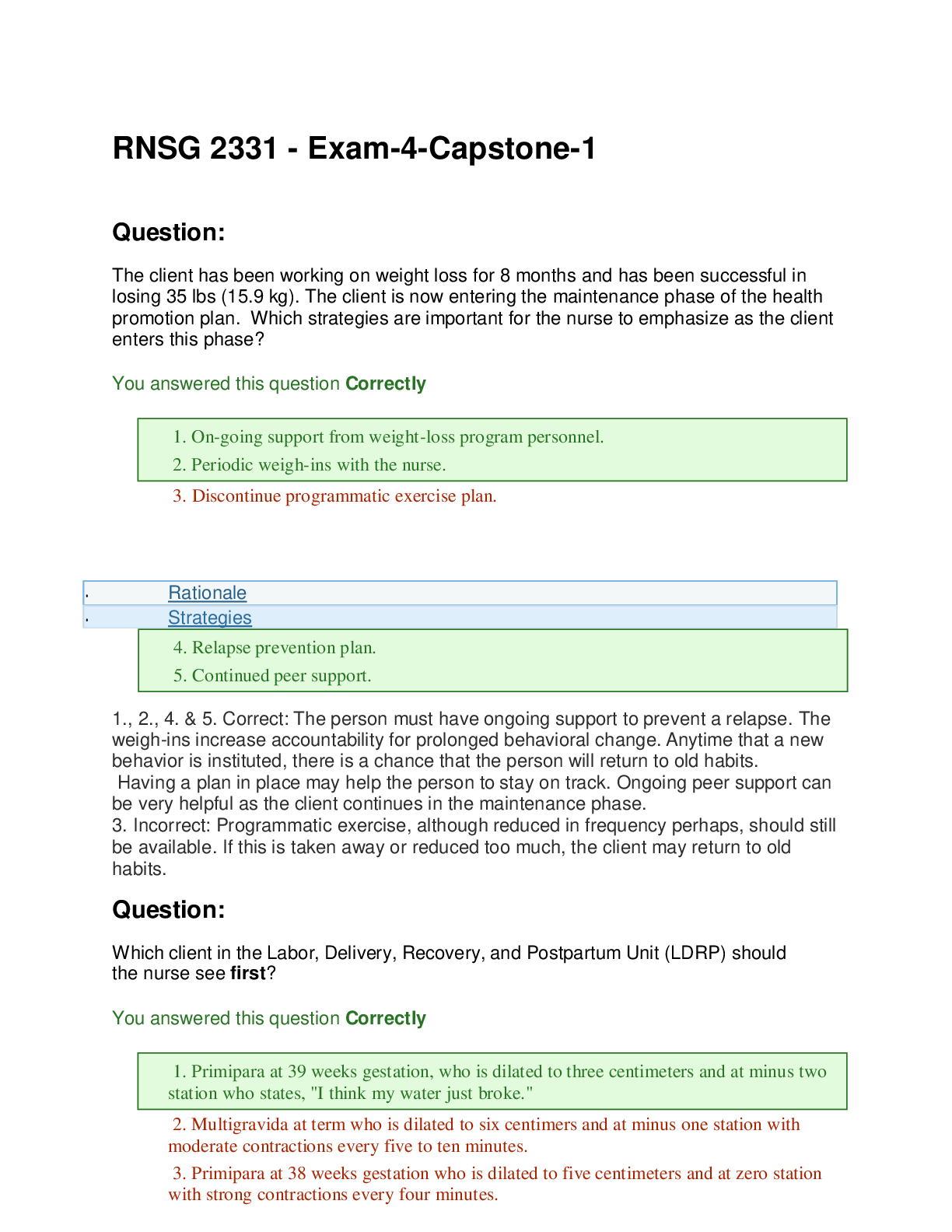

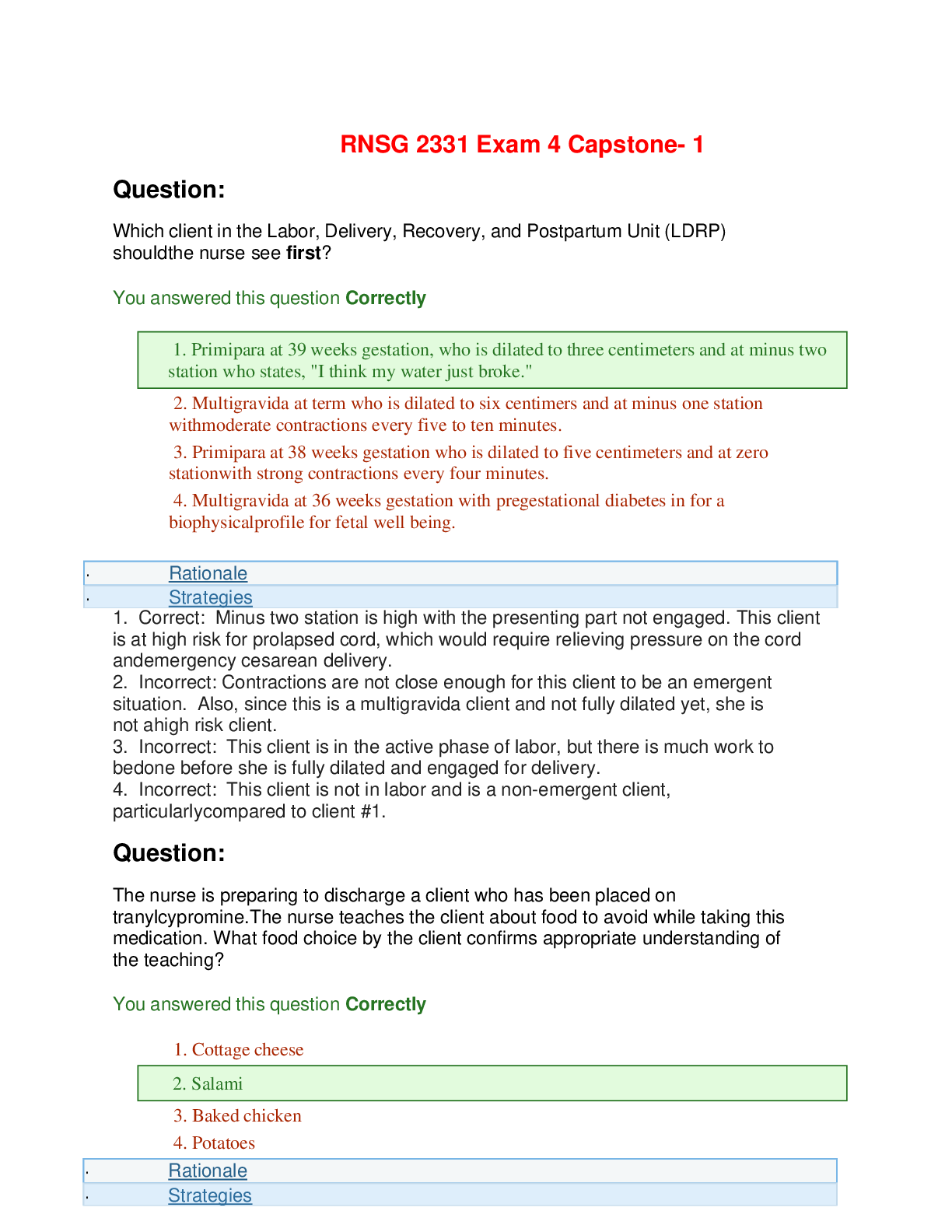
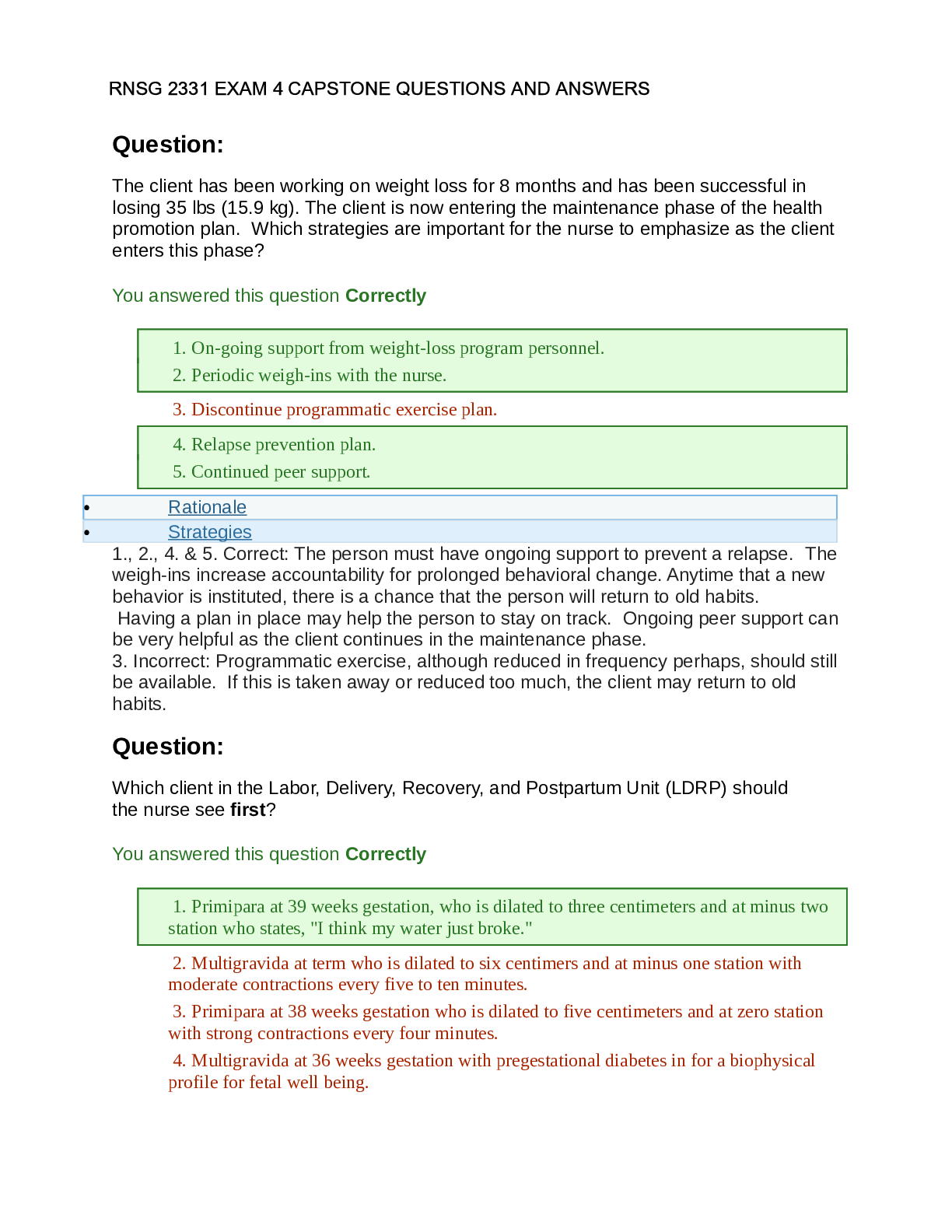








.png)
![Preview of eBook [PDF] Barash, Cullen, and Stoelting's Clinical Anesthesia 9th Edition By Bruce F. Cu](https://browseimages.nyc3.digitaloceanspaces.com/paper-images/2024/Aug/29/8DF2QRTq2024-08-29-10-3966d0259b7c4b5.png)
![Preview of eBook [PDF] Burns' Pediatric Primary Care 7th Edition BY Dawn Lee Garzon Maaks,, Nancy Bar](https://browseimages.nyc3.digitaloceanspaces.com/paper-images/2024/Aug/26/WR2rowXX2024-08-26-02-0966cc625bea839.png)